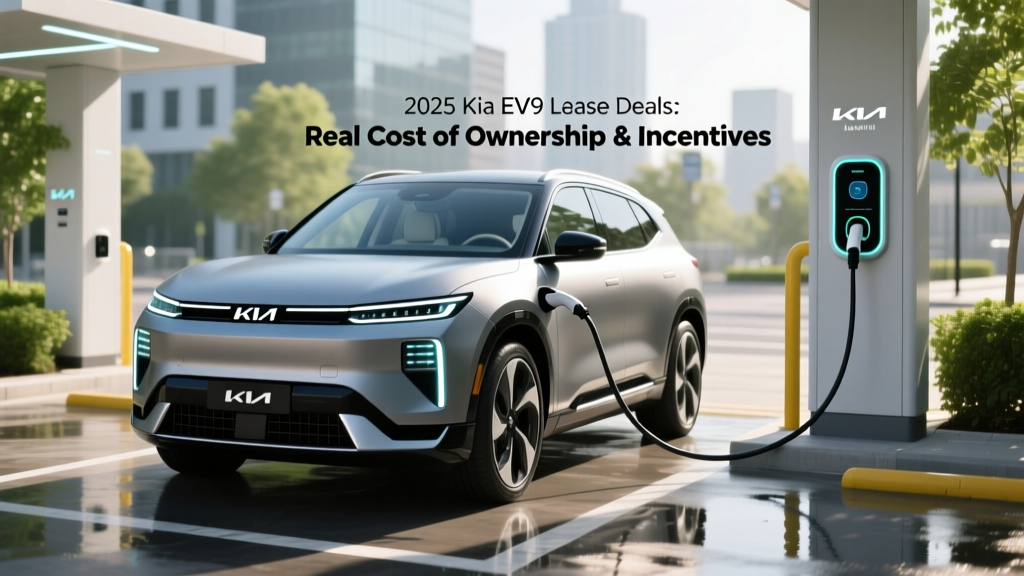
Why the 2025 Kia EV9 Lease Is Attracting Budget-Conscious Families
The three-row electric SUV segment remains thin, and the 2025 Kia EV9 continues to dominate it by default — but also on merit. With up to 304 miles of EPA-estimated range, 201 kW DC fast-charging capability, and a starting MSRP near $54,900, it undercuts rivals like the Rivian R1S and Tesla Model X by tens of thousands. For shoppers scanning 2025 Kia EV9 lease deals, the math gets even more interesting when you factor in the federal §30D tax credit (up to $7,500), lower per-mile energy costs, and reduced maintenance spend.
But leasing an EV isn't a guaranteed win. Insurance premiums run higher, depreciation curves remain steep for mainstream three-row EVs, and the tax credit comes with income, MSRP, and battery-sourcing strings attached. This guide breaks down the real 5-year ownership cost of the EV9 so you can decide whether a lease or purchase makes financial sense in 2026.
2025 Kia EV9: Key Specs at a Glance
Before we run the numbers, here's what you're working with across the EV9 lineup. Note that the Light (RWD) trim uses a 76.1 kWh battery while all other trims step up to a 100.0 kWh pack.
| Spec | Light (RWD) | Wind / Land (RWD/AWD) | GT-Line (AWD) |
|---|---|---|---|
| Base MSRP | $54,900 | $59,900 – $63,900 | $73,900 |
| Battery (usable) | 76.1 kWh (NMC) | 100.0 kWh (NMC) | 100.0 kWh (NMC) |
| EPA Range | 230 mi | 304 mi (Wind RWD) | 270 mi |
| Real-World Range* | ~185–200 mi | ~245–270 mi | ~220–245 mi |
| Combined MPGe | 83 MPGe | 84–89 MPGe | 82 MPGe |
| Peak DC Fast Charge | 201 kW | 201 kW | 201 kW |
| 10–80% DCFC Time | ~24 min | ~24 min | ~24 min |
| Level 2 (240V) Rate | 10.9 kW | 10.9 kW | 10.9 kW |
| Horsepower | 215 hp | 215 hp (RWD) / 379 hp (AWD) | 379 hp |
| 0–60 mph | 8.2 sec | 8.2 sec (RWD) / 5.0 sec (AWD) | 5.0 sec |
| Battery/Powertrain Warranty | 10 years / 100,000 miles | ||
5-Year Total Cost of Ownership: EV9 vs. Gas Three-Row SUV
To understand whether those 2025 Kia EV9 lease deals actually save money, we need a full 5-year / 75,000-mile cost breakdown. Below, we compare the EV9 Wind RWD ($59,900 MSRP) against a comparable gas-powered midsize three-row SUV averaging 22 MPG combined. Assumptions: electricity at $0.16/kWh (national residential average), gasoline at $3.50/gallon, and 15,000 miles driven annually.
| Cost Category | 2025 Kia EV9 Wind RWD | Gas 3-Row SUV (22 MPG) |
|---|---|---|
| Purchase Price (MSRP) | $59,900 | $45,000 |
| Federal Tax Credit (§30D) | –$7,500 (if eligible) | $0 |
| Effective Purchase Price | $52,400 | $45,000 |
| Fuel / Energy (75,000 mi) | $3,600 (~$0.048/mi) | $11,932 (~$0.159/mi) |
| Maintenance | $1,800 | $4,200 |
| Insurance (5-year total) | $12,500 | $9,800 |
| Estimated Depreciation | $28,700 (55%) | $19,350 (43%) |
| 5-Year Total Cost | $70,300 | $70,932 |
| Cost Per Mile | $0.94 | $0.95 |
Energy Cost Per Mile: The Math
The EV9 Wind RWD achieves roughly 35 kWh per 100 miles (or about 0.35 kWh/mi) based on its EPA-rated 89 MPGe combined. At $0.16/kWh for home Level 2 charging, that's $0.056 per mile. DC fast charging on road trips at an average of $0.35/kWh pushes that to $0.12/mi — still well below gasoline.
A gas three-row SUV at 22 MPG combined burning $3.50/gallon fuel costs $0.159 per mile. Over 75,000 miles, the energy savings alone total approximately $8,300 in the EV9's favor — assuming 80% home charging and 20% DC fast charging.
| Scenario | EV9 Wind RWD | Gas SUV (22 MPG) |
|---|---|---|
| Home Level 2 ($0.16/kWh) | $0.056/mi | — |
| DC Fast Charge ($0.35/kWh avg) | $0.123/mi | — |
| Gasoline ($3.50/gal) | — | $0.159/mi |
| Blended (80/20 home/DCFC) | $0.069/mi | $0.159/mi |
Federal Tax Credit (§30D): Do You Actually Qualify?
The §30D Clean Vehicle Credit offers up to $7,500 for qualifying new EVs, but eligibility hinges on several interlocking requirements that changed significantly under the Inflation Reduction Act. Here's the current-year checklist:
- MSRP Cap: SUVs, pickups, and vans must have an MSRP at or below $80,000. Sedans are capped at $55,000. All EV9 trims fall under the $80,000 SUV cap.
- Buyer Income Limits (Modified AGI): $300,000 for joint filers, $225,000 for heads of household, $150,000 for single filers. This applies to the tax year you take delivery or the prior year — whichever is lower.
- Battery Component Sourcing: A percentage of battery components must be manufactured or assembled in North America (threshold increases annually — 100% for 2029+).
- Critical Minerals Requirement: A percentage of critical minerals must be sourced from the U.S. or a free-trade-agreement partner (also escalating yearly).
- Foreign Entity of Concern (FEOC) Exclusion: Vehicles with battery components or critical minerals from a FEOC (e.g., certain Chinese suppliers) may be disqualified.
- Point-of-Sale Transfer: As of 2024, buyers can transfer the credit to the dealer at purchase, receiving it as an upfront price reduction rather than waiting to claim it on their tax return. This applies to purchases — lease treatment differs (see below).
For the latest eligibility details, consult the IRS Clean Vehicle Credits page and verify specific VIN eligibility at fueleconomy.gov.
State, Local, and Utility Incentives
Beyond the federal credit, many states and utilities offer additional rebates that can meaningfully reduce the EV9's effective cost:
- State Rebates: States like California (CVRP — up to $7,000 for income-qualified buyers), Colorado (up to $5,000 state tax credit), Massachusetts (MOR-EV — up to $3,500), and New York (Drive Clean — up to $2,000 point-of-sale) stack on top of the federal credit. Rules, income caps, and funding availability vary by jurisdiction and change frequently.
- Utility Rebates: Many electric utilities offer $250–$1,500 rebates for purchasing an EV and/or installing a Level 2 home charger. Examples include PG&E, Xcel Energy, ConEdison, and others. Check your local utility's EV program page.
- HOV Lane Access: States including California, Colorado, Virginia, and Maryland grant solo HOV-lane access to qualifying EVs — a benefit worth hundreds in time savings for commuters.
- Home Charging Installation: The federal Alternative Fuel Vehicle Refueling Property Credit (§30C) covers up to $1,000 (30% of cost) for home charger installation, subject to census-tract eligibility.
Maintenance Savings: What You Won't Pay For
EVs eliminate many routine maintenance items that gas-vehicle owners pay for every 5,000–10,000 miles. Over a 5-year / 75,000-mile ownership period, the EV9's maintenance advantage is substantial:
| Service Item | EV9 (Estimated Cost) | Gas 3-Row SUV (Estimated Cost) |
|---|---|---|
| Oil Changes | $0 (no engine oil) | $600–$900 (8–12 changes) |
| Transmission Fluid | $0 (single-speed reducer) | $150–$300 |
| Brake Pads/Rotors | $200–$400 (regen reduces wear ~60%) | $800–$1,500 (2–3 replacements) |
| Spark Plugs | $0 | $200–$400 |
| Engine Air Filter | $0 | $100–$200 |
| Cabin Air Filter | $100–$200 | $100–$200 |
| Tire Rotation/Replacement | $1,200–$1,600 (EVs wear tires ~20% faster due to weight/torque) | $1,000–$1,400 |
| Coolant/Other Fluids | $100–$200 | $200–$400 |
| Total Estimated | $1,600–$2,400 | $3,150–$5,300 |
The net maintenance savings over 5 years is approximately $1,500–$2,900. The EV9's regenerative braking system significantly extends brake pad life — many EV owners report original brake pads lasting 80,000+ miles. However, heavier EV tires do wear faster, partially offsetting the advantage.
Insurance Costs: The Expense Most Buyers Overlook
EV insurance premiums typically run 15–30% higher than equivalent gas vehicles. For the EV9, expect annual premiums in the range of $2,200–$2,800 depending on your driving record, location, and coverage level — compared to $1,700–$2,200 for a gas three-row SUV.
Several factors drive the premium gap:
- Higher repair costs: EV battery packs and specialized electronics are expensive to replace after collision damage. Body shops need EV-specific training and certification.
- Higher vehicle value: The EV9's MSRP is simply higher than most gas alternatives, meaning greater insured value.
- Limited claims data: Insurers are still building actuarial models for newer EV platforms, and uncertainty translates to higher premiums.
- Tire and suspension costs: Heavier vehicles with larger wheels cost more to repair.
Shop quotes from EV-friendly insurers (Geico, Progressive, State Farm, and Tesla Insurance in eligible states) before signing a lease or purchase agreement. Some insurers offer EV-specific discounts for garaging near a home charger or bundling with homeowners insurance.
Depreciation and Resale Value: The Honest Picture
EV depreciation has been a sore spot, especially after 2023–2024 price wars (led by Tesla) pulled down used-EV values across the board. The EV9 is not immune:
- 5-year depreciation estimate: 50–60% of MSRP, based on current three-row EV market trends and data from sources like iSeeCars and Kelley Blue Book.
- Gas SUV comparison: Comparable gas three-row SUVs (e.g., Toyota Highlander, Kia Telluride) typically retain 55–65% of value over 5 years, meaning 35–45% depreciation.
- Lease residual values: Kia Motors Finance typically sets EV9 lease residuals at 45–52% for 36-month leases. This means the leasing company is absorbing some depreciation risk — which is why lease payments may be more favorable than purchase-and-sell scenarios.
If depreciation concerns you, leasing actually transfers that risk to the lessor. You pay for the depreciation baked into the lease payment, but you're not on the hook for unexpected market drops when it's time to sell. This is one reason 2025 Kia EV9 lease deals can be more attractive than outright purchases for risk-averse buyers.
Lease vs. Buy: Decision Framework for the EV9
Choose a Lease If:
- You want to capture the $7,500 lease cash incentive without worrying about §30D income caps or battery-sourcing rules (§45W commercial credit pathway).
- You plan to drive fewer than 12,000–15,000 miles per year (typical lease mileage limits).
- You want to avoid long-term depreciation risk on a rapidly evolving EV platform.
- You prefer lower monthly payments and plan to upgrade to newer battery tech in 3 years.
Choose to Purchase If:
- You qualify for the full §30D credit (income below caps, VIN passes sourcing requirements) and can apply it at point of sale.
- You drive more than 15,000 miles per year (lease overage penalties are typically $0.20–$0.30/mile).
- You plan to keep the vehicle 7+ years, well past the steepest depreciation curve.
- You want to modify the vehicle (aftermarket wheels, wraps, etc. — leases restrict this).
Frequently Asked Questions
How much does it really cost to own a 2025 Kia EV9 over 5 years?
With the $7,500 federal credit applied, our analysis shows a 5-year / 75,000-mile total cost of approximately $70,300 for the EV9 Wind RWD — roughly on par with a $45,000 gas three-row SUV at $70,900. Without the credit, the EV9 costs about $7,500 more. Energy and maintenance savings are substantial (~$10,700 combined), but higher insurance (~$2,700 more) and steeper depreciation (~$9,350 more) partially offset them.
Do I qualify for the federal EV tax credit on the Kia EV9?
It depends on your income, the specific VIN's battery sourcing, and the purchase structure. For purchases under §30D, you must fall below the AGI caps ($300K joint / $150K single) and the vehicle must meet escalating battery-component and critical-minerals thresholds. For leases, the §45W commercial credit pathway may apply regardless of your income or sourcing — but confirm with the dealer that the $7,500 is passed through as lease cash. Always verify at fueleconomy.gov and consult a tax professional.
How much do I save on fuel and maintenance with the EV9?
Over 75,000 miles, expect roughly $8,300 in energy savings (home charging at $0.16/kWh vs. gas at $3.50/gal) and $1,500–$2,900 in maintenance savings. Combined, that's approximately $10,000–$11,200 in operational savings over 5 years. The savings widen if gas prices rise and narrow if you rely heavily on expensive DC fast charging.
Are EVs like the EV9 more expensive to insure?
Yes. Expect EV9 insurance premiums to run 15–30% higher than a comparable gas SUV — roughly $2,200–$2,800 annually vs. $1,700–$2,200. Higher repair costs, elevated vehicle values, and limited EV claims data drive the gap. Shop multiple insurers and ask about EV-specific discounts.
How well does the Kia EV9 hold its value?
Current projections estimate 50–60% depreciation over 5 years for the EV9, which is steeper than popular gas three-row SUVs (35–45% depreciation). Tesla's 2023–2024 price cuts and rapid EV technology evolution have pressured used-EV values industry-wide. Leasing transfers depreciation risk to the lessor and may be the smarter financial play if resale value concerns you.
What home charging setup does the EV9 need?
The EV9 accepts up to 10.9 kW on Level 2 (240V, 48-amp circuit). A hardwired Level 2 home charger adds roughly 30–35 miles of range per hour of charging — enough to fully replenish the 100 kWh battery overnight. Professional installation typically costs $500–$2,000 depending on your electrical panel's capacity and the distance from panel to charger location. Older homes with 100-amp panels may need a $1,500–$3,000 panel upgrade. Always get a quote from a licensed electrician before committing.
Sources: EPA fueleconomy.gov, IRS §30D Clean Vehicle Credits, Kia USA EV9 specifications. Tax credit rules and incentive amounts are subject to change — always verify current eligibility with official sources and a qualified tax professional.