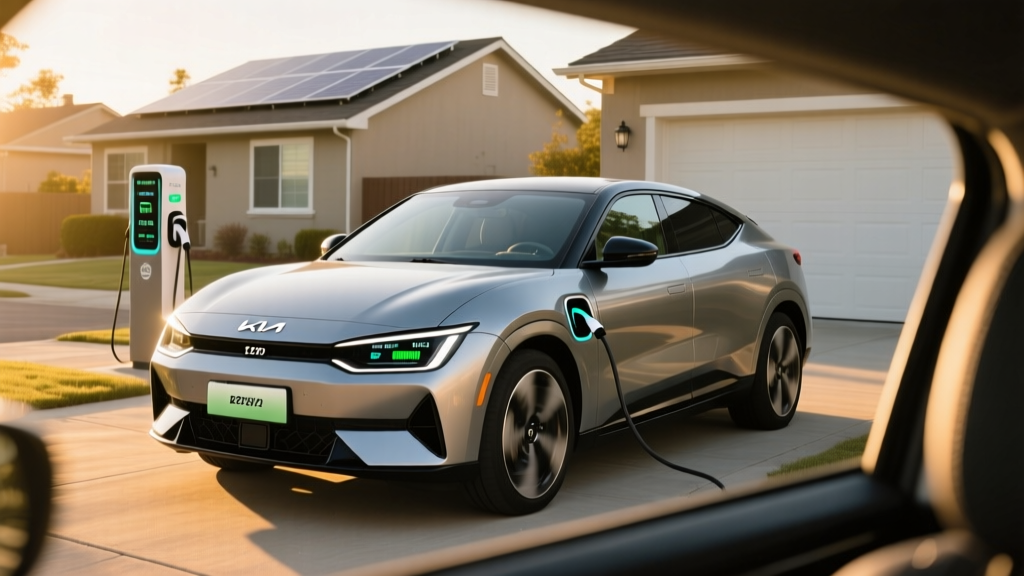
2025 Kia EV6 Lease Deals: Beyond the Monthly Payment
If you're researching 2025 Kia EV6 lease deals, you've likely seen advertised payments in the $300-$500 range. But lease deals only tell part of the story. The real question is: what does owning a 2025 Kia EV6 actually cost over five years when you factor in charging, insurance, maintenance, depreciation, and available incentives?
The 2025 Kia EV6 remains one of the most compelling electric crossovers on the market, offering EPA-estimated range up to 310 miles (Light Long Range RWD), 800V ultra-fast charging capability, and a starting MSRP around $42,900. But before you sign that lease agreement, let's break down the complete financial picture.
5-Year Total Cost of Ownership: The Complete Breakdown
Let's calculate what owning a 2025 Kia EV6 Wind AWD (one of the most popular trims, MSRP $52,900) actually costs over five years and 75,000 miles. We'll compare it against a similarly priced gas-powered crossover averaging 25 MPG combined.
| Cost Category | 2025 Kia EV6 Wind AWD | Gas Crossover (25 MPG) | Difference |
|---|---|---|---|
| Purchase Price (MSRP) | $52,900 | $45,000 | +$7,900 |
| Federal Tax Credit (§30D) | -$3,750 to -$7,500* | $0 | -$3,750 to -$7,500 |
| Effective Purchase Price | $45,400 - $49,150 | $45,000 | -$400 to +$4,150 |
| Fuel/Charging (75k miles) | $3,750** | $10,500*** | -$6,750 |
| Insurance (5 years) | $12,500 | $9,500 | +$3,000 |
| Maintenance (5 years) | $1,200 | $3,800 | -$2,600 |
| Depreciation (5 years) | $22,000 | $18,000 | +$4,000 |
| Total 5-Year Cost | $81,850 - $85,600 | $86,800 | -$1,200 to +$4,950 |
*Tax credit amount depends on battery sourcing compliance. **Assumes $0.15/kWh home charging. ***Assumes $3.50/gallon gas.
The numbers reveal a nuanced picture: the 2025 EV6 can achieve cost parity or modest savings over five years, but only if you qualify for the full federal tax credit and charge primarily at home. Public DC fast charging at $0.35-$0.50/kWh erodes those fuel savings quickly.
Federal Tax Credit: Do You Qualify for §30D?
The federal electric vehicle tax credit under IRS §30D offers up to $7,500, but eligibility depends on multiple factors that changed significantly in recent years. Here's what you need to know for 2025-2026:
- Income Limits: Modified adjusted gross income (MAGI) cannot exceed $300,000 (joint filers), $225,000 (head of household), or $150,000 (single filers)
- MSRP Caps: Vehicle base MSRP must not exceed $55,000 for sedans or $80,000 for SUVs/pickups. The 2025 EV6 qualifies under the SUV cap.
- Battery Sourcing Requirements: The $7,500 credit splits into two $3,750 halves — one for critical minerals sourcing, one for battery component manufacturing. Vehicles must meet increasing domestic content thresholds each year.
- Point-of-Sale Transfer: You can now transfer the credit to the dealer at purchase, reducing your upfront cost rather than waiting for tax filing.
- Lease Loophole: Commercial lease credits (§45W) have different rules, allowing lessors to claim the credit and potentially pass savings to lessees regardless of battery sourcing.
Charging vs Gas: The Per-Mile Cost Reality
Fuel savings are where EVs shine — but only if you charge strategically. Let's compare the 2025 EV6's electricity costs against a 25 MPG gas crossover:
| Charging Scenario | Cost per kWh | Cost per Mile | 75,000 Mile Cost |
|---|---|---|---|
| Home Level 2 (national avg) | $0.15 | $0.05 | $3,750 |
| Home Level 2 (California) | $0.25 | $0.08 | $6,000 |
| Public DC Fast Charging | $0.40 | $0.13 | $9,750 |
| Gas Crossover (25 MPG) | $3.50/gallon | $0.14 | $10,500 |
The 2025 EV6 achieves 134 MPGe combined (Wind AWD), translating to roughly 3.0-3.2 miles per kWh. At home charging rates, you'll save $4,500-$6,750 over 75,000 miles. But if you rely primarily on public fast charging, those savings evaporate — you might even spend more than the gas alternative.
The EV6's 800V architecture enables peak charging rates up to 240 kW on compatible DC fast chargers, achieving 10-80% in approximately 18 minutes. However, charging curves taper significantly above 80%, so plan your stops accordingly. Preconditioning the battery (via navigation to a charger) optimizes charge speed in cold weather.
Maintenance Savings: Where EVs Dominate
Electric vehicles eliminate dozens of moving parts found in internal combustion engines. Here's how the 2025 EV6's maintenance costs compare:
| Maintenance Item | 2025 EV6 Cost (5 yr) | Gas Vehicle Cost (5 yr) |
|---|---|---|
| Oil Changes | $0 | $750 |
| Transmission Service | $0 | $400 |
| Brake Pads/Rotors | $300 (regen extends life) | $1,200 |
| Coolant Flush | $200 | $300 |
| Cabin Air Filter | $150 | $150 |
| Tire Rotation/Replacement | $1,800 (EVs wear tires faster) | $1,500 |
| Total Maintenance | $2,450 | $4,300 |
Regenerative braking dramatically extends brake pad life — many EV owners report 80,000+ miles on original pads. However, EVs tend to wear tires 20-30% faster due to instant torque and heavier weight. Budget for premium tire replacements every 30,000-40,000 miles.
Kia's warranty coverage is excellent: 5-year/60,000-mile basic warranty plus 10-year/100,000-mile powertrain and battery warranty. The battery must retain at least 70% capacity during the warranty period, though real-world degradation data shows most EV6 owners experience 5-8% loss over the first 50,000 miles.
Insurance Costs: The Hidden Expense
Here's where the EV ownership equation gets less favorable. Insurance premiums for the 2025 Kia EV6 typically run 25-40% higher than equivalent gas crossovers. Expect annual premiums of $2,200-$2,800 depending on your location, driving record, and coverage levels.
Why the premium?
- Higher repair costs: EV battery packs and specialized electronics are expensive to replace after collisions
- Limited repair network: Fewer shops have EV-certified technicians, increasing labor rates
- Total loss thresholds: Battery damage often triggers total loss declarations at lower damage levels
- Vehicle cost: Higher MSRP means higher comprehensive/collision premiums
Shop multiple insurers — some (like Tesla Insurance, Progressive, and GEICO) now offer EV-specific policies with competitive rates. Bundling home and auto can save 10-15%.
Depreciation and Resale Value: The Wild Card
EV depreciation has been volatile. Early EVs suffered steep drops due to battery longevity fears and rapid technology improvements. The 2025 EV6 faces different dynamics:
Positive factors:
- 800V fast charging remains competitive through 2026
- Strong EPA range (282-310 miles depending on trim)
- Kia's reputation for reliability and warranty support
- Growing charging infrastructure reduces range anxiety
Negative factors:
- Intense competition from Tesla Model Y, Hyundai Ioniq 5, Ford Mustang Mach-E
- Potential battery technology leaps (solid-state) could age current EVs
- Tesla price cuts have compressed used EV values across the market
- Uncertainty about long-term battery replacement costs ($15,000-$20,000 out of warranty)
Industry projections suggest the 2025 EV6 will retain 45-50% of its value after five years, translating to $22,000-$26,000 in depreciation for a $52,900 Wind AWD. This is competitive with luxury gas crossovers but trails Toyota/Honda's best-selling gas models.
2025 Kia EV6 Lease Deals: What to Expect
Current 2025 EV6 lease deals typically range from $349-$599 per month depending on trim, down payment, and credit tier:
- EV6 Light RWD: $349-$399/month, $3,500 down, 36 months, 10k miles/year
- EV6 Wind AWD: $449-$499/month, $3,500 down, 36 months, 10k miles/year
- EV6 GT-Line AWD: $549-$599/month, $4,000 down, 36 months, 10k miles/year
Leasing offers unique advantages for EVs:
- Tax credit passthrough: Commercial lease credits (§45W) may apply even if you don't qualify for §30D purchase credits due to battery sourcing rules
- Depreciation protection: You return the car at lease end, avoiding resale value risk
- Technology refresh: Upgrade to newer EV tech every 3 years
- Lower upfront cost: Typical down payments of $2,000-$4,000 vs $7,500+ to purchase
However, leasing also means mileage restrictions (typically 10,000-15,000 miles/year), wear-and-tear fees, and no equity buildup. If you drive 15,000+ miles annually or plan to keep the vehicle 7+ years, purchasing often makes more financial sense.
FAQ: 2025 Kia EV6 Ownership Costs
How much does it really cost to own a 2025 Kia EV6 over 5 years?
Between $81,850-$85,600 total for a Wind AWD trim over 5 years and 75,000 miles, including purchase price (after tax credit), charging, insurance, maintenance, and depreciation. This is roughly $1,200-$5,000 less than a comparable gas crossover, assuming you qualify for the federal tax credit and charge primarily at home.
Do I qualify for the $7,500 federal tax credit?
You may qualify if your income is under $300,000 (joint), $225,000 (head of household), or $150,000 (single), and the vehicle meets battery sourcing requirements. The 2025 EV6 qualifies under the $80,000 SUV MSRP cap. However, the credit amount ($3,750 or $7,500) depends on current battery sourcing compliance. Check fueleconomy.gov for up-to-date eligibility before purchasing. Lease deals may pass through commercial lease credits with different rules.
How much do I save on fuel and maintenance?
Expect $4,500-$6,750 in fuel savings over 75,000 miles if charging primarily at home ($0.15-$0.25/kWh). Maintenance savings run $2,000-$2,600 over 5 years, primarily from eliminating oil changes and extending brake life. Combined savings: $6,500-$9,350. However, public DC fast charging at $0.40+/kWh reduces fuel savings to near zero.
Are EVs more expensive to insure?
Yes, typically 25-40% more expensive. A 2025 EV6 costs $2,200-$2,800 annually to insure versus $1,600-$2,000 for a gas crossover. Higher repair costs, specialized parts, and total-loss thresholds drive the premium. Shop multiple insurers and consider bundling to reduce costs.
How well do EVs hold their value?
The 2025 EV6 is projected to retain 45-50% of its value after 5 years, translating to $22,000-$26,000 in depreciation. This is competitive with luxury gas crossovers but trails Toyota/Honda mainstream models. Battery health, charging infrastructure growth, and competition from newer EVs will influence actual resale values.
What happens if the battery needs replacement?
Kia's 10-year/100,000-mile battery warranty covers defects and capacity loss below 70%. Out-of-warranty replacement costs $15,000-$20,000, though this is rare before 150,000+ miles. Real-world data shows 5-8% degradation over the first 50,000 miles for NMC batteries like the EV6's.
Should I lease or buy the 2025 EV6?
Lease if: you drive under 15,000 miles/year, want depreciation protection, prefer upgrading every 3 years, or don't qualify for purchase tax credits but can access lease credits. Buy if: you drive 15,000+ miles/year, plan to keep the vehicle 7+ years, want to build equity, or qualify for the full $7,500 purchase credit.
The Bottom Line: Is the 2025 EV6 Worth It?
The 2025 Kia EV6 delivers compelling value when you factor in the complete ownership equation. With federal tax credits, home charging access, and moderate annual mileage, you can achieve cost parity or modest savings versus gas alternatives over five years. The 800V fast charging, 282-310 mile range, and strong warranty make it one of the most practical EVs in its class.
However, the financial case weakens if you rely on public charging, face high insurance premiums, or don't qualify for tax incentives. Run your personal numbers — your electricity rate, annual mileage, insurance quotes, and tax situation — before signing that lease or purchase agreement.
For the right buyer with home charging access and tax credit eligibility, 2025 Kia EV6 lease deals represent a smart entry point into electric mobility without breaking the bank.