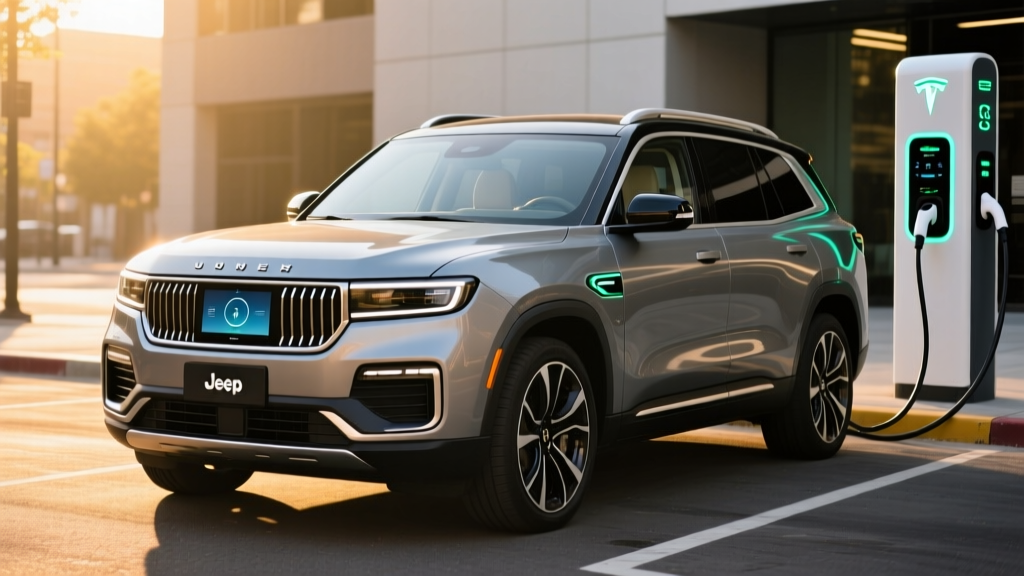
Jeep's first all-electric vehicle is a statement: the 2025 Jeep Wagoneer S pairs the brand's rugged heritage with a 100-kWh battery, dual-motor all-wheel drive, and a sub-4-second 0-60 time. Built on Stellantis' STLA Large platform, it's positioned as a premium electric SUV aimed at families who want Jeep capability without the fuel pump. But how does it hold up when you look past the brochure?
We've dug into the EPA numbers, charging curves, real-world range expectations, and federal tax credit math to give you the full ownership picture. Here's what you need to know before putting down a deposit.
Specs at a Glance: 2025 Jeep Wagoneer S
| Specification | Value |
|---|---|
| EPA Range (est.) | ~300 miles |
| Battery Capacity | 100 kWh (usable), NMC chemistry |
| Drivetrain | Dual-motor AWD |
| Horsepower | 600 hp (Launch Edition) |
| 0–60 mph | ~3.4 seconds |
| Max DC Fast Charge | ~150 kW (peak) |
| 10–80% DC Charge Time | ~23 minutes (est.) |
| Level 2 Home Charging | 11.5 kW onboard charger (~35 mi/hr) |
| Efficiency | ~85 MPGe combined (est.) |
| Cargo Volume (behind 2nd row) | ~30 cu ft (est.) |
| Base MSRP (Launch Edition) | $65,200 |
| Battery/Powertrain Warranty | 8 years / 100,000 miles |
Range & Efficiency: EPA vs. the Real World
The 2025 Jeep Wagoneer S targets an EPA-estimated range of approximately 300 miles from its 100 kWh NMC (nickel-manganese-cobalt) battery pack. NMC chemistry was chosen over LFP here for its higher energy density, which is necessary to hit that range figure in a heavy, AWD luxury SUV.
The EPA sticker is a blended cycle. In practice:
- Highway cruising (70–75 mph): Expect ~240–265 miles before needing a charger. Aerodynamic drag hits a boxy SUV shape hard at speed.
- City / stop-and-go: You'll see closer to or slightly above the EPA number thanks to aggressive regenerative braking recapturing energy.
- Cold weather (below 30°F): Plan for 20–30% range loss, bringing usable range to roughly 210–240 miles. The Wagoneer S includes a heat pump to mitigate this, but physics is physics — battery chemistry slows and cabin heating draws significant power.
For context, a 300-mile EPA rating in a 5,000+ lb dual-motor AWD SUV is competitive with the BMW iX xDrive50 and slightly behind the Tesla Model X Long Range. It's adequate for most daily driving and manageable on road trips with planned stops.
Efficiency is estimated at around 85 MPGe combined, or roughly 39–40 kWh per 100 miles. That's on the thirstier side of the EV spectrum — again, the trade-off for a heavy vehicle with serious power output. By comparison, the Hyundai Ioniq 5 AWD achieves 110 MPGe, but it's a significantly lighter and less powerful vehicle.
Charging Speed: DC Fast Charge and Home Level 2
Charging speed is where many buyers get burned by brochure claims. The Wagoneer S's peak DC fast-charge rate of approximately 150 kW is respectable but not class-leading. Here's what that means in practice:
| Charging Level | Power | Speed (approx.) | Best For |
|---|---|---|---|
| Level 1 (120V household) | ~1.4 kW | ~3–4 mi/hr | Emergency top-up only |
| Level 2 (240V home) | 11.5 kW | ~35 mi/hr | Overnight charging — 0–100% in ~9 hours |
| DC Fast Charge | 150 kW (peak) | 10–80% in ~23 min | Road-trip stops |
A critical concept here is the charge curve. The 150 kW peak is achieved only in the lower state-of-charge window (roughly 10–40% SoC at ideal battery temperature). As the battery fills past 60%, the rate tapers significantly to protect cell health. By 80%, you may be pulling only 50–70 kW. This is why the 10–80% metric matters more than peak kW — and why the ~23-minute estimate is realistic but not exceptional.
Compared to the Hyundai Ioniq 5's 800-volt architecture (peak 240 kW, 10–80% in ~18 minutes) or the Tesla Model Y's ~250 kW peak on V3 Superchargers, the Wagoneer S is a step behind. On a long road trip, that translates to 5–10 extra minutes per stop. Not deal-breaking, but worth budgeting for.
The 11.5 kW onboard Level 2 charger is solid. With a home wall connector on a 48-amp circuit, you'll add roughly 35 miles of range per hour, meaning a full overnight charge from near-empty is easily achievable in 8–9 hours. Home charging is where most Wagoneer S owners will do 80%+ of their charging, and this setup handles it well.
Performance: 600 Horsepower Meets Jeep DNA
The Launch Edition of the 2025 Wagoneer S puts out 600 horsepower and an estimated 617 lb-ft of torque from its dual-motor AWD powertrain. The result is a 0–60 mph sprint in approximately 3.4 seconds — quicker than a Dodge Charger Scat Pack and firmly in sports-sedan territory for a vehicle that weighs over 5,000 pounds.
Jeep has also equipped the Wagoneer S with a disconnecting front axle, meaning the front motor can decouple during light-load cruising to improve efficiency. It's a clever engineering touch that helps offset the AWD efficiency penalty on highway drives.
Drive modes include the expected Sport, Snow, and Sand settings, plus an Auto mode that balances front/rear torque distribution. While this isn't a Wrangler — there's no low-range transfer case or locking differentials — the AWD system provides confident traction in rain, light snow, and gravel. It's a capable all-weather daily driver, not a rock crawler.
Interior, Tech & Cargo: What You Get Inside
The Wagoneer S cabin marks a significant departure from Jeep's traditional interiors. The dashboard is dominated by a multi-screen layout: a 12.3-inch digital instrument cluster, a 12.3-inch central infotainment touchscreen running Stellantis' Uconnect 5 system, and a 10.25-inch passenger display. A head-up display rounds out the forward-view tech.
Uconnect 5 is one of the better mainstream infotainment platforms — responsive, logically laid out, and supporting wireless Apple CarPlay and Android Auto. The system also handles over-the-air (OTA) software updates, navigation with real-time traffic, and vehicle settings management.
Driver assistance is SAE Level 2 (the driver must remain engaged at all times). The Wagoneer S includes adaptive cruise control with stop-and-go, lane-centering assist, automatic emergency braking, blind-spot monitoring, rear cross-traffic alert, and a 360-degree camera system. This is not autonomous driving — hands must stay on the wheel, and you are responsible for the vehicle at all times.
Cargo space is estimated at approximately 30 cubic feet behind the second row, with additional under-floor storage. The two-row seating configuration means this is strictly a five-passenger SUV. Rear legroom is generous at an estimated 40+ inches. A front trunk (frunk) provides additional sealed storage for charging cables or groceries.
Pricing, Trims & Federal Tax Credit Eligibility
The 2025 Wagoneer S launches with the Launch Edition at a base MSRP of $65,200 (including destination). This is a fully loaded trim — there are no stripped-down base models at launch. Expect additional trims at lower price points to follow in subsequent model years, potentially bringing the entry price closer to $55,000.
| Trim | MSRP (est.) | Federal Tax Credit | Effective Price (est.) |
|---|---|---|---|
| Launch Edition | $65,200 | Up to $7,500* | ~$57,700* |
| Future lower trims (TBD) | ~$55,000–$60,000 | Up to $7,500* | ~$47,500–$52,500* |
*Federal tax credit eligibility under IRS §30D is subject to multiple requirements. It is not a guaranteed $7,500 for every buyer.
- MSRP cap: SUVs must be at or below $80,000 MSRP. The Wagoneer S at $65,200 qualifies. (Source: IRS)
- Buyer income limits: Modified AGI must not exceed $300,000 (married filing jointly), $225,000 (head of household), or $150,000 (single).
- Battery sourcing: The full $7,500 requires meeting both critical minerals ($3,750) and battery component ($3,750) requirements. Stellantis has not confirmed full compliance for the Wagoneer S — partial credit ($3,750) is possible if only one requirement is met. Verify current sourcing status with your dealer before purchase.
- Point-of-sale transfer: As of 2024, eligible buyers can transfer the credit to the dealer at purchase, reducing the purchase price directly rather than waiting for a tax refund.
- Final authority: Consult a tax professional and check IRS §30D guidance for your specific situation.
Warranty & Long-Term Ownership
Stellantis backs the Wagoneer S battery pack and electric powertrain with an 8-year / 100,000-mile warranty, which is the industry-standard minimum for EV traction batteries. The warranty covers defects and excessive capacity loss (typically defined as falling below 60–70% of original capacity, though Stellantis' exact threshold should be confirmed at purchase).
The bumper-to-bumper limited warranty covers 3 years / 36,000 miles. For a vehicle in this price range, that's on the shorter side — Hyundai and Kia offer 5-year/60,000-mile basic coverage on their EVs.
NMC battery degradation typically runs 2–3% per year under normal use, meaning after 5 years you can expect roughly 85–90% of original capacity remaining. Factors that accelerate degradation include frequent DC fast charging to 100%, extended exposure to extreme heat, and consistently operating at very high or very low states of charge. Best practice: charge to 80% daily, use DC fast charging sparingly, and let the battery precondition before fast charging (the Wagoneer S supports navigation-based preconditioning).
How It Compares: Wagoneer S vs. Key Rivals
The Wagoneer S enters a competitive segment. Here's how it stacks up against the most relevant alternatives:
| Metric | 2025 Jeep Wagoneer S | Tesla Model Y LR AWD | BMW iX xDrive50 | Cadillac Lyriq AWD |
|---|---|---|---|---|
| EPA Range | ~300 mi | 320 mi | 324 mi | 307 mi |
| Battery | 100 kWh NMC | ~75 kWh NMC | 111.5 kWh NMC | 102 kWh NMC |
| 0–60 mph | 3.4 sec | 4.8 sec | 4.4 sec | 4.6 sec |
| Peak DC Charge | ~150 kW | ~250 kW | ~150 kW | ~190 kW |
| Base MSRP | $65,200 | $48,590 | $87,250 | $61,295 |
| Seating | 5 | 5 (+ opt. 7) | 5 | 5 |
The Tesla Model Y is significantly cheaper, charges faster, and has a more extensive Supercharger network. It's the pragmatic choice. The BMW iX is more refined and has more range but costs $20,000+ more. The Cadillac Lyriq is the closest competitor in price and positioning — it's slightly less powerful but offers a comparable luxury experience and slightly faster charging.
The Wagoneer S's differentiator is brand identity and design. If you want something that reads as rugged and distinctly American — and you're willing to pay a premium over the Model Y for it — the Wagoneer S occupies a unique niche.
Pros, Cons & Final Verdict
- 600 hp / 3.4-sec 0–60 is genuinely thrilling
- Distinctive Jeep design in a crowded EV SUV segment
- Fully loaded Launch Edition — no options-package games
- Heat pump included for cold-weather efficiency
- Qualifies under §30D MSRP cap for SUVs ($80K)
- Uconnect 5 is responsive and feature-rich
- 150 kW peak DC charging trails Tesla and Hyundai/Kia
- Only two rows / five seats — no three-row option
- Real-world highway range likely ~240–265 miles
- Full $7,500 tax credit not yet confirmed (sourcing rules)
- 3-year/36K bumper-to-bumper is short for this price class
- No proven off-road capability despite Jeep branding
- Efficiency (~85 MPGe) is below lighter competitors
This EV is best for performance-oriented families who want a premium, American-branded SUV with serious acceleration and all-weather AWD capability. It's ideal if you charge primarily at home, drive mostly in suburban/urban environments, and take road trips no longer than 250 miles between stops (or don't mind a 25-minute charge break). If maximum range, fastest charging, or three-row seating are non-negotiable, look at the Model Y, BMW iX, or Kia EV9 instead.
Frequently Asked Questions
What is the real-world range of the 2025 Jeep Wagoneer S?
The EPA estimate is approximately 300 miles. In real-world highway driving at 70–75 mph, expect 240–265 miles. In cold weather (below 30°F), plan for 210–240 miles. City driving with regenerative braking may approach or slightly exceed the EPA figure.
How fast does the Wagoneer S charge at home and on the road?
At home on a Level 2 (240V, 48A) charger, the 11.5 kW onboard charger adds about 35 miles per hour, with a full charge taking roughly 9 hours. On DC fast chargers, it peaks at approximately 150 kW, achieving a 10–80% charge in about 23 minutes under ideal conditions. Charge speed tapers above 60% SoC to protect battery health.
Does the 2025 Jeep Wagoneer S qualify for the $7,500 federal tax credit?
It qualifies under the MSRP cap ($65,200 is below the $80,000 SUV limit) and the buyer must meet income thresholds. However, the full $7,500 depends on battery-critical-mineral and component-sourcing requirements under §30D. Stellantis has not fully confirmed compliance for both halves of the credit — you may qualify for $3,750 or the full $7,500. Check with your dealer and consult IRS guidance before purchasing.
Is the Wagoneer S worth buying over the Tesla Model Y or Cadillac Lyriq?
If you prioritize brand identity, standout design, and raw acceleration, the Wagoneer S offers something neither the Model Y nor Lyriq can match. If you prioritize charging speed, Supercharger network access, value, or three-row seating, the Model Y is the stronger buy. The Lyriq is the closest direct competitor and offers slightly faster DC charging at a similar price. (Compare efficiency data at fueleconomy.gov.)
What is the battery warranty on the Wagoneer S?
The battery pack and electric powertrain are covered for 8 years or 100,000 miles, whichever comes first. This covers defects and excessive capacity degradation. The basic bumper-to-bumper warranty is 3 years / 36,000 miles.
Can the Wagoneer S go off-road?
Not in any meaningful way. The AWD system handles rain, snow, and light gravel with confidence, but there's no low-range gearing, no skid plates, and no Trail Rated badge. This is a performance street SUV that wears a Jeep badge, not a Rubicon replacement.