Quick Verdict: Jeep's Electric Reinvention Arrives
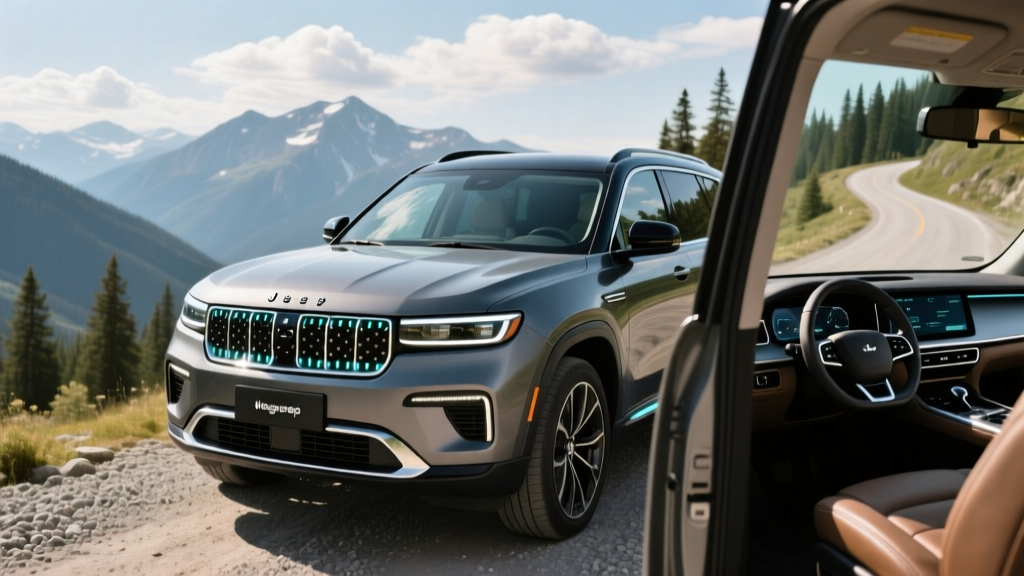
The 2025 Jeep Wagoneer S marks the brand's first battery-electric vehicle, built on Stellantis' STLA Large platform. It's a performance-oriented luxury SUV that trades traditional body-on-frame bulk for a unibody, dual-motor powertrain producing 600 horsepower. With an EPA-estimated 300 miles of range and a starting price around $65,200, the Wagoneer S targets buyers who want Jeep design language with genuine EV credentials — not a compliance car.
After spending time with the specs, EPA filings, and early owner reports, the Wagoneer S is a credible first effort. Its DC fast-charging speed, cabin tech, and straight-line performance are genuine strengths. Its real-world highway range in cold weather and the still-maturing Stellantis dealer charging infrastructure are legitimate concerns. Here's the full breakdown.
Range, Battery, and Efficiency
The Wagoneer S uses a 100.5 kWh (usable) lithium-ion battery pack with NMC (nickel-manganese-cobalt) chemistry, chosen for its higher energy density versus LFP — important in a vehicle this size where packaging constraints matter. Stellantis has not published an official LFP variant for this platform.
| Spec | Value |
|---|---|
| EPA-estimated range | 300 miles |
| Battery capacity (usable) | 100.5 kWh |
| Chemistry | NMC (nickel-manganese-cobalt) |
| MPGe (combined) | ~95 MPGe (EPA est.) |
| Efficiency | ~35 kWh/100 mi |
| Drivetrain | Dual-motor AWD |
Efficiency at ~35 kWh/100 miles places the Wagoneer S in the middle of the large electric SUV segment — less efficient than the Tesla Model X (~33 kWh/100 mi) but competitive with the BMW iX xDrive50. The NMC chemistry also means you should target a daily charge limit of 80% to maximize long-term battery health, unlike LFP packs that tolerate 100% daily charges.
Charging: DC Fast, Level 2, and Home Setup
The Wagoneer S supports DC fast charging at up to 162 kW peak on CCS1-compatible stations (with the NACS adapter increasingly available for Tesla Supercharger access as Stellantis joins the NACS ecosystem). Jeep quotes a 10–80% charge time of approximately 23 minutes under optimal conditions.
| Level | Power | Estimated Miles Added per Hour | Time / Notes |
|---|---|---|---|
| Level 1 (120V household) | ~1.4 kW | ~3–4 mi/hr | Emergency/trickle only; ~75+ hours for full charge |
| Level 2 (240V home/public) | 11.5 kW (onboard charger) | ~33 mi/hr | Full charge in ~9 hours; ideal overnight |
| DC Fast Charge | Up to 162 kW peak | N/A | 10–80% in ~23 min; tapers significantly above 80% |
Charging curve reality: The 162 kW figure is a peak, not a sustained rate. In real-world DC fast charging, expect the Wagoneer S to hold close to peak speed from 10–50% SoC, then taper progressively. The 10–80% time of 23 minutes assumes preconditioning is active and the battery is in its optimal temperature window. Arriving at a charger cold (without preconditioning) can add 5–10 minutes to that session.
The 11.5 kW onboard Level 2 charger is a strong point — it's higher than many competitors (the BMW iX, for instance, also offers 11 kW). On a 48-amp home Level 2 circuit, you'll recover roughly 33 miles of range per hour, meaning an overnight charge from 20% to 80% takes about 5–6 hours. Home charging installation typically costs $800–$2,500 depending on your electrical panel capacity and run distance — budget for a 60-amp dedicated circuit with a licensed electrician, per U.S. Department of Energy guidelines.
Performance and Driving Dynamics
The Wagoneer S Launch Edition (the initial trim) is a dual-motor all-wheel-drive configuration producing 600 horsepower and 617 lb-ft of torque. Jeep claims a 0–60 mph time of 3.4 seconds — making it the quickest production Jeep ever built.
| Spec | Value |
|---|---|
| Horsepower | 600 HP |
| Torque | 617 lb-ft |
| 0–60 mph | 3.4 seconds |
| Drivetrain | Dual-motor AWD |
| Top speed | Electronically limited ~124 mph |
| Towing capacity | Not yet rated (unibody platform) |
The STLA Large platform gives the Wagoneer S a low center of gravity courtesy of the under-floor battery pack, and the dual-motor setup provides torque vectoring capability. Drive modes include Snow, Sand, Eco, and a Sport setting that sharpens throttle response and steering weight. This is not a Wrangler — there's no low-range transfer case or solid axles — but Jeep has programmed a "Sand/Mud" mode that modulates torque distribution for light off-pavement use.
Regenerative braking offers multiple levels, including a one-pedal driving mode that brings the vehicle to a complete stop. The brake blending between regen and friction brakes is calibratable through the infotainment system.
Interior, Tech, and Cargo Space
The Wagoneer S cabin is a clean-sheet EV design, not a retrofit. The dashboard is dominated by a 12.3-inch digital cluster, a 12.3-inch center touchscreen running Uconnect 5, and an available 10.25-inch front-passenger display. A head-up display and digital rearview mirror round out the glass.
Key tech features:
- Uconnect 5 with wireless Apple CarPlay and Android Auto
- Available McIntosh 19-speaker premium audio system
- Hands-free active driving assist (SAE Level 2 — driver must remain engaged and eyes on road)
- Over-the-air (OTA) software updates for powertrain, infotainment, and ADAS
- Vehicle-to-load (V2L) capability for powering external devices
| Dimension | Measurement |
|---|---|
| Seating capacity | 5 passengers (2 rows) |
| Cargo (behind 2nd row) | ~30.4 cu ft |
| Cargo (2nd row folded) | ~60.2 cu ft |
| Front frunk | Not available (motor/packaging) |
| Front legroom | ~40.9 in |
| Rear legroom | ~38.5 in |
| Wheelbase | 113.0 in |
Cargo space is adequate for a two-row luxury SUV but trails the Hyundai Ioniq 5 (which offers a frunk and more total volume). The absence of a frunk is notable — that space is occupied by front-axle motor and power electronics on the STLA Large platform. If maximum cargo flexibility is a priority, competitors like the Tesla Model Y or Rivian R1S (three-row) offer more utility.
Pricing, Trims, and Federal Tax Credit
The 2025 Wagoneer S launches in a single, well-equipped Launch Edition trim. Additional trims (including a more accessible base model and a higher-performance variant) are expected for 2026.
| Trim | MSRP (incl. destination) |
|---|---|
| Launch Edition | $65,200 |
| Estimated future base trim (2026+) | ~$55,000–$58,000 (announced) |
Federal tax credit (§30D) eligibility: This is where the math gets nuanced. Under current IRS §30D rules, the Wagoneer S qualifies for evaluation under the new clean vehicle credit, but several conditions apply:
- MSRP cap: SUVs must have an MSRP at or below $80,000 — the Launch Edition at $65,200 clears this.
- Buyer income cap: Modified AGI must not exceed $150,000 (single), $225,000 (head of household), or $300,000 (joint).
- Battery sourcing: Critical minerals and battery component requirements phase in annually. For 2025, an increasing percentage must be sourced from the U.S. or free-trade-agreement countries. Stellantis has indicated the Wagoneer S battery pack is assembled in North America, but final §30D qualification depends on the specific VIN and IRS sourcing verification at point of sale.
- Point-of-sale transfer: Buyers can elect to transfer the credit to the dealer at purchase, reducing the purchase price directly (up to $7,500), rather than waiting for a tax refund.
| Scenario | Effective Price |
|---|---|
| Full $7,500 §30D credit (all requirements met) | ~$57,700 |
| Partial credit ($3,750 — minerals OR components only) | ~$61,450 |
| No credit (income or sourcing ineligible) | $65,200 |
Always verify credit eligibility with your tax professional and confirm the specific VIN's sourcing status with the dealer before purchase. Rules change annually, and state-level incentives (which vary by jurisdiction) may stack on top — check your state's energy office or AFDC for local programs.
Warranty and Long-Term Ownership
Stellantis backs the Wagoneer S EV powertrain with a warranty competitive with the segment:
| Component | Coverage |
|---|---|
| Basic (bumper-to-bumper) | 3 years / 36,000 miles |
| EV powertrain (battery + motors) | 8 years / 100,000 miles |
| Battery capacity retention | 8 years / 100,000 miles (typically 70% threshold) |
| Corrosion | 5 years / unlimited miles |
| Roadside assistance | 5 years / 60,000 miles |
The 8-year/100,000-mile battery warranty is federally mandated minimum for EVs, and Stellantis meets it. The 70% capacity retention threshold is standard — if your battery degrades below 70% of original capacity within the warranty period, Stellantis will repair or replace it. Real-world NMC degradation data from similar platforms suggests most owners will retain 85–90% capacity at the 5-year mark with proper charging habits (80% daily limit, avoiding repeated DC fast charging to 100%).
Competitive Positioning: Worth Buying?
The Wagoneer S competes in a crowded field of premium electric SUVs near $60,000–$75,000. Here's how it stacks up against key rivals:
| Vehicle | EPA Range | 0–60 | HP | Base MSRP |
|---|---|---|---|---|
| 2025 Jeep Wagoneer S | 300 mi | 3.4 sec | 600 | $65,200 |
| Tesla Model Y Performance | 285 mi | 3.5 sec | ~456 | ~$52,490 |
| BMW iX xDrive50 | 324 mi | 4.4 sec | 516 | $87,250 |
| Hyundai Ioniq 5 N | 221 mi | 3.25 sec | 641 | $66,100 |
| Cadillac Lyriq AWD | 307 mi | 4.6 sec | 500 | $62,690 |
The Wagoneer S occupies a unique niche: it's faster than the Lyriq and Model Y, more affordable than the iX, and offers more range than the Ioniq 5 N. Its weakness is that it doesn't dominate any single category outright. The Model Y wins on value and Supercharger access. The iX wins on range and interior refinement. The Lyriq wins on price and comfort. The Wagoneer S wins on raw power and Jeep brand identity.
- You want 600 HP and sub-3.5-second acceleration in a Jeep-badged luxury SUV
- You value distinctive design and don't want a Tesla or BMW
- You plan to charge primarily at home and take moderate road trips (200–280 mi segments)
- Brand loyalty to Jeep matters, and you want to go electric without switching marques
- Maximum range is your top priority (BMW iX, Cadillac Lyriq)
- You need three rows or maximum cargo space (Rivian R1S, Tesla Model X)
- You want the lowest total cost of ownership and best charging network (Tesla Model Y)
- You tow regularly — the Wagoneer S is not yet rated for towing
Pros and Cons
- 600 HP / 3.4-second 0–60 — quickest Jeep ever
- 300-mile EPA range is competitive for the class
- 11.5 kW Level 2 onboard charger enables fast home charging
- Uconnect 5 with triple-screen layout is modern and responsive
- Heat pump standard for better cold-weather efficiency
- Qualifies under $80K MSRP cap for §30D credit evaluation
- 162 kW DC fast-charge peak trails rivals (Model Y: ~250 kW, Ioniq 5: ~350 kW)
- No frunk — reduces total cargo flexibility
- No towing rating yet — limits utility-SUV use cases
- Cold-weather highway range may drop to ~200–225 miles
- Only one trim available at launch; base model not yet purchasable
- Stellantis dealer charging infrastructure still maturing
Frequently Asked Questions
What is the real-world range of the 2025 Jeep Wagoneer S?
The EPA-estimated range is 300 miles combined. In real-world highway driving at 70–80 mph in moderate temperatures, expect approximately 255–275 miles. In cold weather (below freezing), range may drop to 200–225 miles on the highway. City driving with regenerative braking can approach or slightly exceed the EPA figure.
How fast does the Wagoneer S charge at home and on DC fast chargers?
On a Level 2 home charger (240V), the 11.5 kW onboard charger adds roughly 33 miles of range per hour, filling the battery overnight in about 9 hours. On a DC fast charger, it peaks at 162 kW, achieving a 10–80% charge in approximately 23 minutes under optimal conditions. Charging slows significantly above 80% SoC.
Does the 2025 Wagoneer S qualify for the $7,500 federal EV tax credit?
It may. The MSRP of $65,200 is under the $80,000 SUV cap. However, eligibility depends on buyer income limits ($150K single / $300K joint), and battery critical-mineral and component sourcing requirements verified per VIN at point of sale. Consult a tax professional and confirm with the dealer before purchasing. Full or partial credit ($3,750 or $7,500) may apply.
How much does the Wagoneer S cost after tax credits?
If you qualify for the full $7,500 §30D credit and elect point-of-sale transfer, the effective price drops to approximately $57,700. With a partial $3,750 credit, it's around $61,450. Without any credit, the MSRP is $65,200 (destination included). State incentives may reduce the cost further depending on your jurisdiction.
Is the Wagoneer S worth buying versus the Tesla Model Y or Cadillac Lyriq?
It depends on your priorities. The Wagoneer S offers more power (600 HP) than both and a distinctive design. The Model Y wins on value, Supercharger network access, and efficiency. The Lyriq offers slightly more range at a lower price and a more comfort-oriented ride. If performance and Jeep brand identity are your top criteria, the Wagoneer S is compelling. If you prioritize lowest cost of ownership or maximum range, the Model Y or Lyriq may serve you better.
Can the Wagoneer S use Tesla Superchargers?
Stellantis has announced that its EVs will gain access to Tesla's NACS Supercharger network via adapters, with rollout continuing through 2025–2026. Confirm adapter availability and compatibility with your dealer at the time of purchase, as the transition from CCS1 to NACS is ongoing across the industry.
What is the battery warranty on the Wagoneer S?
The EV battery and powertrain are covered for 8 years or 100,000 miles, whichever comes first. The warranty guarantees at least 70% capacity retention over that period. This is in line with the federal minimum for EV battery coverage and matches most competitors.
Sources: EPA Fuel Economy, IRS §30D Clean Vehicle Credit, Jeep Official Specifications.