The 2025 Hyundai Ioniq 5 N: An EV Track Weapon With Daily-Driver DNA
Hyundai's N performance division took the already-capable Ioniq 5 platform and cranked every dial to maximum. The result is the 2025 Ioniq 5 N — a 641-horsepower electric hot hatch that sprints to 60 mph in 3.4 seconds, holds its own on a road course, and still offers a usable back seat and hatchback cargo area. But performance EVs always trade something for their speed, and the Ioniq 5 N's compromise is range. With an EPA-estimated 221 miles, it gives up roughly 80 miles compared to the standard long-range Ioniq 5. That trade-off defines the ownership experience and determines whether this car fits your life.
We've spent time with the Ioniq 5 N in mixed driving — highway commutes, canyon roads, and DC fast-charging stops — to separate the spec-sheet promises from the real-world reality. Here's everything you need to decide if Hyundai's electric N car earns a spot in your garage.
Range and Efficiency: The Performance Tax Is Real
The 2025 Ioniq 5 N carries an 84.0 kWh usable lithium-ion battery pack using NMC (nickel-manganese-cobalt) chemistry — chosen for its higher energy density and discharge rates, which matter when you're pulling 600+ horsepower repeatedly. The EPA rates the Ioniq 5 N at 221 miles of combined range.
- EPA Combined: 221 miles
- Real-World Highway (70-80 mph, moderate climate): ~180–195 miles
- Real-World City/Mixed (mild weather): ~200–215 miles
- Cold Weather (below 32°F, highway): ~150–170 miles
The Ioniq 5 N's aggressive tire compound, performance-tuned suspension, and higher curb weight (~4,800 lbs) all work against efficiency. Highway driving at 75+ mph sees the most significant drop. If your commute is 50 miles each way with DC charging access at one end, you'll manage — but this is not a road-trip cruiser in the mold of a Tesla Model Y Long Range.
Efficiency lands at 83 MPGe combined (approximately 40 kWh/100 miles), according to fueleconomy.gov. That's roughly 25% thirstier than the standard Ioniq 5 SEL AWD, which achieves 110 MPGe. The performance tax is measured in electrons.
Charging: 800V Architecture Keeps Pit Stops Short
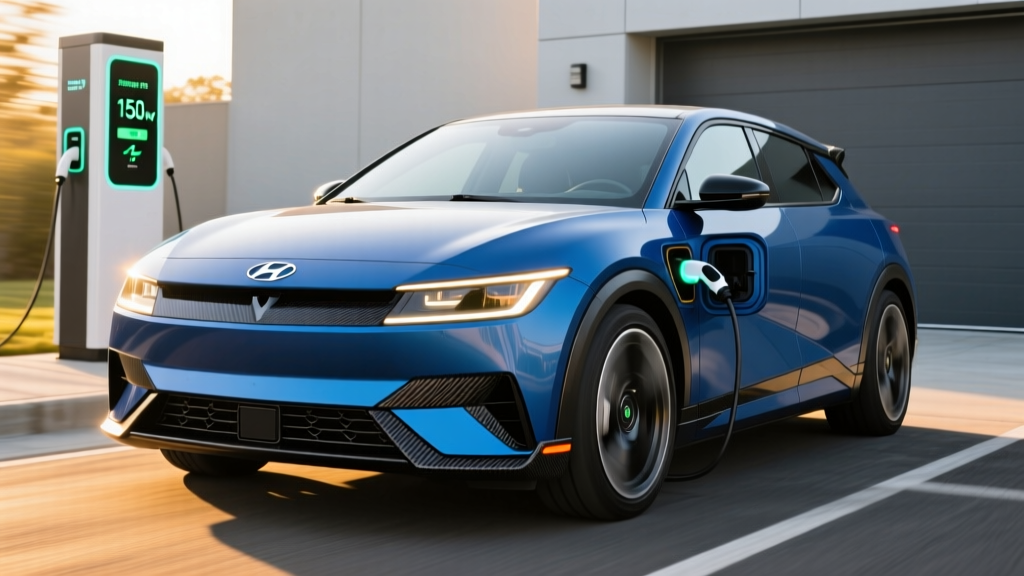
The Ioniq 5 N retains Hyundai's E-GMP 800-volt electrical architecture, which remains one of the fastest-charging platforms available in a production EV. Peak DC fast-charge rate hits 232 kW, and under optimal conditions (battery preconditioned, charger capable), a 10–80% session takes approximately 18 minutes.
| Charging Level | Power | Speed / Time | Connector |
|---|---|---|---|
| Level 1 (120V household) | ~1.4 kW | ~3 miles per hour | J1772 / NACS |
| Level 2 (240V home, 48A) | 10.9 kW (onboard max) | ~28 miles per hour; 0–100% in ~8 hours | J1772 / NACS |
| DC Fast Charge (peak) | 232 kW | 10–80% in ~18 min; ~165 miles added | CCS / NACS (adapter) |
A few real-world caveats on charging: The 232 kW peak only holds between roughly 10% and 40% state of charge. Above 60%, the charge curve tapers significantly — you'll see 80–100 kW in the 60–80% zone, and a trickle above 90%. This is normal physics for NMC packs protecting cell longevity, but it means a 5–95% session takes closer to 35–40 minutes, not 18.
The Ioniq 5 N ships with a CCS1 port natively. Hyundai provides a NACS adapter for Tesla Supercharger access (and beginning with 2025 production, some units ship with the native NACS port — verify with your dealer). Battery preconditioning activates automatically when a DC fast charger is set as your navigation destination, which is essential for hitting peak charge rates in cold weather.
Performance Specs: 641 HP and N-Division Engineering
| Specification | Figure |
|---|---|
| Powertrain | Dual-motor AWD |
| Horsepower (N Grin Boost) | 641 hp |
| Torque | 568 lb-ft |
| 0–60 mph | 3.4 seconds |
| Top Speed | 161 mph |
| Battery (usable) | 84.0 kWh, NMC |
| EPA Range | 221 miles |
| MPGe (combined) | 83 MPGe |
| Curb Weight | ~4,861 lbs |
| Wheels / Tires | 21" forged alloys / Pirelli P Zero (275/35R21) |
The dual-motor setup delivers 601 hp in standard driving; engaging N Grin Boost (a steering-wheel button) temporarily raises output to 641 hp for 10-second bursts. The result is violent acceleration that rivals a Porsche Taycan 4S at a fraction of the price.
But straight-line speed is only part of the N formula. Hyundai added a reinforced body structure, N-tuned adaptive dampers, an electronically controlled limited-slip differential (e-LSD), and N Drift Optimizer. The brake system uses 4-piston front calipers with 400mm rotors, and regenerative braking can pull up to 0.65g of deceleration before the friction brakes engage — critical for track-lap endurance.
The N Active Sound+ system (simulated engine and exhaust sound through interior and exterior speakers) and N e-Shift (simulated 8-speed dual-clutch shifts with torque interruption) are love-it-or-hate-it features. They add visceral engagement for drivers who miss the drama of an internal-combustion hot hatch, but purists can turn them off entirely.
Interior, Cargo, and Daily Practicality
Inside, the Ioniq 5 N distinguishes itself with N-specific sport bucket seats with heavy bolstering and Alcantara trim, an Alcantara-wrapped steering wheel with N buttons, and blue contrast stitching throughout. The dual 12.3-inch displays (instrument cluster and infotainment) run Hyundai's latest software with wireless Apple CarPlay and Android Auto, over-the-air updates, and the Bluelink connected-services suite.
Practicality figures:
- Front legroom: 41.7 inches
- Rear legroom: 39.4 inches
- Cargo (rear seats up): 27.2 cu ft
- Cargo (rear seats folded): 59.3 cu ft
- Frunk: 0.85 cu ft (limited by performance electronics)
Rear-seat space is genuinely adult-friendly, and the hatchback cargo area swallows a week's worth of groceries or a set of track-day tires with seats folded. The frunk is essentially a token compartment — don't plan on storing much there.
Notable drawbacks: The N sport seats, while excellent for lateral support, are firmer than the standard Ioniq 5's chairs and may fatigue some drivers on long highway stints. Road noise from the 21-inch Pirelli P Zero tires is noticeable above 65 mph — a trade-off for the grip they provide.
Pricing, Tax Credits, and Value
The 2025 Ioniq 5 N is offered in a single, fully-loaded trim:
| Item | Amount |
|---|---|
| Base MSRP | $67,475 (incl. $1,375 destination) |
| As-Tested (with Performance Blue paint) | $67,875 |
| Federal §30D Tax Credit | $0 — does NOT qualify |
| Estimated Effective Price (federal credit) | $67,475 |
The Ioniq 5 N does not qualify for the $7,500 federal EV tax credit under IRS §30D rules. Two factors eliminate it: First, the MSRP exceeds the $55,000 cap for sedans/hatchbacks (SUVs have an $80,000 cap, but the Ioniq 5 N is classified as a passenger car). Second, battery-sourcing and critical-mineral requirements may not be fully met depending on production batch. Always verify current eligibility on the IRS clean vehicle credit page before purchasing.
State-level incentives may still apply — California's CVRP rebate, Colorado's state tax credit, and others vary by jurisdiction. Consult your state's energy office or a tax professional for specifics.
- MSRP cap for cars: $55,000 (Ioniq 5 N MSRP: $67,475 — exceeds cap)
- Buyer AGI limits: $150K single / $300K joint (buyer-dependent)
- Battery sourcing & critical mineral requirements (varies by production run)
- Point-of-sale transfer available only for qualifying vehicles
Warranty and Ownership Costs
Hyundai backs the Ioniq 5 N with one of the best warranties in the EV segment:
- New-vehicle limited warranty: 5 years / 60,000 miles
- Powertrain warranty: 10 years / 100,000 miles
- Battery warranty: 10 years / 100,000 miles (replaced if capacity drops below 70%)
- Complimentary maintenance: 3 years / 36,000 miles
Insurance costs run higher than the standard Ioniq 5 — expect quotes 20–35% above a comparably-priced non-performance EV, given the 641-hp output and specialized body panels. Get quotes before ordering.
Pros and Cons: The Honest Scorecard
- 641 hp and 3.4-sec 0–60 at under $70K — supercar acceleration at a fraction of the cost
- 800V architecture enables 10–80% DC charging in ~18 minutes
- Genuine track capability with reinforced chassis, e-LSD, and robust cooling
- Industry-leading 10-year/100,000-mile battery warranty
- Usable hatchback practicality with adult-friendly rear seats
- N e-Shift and N Active Sound+ add engagement without mandatory artificiality
- 221-mile EPA range is the lowest in the Ioniq 5 lineup
- Does not qualify for the $7,500 federal EV tax credit
- 21-inch performance tires are expensive to replace (~$350+ per corner)
- Firm sport seats and noticeable road noise on highway drives
- ~4,861 lb curb weight is felt during direction changes
- Tiny frunk (0.85 cu ft) is nearly useless
Who Should Buy the 2025 Ioniq 5 N?
The Ioniq 5 N is built for a specific buyer: the driving enthusiast who wants electric performance without spending Porsche Taycan money, and who has reliable home charging to offset the limited range. It excels as a weekend canyon car, a track-day toy that can daily-drive to work, and a conversation starter at every cars-and-coffee.
It is not ideal for high-mileage commuters (100+ miles daily round-trip), frequent long-distance road trippers, or buyers who prioritize lowest cost-per-mile. If range and efficiency are your top criteria, the standard Ioniq 5 SEL AWD (290-mile EPA range, 110 MPGe) or a Tesla Model Y Long Range (310+ miles) are better daily companions.
- You want sub-3.5-sec acceleration and track-capable handling under $70K
- Your daily commute is under 80 miles round-trip with home Level 2 charging
- You value Hyundai's 10-year battery warranty and dealer network
- You regularly drive 200+ miles between charges
- The $7,500 federal tax credit is essential to your budget
- You prioritize a quiet, plush ride over sporty engagement
Frequently Asked Questions
What is the real-world range of the 2025 Ioniq 5 N?
In mixed driving at moderate temperatures, expect approximately 195–215 miles. Sustained highway driving at 75+ mph drops that to 180–195 miles. In sub-freezing winter conditions with highway use, plan for 150–170 miles. The 221-mile EPA figure is achievable in gentle city driving at 55–65°F.
How fast does the Ioniq 5 N charge at home and on the road?
On a 48-amp Level 2 home charger (240V), the Ioniq 5 N accepts up to 10.9 kW, adding roughly 28 miles of range per hour — a full charge takes about 8 hours overnight. On a DC fast charger, peak rate is 232 kW, with a 10–80% session taking approximately 18 minutes under optimal (preconditioned battery) conditions.
Does the 2025 Ioniq 5 N qualify for the federal EV tax credit?
No. The Ioniq 5 N's $67,475 MSRP exceeds the IRS §30D cap of $55,000 for passenger cars (sedans and hatchbacks). It does not qualify for the $7,500 credit or the point-of-sale transfer. State incentives may still apply depending on your jurisdiction.
Is the Ioniq 5 N worth it versus the Tesla Model 3 Performance or Porsche Taycan?
Against the Tesla Model 3 Performance ($52,990, 315-mile range), the Ioniq 5 N costs more, has less range, but offers a more engaging chassis, hatchback practicality, and a far superior warranty. Against the Porsche Taycan ($90,000+), the Ioniq 5 N delivers comparable acceleration and track manners at roughly $25K less, though the Porsche has superior build quality and steering feel. The Ioniq 5 N occupies a compelling middle ground — if range isn't your top priority.
Can the Ioniq 5 N charge at Tesla Superchargers?
Yes. Hyundai provides a NACS adapter for CCS-equipped Ioniq 5 N models, enabling access to Tesla's Supercharger network. Some 2025 production units may ship with a native NACS port — confirm with your dealer at time of purchase.
What is the battery warranty on the Ioniq 5 N?
Hyundai covers the high-voltage battery for 10 years or 100,000 miles, whichever comes first. If battery capacity drops below 70% of its original capacity during the warranty period, Hyundai will repair or replace the battery at no cost.