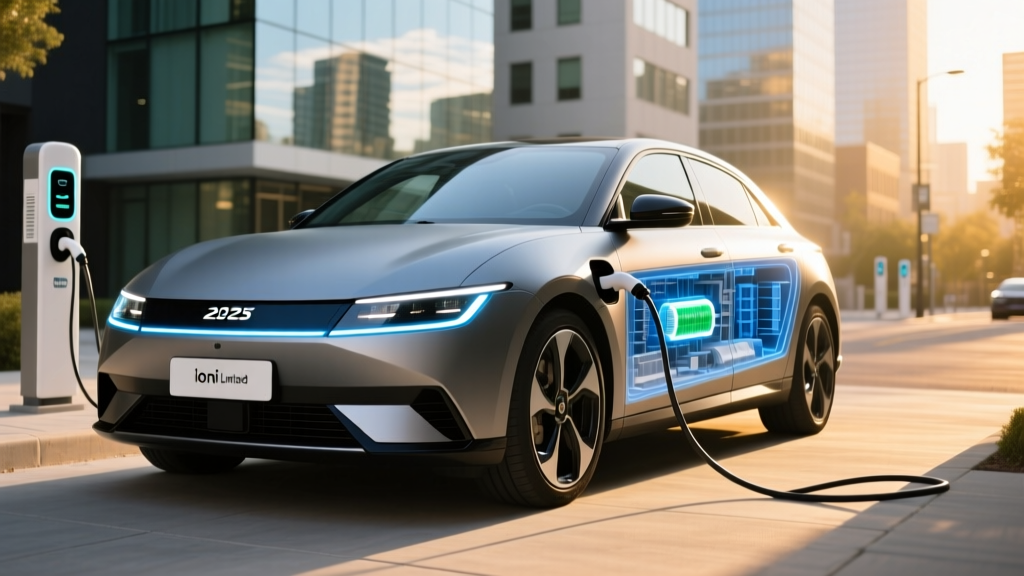
The Hyundai Ioniq 5 has been a benchmark compact electric crossover since its 2022 debut, and the refreshed 2025 model year brings meaningful upgrades: a larger battery, a standard NACS charge port (unlocking native Tesla Supercharger access), revised styling, and a new XRT trim. But the range-topping 2025 Ioniq 5 Limited AWD remains the variant that luxury-leaning EV buyers scrutinize most. It packs Hyundai's full technology suite, dual-motor all-wheel drive, and the largest battery in the lineup — but at a price that pushes into territory occupied by the Tesla Model Y, Ford Mustang Mach-E, and even entry-level luxury EVs.
This review breaks down every number that matters — from real-world highway range to the exact DC fast-charging curve you'll see at a 350 kW station — and evaluates whether the Limited trim justifies its premium in the current EV market.
2025 Ioniq 5 Limited at a Glance: Core Specifications
| Attribute | Specification |
|---|---|
| EPA Range | 290 miles (AWD); 318 miles (RWD Limited not offered in 2025) |
| Usable Battery Capacity | 84.0 kWh (NMC lithium-ion) |
| Drivetrain | Dual-motor AWD |
| Horsepower | 320 hp combined |
| Torque | 446 lb-ft |
| 0–60 mph | 4.5 seconds |
| Max DC Fast Charge Rate | 240 kW (peak) |
| 10–80% DC Charge Time | ~20 minutes (optimal conditions) |
| Level 2 Charge Rate | 10.9 kW (48A) |
| Charge Port | NACS (native Tesla Supercharger compatible) |
| EPA Efficiency (Combined) | 98 MPGe / 34 kWh/100 mi |
| Cargo Volume (rear seats up) | 27.2 cu ft |
| Cargo Volume (rear seats folded) | 59.3 cu ft |
| Front Trunk (Frunk) | 0.85 cu ft (AWD) |
| Rear Legroom | 39.4 inches |
| Base MSRP (Limited AWD) | $52,600 (excl. $1,195 destination) |
| Battery/Powertrain Warranty | 10 years / 100,000 miles |
| Vehicle Warranty | 5 years / 60,000 miles |
Real-World Range: What the EPA Sticker Doesn't Tell You
Real-World Expectation: 245–270 miles at sustained highway speeds (70–80 mph); 260–285 miles mixed city/suburban driving. In cold weather (below 32°F), expect a 20–30% reduction, yielding roughly 200–230 miles on a full charge.
The 2025 Ioniq 5 Limited AWD carries an EPA-estimated 290 miles of range — a solid figure for a dual-motor crossover, and a meaningful improvement over the pre-refresh 77.4 kWh AWD model's 256-mile rating. The larger 84.0 kWh NMC battery (up from 77.4 kWh usable in prior model years) is the primary driver of this gain.
However, EPA range is measured on a standardized dynamometer cycle that doesn't fully replicate sustained highway driving. In independent real-world highway tests at 70 mph in moderate temperatures (60–75°F), the Ioniq 5 AWD typically delivers between 245 and 270 miles before reaching a low-state-of-charge buffer warning. City and suburban driving, where regenerative braking recaptures energy, pushes efficiency closer to the EPA sticker — often 260–285 miles in mixed use.
Cold weather is the great equalizer for all EVs. The Ioniq 5's heat pump (standard on the Limited trim) mitigates cabin-heating energy draw, but battery chemistry itself becomes less efficient in freezing temperatures. Owners in northern climates should budget for 200–230 miles of usable range on the coldest days. Preconditioning the battery while plugged in — a feature accessible through Hyundai's Bluelink app — recovers a meaningful portion of that loss by warming the pack before departure.
Charging Performance: 800V Architecture Still Pays Dividends
The Ioniq 5's 800-volt electrical architecture remains one of its strongest competitive advantages. While most EVs in this price class use 400V systems, the higher voltage allows the Ioniq 5 to accept higher charge power without excessive current, which translates to faster charging at compatible DC fast chargers.
| Charge Level | Power / Current | Speed (Miles of Range Added) |
|---|---|---|
| Level 1 (120V household) | ~1.4 kW (12A) | ~3–4 miles per hour |
| Level 2 (240V home / public) | 10.9 kW (48A) | ~29–32 miles per hour |
| DC Fast Charge (350 kW station) | Peak 240 kW | 10–80% in ~20 minutes |
| DC Fast Charge (150 kW station) | ~130–145 kW sustained | 10–80% in ~30 minutes |
| Tesla Supercharger V3 (via NACS) | ~150–170 kW peak | 10–80% in ~25–28 minutes |
DC fast charging in practice: The 240 kW peak rate is achievable only at chargers rated 250 kW or higher (such as Electrify America 350 kW stalls or Hyundai's own E-GMP-optimized stations). The charge curve is aggressive from 10% to roughly 55% SoC, where the car sustains above 200 kW. Beyond 55%, power tapers progressively — a characteristic of NMC chemistry managed by the battery management system to protect long-term cell health. The 10–80% sprint of approximately 20 minutes is among the fastest in the segment and means a realistic highway road-trip stop takes about 22–25 minutes including plug-in and stretch time.
NACS adoption matters: For 2025, Hyundai transitioned the Ioniq 5 to the North American Charging Standard (NACS) connector, replacing the CCS1 port used on 2022–2024 models. This gives the Ioniq 5 native access to Tesla's Supercharger network — over 20,000 stalls across North America — without an adapter. For road-trippers, this is a significant reliability and convenience upgrade, as Superchargers consistently report higher uptime than third-party networks.
Home Level 2 charging: At 10.9 kW (48 amps on a 60-amp circuit), a full overnight charge from 20% to 100% takes roughly 7–8 hours. Most owners will need a hardwired Level 2 wallbox installed by a licensed electrician. Expect installation costs of $500–$2,000 depending on panel capacity and wiring distance — and potentially more if your home requires a 200-amp panel upgrade.
Performance and Driving Dynamics
The Limited AWD pairs a front motor (99 hp) with a rear motor (221 hp) for a combined 320 horsepower and 446 lb-ft of torque. The 0–60 mph time of 4.5 seconds makes it genuinely quick — not sports-car quick, but brisk enough to merge confidently and pass without hesitation. The instantaneous torque delivery that defines EVs is fully present here.
Driving dynamics are competent rather than sporty. The Ioniq 5 rides on a flat skateboard platform with a low center of gravity, so body roll is well-controlled. However, the steering is light and somewhat numb, and the suspension tuning prioritizes comfort over corner-carving. This is a grand-touring-oriented crossover, not a track weapon. Compared to the Ford Mustang Mach-E GT or Tesla Model Y Performance, the Ioniq 5 Limited trades outright agility for ride quality and cabin isolation.
The regenerative braking system offers multiple levels, selectable via steering-wheel paddles. Level 3 provides near-one-pedal driving in city traffic, though the car doesn't come to a complete stop without touching the brake pedal (unlike some competitors). The i-Pedal mode does enable full one-pedal operation if preferred.
Interior, Cargo, and Daily Practicality
The Ioniq 5's retro-futuristic interior remains a differentiator. The dual 12.3-inch displays (instrument cluster and infotainment) sit behind a flat, minimalist dashboard. The Limited trim adds premium touches: leather-trimmed seats, a panoramic fixed glass roof, a Bose premium audio system, a head-up display with augmented-reality navigation, and ventilated front seats.
Space is generous. The 118.1-inch wheelbase — longer than many midsize SUVs — yields 39.4 inches of rear legroom, enough for tall adults to sit comfortably behind a six-foot driver. The flat floor (no transmission tunnel) makes the middle rear seat usable, a rarity in this segment.
Cargo capacity is competitive but not class-leading. Behind the rear seats, you get 27.2 cubic feet — adequate for a week's groceries or two large suitcases. Fold the 60/40-split rear bench and capacity expands to 59.3 cubic feet. The AWD model's frunk is a shallow 0.85 cubic feet, useful only for charging cables and small items. The RWD version offers a larger frunk, but the Limited trim is AWD-only for 2025.
One notable drawback: the Ioniq 5 lacks a rear wiper. In rain or snow, the rear glass accumulates spray with no way to clear it, a common complaint among owners and a genuine visibility issue in foul weather.
Pricing, Trims, and Federal Tax Credit Eligibility
The 2025 Ioniq 5 lineup spans four trims: SE ($42,600), SEL ($46,200), XRT ($49,600), and Limited ($52,600). All prices exclude the $1,195 destination charge. The Limited AWD, as tested with no additional packages (Hyundai offers few options on the top trim), comes to $53,795 out the door before taxes and registration.
| Trim | Drivetrain | MSRP (+ Destination) |
|---|---|---|
| SE Standard Range | RWD | $42,600 ($43,795) |
| SE | RWD / AWD | $46,200 ($47,395) |
| SEL | RWD / AWD | $46,200 ($47,395) |
| XRT | AWD | $49,600 ($50,795) |
| Limited | AWD | $52,600 ($53,795) |
Does the 2025 Ioniq 5 Qualify for the Federal EV Tax Credit?
Under current IRS §30D rules, the 2025 Ioniq 5's eligibility for the full $7,500 federal tax credit depends on three factors that buyers must verify:
- MSRP Cap: The vehicle must have an MSRP at or below $80,000 for SUVs/crossovers. The Ioniq 5 Limited at $52,600 clears this threshold comfortably.
- Buyer Income Cap: Modified adjusted gross income (MAGI) must not exceed $150,000 (single), $225,000 (head of household), or $300,000 (joint filers).
- Battery Component & Critical Minerals Sourcing: A percentage of battery components must be manufactured or assembled in North America, and a percentage of critical minerals must be sourced from the U.S. or FTA partners. These thresholds tighten annually. Hyundai has been working to shift Ioniq 5 battery sourcing to qualify, but eligibility can change mid-year based on supply-chain adjustments.
Critical note: Hyundai's U.S.-built Ioniq 5 models (production shifted to the Ellabell, Georgia plant) are positioned to meet sourcing requirements, but buyers should verify the specific vehicle's credit eligibility using the IRS's official VIN-lookup tool at fueleconomy.gov before purchase. The credit can be transferred to the dealer at point of sale for an immediate price reduction, effectively lowering the Limited to approximately $46,295 if the full $7,500 applies.
Always consult a tax professional for your specific situation. State and local incentives may stack on top of the federal credit but vary by jurisdiction.
Technology, Safety, and Driver Assistance
The Limited trim includes Hyundai's full SmartSense suite: forward collision-avoidance assist with pedestrian and cyclist detection, blind-spot collision-avoidance, rear cross-traffic collision-avoidance, lane-keeping assist, and navigation-based smart cruise control with stop-and-go. Highway Driving Assist 2 (HDA 2) provides lane-centering and adaptive cruise on divided highways, with automatic lane-change initiation when the turn signal is activated.
The infotainment system runs on a 12.3-inch touchscreen with wireless Apple CarPlay and Android Auto, built-in navigation, over-the-air updates, and Hyundai's Digital Key 2 (which allows your smartphone to function as the key fob). The Limited also adds a digital side-mirror system in select markets (camera-based, replacing traditional mirrors) — though U.S. availability of this feature varies by state due to regulatory approval.
One tech frustration: the climate controls share a touch-capacitive panel with the infotainment shortcut bar. There are no physical knobs for temperature or fan speed, which means taking your eyes off the road to adjust cabin settings. This is a common complaint in Hyundai/Kia EVs and a notable ergonomic step backward from traditional controls.
Ownership Costs and 5-Year Outlook
Hyundai's warranty coverage is among the best in the EV market. The high-voltage battery and electric powertrain are covered for 10 years or 100,000 miles (whichever comes first), with a capacity-retention threshold typically set at 70% state of health. The limited vehicle warranty covers 5 years or 60,000 miles, and complimentary maintenance (oil changes don't apply, but tire rotations and inspections do) is included for 3 years or 36,000 miles.
Charging costs depend heavily on your electricity rate and charging mix. At the U.S. average residential rate of $0.17/kWh, a full home charge of the 84 kWh battery costs approximately $14.28, yielding a per-mile fuel cost of roughly $0.049 (at real-world efficiency of ~34 kWh/100 mi). By comparison, a gasoline crossover averaging 28 MPG at $3.40/gallon costs about $0.121 per mile — making the Ioniq 5 roughly 60% cheaper to fuel on home electricity.
Insurance premiums for the Ioniq 5 Limited tend to run 10–20% higher than comparable gas crossovers, reflecting higher repair costs for EV-specific components. Expect annual premiums in the $1,800–$2,400 range depending on your profile and location.
2025 Ioniq 5 Limited vs. Key Competitors
The Ioniq 5 Limited doesn't exist in a vacuum. Here's how it stacks up against the three most common cross-shops:
- Tesla Model Y Long Range AWD (~$48,000): The Model Y offers more cargo space (30.2 cu ft rear, 72 cu ft folded), slightly longer range (315 miles EPA), and access to the same Supercharger network (now shared). However, its interior materials and ride quality fall short of the Ioniq 5 Limited's premium feel, and its tax credit eligibility faces the same sourcing scrutiny.
- Ford Mustang Mach-E Premium AWD (~$48,000): The Mach-E delivers sportier handling and a more engaging drive, with 290 miles of EPA range. Its charging speed (peak ~150 kW on 400V architecture) is noticeably slower than the Ioniq 5's 800V system, adding 8–10 minutes to typical DC fast-charge stops.
- Kia EV6 GT-Line AWD (~$53,000): The EV6 shares the Ioniq 5's E-GMP platform, 800V architecture, and 84 kWh battery. Differences are primarily styling, interior layout, and suspension tuning. The EV6 is slightly sportier; the Ioniq 5 is slightly more comfortable. Both are excellent — choose based on design preference.
Pros, Cons, and Who Should Buy the Ioniq 5 Limited
Pros
- Class-leading DC fast-charge speed (240 kW peak, ~20 min 10–80%)
- Native NACS port with Tesla Supercharger access
- Spacious, flat-floor cabin with premium Limited-trim materials
- 10-year / 100,000-mile battery warranty
- Competitive 290-mile EPA range for AWD
- Vehicle-to-load (V2L) capability powers devices up to 3.6 kW
- Strong value with tax credit — potentially under $47K
Cons
- No rear wiper — a real visibility issue in rain/snow
- Touch-capacitive climate controls lack physical knobs
- Small frunk on AWD models (0.85 cu ft)
- Cargo space trails the Model Y and some competitors
- Highway range falls 20–45 miles short of EPA estimate
- Steering feel is light and disconnected
- Limited trim price pushes past $53K before incentives
Who This EV Suits Best
The 2025 Ioniq 5 Limited AWD is ideal for tech-forward commuters and small families who prioritize charging speed, interior quality, and a strong warranty over outright sportiness. If your routine includes regular highway road trips, the 800V fast-charging and Supercharger access make it one of the least stressful EVs to travel in. It's less suited for buyers who need maximum cargo volume (look at the Model Y) or those who want an engaging, sporty drive (look at the Mach-E or EV6).
Frequently Asked Questions
What is the real-world range of the 2025 Ioniq 5 Limited AWD?
In mixed driving at moderate temperatures, expect 260–285 miles. Sustained highway driving at 70–80 mph drops that to 245–270 miles. Cold weather (below freezing) can reduce range to 200–230 miles. The EPA rates it at 290 miles, but real-world conditions rarely match the laboratory test cycle perfectly.
How fast does the 2025 Ioniq 5 charge at home and on the road?
At home on a Level 2 (240V, 48A) charger, the Ioniq 5 adds about 29–32 miles of range per hour, with a full charge taking 7–8 hours. On a 350 kW DC fast charger, it peaks at 240 kW and charges from 10% to 80% in approximately 20 minutes. At a Tesla Supercharger V3 (250 kW), expect 10–80% in about 25–28 minutes.
Does the 2025 Ioniq 5 qualify for the $7,500 federal EV tax credit?
It can, but eligibility depends on the buyer's income (MAGI caps of $150K single / $300K joint), the vehicle's MSRP (must be under $80K — the Ioniq 5 qualifies), and battery-component/critical-minerals sourcing requirements that tighten annually. Verify eligibility via the IRS VIN-lookup tool on fueleconomy.gov before purchasing. The credit can be applied at the point of sale as a direct price reduction.
Is the 2025 Ioniq 5 Limited worth buying over the Tesla Model Y?
It depends on your priorities. The Ioniq 5 Limited offers a more premium interior, faster DC charging (240 kW vs. ~250 kW peak but on 400V Tesla architecture with different curve characteristics), and a longer battery warranty (10 yr/100K mi vs. 8 yr/120K mi for Tesla). The Model Y wins on cargo space, range (315 mi EPA), and software ecosystem. Both now share Supercharger access. Test-drive both before deciding.
What is the biggest drawback of the Ioniq 5 Limited?
The most commonly cited complaints are the lack of a rear wiper (a genuine safety concern in wet weather), the absence of physical climate-control knobs, and the small frunk on AWD models. None are deal-breakers, but they're persistent annoyances that Hyundai has not addressed in the 2025 refresh.
How long will the Ioniq 5 battery last?
Hyundai warranties the high-voltage battery for 10 years or 100,000 miles against capacity loss below a defined threshold (typically 70% state of health). Industry data from similar NMC packs suggests 80–85% capacity retention after 100,000 miles under normal use. Many EV batteries outlast their warranty periods with gradual, manageable degradation rather than sudden failure.