The 2025 Hyundai Ioniq 5 arrives at a pivotal moment for the electric crossover segment. With the long-awaited switch to the North American Charging Standard (NACS) port, a refreshed interior, and the addition of the rugged XRT trim, Hyundai has addressed the most common complaints from early adopters while sharpening its competitive edge against the Tesla Model Y, Ford Mustang Mach-E, and Kia EV6.
But specs on paper only tell part of the story. After analyzing EPA data, real-world efficiency logs, and DC fast-charging curves, here's everything you need to know about the 2025 Ioniq 5 — from its reworked cabin to its actual highway range and charging behavior.
2025 Ioniq 5 Interior: What Changed and Why It Matters
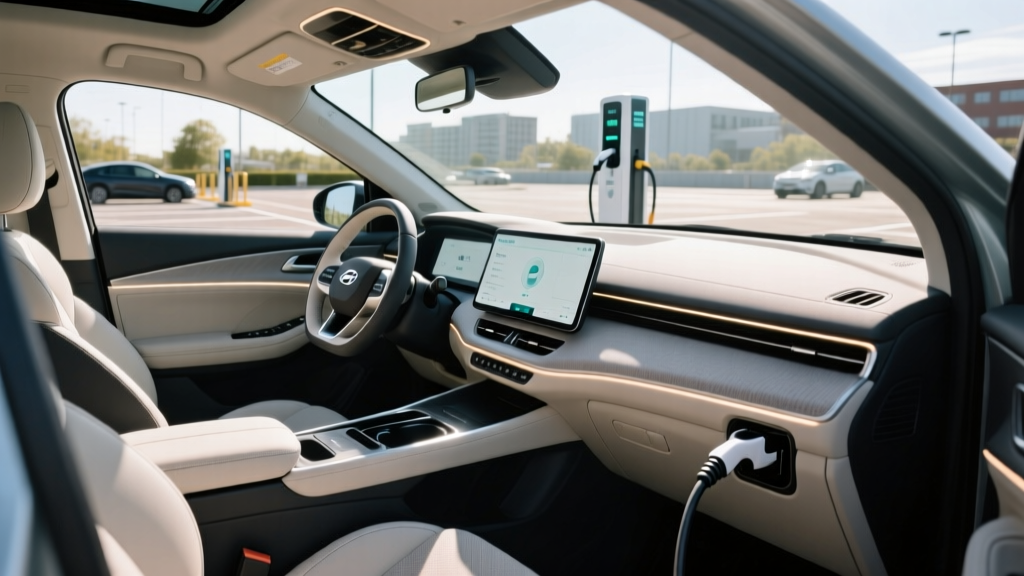
The headline for the 2025 model year is the interior refresh, and it's more than cosmetic. Hyundai listened to three years of owner feedback and made targeted improvements that elevate daily usability.
Physical controls return. The most requested change: physical HVAC buttons and a dedicated volume knob. The 2022–2024 models relied on a capacitive touch panel below the central screen that was prone to accidental inputs and lacked tactile feedback. The 2025 Ioniq 5 replaces this with proper buttons and a rotary knob — a small change that dramatically improves usability while driving.
Updated infotainment. The dual 12.3-inch display setup carries over, but the software now runs Hyundai's latest ccNC (Connected Car Navigation Cockpit) platform. Wireless Apple CarPlay and Android Auto remain standard across all trims. Over-the-air updates are supported, and the navigation system now includes real-time charger availability along planned routes.
Materials and build quality. The SEL and Limited trims use a combination of recycled PET fabric and synthetic leather (H-Tex). The Limited adds genuine leather seating surfaces with ventilated front seats and a heated steering wheel. Fit and finish are tight throughout — panel gaps are consistent, and there's no cowl shake or rattling from the floating center console, a hallmark of the Ioniq 5's E-GMP platform.
Seating and space. The flat floor (enabled by the skateboard-style battery pack) gives the cabin an airy, open feel. The sliding center console — unique to this segment — can move rearward to create a pass-through from the driver to passenger side, useful for exiting curbside in tight parking spots.
- Front headroom: 39.6 inches
- Rear headroom: 38.7 inches
- Front legroom: 41.7 inches
- Rear legroom: 39.4 inches
- Cargo volume (behind rear seats): 27.2 cu ft
- Cargo volume (rear seats folded): 59.3 cu ft
- Front trunk (frunk): 0.85 cu ft (RWD) / 2.0 cu ft (AWD) — enough for a charging cable bag, not luggage
The rear seat is genuinely comfortable for adults on longer trips. The seat cushion is mounted higher than in many EV crossovers, avoiding the "knees-up" posture that plagues competitors with floor-mounted battery packs. The reclining rear seatback is a welcome feature on road trips.
Range, Efficiency, and Real-World Expectations
The 2025 Ioniq 5 carries over the same battery and powertrain options from the prior model year, meaning EPA range figures are largely unchanged. Here's what the sticker says — and what you should actually expect.
| Trim / Drivetrain | Battery (kWh usable) | EPA Range (mi) | MPGe (city/hwy/combined) | kWh/100 mi |
|---|---|---|---|---|
| SE Standard Range (RWD) | 58.0 | 245 | 129 / 107 / 119 | 28 |
| SE / SEL / Limited (RWD, Long Range) | 77.4 | 303 | 134 / 110 / 123 | 27 |
| SE / SEL / Limited (AWD, Long Range) | 77.4 | 270–290 | 119 / 100 / 110 | 30 |
| XRT (AWD, Long Range) | 77.4 | 257 | 110 / 93 / 102 | 32 |
The EPA-rated 303 miles (RWD Long Range) assumes a mix of city and highway driving at moderate temperatures. In real-world highway use at 70–75 mph, expect 250–270 miles before needing to charge. In cold weather (below 30°F), range can drop 15–25% depending on cabin heating use — bringing a 303-mile sticker down to roughly 230–260 miles. The heat pump (standard on Long Range trims) mitigates some of this loss by scavenging waste heat from the powertrain rather than relying solely on resistive heating.
The Ioniq 5's efficiency of 27 kWh/100 mi (RWD Long Range) is competitive with the Tesla Model Y Long Range (28 kWh/100 mi) and slightly better than the Ford Mustang Mach-E Extended Range RWD (31 kWh/100 mi), per fueleconomy.gov. That translates to lower charging costs per mile, which matters for high-mileage commuters.
Battery Chemistry and Longevity
The Long Range Ioniq 5 uses a 77.4 kWh usable (84.0 kWh gross) battery pack with NMC (nickel-manganese-cobalt) chemistry supplied by SK On. The Standard Range uses a 58.0 kWh pack, also NMC.
NMC offers higher energy density than LFP (lithium iron phosphate), which is why Hyundai can fit 303 miles of range into a relatively compact crossover footprint. The trade-off: NMC cells are more sensitive to sustained high states of charge and extreme heat. Hyundai recommends setting the charge limit to 80% for daily driving and only charging to 100% when you need the full range for a road trip.
Battery warranty: Hyundai covers the high-voltage battery for 10 years or 100,000 miles (whichever comes first) against defects and excessive capacity loss. Hyundai defines "excessive" as degradation below 70% of original capacity within the warranty period — a standard threshold for the industry. The powertrain (motors, reduction gear, onboard charger) carries the same 10-year/100,000-mile coverage.
For context, real-world degradation data from Ioniq 5 owners on forums like IoniqForum.com and Hyundai's own telematics suggest approximately 5–8% capacity loss after the first 50,000 miles under normal use — well within the warranty threshold.
Charging Speed: NACS Port, DC Fast Charging, and Home Setup
The biggest hardware change for 2025: the Ioniq 5 now ships with a native NACS (Tesla-style) charge port, replacing the CCS1 connector used on 2022–2024 models. This gives the Ioniq 5 direct access to Tesla's Supercharger network — over 25,000 stalls in North America — without an adapter.
For owners of 2022–2024 Ioniq 5 models, Hyundai provides a CCS-to-NACS adapter to access Superchargers, though native NACS on the 2025 model eliminates adapter hassle and potential connection issues.
| Charging Level | Power / Rate | Miles Added per Hour | Notes |
|---|---|---|---|
| Level 1 (120V household) | 1.4 kW | ~3–5 mi/hr | Emergency/trickle only; full charge takes 50+ hours |
| Level 2 (240V home, 48A) | 10.9 kW | ~32–38 mi/hr | Full charge in ~8 hours (Long Range); ideal overnight setup |
| DC Fast Charge (Long Range) | Peak 240 kW | ~200+ mi in 18 min (10–80%) | 800V architecture; requires 350 kW-class station for peak rate |
| DC Fast Charge (Standard Range) | Peak 175 kW | ~150 mi in 20 min (10–80%) | Slower peak; adequate for the smaller battery |
Understanding the charge curve: The Ioniq 5's 800-volt architecture is its secret weapon. On a 350 kW DC fast charger, the Long Range model peaks at approximately 240 kW and sustains above 150 kW through roughly 60% state of charge (SoC). Above 80%, charging power tapers sharply to protect the battery — expect 50–70 kW in the 80–90% range and even slower above 90%. This is why the 10–80% time of approximately 18 minutes is the relevant metric; charging from 80–100% can add another 20–25 minutes for relatively few additional miles.
Preconditioning matters. When you navigate to a DC fast charger using the built-in navigation, the Ioniq 5 automatically warms or cools the battery to its optimal charging temperature before you arrive. In cold weather, this can cut your 10–80% charging time by 5–8 minutes. Always use the nav-based preconditioning — arriving at a fast charger with a cold battery will result in significantly slower charging speeds.
Home charging setup: The Ioniq 5's 10.9 kW onboard charger is among the fastest in its class (the Model Y accepts 11.5 kW; the Mach-E accepts 10.5 kW). To take full advantage, you'll need a 240V Level 2 home charger on a 60-amp circuit (delivering 48 amps continuous). A quality Level 2 unit like the ChargePoint Home Flex or Emporia Level 2 runs $400–$700 for the equipment, with professional installation typically adding $500–$1,500 depending on your electrical panel's capacity and the run distance.
Performance and Driving Dynamics
| Configuration | Horsepower | Torque (lb-ft) | 0–60 mph | Drivetrain |
|---|---|---|---|---|
| Standard Range RWD | 168 hp | 258 | ~7.5 sec | RWD |
| Long Range RWD | 225 hp | 258 | ~6.7 sec | RWD |
| Long Range AWD | 320 hp | 446 | ~4.5 sec | Dual-motor AWD |
| XRT (AWD) | 320 hp | 446 | ~4.5 sec | Dual-motor AWD |
The Long Range AWD is the sweet spot for most buyers — 320 horsepower and 446 lb-ft of torque deliver brisk acceleration that's more than adequate for highway merging and passing. The instant torque delivery makes the Ioniq 5 feel quicker than its 4.5-second 0–60 time suggests around town.
Ride quality is a strong point. The Ioniq 5 uses a multi-link rear suspension that absorbs bumps and expansion joints with composure, and the low center of gravity (battery mounted under the floor) keeps body roll minimal in corners. Steering is light but precise — this is a comfortable cruiser, not a sports car, and that's the right calibration for the segment.
The XRT trim adds 0.6 inches of ground clearance (bringing it to 7.3 inches total), all-terrain tires, and reinforced underbody cladding. It's not a dedicated off-roader, but it handles gravel roads, snow, and light trail use with confidence — a niche no other EV crossover in this price range fills as effectively.
Towing: The AWD Ioniq 5 is rated for 2,300 pounds (with trailer brakes). That's enough for a small utility trailer or a pair of jet skis, but significantly less than the Ford Mustang Mach-E (3,500 lbs) or Tesla Model Y (3,500 lbs). If towing is a priority, the Ioniq 5 isn't the best choice.
Pricing, Trims, and Federal Tax Credit Eligibility
| Trim | Drivetrain | MSRP | Est. Price After §30D Credit* |
|---|---|---|---|
| SE Standard Range | RWD | $42,450 | $34,950 |
| SE (Long Range) | RWD | $46,700 | $39,200 |
| SEL (Long Range) | AWD | $52,200 | $44,700 |
| Limited (Long Range) | AWD | $58,200 | $50,700 |
| XRT (Long Range) | AWD | $54,350 | $46,850 |
*Estimated prices assume full $7,500 federal tax credit eligibility. Actual credit amount and eligibility vary — see below.
Federal tax credit (IRS §30D) eligibility: The 2025 Ioniq 5 is assembled at Hyundai's Metaplant in Ellabell, Georgia, making it eligible for the federal EV tax credit — a significant shift from 2022–2023 when the Ioniq 5 was built in South Korea and did not qualify. However, eligibility is not automatic. Per IRS guidelines, you must meet all of the following:
- Income caps: Modified adjusted gross income (MAGI) must not exceed $150,000 (single), $225,000 (head of household), or $300,000 (married filing jointly).
- MSRP cap: The vehicle's MSRP must not exceed $80,000 for SUVs/crossovers (all Ioniq 5 trims qualify).
- Battery sourcing: A percentage of critical minerals and battery components must be sourced from the U.S. or free-trade-agreement countries. These thresholds increase annually. Hyundai has worked to shift its battery supply chain to meet these requirements, but confirm current-year sourcing compliance with your dealer before purchase.
- Point-of-sale transfer: As of 2024, you can transfer the credit to the dealer at the point of sale, effectively reducing your purchase price by up to $7,500 at the time of transaction — rather than waiting to claim it on your tax return.
Important: Tax credit rules under §30D are subject to change, and battery-sourcing requirements tighten each year. Always verify current eligibility on irs.gov and consult a tax professional before relying on the credit in your purchase decision.
Driver Assistance and Safety Technology
The 2025 Ioniq 5 comes equipped with Hyundai's SmartSense suite as standard across all trims:
- Forward collision-avoidance assist with pedestrian/cyclist detection
- Blind-spot collision-avoidance assist
- Rear cross-traffic collision-avoidance assist
- Lane keeping assist and lane following assist
- Navigation-based smart cruise control with stop-and-go
- Highway Driving Assist 2 (HDA2) on SEL and above — includes lane-change assist
- Remote Smart Parking Assist (Limited) — the car can park/unpark itself while you stand outside
Highway Driving Assist 2 (HDA2) is an SAE Level 2 driver-assistance system. It combines adaptive cruise control and lane-centering for hands-on, eyes-on highway driving. The driver must remain engaged and keep hands on the wheel at all times. This is not autonomous or self-driving capability — that would require SAE Level 4 or above.
The Ioniq 5 earned the IIHS Top Safety Pick+ designation (for the equivalent prior model year) with Good ratings across all crashworthiness tests. NHTSA ratings for the 2025 model year carry over 5-star overall ratings, per nhtsa.gov.
Who Should Buy the 2025 Ioniq 5?
- Daily commuters who value a quiet, comfortable cabin and can charge at home overnight
- Tech-forward buyers who want 800V fast charging and native NACS/Supercharger access
- Small families needing generous rear-seat space and easy car-seat installation
- Light-adventure drivers (XRT trim) who want gravel/snow capability without a truck
- You need heavy towing capacity (Mach-E or Model Y tow more)
- You want maximum cargo space — the Model Y offers 76 cu ft with seats folded vs. 59.3 here
- You prefer a sportier driving feel — the EV6 (mechanical twin) is tuned more aggressively
- You want an LFP battery for daily 100% charging convenience — the Ioniq 5 uses NMC
Pros, Cons, and the Competition
- Native NACS port with full Supercharger access
- 800V architecture enables 18-minute 10–80% DC fast charging
- Physical HVAC controls and volume knob (finally)
- Class-leading rear-seat comfort and legroom
- 10-year/100,000-mile battery and powertrain warranty
- U.S.-assembled, eligible for $7,500 federal credit (with caveats)
- XRT trim fills a unique all-terrain EV niche
- Frunk is tiny (0.85–2.0 cu ft) — barely fits a charging cable
- Cargo space trails the Model Y by ~17 cu ft with seats folded
- Towing limited to 2,300 lbs (AWD)
- No single-pedal driving mode (i-Pedal) — regen levels require paddle use
- AWD range drops noticeably vs. RWD (270 vs. 303 mi)
- Rear wiper is absent on non-XRT trims (a common complaint)
Frequently Asked Questions
What is the real-world range of the 2025 Ioniq 5?
The EPA rates the Long Range RWD at 303 miles. In real-world mixed driving, expect 270–290 miles. On the highway at 70+ mph, plan for 250–270 miles. In cold weather (below 30°F), range can drop to 230–260 miles. The AWD variants lose 13–33 miles of EPA range depending on trim and wheel size.
How fast does the 2025 Ioniq 5 charge at home and on the road?
On a Level 2 home charger (240V, 48A), the Ioniq 5 charges at up to 10.9 kW, adding roughly 32–38 miles of range per hour — a full charge overnight in about 8 hours. On a 350 kW DC fast charger, the Long Range model peaks at 240 kW and charges from 10–80% in approximately 18 minutes. The Standard Range model peaks at 175 kW with a 10–80% time of about 20 minutes.
Does the 2025 Ioniq 5 qualify for the $7,500 federal EV tax credit?
The Ioniq 5 is assembled in Georgia and can qualify for the full $7,500 federal credit under IRS §30D, but eligibility depends on your income (MAGI caps apply), the vehicle's MSRP (must be under $80,000 — all trims qualify), and battery component/critical mineral sourcing requirements that tighten annually. Confirm eligibility on irs.gov and with your dealer before purchase. The credit can be transferred to the dealer at point of sale to reduce your purchase price immediately.
Is the 2025 Ioniq 5 worth buying over the Tesla Model Y or Ford Mustang Mach-E?
The Ioniq 5 is the best choice if you prioritize ride comfort, rear-seat space, charging speed (800V architecture), and a more traditional interior layout with physical controls. The Model Y wins on cargo volume, Supercharger network maturity (though the gap is closing with NACS adoption), and software ecosystem. The Mach-E offers more towing capacity and a sportier driving feel. All three are strong — the right choice depends on which trade-offs matter most to you.
What is the biggest drawback of the 2025 Ioniq 5?
The most common owner complaints center on the small frunk (essentially useless for storage), limited cargo capacity compared to the Model Y, and the absence of a rear wiper on non-XRT trims. For road-trip-heavy owners, the 2,300-pound towing limit may also be a dealbreaker compared to competitors rated at 3,500 pounds.
How long will the Ioniq 5 battery last?
Hyundai warranties the battery for 10 years or 100,000 miles against degradation below 70% of original capacity. Real-world data from early Ioniq 5 owners suggests 5–8% capacity loss after 50,000 miles under normal use. With proper care (avoiding frequent 100% charges, using preconditioning for DC fast charging), the battery should retain well over 80% capacity at 100,000 miles. NMC batteries are proven to last 200,000+ miles before reaching end-of-life thresholds.