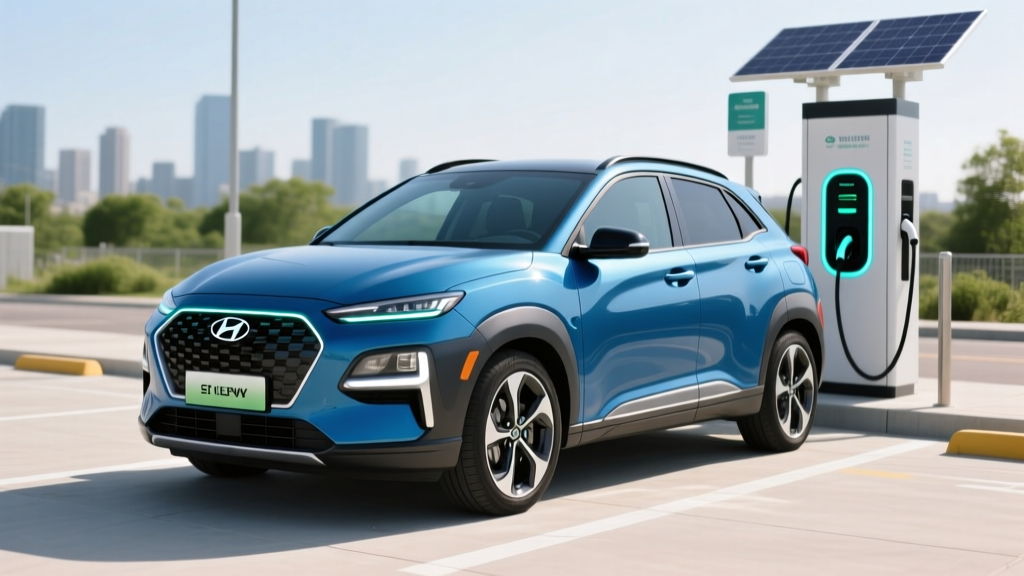
The 2025 Hyundai Kona Electric SE occupies a rare space in the EV market: a sub-$35,000 crossover with over 260 miles of EPA range, practical cargo space, and DC fast-charging capability. As the base trim of Hyundai's redesigned second-generation Kona Electric lineup, the SE strips away premium frills while keeping the powertrain, battery, and safety tech intact. For budget-conscious buyers transitioning from a gas compact SUV, the Kona Electric SE makes a compelling case — but its charging speed and cold-weather range deserve a hard look before you sign.
In this review, we break down the 2025 Hyundai Kona Electric SE with the exact numbers that matter: real-world range expectations, charging-curve behavior, §30D tax-credit eligibility, and how it stacks up against the Chevrolet Equinox EV, Kia Niro EV, and Nissan Ariya.
Range and Efficiency: 261 Miles EPA, but Plan for Less
The 2025 Kona Electric SE carries an EPA-estimated range of 261 miles from its 64.8 kWh (usable) lithium-ion battery pack. Hyundai uses an NMC (nickel-manganese-cobalt) chemistry in the Kona Electric, prioritizing energy density over the extended cycle life of LFP cells. The SE rides on 17-inch alloy wheels; stepping up to the SEL or Limited trim with 19-inch wheels drops the EPA range to 240 miles due to increased rolling resistance and weight.
- EPA sticker: 261 miles
- Mixed city/highway (55-70 mph, moderate climate): ~235–250 miles
- Sustained highway (75+ mph): ~215–230 miles
- Cold weather (below 32°F, cabin heat on): ~180–210 miles (20–30% reduction)
The Kona Electric SE lacks a heat pump on the base trim — it uses resistive PTC heating, which draws significantly more energy from the battery in winter. If cold-weather commuting is your daily reality, plan routes around the lower bound.
Efficiency lands at 113 MPGe combined (city/highway blend), which translates to roughly 29 kWh per 100 miles according to fueleconomy.gov. That's competitive with the segment — the Kia Niro EV achieves 113 MPGe as well, while the Chevy Equinox EV edges slightly higher at 115 MPGe on certain trims.
| Spec | Value |
|---|---|
| EPA Range | 261 miles |
| Battery (Usable) | 64.8 kWh, NMC chemistry |
| Efficiency | 113 MPGe / 29 kWh/100 mi |
| Motor | Single front-mounted (FWD) |
| Horsepower | 201 hp |
| Torque | 188 lb-ft |
| 0–60 mph | ~7.3 seconds |
| Max DC Fast Charge | ~100 kW (peak) |
| 10–80% DCFC Time | ~43 minutes |
| Level 2 Charge Rate | 10.9 kW (est. ~37 mi/hr) |
| Drivetrain | Front-wheel drive |
| Base MSRP | $32,975 (incl. destination) |
Charging Speed: Functional, Not Fast
This is where the 2025 Kona Electric SE reveals its budget-EV roots. The vehicle uses a CCS1 connector and supports a peak DC fast-charge rate of approximately 100 kW. That peak is short-lived — the charge curve tapers noticeably after 60% state of charge, and the 10–80% session takes roughly 43 minutes under ideal conditions (warm battery, 150+ kW station).
On a 50 kW DC charger — still common at older Electrify America or EVgo stations — expect a 10–80% session closer to 65–70 minutes. For road trips through charging deserts, this matters: you'll spend more time plugged in than you would in a Hyundai Ioniq 5 (which peaks at 240 kW on its 800V architecture).
| Charge Level | Power | Time (10–80%) | Miles Added per Hour |
|---|---|---|---|
| Level 1 (120V household) | ~1.4 kW | ~50+ hours (full) | ~4 mi/hr |
| Level 2 (240V, 48A) | 10.9 kW | ~6.5 hours (full) | ~37 mi/hr |
| DC Fast (50 kW station) | 50 kW | ~65–70 min | ~130 mi/hr (peak) |
| DC Fast (150+ kW station) | ~100 kW peak | ~43 min | ~230 mi/hr (peak) |
Home charging setup: A Level 2 home charger at 10.9 kW replenishes roughly 37 miles of range per hour. Overnight charging (8–10 hours) easily restores a full battery. Installation typically costs $500–$1,500 for a 240V/48A circuit if your electrical panel has capacity; budget $2,000–$3,500 if a panel upgrade to 200A is needed.
One practical note: Hyundai does not include battery preconditioning for DC fast charging in the Kona Electric the way it does on the Ioniq 5/6. In cold weather, your first fast-charge stop of a road trip will be slower than the spec sheet suggests because the battery hasn't been actively warmed.
Performance and Drivetrain
The 2025 Kona Electric SE pairs its 64.8 kWh battery with a single front-mounted permanent-magnet synchronous motor producing 201 horsepower and 188 lb-ft of torque. There is no all-wheel-drive option — the Kona Electric is front-wheel drive only.
The 0–60 mph time clocks in at approximately 7.3 seconds. That's adequate for highway merging and city driving, though it trails the Kia EV6 (5.1 seconds) and the dual-motor Nissan Ariya (5.7 seconds). The instant torque delivery makes the Kona feel quicker around town than the number suggests, but sustained highway passing power is modest.
Regenerative braking is adjustable via steering-wheel paddles across four levels (0–3), with Level 3 providing near one-pedal driving in city traffic. The system is smooth and predictable — one of Hyundai's strengths.
Interior, Cargo, and Technology
The second-generation Kona grew substantially over its predecessor. The 2025 model offers:
- Front legroom: 41.7 inches
- Rear legroom: 38.3 inches
- Cargo (behind rear seats): 25.5 cubic feet
- Cargo (rear seats folded): 55.3 cubic feet
That cargo volume beats the Kia Niro EV (22.8 cu ft) and approaches the Nissan Ariya (22.8 cu ft behind rear seats, though the Ariya expands to 59.7 cu ft folded). The Kona Electric also includes a small front trunk (frunk) for charging cables or a bag.
The SE trim includes a dual 12.3-inch display setup (digital instrument cluster + infotainment touchscreen), wireless Apple CarPlay and Android Auto, six USB-C ports across both rows, and Hyundai's Bluelink connected services. Driver-assist features on the SE include forward collision-avoidance assist, lane-keeping assist, blind-spot collision warning, rear cross-traffic collision-avoidance assist, and smart cruise control with stop-and-go. These are SAE Level 1–2 driver-assist features — the driver must remain fully engaged at all times.
Notable SE omissions: No heat pump, no highway driving assist (lane-centering on highways), no ventilated seats, no surround-view monitor, and no digital key. Those features require stepping up to the SEL ($34,975) or Limited ($38,975) trims.
Pricing, Trims, and Federal Tax Credit
The 2025 Hyundai Kona Electric is offered in three trims:
| Trim | MSRP (incl. destination) | EPA Range | Key Adds Over SE |
|---|---|---|---|
| SE | $32,975 | 261 mi | Base — 17" wheels, dual 12.3" screens, full ADAS suite |
| SEL | $34,975 | 240 mi | 19" wheels, heated seats, highway driving assist, power liftgate |
| Limited | $38,975 | 240 mi | Leather, ventilated front seats, sunroof, surround-view, digital key |
Federal tax credit (§30D): The 2025 Kona Electric's eligibility for the IRS §30D Clean Vehicle Credit depends on battery-component and critical-minerals sourcing requirements that shift annually. As of the current tax year, the credit is structured as two halves — $3,750 for battery components manufactured in North America and $3,750 for critical minerals sourced from the U.S. or free-trade-agreement partners. Vehicles using battery components from a "foreign entity of concern" (FEOC) lose eligibility.
- MSRP cap: SUVs must be ≤$80,000 — Kona Electric qualifies ✓
- Buyer income cap: AGI ≤$150,000 (single), ≤$300,000 (joint) — check your return
- Final assembly: Must occur in North America — Kona Electric is assembled in Ulsan, South Korea ⚠️
- Battery sourcing (FEOC rule): Verify current-year compliance with dealer or fueleconomy.gov tax credit listings
- Point-of-sale transfer: If eligible, credit can be applied at purchase to reduce out-of-pocket cost
Critical caveat: The Kona Electric is built in South Korea, which disqualifies it from the §30D new-vehicle credit under the final-assembly requirement. However, it may qualify for a lease credit under §45W (commercial clean vehicle credit), which the lessor can pass through as a reduced monthly payment. Ask the dealer about current lease incentive structures. Consult a tax professional before relying on any credit projection.
Warranty and Long-Term Ownership
Hyundai backs the 2025 Kona Electric with one of the strongest warranty packages in the segment:
- Battery & drive unit: 10 years / 100,000 miles (whichever comes first)
- New vehicle limited: 5 years / 60,000 miles
- Powertrain: 10 years / 100,000 miles
- Roadside assistance: 5 years / unlimited miles
- Complimentary maintenance: 3 years / 36,000 miles
The battery warranty guarantees that the pack will retain a minimum capacity threshold (typically 70% state of health) over the 10-year/100,000-mile period. Hyundai's NMC chemistry has shown moderate degradation in real-world fleet data — expect roughly 8–12% capacity loss over 100,000 miles under normal use, based on data from first-generation Kona Electric owners.
For long-term cost of ownership, the Kona Electric SE benefits from minimal maintenance (no oil changes, no transmission fluid, fewer brake replacements due to regen) and electricity costs that average $0.13–$0.17/kWh nationally — translating to roughly $3.80–$5.00 per 100 miles of driving versus $12–$16 per 100 miles in a 28-MPG gas crossover at $3.40/gallon.
How It Compares: Kona Electric SE vs. the Competition
The sub-$35K electric crossover segment has grown crowded. Here's how the 2025 Kona Electric SE stacks up against three direct rivals:
| Spec | 2025 Kona Electric SE | 2025 Kia Niro EV Wind | 2025 Chevy Equinox EV LT | 2025 Nissan Ariya Engage |
|---|---|---|---|---|
| Base MSRP | $32,975 | $39,600 | $33,600 | $39,590 |
| EPA Range | 261 mi | 239 mi | 319 mi | 216 mi |
| Battery | 64.8 kWh NMC | 64.8 kWh NMC | 85 kWh NMC | 63 kWh NMC |
| Peak DCFC | ~100 kW | ~85 kW | ~150 kW | ~130 kW |
| Horsepower | 201 hp | 201 hp | 213 hp | 214 hp |
| Drivetrain | FWD | FWD | FWD (AWD avail.) | FWD (AWD avail.) |
| Cargo (rear up) | 25.5 cu ft | 22.8 cu ft | 26.4 cu ft | 22.8 cu ft |
| Battery Warranty | 10yr/100k mi | 10yr/100k mi | 8yr/100k mi | 8yr/100k mi |
- You want the lowest entry price with 260+ miles of range
- Your daily commute is under 100 miles round-trip with home charging
- Cargo versatility matters (25.5 cu ft beats the Niro and Ariya)
- You value Hyundai's 10-year battery warranty
- You rarely take road trips exceeding 200 miles between stops
- You need fast road-trip charging — the Equinox EV (150 kW) or Ioniq 5 (240 kW) recharge significantly faster
- You live in a cold climate and need a heat pump (Equinox EV includes one; Kona SE does not)
- You want AWD — neither the Kona Electric nor the Niro EV offers it
- Federal tax credit eligibility is critical to your budget — the Kona's South Korean assembly complicates §30D qualification
- 261-mile EPA range at a $32,975 price point is outstanding value
- Generous cargo space (25.5 cu ft) for a compact EV crossover
- Industry-leading 10-year/100,000-mile battery warranty
- Comprehensive standard ADAS suite on the base trim
- Dual 12.3" screens and wireless smartphone integration standard
- Strong regenerative braking with adjustable levels
- DC fast-charging peaks at ~100 kW — slow for road trips
- No heat pump on SE trim; cold-weather range suffers
- FWD only — no AWD option for snow-belt buyers
- South Korean assembly likely disqualifies from §30D new-vehicle credit
- No battery preconditioning for DC fast charging
- Highway driving assist (lane centering) reserved for SEL and above
Frequently Asked Questions
What is the real-world range of the 2025 Hyundai Kona Electric SE?
Expect 235–250 miles in mixed driving, 215–230 miles on sustained highway trips, and 180–210 miles in freezing temperatures. The EPA sticker says 261 miles, but real-world conditions — especially winter and highway speeds — reduce that figure meaningfully. The lack of a heat pump on the SE trim amplifies cold-weather losses.
How fast does the Kona Electric SE charge at home and on the road?
At home on a Level 2 (240V) charger, the Kona Electric SE adds roughly 37 miles of range per hour, with a full charge taking about 6.5 hours. On DC fast chargers, it peaks at approximately 100 kW, reaching 10–80% in about 43 minutes under ideal conditions. On slower 50 kW stations, plan for 65–70 minutes.
Does the 2025 Kona Electric qualify for the federal EV tax credit?
Likely not for outright purchase. The §30D credit requires final assembly in North America, and the Kona Electric is built in South Korea. However, leasing may unlock a pass-through credit under §45W commercial vehicle rules, reducing your monthly payment. Always verify current eligibility on fueleconomy.gov and consult a tax professional.
Is the Kona Electric SE worth it over the Chevy Equinox EV?
It depends on your priorities. The Equinox EV offers more range (319 mi), faster DC charging (~150 kW), a heat pump, and potential §30D eligibility (U.S. assembly). The Kona Electric SE counters with a lower starting price, a longer battery warranty (10 years vs. 8), and slightly more cargo room. For pure value per mile of range, the Equinox EV has the edge; for warranty peace of mind, the Kona wins.
Can I tow with the 2025 Kona Electric SE?
Hyundai does not rate the Kona Electric for towing in the U.S. market. If towing is a requirement, look at the Hyundai Ioniq 5 (up to 2,300 lbs with the tow package) or the Ford Mustang Mach-E.
What charger do I need at home for the Kona Electric SE?
A 240V Level 2 charger on a 48-amp circuit (requiring a 60-amp breaker) delivers the Kona's maximum AC charge rate of 10.9 kW. Popular options include the ChargePoint Home Flex, Emporia Vue, and Wallbox Pulsar Plus. Budget $500–$1,500 for installation if your panel has spare capacity.