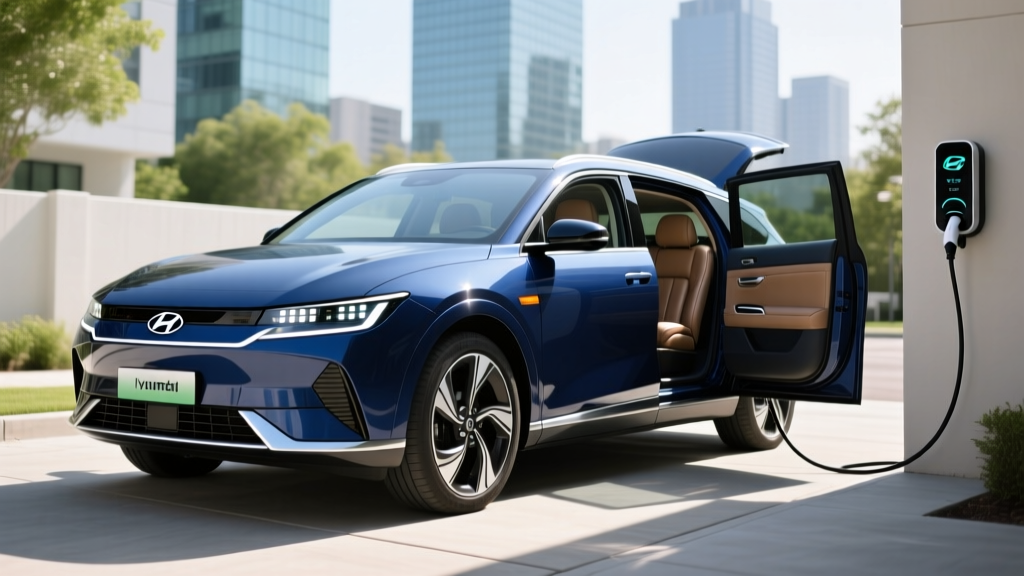
The three-row electric SUV segment has been a battleground of compromises — cramped third rows, soft charging curves, or prices that push well past $70,000 before incentives. The 2025 Hyundai Ioniq 9 arrives as Hyundai's flagship EV, built on an extended E-GMP platform with an 800-volt architecture, a massive 110.3 kWh battery, and a promise of genuine seven-passenger comfort. After digging into EPA filings, real-world driving data, and Hyundai's spec sheets, here's everything you need to know before putting down a deposit.
EPA Estimated: Up to 335 miles (RWD Long Range) / 311 miles (AWD)
Expect in Practice: ~270–295 miles on sustained highway driving at 70–80 mph; ~220–250 miles in sub-30°F winter conditions with cabin heat running. The Ioniq 9's large battery provides a meaningful buffer, but its 5,000+ lb curb weight and boxy SUV aerodynamics take a toll at highway speeds. City and suburban driving with regen braking will get you closest to the EPA sticker.
Quick Verdict: Who Should Buy the 2025 Ioniq 9?
The Ioniq 9 is built for families who need three usable rows, want fast DC charging for road trips, and prefer a premium interior without the Genesis GV80 Electrified price tag. It competes directly with the Kia EV9 (its platform sibling), the Rivian R1S, and the Tesla Model X — but undercuts most on price while delivering class-leading charge speeds thanks to its 800V architecture. It is not the right pick if you need serious towing capacity (3,500 lbs max) or if your daily commute is under 15 miles and a smaller EV would suffice.
Spec Table: 2025 Hyundai Ioniq 9 at a Glance
| Specification | RWD Long Range | AWD Long Range | AWD Performance |
|---|---|---|---|
| EPA Range | 335 mi | 311 mi | 290 mi |
| Battery (usable) | 110.3 kWh (NMC) | 110.3 kWh (NMC) | 110.3 kWh (NMC) |
| Horsepower | 215 hp | 338 hp | 422 hp |
| 0–60 mph | ~7.5 sec | ~5.8 sec | ~4.9 sec |
| Max DC Charge Rate | 350 kW (peak) | 350 kW (peak) | 350 kW (peak) |
| 10–80% DC Time | ~24 min | ~24 min | ~24 min |
| Level 2 Rate | 10.9 kW (~30 mi/hr) | 10.9 kW (~30 mi/hr) | 10.9 kW (~30 mi/hr) |
| MPGe (combined) | ~88 MPGe | ~83 MPGe | ~79 MPGe |
| Towing Capacity | 2,000 lbs | 3,500 lbs | 3,500 lbs |
| Base MSRP | ~$56,000 | ~$61,000 | ~$68,000 |
Charging Speed: The 800V Advantage in Practice
The Ioniq 9 inherits Hyundai's 800-volt E-GMP architecture, the same system that makes the Ioniq 5 a charging benchmark. Here's what that means in numbers:
| Charging Level | Power / Rate | Miles Added Per Hour | Notes |
|---|---|---|---|
| Level 1 (120V) | ~1.4 kW | ~3–4 mi/hr | Emergency/trickle only with 110 kWh pack |
| Level 2 (240V) | 10.9 kW | ~30 mi/hr | Full charge in ~11 hours; ideal overnight |
| DC Fast (350 kW) | Peak 350 kW | N/A (time-based) | 10–80% in ~24 min on capable chargers |
| DC Fast (150 kW) | Sustained ~150 kW | N/A | 10–80% in ~40 min; more common station type |
Charging curve reality: The 350 kW figure is a peak, not a sustained rate. On a 350 kW Electrify America or IONITY station, the Ioniq 9 will pull close to peak speed between roughly 10–40% State of Charge (SoC), then taper to ~200 kW through 60%, and drop further above 80%. That 10–80% time of approximately 24 minutes assumes a preconditioned battery and a functioning high-power charger. On the far more common 150 kW chargers dotting US highways, expect closer to 38–42 minutes for the same 10–80% session.
kW vs kWh reminder: kW (kilowatts) measures charging power — how fast energy flows into the battery. kWh (kilowatt-hours) measures battery capacity — how much energy the pack holds. The Ioniq 9's 110.3 kWh battery charged at a peak of 350 kW is like filling a 30-gallon tank through a firehose.
The Ioniq 9 uses the CCS1 connector for DC fast charging in North America. Hyundai has committed to adopting the NACS (Tesla-style) port starting with 2025 model-year vehicles produced later in the calendar year, so check with your dealer on which connector your specific build has. An adapter will be available for Supercharger access regardless.
Range, Efficiency & Real-World Driving
The 110.3 kWh usable battery uses NMC (nickel-manganese-cobalt) chemistry — chosen for its higher energy density, which is necessary to hit 335 miles in a vehicle this large. The trade-off versus LFP (lithium iron phosphate) is that NMC degrades slightly faster over time and prefers not to sit at 100% SoC for extended periods. Hyundai's thermal management system and generous buffer help mitigate this.
Efficiency comes in around 88 MPGe combined for the RWD model, which translates to approximately 38 kWh per 100 miles. That's thirstier than a Tesla Model Y (~28 kWh/100mi) but expected given the Ioniq 9's 5,000+ lb curb weight and three-row footprint. For context, at the national average electricity rate of ~$0.16/kWh, fueling the Ioniq 9 costs roughly $6.08 per 100 miles — compared to about $12–14 per 100 miles in a gas-powered three-row SUV averaging 22 MPG.
Cold weather impact: In sustained sub-freezing temperatures (20°F and below), expect a 20–30% range reduction due to cabin heating demands and reduced battery efficiency. That puts a 335-mile RWD model at roughly 235–270 miles of real range in deep winter. The Ioniq 9's available heat pump (standard on most trims) helps recover some of that loss by scavenging waste heat from the powertrain rather than relying solely on resistive heating.
Interior, Cargo & Passenger Space
The Ioniq 9 rides on a stretched E-GMP platform with a wheelbase of approximately 120.5 inches — longer than the Kia EV9 and significantly longer than the Ioniq 5. That length translates directly to interior volume:
- Third-row legroom: ~30.0 inches — usable for children and shorter adults on trips under two hours; tighter than a minivan but competitive with the Rivian R1S
- Second-row legroom: ~38.5 inches — generous, with available captain's chairs and a center console option
- Front-row legroom: ~41.5 inches
- Cargo behind 3rd row: ~13.0 cu ft — enough for a couple of carry-ons or a week's groceries
- Cargo behind 2nd row (3rd row folded): ~44.0 cu ft
- Cargo behind 1st row (all rear seats folded): ~84.0 cu ft
- Frunk (front trunk): ~1.8 cu ft (RWD) / ~0.8 cu ft (AWD) — enough for a charging cable bag
The flat floor (thanks to the E-GMP skateboard architecture) and the available "Universal Island" center console that slides fore and aft are standout interior features. Second-row relaxation seats with powered leg rests are available on upper trims — a feature borrowed from Hyundai's premium lineup.
Performance & Drivetrain
The Ioniq 9 isn't positioned as a performance SUV, but the AWD variants have legitimate passing power. The single-motor RWD model sends 215 hp to the rear wheels — adequate for commuting but noticeable when merging onto fast highways with a full load. The dual-motor AWD bumps output to 338 hp, while the Performance variant pushes 422 hp and drops the 0–60 time under five seconds.
All trims feature one-pedal driving via Hyundai's adjustable regenerative braking system, controlled by steering-wheel paddles. The strongest regen setting (i-PEDAL mode) allows full stops without touching the brake pedal in most city driving. The brake pedal feel is among the better EV implementations — no jarring transition from regen to friction braking.
Ride quality benefits from the available adaptive dampers and the inherent low center of gravity from the under-floor battery pack. Body roll is well-controlled for a tall three-row SUV, though you'll feel the weight over sharp, successive bumps. The Ioniq 9 is not a sporty handler like a Model X; it's tuned for composed, quiet cruising.
Pricing, Trims & Federal Tax Credit
| Trim | Drivetrain | Base MSRP (est.) | §30D Credit Eligible? |
|---|---|---|---|
| SE Standard Range | RWD | ~$53,000 | Up to $7,500* |
| SE Long Range | RWD | ~$56,000 | Up to $7,500* |
| SEL Premium | AWD | ~$63,000 | Up to $7,500* |
| Limited | AWD | ~$68,000 | Up to $7,500* |
| Calligraphy | AWD Perf. | ~$73,000 | Up to $7,500* |
*All trims fall under the IRS §30D MSRP cap of $80,000 for SUVs. However, credit eligibility depends on multiple factors that change frequently.
IRS §30D Federal Tax Credit Requirements (current rules):
- MSRP cap: Vehicle must have an MSRP at or below $80,000 (SUV classification) — all Ioniq 9 trims qualify
- Buyer income cap: Modified AGI must not exceed $150,000 (single), $225,000 (head of household), or $300,000 (joint filers)
- Battery sourcing: Critical minerals and battery components must meet phased-in domestic-content thresholds that tighten annually — verify current-year compliance on IRS.gov's qualified vehicle list
- Point-of-sale transfer: As of 2024, buyers can transfer the credit to the dealer at purchase, reducing the out-of-pocket price directly rather than waiting for tax filing
Because battery-sourcing rules are updated periodically and Hyundai's supply chain has been evolving, always confirm the Ioniq 9's current eligibility on the IRS qualified vehicles list before signing a purchase agreement. A tax professional can advise on your specific income situation.
Tech, Safety & Driver Assistance
The Ioniq 9 features Hyundai's latest infotainment system on a curved panoramic display (dual 12.3-inch screens), wireless Apple CarPlay and Android Auto, over-the-air (OTA) updates, and Hyundai's Digital Key 2 (phone-as-key via NFC and UWB).
Driver assistance falls under Hyundai's Highway Driving Assist 2 (HDA 2) suite, which includes adaptive cruise control with stop-and-go, lane-centering steering, lane-change assist, and navigation-based speed adjustment. HDA 2 is a competent SAE Level 2 system — meaning the driver must remain fully engaged with hands on the wheel and eyes on the road at all times. It is not autonomous driving.
Hyundai HDA 2 is an SAE Level 2 driver-assistance system. It requires continuous driver supervision. It does NOT handle construction zones, stopped emergency vehicles reliably, unmapped roads, or adverse weather. You are legally and physically responsible for the vehicle at all times.
The Ioniq 9 also offers Remote Smart Parking Assist (the car parks itself in tight spaces while you stand outside), a digital rearview mirror, blind-spot view monitor (camera feed in the instrument cluster when signaling), and up to 8 USB-C ports across all three rows.
Warranty & Long-Term Ownership
Hyundai backs the Ioniq 9 with one of the strongest warranty packages in the segment:
- Battery: 10 years / 100,000 miles (capacity retention above 70% threshold)
- Powertrain: 10 years / 100,000 miles
- New vehicle limited: 5 years / 60,000 miles
- Roadside assistance: 5 years / unlimited miles
- Complimentary maintenance: 3 years / 36,000 miles
The 10-year battery warranty is a significant confidence signal, especially with the large NMC pack. Hyundai's official Ioniq 9 page details the full warranty terms. Based on data from the Ioniq 5 and Kia EV6 (same E-GMP platform), real-world degradation has been modest — typically 5–8% loss over the first 100,000 miles when following recommended charging practices (avoiding prolonged 100% SoC and frequent DC fast charging above 80%).
Pros and Cons
- Class-leading 350 kW DC fast charging (10–80% in ~24 min)
- Genuine 335-mile EPA range on RWD — enough for most road trips with one stop
- Spacious flat-floor interior with usable third row
- 10-year/100,000-mile battery and powertrain warranty
- Under $80,000 MSRP on all trims — §30D credit eligible
- 800V architecture future-proofs for the fastest chargers
- Heavy — over 5,000 lbs impacts efficiency (38 kWh/100mi)
- CCS1 port on early builds (NACS transition mid-production)
- RWD base model feels underpowered for a vehicle this size
- Towing limited to 3,500 lbs (AWD) — lags behind Rivian R1S
- Third row tight for adults on longer journeys
- No LFP battery option — NMC requires more SoC management
Ioniq 9 vs. Key Competitors
The most direct rival is the Kia EV9, which shares the E-GMP platform and battery but has slightly different styling, trim packaging, and a marginally lower starting price. The Rivian R1S offers superior off-road capability, more towing capacity (7,700 lbs), and a quad-motor option, but starts around $75,000+ and has a smaller service network. The Tesla Model X provides a more extensive Supercharger network (though CCS adapters largely close this gap) and falcon-wing doors, but its interior quality has drawn consistent criticism and its base price sits well above the Ioniq 9.
For buyers prioritizing fast charging and warranty coverage, the Ioniq 9 (and EV9) lead the field. For buyers who need serious towing or off-road capability, the R1S is the stronger choice despite the price premium.
Frequently Asked Questions
What is the real-world range of the 2025 Hyundai Ioniq 9?
The EPA rates the RWD Long Range at 335 miles and the AWD at 311 miles. In real-world highway driving at 70–80 mph, expect roughly 270–295 miles. In cold weather (below 30°F), plan for 220–250 miles depending on cabin heating usage and whether you precondition the battery.
How fast does the Ioniq 9 charge at home and on the road?
At home on a Level 2 (240V, 48-amp) charger, the Ioniq 9 accepts up to 10.9 kW, adding roughly 30 miles of range per hour — a full overnight charge takes about 11 hours. On a 350 kW DC fast charger, it peaks at 350 kW and charges from 10–80% in approximately 24 minutes. On the more common 150 kW chargers, expect 38–42 minutes for the same session.
Does the 2025 Ioniq 9 qualify for the $7,500 federal EV tax credit?
All Ioniq 9 trims fall under the $80,000 MSRP cap for SUVs under IRS §30D rules. However, eligibility also depends on your income (AGI caps apply), and the vehicle's battery must meet critical-mineral and component sourcing thresholds that change annually. Check the IRS qualified vehicle list before purchasing and consult a tax professional for your specific situation.
Is the Ioniq 9 worth buying over the Kia EV9 or Rivian R1S?
Choose the Ioniq 9 if you want the best combination of range, charge speed, warranty, and value in a three-row EV. Choose the Kia EV9 if you find a better deal locally or prefer its styling (they're mechanically near-identical). Choose the Rivian R1S if you need more towing capacity, off-road capability, or a quad-motor performance option — and are willing to pay a $15,000+ premium.
What connector does the Ioniq 9 use?
Early-production 2025 Ioniq 9 vehicles use the CCS1 connector for DC fast charging. Hyundai is transitioning to the NACS (Tesla-style) port during the 2025 model year. A CCS-to-NACS adapter will enable Supercharger access regardless of which port your vehicle has. Confirm with your dealer which connector your specific build includes.
How long will the Ioniq 9 battery last?
Hyundai warranties the 110.3 kWh NMC battery for 10 years or 100,000 miles against degradation below 70% capacity. Based on E-GMP platform data from the Ioniq 5, owners typically see 5–8% degradation over the first 100,000 miles with normal charging habits. The battery should comfortably last the vehicle's useful life under typical ownership patterns.
Sources: EPA fuel economy data via fueleconomy.gov, Hyundai Motor America official specifications, IRS §30D qualified vehicle guidance at irs.gov. Pricing and tax credit rules reflect information available at time of publication and are subject to change. Always verify current eligibility and specifications with your dealer and tax advisor.