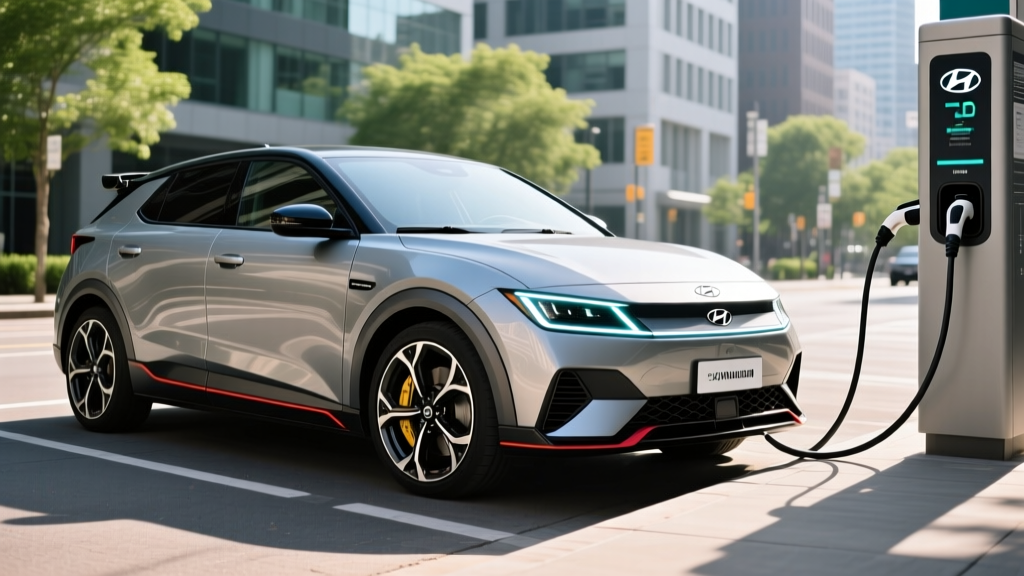
The 2025 Hyundai Ioniq 5 N is not a typical electric SUV. It is a 640-horsepower performance machine that happens to be battery-electric, built on the same E-GMP platform as the standard Ioniq 5 but heavily modified for track duty and driver engagement. For buyers cross-shopping it against the Tesla Model Y Performance or Porsche Macan Electric, the Ioniq 5 N occupies a distinct niche: serious track capability wrapped in a practical five-door hatchback body. But performance comes with trade-offs — notably in range, efficiency, and price. This review breaks down every number that matters.
Quick Verdict: Who the Ioniq 5 N Is For
The Ioniq 5 N targets driving enthusiasts who want an EV that can genuinely perform on a track while serving as a daily driver during the week. If your priorities are maximum range, lowest cost per mile, or family-crossover practicality, the standard Ioniq 5 or a Kia EV6 GT-Line will serve you better at a lower price. If you want simulated gear shifts, launch control, and a car that can sustain high-power laps without derating — and you accept a ~221-mile range to get it — the Ioniq 5 N has no direct rival at its price point.
Range, Efficiency, and Real-World Expectations
Real-World Expectation: Expect 180–200 miles in mixed highway driving at 70+ mph. In cold weather (below 32°F), plan for 150–175 miles. Aggressive driving or track use will drop this significantly — Hyundai's own N engineers acknowledge that sustained track sessions can consume 50% or more of the battery in under 20 minutes.
The Ioniq 5 N carries an 84.0 kWh usable lithium-ion battery pack using NMC (nickel-manganese-cobalt) chemistry. That is the same cell chemistry and similar capacity as the standard Ioniq 5 Long Range AWD, but the N variant's efficiency takes a hit due to its wider 275-section Pirelli P Zero tires, stiffer suspension, heavier curb weight (~4,861 lbs), and performance-oriented powertrain calibration.
On the EPA's fueleconomy.gov listing, the Ioniq 5 N is rated at approximately 2.0 kWh/mile (50 MPGe combined). That is noticeably less efficient than the standard Ioniq 5 AWD, which achieves around 2.6 kWh/mile (113 MPGe combined). In practical terms, you will pay more per mile to drive the N — but that is the cost of 640 horsepower.
| Specification | Value |
|---|---|
| EPA Range | 221 miles |
| Battery (usable) | 84.0 kWh, NMC chemistry |
| Drivetrain | Dual-motor AWD |
| Horsepower | 601 hp (640 hp w/ N Grin Boost) |
| Torque | 545 lb-ft (568 lb-ft w/ N Grin Boost) |
| 0–60 mph | 3.4 seconds (w/ N Grin Boost) |
| Top Speed | 161 mph |
| EPA Efficiency | ~50 MPGe combined (~2.0 kWh/mi) |
| Curb Weight | ~4,861 lbs |
| Base MSRP | $66,500 |
Charging Speed: DC Fast Charging and Home Level 2
The Ioniq 5 N retains the E-GMP platform's 800-volt electrical architecture, which is its biggest charging advantage. This allows it to accept significantly higher DC fast-charge power than most 400-volt competitors.
| Charging Level | Power / Rate | Time / Speed |
|---|---|---|
| DC Fast Charge (350 kW station) | Peak ~238 kW | 10–80% in ~18 minutes |
| DC Fast Charge (150 kW station) | Peak ~150 kW | 10–80% in ~28 minutes |
| Level 2 (240V, 48A home charger) | 10.9 kW | ~8.5 hours (0–100%); ~32 mi/hr of charging |
| Level 1 (120V standard outlet) | ~1.4 kW | ~4 miles of range per hour |
Charging curve reality: The Ioniq 5 N peaks near 238 kW between roughly 10–45% state of charge, then tapers progressively. By 70% SoC, you will see roughly 100–120 kW; above 80%, it drops further to protect battery health. The 18-minute 10–80% figure assumes a 350 kW-capable station and battery preconditioning (which the car activates automatically when a DC fast charger is set as your navigation destination).
The NACS port is standard on the 2025 Ioniq 5 N for the US market, giving it direct access to Tesla Supercharger stations via the North American Charging Standard. For Electrify America and other CCS networks, an adapter is included. This dual-network flexibility is a genuine advantage for road trips.
Performance: 0–60, Track Capability, and Drivetrain
The dual-motor all-wheel-drive system produces 601 horsepower in standard driving mode and 640 horsepower when N Grin Boost (NGB) is activated — a 10-second burst triggered by the dedicated N button on the steering wheel. The 3.4-second 0–60 mph time places the Ioniq 5 N firmly in supercar territory from a standing start, and the instant torque delivery makes it feel even quicker in real-world passing situations.
What separates the Ioniq 5 N from other fast EVs is its thermal management system, which Hyundai N developed specifically to prevent power derating during track sessions. The car features an enhanced cooling system with a larger radiator, additional cooling circuits for the battery and motors, and an N-specific battery preconditioning mode that pre-cools the pack before hard driving.
The N e-Shift feature simulates an 8-speed dual-clutch transmission, complete with simulated shift shock and rev-matching. This is either a brilliant engagement tool or an unnecessary gimmick, depending on your philosophy — but it is unique in the EV market. The car also offers N Active Sound+, which pipes synthetic engine and exhaust sounds through the cabin speakers. Both features can be turned off entirely for a traditional, silent EV experience.
Other performance hardware includes:
- Electronically controlled suspension with N-specific tuning
- N-tuned rear limited-slip differential (e-LSD)
- 21-inch forged alloy wheels with 275/35R21 Pirelli P Zero tires
- Upgraded brakes with 400mm front rotors and regenerative braking integration
- N Drift Optimizer for controlled oversteer (track use only)
- Launch control with N Grin Boost
Interior, Cargo Space, and Technology
Inside, the Ioniq 5 N gets N-specific sport bucket seats with heavy bolstering and an illuminated N logo, a thick N-branded steering wheel with dedicated mode buttons, aluminum pedals, and blue accent stitching throughout. The dual 12.3-inch display setup (instrument cluster and infotainment) carries over from the standard Ioniq 5 but with N-exclusive menus showing battery temperature, motor output, G-forces, and lap timers.
Cargo space: The Ioniq 5 N offers approximately 27.2 cubic feet behind the rear seats and 59.3 cubic feet with the rear seats folded. The front trunk (frunk) is small — roughly 0.85 cubic feet — enough for a charging cable bag but not much more. This is competitive with the Model Y but less than a midsize SUV.
Passenger space: Front legroom is 41.7 inches; rear legroom is 39.4 inches. Headroom is generous at 39.6 inches front and 38.3 inches rear, thanks to the flat-floor E-GMP architecture. Four adults fit comfortably; five is tight on longer trips.
Driver assistance: The Ioniq 5 N comes with Hyundai's Highway Driving Assist 2 (HDA2), which is a SAE Level 2 driver-assist system. It provides adaptive cruise control with stop-and-go, lane-centering steering, and lane-change assistance. The driver must keep hands on the wheel and remain fully engaged at all times — this is not a self-driving system.
Pricing, Tax Credit Eligibility, and Ownership Costs
| Item | Amount |
|---|---|
| Base MSRP (single trim) | $66,500 |
| Destination charge | $1,195 |
| As-tested (with Ecotronic Matte Gray paint) | ~$68,400 |
| Federal EV Tax Credit (§30D) | Up to $7,500 (see eligibility below) |
| Estimated price after max credit | ~$59,000 (if eligible) |
Federal tax credit eligibility: Under the IRS §30D New Clean Vehicle Credit, the Ioniq 5 N may qualify for up to $7,500 — split between a $3,750 critical-minerals component and a $3,750 battery-components component. However, eligibility depends on several conditions that change frequently:
- MSRP cap: The Ioniq 5 N is classified as an SUV/hatchback, so the cap is $80,000 — it clears this easily at $66,500 base.
- Buyer income cap: Adjusted gross income must not exceed $150,000 (single), $225,000 (head of household), or $300,000 (married filing jointly).
- Battery sourcing requirements: Critical minerals and battery components must meet increasing domestic/FEOC-free thresholds each year. Hyundai has been working to shift battery production to its Georgia plant, but sourcing compliance varies by build date. Confirm the specific VIN's eligibility at fueleconomy.gov before purchase.
- Point-of-sale transfer: As of 2024+, buyers can transfer the credit to the dealer at purchase, reducing the upfront cost rather than waiting for a tax refund.
Always verify current eligibility with a tax professional and the IRS's official guidance — battery-sourcing rules tighten annually, and a vehicle eligible in January may not be by December.
Warranty and Long-Term Battery Confidence
Hyundai backs the Ioniq 5 N with one of the strongest warranty packages in the industry:
- New vehicle limited warranty: 5 years / 60,000 miles
- Powertrain warranty: 10 years / 100,000 miles
- High-voltage battery warranty: 10 years / 100,000 miles (covers capacity below 70% of original)
- Complimentary maintenance: 3 years / 36,000 miles
The 70% capacity-retention threshold is standard for the industry. Based on data from the standard Ioniq 5, real-world degradation has been minimal — most owners report 95%+ state of health after two years and 30,000 miles. The N variant's more aggressive thermal management may actually help longevity by keeping the battery in its optimal temperature window more consistently, though long-term data specific to the N model is still limited given its recent launch.
Pros and Cons
Pros
- 640 hp and 3.4-second 0–60 with N Grin Boost — genuine supercar acceleration
- 800V architecture enables 10–80% DC fast charging in ~18 minutes
- Track-capable thermal management prevents derating
- NACS port standard — direct Tesla Supercharger access
- 10-year/100,000-mile battery and powertrain warranty
- Unique N e-Shift and sound customization for enthusiasts
- Practical hatchback with ~27 cu ft cargo space
Cons
- 221-mile EPA range is the lowest in the Ioniq 5 lineup
- $66,500 base price — $20,000+ above a standard Ioniq 5 AWD
- ~50 MPGe efficiency means higher charging costs per mile
- Heavy at 4,861 lbs — felt in corner transitions despite excellent chassis tuning
- Firm ride on rough roads due to performance suspension and 21-inch wheels
- Fake engine sounds and simulated shifts won't appeal to purists
- Tiny frunk (0.85 cu ft)
How the Ioniq 5 N Compares to Key Rivals
Versus Tesla Model Y Performance (~$52,000): The Model Y is cheaper, more efficient (~295-mile range), and has access to the full Supercharger network natively. But it lacks the Ioniq 5 N's track-focused hardware, thermal endurance, and driver-engagement features. If track days matter, the Ioniq 5 N wins. If daily commuting efficiency and value matter, the Model Y does.
Versus Kia EV6 GT (~$61,500): The corporate cousin shares the E-GMP platform and 800V charging, but the EV6 GT produces 576 hp and has a slightly shorter wheelbase. The Ioniq 5 N is more powerful, has more advanced track hardware, and offers the N e-Shift gimmick. The EV6 GT is the value pick; the Ioniq 5 N is the enthusiast pick.
Versus Porsche Macan Electric (~$78,000+): The Macan is more expensive, more luxurious, and offers superior build quality, but the Ioniq 5 N is quicker to 60, charges faster (800V vs. Macan's similar architecture but higher price), and costs substantially less. The Porsche wins on prestige and interior refinement; the Hyundai wins on value and outright acceleration.
Frequently Asked Questions
What is the real-world range of the 2025 Hyundai Ioniq 5 N?
The EPA rates it at 221 miles, but in real-world highway driving at 70 mph, expect roughly 180–200 miles. In cold weather, plan for 150–175 miles. Aggressive driving or track use will dramatically reduce range — a full track session can drain 50% or more of the battery in under 20 minutes.
How fast does the Ioniq 5 N charge?
On a 350 kW DC fast charger, it peaks at approximately 238 kW and charges from 10–80% in about 18 minutes, thanks to its 800-volt architecture. On a home Level 2 charger (10.9 kW), a full charge takes roughly 8.5 hours, adding about 32 miles of range per hour.
Does the 2025 Hyundai Ioniq 5 N qualify for the federal EV tax credit?
It may qualify for up to $7,500 under IRS §30D, but eligibility depends on battery-sourcing compliance (which changes periodically), buyer income caps ($150K single / $300K married), and the $80,000 MSRP cap for SUVs. Always verify the specific VIN at fueleconomy.gov and consult a tax professional before relying on the credit.
Is the Ioniq 5 N worth buying over a standard Ioniq 5?
Only if performance is your priority. The standard Ioniq 5 AWD offers ~290 miles of range, 113 MPGe, and a price starting around $47,000. The N costs $20,000 more, delivers 69 fewer miles of range, and costs more to charge. It exists for enthusiasts who value 640 hp, track capability, and engagement features — not efficiency or value.
Can the Ioniq 5 N use Tesla Superchargers?
Yes. The 2025 Ioniq 5 N comes with a NACS (North American Charging Standard) port, providing direct access to Tesla's Supercharger network without an adapter. For CCS-based networks like Electrify America, Hyundai includes a CCS adapter.
What is the battery warranty?
Hyundai covers the high-voltage battery for 10 years or 100,000 miles, whichever comes first. The warranty covers capacity loss below 70% of the original usable capacity. The powertrain is also covered for 10 years/100,000 miles.