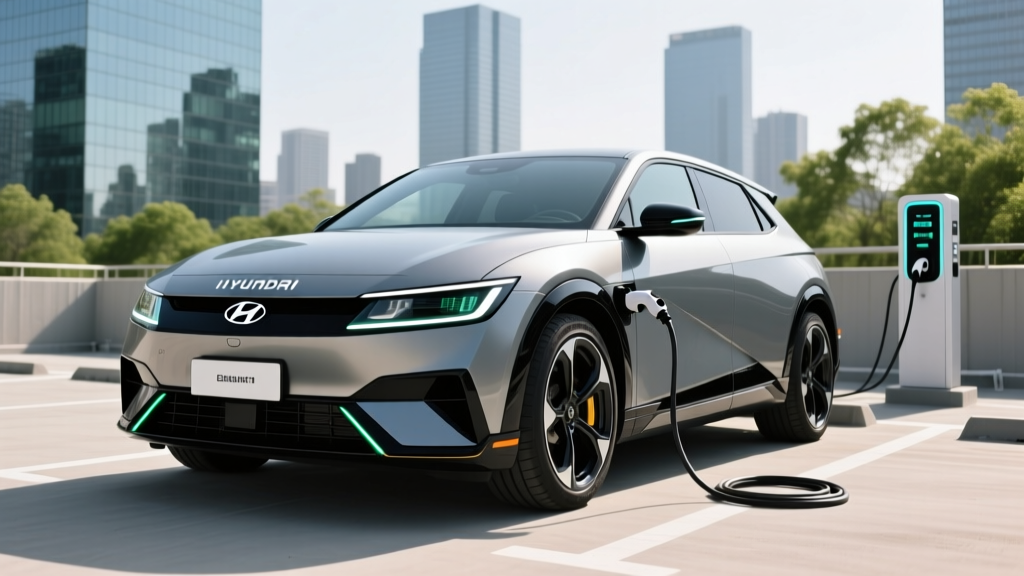
The Hyundai Ioniq 5 N arrived as a paradox: a 4,900-pound electric crossover that genuinely embarrasses sports cars on track while remaining a practical daily driver. For 2025, it remains the only performance EV in its price bracket offering Nurburgring-tuned dynamics, simulated gear shifts, and an 84 kWh battery. But the sticker price — starting at $66,100 before destination — makes leasing an attractive path to get behind the wheel without absorbing the steeper depreciation that performance EVs typically suffer. Here's a data-driven breakdown of what 2025 Hyundai Ioniq 5 N lease deals actually look like, what you're getting for the money, and whether the math works versus buying or choosing a competitor.
2025 Hyundai Ioniq 5 N: Full Specifications at a Glance
| Spec | Value |
|---|---|
| Base MSRP | $66,100 (+ $1,095 destination) |
| EPA Range | 221 miles |
| Battery (usable) | 84.0 kWh, NMC (nickel-manganese-cobalt) |
| Drivetrain | Dual-motor AWD |
| Horsepower | 601 hp standard / 641 hp with N Grin Boost (10-sec burst) |
| Torque | 545 lb-ft (568 lb-ft with N Grin Boost) |
| 0-60 mph | 3.25 seconds (with N Grin Boost) |
| Top Speed | 161 mph |
| Max DC Fast Charge | 240 kW (peak) |
| 10-80% DC Charge Time | ~18 minutes (preconditioned) |
| Level 2 Charge Rate | 10.9 kW (~35 miles/hour) |
| MPGe (combined) | 84 MPGe |
| Efficiency | 40 kWh/100 mi |
| Cargo (behind rear seats) | 27.2 cu ft |
| Cargo (rear seats folded) | 59.3 cu ft |
| Front Legroom | 41.7 inches |
| Rear Legroom | 39.4 inches |
| Battery Warranty | 8 years / 100,000 miles |
| Powertrain Warranty | 10 years / 100,000 miles |
| Federal Tax Credit | Up to $7,500 (§30D — see eligibility below) |
Real-World Range: What 221 EPA Miles Actually Means
Real-World Highway (70 mph, 70°F): ~185–200 miles
Real-World City/Mixed: ~195–215 miles
Cold Weather (below 32°F, highway): ~150–175 miles
The 221-mile EPA estimate, sourced from fueleconomy.gov, already reflects a penalty for the Ioniq 5 N's aggressive performance tuning — stickier Pirelli P Zero tires, stiffer suspension, and added weight from structural bracing all increase rolling resistance compared to the standard Ioniq 5. On highway loops at sustained 70-75 mph speeds, expect to see roughly 185 to 200 miles before hitting 10% state of charge in moderate temperatures.
Cold weather compounds the loss. NMC chemistry is less tolerant of low temperatures than LFP, and without a dedicated battery preheat function tied to navigation-based preconditioning (the Ioniq 5 N lacks the full route-based preconditioning found in some Tesla models), winter highway range can drop to 150-175 miles. For context, that's roughly a 20-30% reduction — typical for performance EVs with high-discharge batteries but worth budgeting for if your commute exceeds 80 miles one way in winter.
The efficiency figure of 40 kWh/100 mi (84 MPGe combined) is thirstier than the standard Ioniq 5 AWD (which achieves 110 MPGe combined). That's the trade-off for 641 hp and track-capable thermal management. On a 300-mile road trip, plan for two DC fast-charge stops rather than one.
Charging Speed: 240 kW Peak, But Mind the Curve
| Charging Level | Power (kW) | Speed (mi/hr added) | Notes |
|---|---|---|---|
| Level 1 (120V household) | ~1.4 kW | ~3–4 mi/hr | Emergency/trickle only |
| Level 2 (240V, 48A) | 10.9 kW | ~35 mi/hr | Full charge in ~8 hours |
| DC Fast Charge (peak) | 240 kW | ~600+ mi/hr (at peak) | 10-80% in ~18 min |
| DC Fast Charge (sustained avg 10-80%) | ~165 kW avg | ~400 mi/hr avg | Real-world average over session |
The Ioniq 5 N uses Hyundai's 800V battery architecture, enabling peak charge rates up to 240 kW at compatible DC fast chargers ( Electrify America, Tesla Supercharger V3/V4 via NACS adapter, and select ChargePoint stations). The 10-80% time of approximately 18 minutes is among the fastest in its class — but that number requires a preconditioned battery and a charger capable of sustaining 350 kW.
Here's the charging-curve reality most spec sheets omit: the Ioniq 5 N holds near-peak power (above 200 kW) only from roughly 10% to 50% state of charge. From 50-70%, the rate tapers to approximately 130-150 kW, and from 70-80% it drops further to around 80-100 kW. The 18-minute figure is accurate, but the average sustained rate over the full 10-80% session is closer to 165 kW. This is still excellent — it means a typical highway stop adds about 140 miles of range in 12 minutes — but don't expect the full 240 kW for the entire session.
For home charging, the 10.9 kW Level 2 rate means an overnight charge from 20% to 100% takes roughly 7-8 hours on a 48-amp hardwired Level 2 station (requires a 60-amp circuit). If your home panel is limited to a 40-amp circuit (32-amp charger), expect roughly 7.7 kW and a full charge closer to 10-11 hours.
Performance: 641 HP That Justifies the Badge
The dual-motor all-wheel-drive powertrain produces 601 hp in standard driving and 641 hp when you activate N Grin Boost (NGB), a 10-second overboost function accessible via a steering-wheel button. The 0-60 mph time of 3.25 seconds (with NGB, launch control engaged) puts the Ioniq 5 N in Porsche Taycan territory at less than half the price.
But straight-line speed is only part of the story. The N variant features a reinforced body structure, electronically controlled limited-slip differential (e-LSD), N-tuned adaptive dampers, and 275/35R21 Pirelli P Zero tires. On a road course, it manages weight transfer with surprising composure for a 4,861-pound vehicle. The N e-Shift system simulates an 8-speed dual-clutch transmission with audible and haptic "shifts" — a polarizing feature that enthusiasts love and pragmatists find gimmicky. You can disable it entirely for smooth single-speed EV acceleration.
The N Active Sound+ system projects synthesized engine and exhaust sounds through interior and exterior speakers. Again, love-it-or-hate-it, but Hyundai includes a mute option. Track Mode manages battery and motor temperatures aggressively, allowing sustained lap sessions at tracks like Buttonwillow or Sonoma without thermal derating — a genuine differentiator versus the Tesla Model 3 Performance, which can thermally limit during extended track use.
Pricing, Lease Deals & Federal Tax Credit Eligibility
| Item | Amount |
|---|---|
| Base MSRP (single trim) | $66,100 |
| Destination charge | $1,095 |
| As-tested (with N Design Package) | $70,500–$72,000 est. |
| Federal §30D tax credit (max) | Up to $7,500* |
| Estimated lease payment (36 mo, 12K mi/yr, $5K down) | $850–$1,050/mo** |
The Ioniq 5 N comes in a single, fully loaded trim — there's no base stripper model. The $66,100 MSRP includes N-specific hardware, adaptive dampers, a 12.3-inch dual-screen setup, head-up display, heated/ventilated front seats, and a panoramic sunroof. The available N Design Package (approximately $3,500-$4,000) adds forged 21-inch wheels, Performance Blue paint, and N-specific interior trim.
Federal tax credit (§30D) eligibility requires careful review. Per IRS guidelines, the Ioniq 5 N may qualify for up to $7,500 in federal tax credits, but eligibility depends on several conditions that change frequently:
- MSRP cap: The vehicle must have an MSRP at or below $80,000 for SUVs/trucks or $55,000 for sedans. The Ioniq 5 N is classified as an SUV by the IRS, so it clears the $80,000 cap.
- Buyer income limits: Modified AGI must not exceed $300,000 (joint), $225,000 (head of household), or $150,000 (single).
- Battery sourcing requirements: The credit splits into two halves ($3,750 each) — one for critical-mineral sourcing and one for battery-component manufacturing. Sourcing rules tighten annually, and Hyundai's supply chain compliance should be verified at point of sale for the specific model year.
- Point-of-sale transfer: As of 2024, buyers can transfer the credit to the dealer for an immediate price reduction, which effectively lowers the capitalized cost on a lease.
*Consult a tax professional and verify current eligibility at irs.gov before committing. Rules change, and state-level incentives vary by jurisdiction.
Lease deal reality check: Lease payments for the Ioniq 5 N typically range from $850 to $1,050 per month on a 36-month term with $4,000-$5,000 due at signing, depending on money factor, residual value, and whether the $7,500 credit is applied as a cap-cost reduction. Hyundai Motor Finance occasionally offers promotional money factors that can pull payments toward the lower end of that range. The key lease advantage here: performance EVs depreciate steeply (often 40-50% over three years), so a lease shifts residual-value risk to the lender.
Interior, Tech & Daily Practicality
The cabin mirrors the standard Ioniq 5's architecture — a flat floor, dual 12.3-inch displays (one for instruments, one for infotainment), and physical climate-control buttons (a welcome decision versus touchscreen-only setups). N-specific additions include a dedicated N steering wheel with red NGB and drive-mode buttons, heavily bolstered sport seats with N badging, and an N-specific head-up display showing G-forces, lap times, and battery temperature.
Cargo space remains generous at 27.2 cubic feet behind the rear seats (59.3 cu ft with seats folded), enough for a full weekend track-day setup including a helmet bag, tire set, and cooler. The frunk (front trunk) is modest at 0.85 cu ft — essentially a charging-cable cubby, not real storage.
The driver-assistance suite includes Highway Driving Assist 2 (HDA2), which provides adaptive cruise control with stop-and-go, lane-centering, and lane-change assist. This is an SAE Level 2 system — it requires continuous driver supervision and does not constitute autonomous or self-driving capability. Hyundai's HDA2 is competent for highway commuting but doesn't match the hands-free capability of GM's Super Cruise or Ford's BlueCruise on mapped highways.
Notable tech drawbacks: The infotainment system lacks wireless Apple CarPlay/Android Auto on the 12.3-inch screen (wired connection required) — an inexplicable omission at this price point. The vehicle-to-load (V2L) feature is present, allowing you to power external devices (up to 3.6 kW) via an adapter — useful for camping or emergency backup.
Pros, Cons & Who Should Lease the Ioniq 5 N
Pros
- Sub-3.3-second 0-60 with genuine track stamina
- 800V architecture: 10-80% in ~18 min at 240 kW peak
- Class-leading 10-yr/100,000-mi powertrain warranty
- Practical cargo space (27.2 cu ft) for a performance vehicle
- Single loaded trim — no confusing option packages
- V2L capability for off-grid power
Cons
- 221-mile EPA range is short for road trips
- 40 kWh/100 mi efficiency means higher charging costs
- No wireless Apple CarPlay/Android Auto
- Synthesized engine sounds won't appeal to purists
- $66K+ price is steep for a Hyundai badge
- Winter range drops to ~150-175 mi on highway
Who This EV Suits Best
Choose the Ioniq 5 N if: You want a dual-purpose daily driver and track car, you have reliable home Level 2 charging, your daily commute is under 80 miles, and you value warranty coverage. The lease route makes sense if you want to avoid performance-EV depreciation risk.
Look elsewhere if: You regularly drive 250+ miles between charges, you prioritize efficiency over performance, or you need hands-free highway driving. The standard Ioniq 5 Limited (305-mile range, $52,600) or the Kia EV6 GT (206-mile range, slightly cheaper) may better fit those use cases.
Competitor Check: Ioniq 5 N vs. the Field
The most direct rival is the Tesla Model 3 Performance (2025 refresh): 315-mile EPA range, 0-60 in 2.9 seconds, starting at $54,990. The Tesla wins on range, efficiency, and price, and offers access to the Supercharger network natively. But the Ioniq 5 N counters with superior track thermal management, more engaging driver feedback (simulated shifts, adaptive dampers), and a longer powertrain warranty. The Model 3 is the rational pick; the Ioniq 5 N is the emotional one.
The Kia EV6 GT shares the same 800V platform and NMC battery chemistry but delivers 576 hp and a 206-mile EPA range at roughly $61,400. It's slightly less powerful and less track-focused but costs about $5,000 less. If you want the performance without the full N premium, the EV6 GT is a strong alternative.
The Porsche Taycan (base, ~$92,000) offers superior driving dynamics and build quality but at nearly double the price and with a smaller 79.2 kWh battery yielding 225 miles EPA. The Ioniq 5 N delivers 80% of the Porsche experience at 50% of the cost — and charges faster.
Frequently Asked Questions
What is the real-world range of the 2025 Hyundai Ioniq 5 N?
The EPA rates it at 221 miles, but real-world highway driving in moderate temperatures yields approximately 185-200 miles. City and mixed driving can stretch to 195-215 miles. In cold weather (below 32°F) on the highway, expect 150-175 miles due to battery chemistry limitations and increased cabin heating demand.
How fast does the Ioniq 5 N charge at home and on the road?
On a Level 2 home charger (240V, 48A), it charges at 10.9 kW, adding about 35 miles of range per hour — a full charge takes roughly 8 hours. On a DC fast charger, it peaks at 240 kW and reaches 10-80% in approximately 18 minutes when the battery is preconditioned. The average sustained rate over that session is closer to 165 kW due to charge-curve taper above 50%.
How much does the Ioniq 5 N cost after the federal tax credit?
The base MSRP is $66,100 plus $1,095 destination. If you qualify for the full $7,500 federal §30D credit (subject to income, MSRP, and battery-sourcing requirements), the effective purchase price drops to approximately $59,695. On a lease, the credit can be applied as a capitalized-cost reduction, lowering monthly payments by roughly $150-$200/month over a 36-month term.
Does the 2025 Ioniq 5 N qualify for the $7,500 federal EV tax credit?
It may, but eligibility is not automatic. The Ioniq 5 N clears the $80,000 MSRP cap for SUVs. However, you must also meet income limits ($300K joint / $150K single) and the vehicle must satisfy battery critical-mineral and component-sourcing requirements that tighten each year. Verify eligibility with your dealer at the time of purchase or lease, and consult the IRS clean vehicle credit page for current rules.
Is it worth leasing vs. buying the Ioniq 5 N?
Leasing is often the smarter financial play for performance EVs. The Ioniq 5 N is likely to depreciate 40-50% over three years (performance EVs historically lose value faster than mainstream models), and a lease transfers that residual-value risk to the lender. If you plan to keep the car 5+ years and stay under 12,000 miles annually, buying with the tax credit applied may work — but you absorb the depreciation hit. Leasing also lets you upgrade when Hyundai's next-gen N performance EVs arrive.
What are the biggest drawbacks of the Ioniq 5 N?
The 221-mile EPA range is the primary limitation — road trips require planning and multiple charge stops. The 40 kWh/100 mi efficiency makes it one of the thirstier EVs on the market, raising per-mile charging costs. The lack of wireless smartphone integration at this price point is frustrating, and the synthesized engine/exhaust sounds are a matter of taste. Finally, the $66,100 entry price, while justified by the hardware, is a significant premium over the standard Ioniq 5.