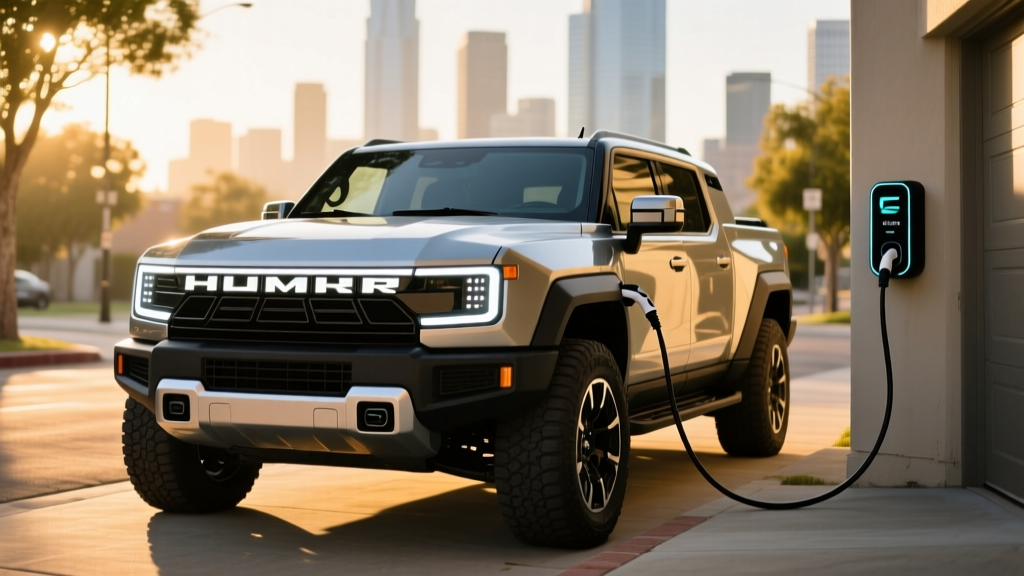
The GMC Hummer EV Pickup is an exercise in excess — a 9,000-pound electric supertruck that trades efficiency for spectacle. For the 2025 model year, GMC has refined the Ultium-based platform with improved software, expanded trim availability, and the long-awaited rollout of the more accessible 3X trim alongside the flagship Edition 1. But beneath the CrabWalk parlor tricks and 1,000-horsepower headlines sits a genuine question for buyers: does the 2025 Hummer EV truck work as a daily driver, or is it purely a statement piece?
After analyzing EPA data, real-world range tests, and ownership costs, here's what you need to know before writing a six-figure check.
Spec Sheet: 2025 Hummer EV Pickup at a Glance
| Specification | 2X Trim | 3X Trim | Edition 1 |
|---|---|---|---|
| EPA Range | ~314 mi | ~314 mi | ~314 mi |
| Battery (usable) | ~212.7 kWh (NMC) | ~212.7 kWh (NMC) | ~212.7 kWh (NMC) |
| Drivetrain | Dual-Motor AWD | Tri-Motor AWD | Tri-Motor AWD |
| Horsepower | 625 hp | 830 hp | 1,000 hp (Watts to Freedom) |
| 0-60 mph | ~4.5 sec | ~3.5 sec | ~3.0 sec (WTF mode) |
| Max DC Charge Rate | 350 kW (peak) | 350 kW (peak) | 350 kW (peak) |
| 10-80% DC Charge | ~35 min (est.) | ~35 min (est.) | ~35 min (est.) |
| Level 2 Charge Rate | 11.5 kW (~16 mi/hr) | 11.5 kW (~16 mi/hr) | 11.5 kW (~16 mi/hr) |
| MPGe (combined) | 47 MPGe | 47 MPGe | 47 MPGe |
| Efficiency | ~72 kWh/100 mi | ~72 kWh/100 mi | ~72 kWh/100 mi |
| Base MSRP | ~$98,845 | ~$106,495 | ~$112,595 |
| Towing Capacity | 7,500 lbs | 7,500 lbs | 7,500 lbs |
| Battery Warranty | 8 yr / 100,000 mi | 8 yr / 100,000 mi | 8 yr / 100,000 mi |
Range and Efficiency: What the EPA Number Doesn't Tell You
The EPA rates the 2025 Hummer EV Pickup at approximately 314 miles of combined range. That figure comes from the massive 212.7 kWh (usable) Ultium battery pack — one of the largest ever installed in a production passenger vehicle. GMC uses NMC (nickel manganese cobalt) chemistry across all trims, chosen for its high energy density to offset the truck's extreme curb weight of roughly 9,046 pounds.
EPA 314 miles combined. In real-world highway driving at 70-75 mph, expect approximately 250-275 miles before needing a charger. In cold weather (below 32°F), range can drop to 200-230 miles due to battery resistance and cabin heating demands. City driving with regenerative braking can approach or slightly exceed the EPA figure. This truck's aerodynamics — it's a brick on wheels — punish highway efficiency severely.
At 47 MPGe combined and roughly 72 kWh per 100 miles, the Hummer EV is among the least efficient EVs on the market. For context, the Ford F-150 Lightning achieves 70 MPGe combined and uses about 49 kWh/100 mi. That efficiency gap translates directly to higher charging costs and more frequent stops on road trips. According to fueleconomy.gov, the estimated annual electricity cost is approximately $1,650 based on 15,000 miles of driving and national average electricity rates — roughly triple the cost to run a Rivian R1T.
Charging Speed: DC Fast Charging and Home Setup
The 2025 Hummer EV supports up to 350 kW peak DC fast charging via its CCS1 connector on 800V-capable architecture. However, with a 212.7 kWh battery, even maximum charge rates can't overcome simple physics — filling this pack takes longer than most EVs on the market.
| Charging Level | Power / Rate | Speed (Miles Added per Hour) | Full Charge Time (approx.) |
|---|---|---|---|
| Level 1 (120V outlet) | ~1.4 kW | ~2 mi/hr | ~6+ days |
| Level 2 (240V, 48A) | 11.5 kW | ~16 mi/hr | ~19-20 hours |
| DC Fast Charge (peak) | 350 kW (peak, tapering) | ~100 mi in ~12 min (10-30% SoC) | 10-80% in ~35 min |
Charging curve reality: The 350 kW peak rate only holds at low states of charge (roughly 5-25% SoC). Above 50% SoC, the rate tapers significantly — expect sustained rates of 100-150 kW through the middle of the pack, dropping further above 80%. This is standard for NMC chemistry but is amplified by the sheer battery size. A 10-80% charge at a 350 kW Electrify America or EVgo station will take approximately 35 minutes under ideal conditions (preconditioned battery, warm ambient temperature).
For home charging, the onboard 11.5 kW Level 2 charger means a full charge from empty takes roughly 19-20 hours. Most owners will plug in nightly and rarely deplete the pack fully, but this slow home-charge rate is a real limitation compared to the Ford F-150 Lightning's available 19.2 kW onboard charger (which cuts home charging to ~10 hours). Plan for a dedicated 60-amp circuit and a quality Level 2 station — a licensed electrician will typically charge $800-$2,000 for installation depending on panel proximity and local permitting.
Performance and Driving Dynamics
The tri-motor 3X and Edition 1 trims deliver staggering acceleration for a vehicle that weighs over four and a half tons. In Watts to Freedom (WTF) mode — GMC's launch-control feature that lowers the suspension, preconditions the battery, and plays a haptic rumble sequence through the seats — the Edition 1 hits 60 mph in approximately 3.0 seconds with 1,000 horsepower. The 3X trim delivers 830 hp and a roughly 3.5-second run. The dual-motor 2X produces 625 hp with a 0-60 time around 4.5 seconds.
But straight-line speed is only part of the story. The Hummer EV features several off-road-oriented technologies:
- CrabWalk: Rear wheels turn up to 10 degrees in the same direction as the front wheels, allowing diagonal movement at low speeds — useful on tight trails, less so in a grocery parking lot.
- Extract Mode: The adaptive air suspension raises the ride height by approximately 6 inches for extreme obstacle clearance.
- 4-Wheel Steer: Reduces the turning circle to a surprisingly manageable ~37 feet despite the truck's 217-inch length.
- Underbody armor: Steel skid plates protect the battery pack during off-road use.
On-road, the ride quality is competent but the sheer mass is noticeable in corners and during emergency braking. The regenerative braking system offers adjustable levels and a one-pedal driving mode, though the truck's weight means stopping distances are longer than lighter EVs.
Pricing, Trims, and Federal Tax Credit Eligibility
The 2025 Hummer EV Pickup starts at approximately $98,845 for the 2X dual-motor trim, climbing to $112,595 for the Edition 1 (which includes the tri-motor powertrain, Watts to Freedom mode, and an expanded off-road package). Destination charges add approximately $1,995.
| Trim | Base MSRP | As-Tested (typical) | Federal Tax Credit (§30D) |
|---|---|---|---|
| 2X (Dual-Motor) | $98,845 | $102,000-$108,000 | Up to $7,500* |
| 3X (Tri-Motor) | $106,495 | $110,000-$118,000 | Up to $7,500* |
| Edition 1 | $112,595 | $115,000-$125,000 | Up to $7,500* |
*Federal tax credit caveats: Under current IRS §30D rules, the Hummer EV Pickup qualifies as a truck (MSRP cap of $80,000 for trucks — however, the Hummer EV's MSRP exceeds this cap on all trims). As of the 2025 model year, buyers should verify current eligibility directly with their dealer and a tax professional, as the truck's pricing places it above the MSRP threshold that disqualifies many luxury EVs. Additionally, buyer income caps apply ($150,000 single / $300,000 joint filers for modified AGI), and critical mineral and battery component sourcing requirements must be met for the full $7,500. The credit can be transferred to the dealer as a point-of-sale rebate if eligible. Always confirm eligibility before purchase — rules are subject to change.
Note: The Hummer EV's MSRP exceeds the $80,000 truck cap under §30D, meaning it likely does NOT qualify for the new-vehicle federal tax credit. Some buyers may explore the used-EV credit (§25E, up to $4,000) if purchasing a qualifying pre-owned unit from a dealer, subject to separate income and price caps.
Interior, Cargo, and Technology
The Hummer EV's cabin reflects its premium pricing with a 13.4-inch diagonal infotainment touchscreen running GMC's latest Ultifi software, a 12.3-inch driver instrument cluster, and a head-up display. The interface supports wireless Apple CarPlay and Android Auto, over-the-air updates, and embedded Google Built-In navigation. A 14-speaker Bose audio system is standard.
Dimensions and space:
- Bed length: 5 feet (standard)
- Cargo bed volume: ~41.1 cu ft
- Front trunk (frunk): ~11.3 cu ft (with eTrunk power-operated cover)
- Front legroom: ~42.5 inches
- Rear legroom: ~38.9 inches
- Seating: 5 passengers
The infinity roof features modular sky panels that can be removed and stored in the frunk for open-air driving — a genuinely unique feature no competitor matches. The MultiPro tailgate offers six configurations including a load-stop and step function.
Driver assistance: GMC's Super Cruise hands-free driving system is available on mapped divided highways (over 750,000 miles of compatible roads in North America). This is an SAE Level 2 system — the driver must remain attentive and ready to take over at all times, despite the hands-free capability. An infrared camera monitors driver eye attention. Super Cruise is one of the most polished Level 2 systems available, but it is emphatically not autonomous driving.
Ownership Costs and Who Should Buy
The Hummer EV is not a rational purchase — and that's fine. But buyers should enter with eyes open about running costs:
- Home electricity (national avg $0.16/kWh): A full 212.7 kWh charge costs approximately $34 at home. At 314 miles per charge, that's roughly $0.11/mile in electricity.
- Public DC fast charging (avg $0.40-$0.50/kWh): A 10-80% top-up (~150 kWh) costs $60-$75 at current public rates.
- Insurance: Expect premiums 30-50% higher than a comparably priced gas truck due to repair costs and battery replacement risk. Average annual premiums range $2,800-$4,200 depending on state and driving record.
- Tires: The 35-inch Goodyear Wrangler Territory MT tires are specialized and cost approximately $400-$500 each. Expect 30,000-40,000 miles of tread life given the vehicle weight.
- Depreciation: Luxury EVs in the $100K+ segment have shown steep first-year depreciation (25-35%). Early adopter risk is real.
Buy it if: You want a head-turning electric truck with genuine off-road capability, have reliable home Level 2 charging, rarely drive more than 250 miles between stops, and budget is flexible. It's a weekend adventure truck and daily conversation piece.
Look elsewhere if: Efficiency and low running costs are priorities, you regularly tow heavy loads over long distances (range drops dramatically when towing — expect 120-160 miles), you need a practical work truck, or you're stretching financially to afford it.
2025 Hummer EV Pickup: Pros and Cons
Pros
- Stunning acceleration — 3.0 sec 0-60 in WTF mode
- Genuine off-road hardware (Extract Mode, skid plates, CrabWalk)
- Massive 314-mi EPA range from 212.7 kWh pack
- Super Cruise hands-free driving on mapped highways
- Removable infinity roof panels — unique open-air experience
- 8-year/100,000-mile battery warranty
- Over-the-air update capability for continued improvement
Cons
- Abysmal efficiency — 47 MPGe, ~72 kWh/100 mi
- Slow Level 2 home charging (11.5 kW, ~19-20 hrs full charge)
- Very likely does NOT qualify for §30D federal tax credit (MSRP cap)
- Towing slashes range to an estimated 120-160 miles
- High insurance premiums and specialized tire costs
- Extreme curb weight (9,046 lbs) impacts braking and tire wear
- Limited availability and long wait times on some trims
- Steep expected depreciation in the luxury EV segment
Competitor Comparison: Hummer EV vs. F-150 Lightning vs. Rivian R1T
| Spec | 2025 Hummer EV 3X | 2025 F-150 Lightning (Ext. Range) | 2025 Rivian R1T (Dual-Motor Max) |
|---|---|---|---|
| EPA Range | ~314 mi | ~320 mi | ~352 mi |
| Battery | 212.7 kWh (NMC) | ~131 kWh (NMC) | ~149 kWh (NMC) |
| Horsepower | 830 hp | 580 hp | 665 hp |
| 0-60 mph | ~3.5 sec | ~4.0 sec | ~3.5 sec |
| Max DC Charge | 350 kW (peak) | 150 kW | 200 kW+ |
| Efficiency (MPGe) | 47 MPGe | 70 MPGe | 73 MPGe |
| Towing | 7,500 lbs | 10,000 lbs | 11,000 lbs |
| Base MSRP | ~$106,495 | ~$72,090 | ~$89,900 |
| Tax Credit (§30D) | Unlikely (MSRP cap) | Eligible (varies) | Eligible (varies) |
The Hummer EV wins on raw power and spectacle. The F-150 Lightning wins on practicality, towing, and value. The Rivian R1T offers the best balance of range, efficiency, and adventure capability. For a detailed breakdown of the F-150 Lightning's real-world ownership experience, see fueleconomy.gov's side-by-side tool.
Frequently Asked Questions
What is the real-world range of the 2025 Hummer EV truck?
The EPA rates it at 314 miles combined. In real-world highway driving at 70-75 mph, expect 250-275 miles. Cold weather (below freezing) can reduce range to 200-230 miles. Towing drops range dramatically to an estimated 120-160 miles depending on trailer weight and conditions.
How fast does the Hummer EV charge at home and on the road?
On a 350 kW DC fast charger, a 10-80% charge takes approximately 35 minutes under ideal conditions. At home on a Level 2 (240V, 48A) charger, the 11.5 kW onboard rate means about 16 miles of range per hour, or roughly 19-20 hours for a full charge from empty. Level 1 (120V) trickle charging adds about 2 miles per hour and is only suitable for emergency top-ups.
Does the 2025 Hummer EV qualify for the $7,500 federal tax credit?
Very likely not. Under current IRS §30D rules, new electric trucks must have an MSRP at or below $80,000 to qualify. All 2025 Hummer EV trims exceed this cap. Buyer income limits and battery sourcing rules add additional hurdles. Consult a tax professional before relying on any credit assumption. A used Hummer EV may qualify for the §25E used-EV credit (up to $4,000) if the sale price is at or below $25,000 and buyer income limits are met.
Is the Hummer EV worth buying vs. the F-150 Lightning or Rivian R1T?
It depends on your priorities. If you want maximum attention, off-road tech (CrabWalk, Extract Mode), and brute acceleration, the Hummer EV is unmatched. If you need a practical work truck with strong towing (10,000+ lbs), better efficiency, lower running costs, and possible tax credit eligibility, the F-150 Lightning or Rivian R1T are more rational choices. The Hummer EV is an experience purchase, not an efficiency purchase.
How much does it cost to charge a Hummer EV?
At home on the national average electricity rate ($0.16/kWh), a full 212.7 kWh charge costs approximately $34. At public DC fast chargers ($0.40-$0.50/kWh), a typical 10-80% session (~150 kWh) costs $60-$75. Annual electricity costs for 15,000 miles of driving are estimated at approximately $1,650 by the EPA — significantly higher than most EVs due to the truck's poor efficiency.
What is the battery warranty on the Hummer EV?
GMC covers the Ultium battery pack with an 8-year/100,000-mile warranty (whichever comes first), with a capacity retention threshold of 70%. The powertrain is similarly covered at 8 years/100,000 miles. Given the pack size, out-of-warranty replacement would be extremely costly — estimates for Ultium pack replacement range from $25,000-$40,000+ depending on labor and pack availability.
Sources: EPA fuel economy data via fueleconomy.gov, GMC official specifications, IRS §30D guidance via irs.gov. Pricing and credit eligibility reflect 2025 model year information and are subject to change. Verify all figures with your dealer and tax advisor before purchase.