Quick Verdict: A 9,000-Pound Electric Fortress With Real Compromises
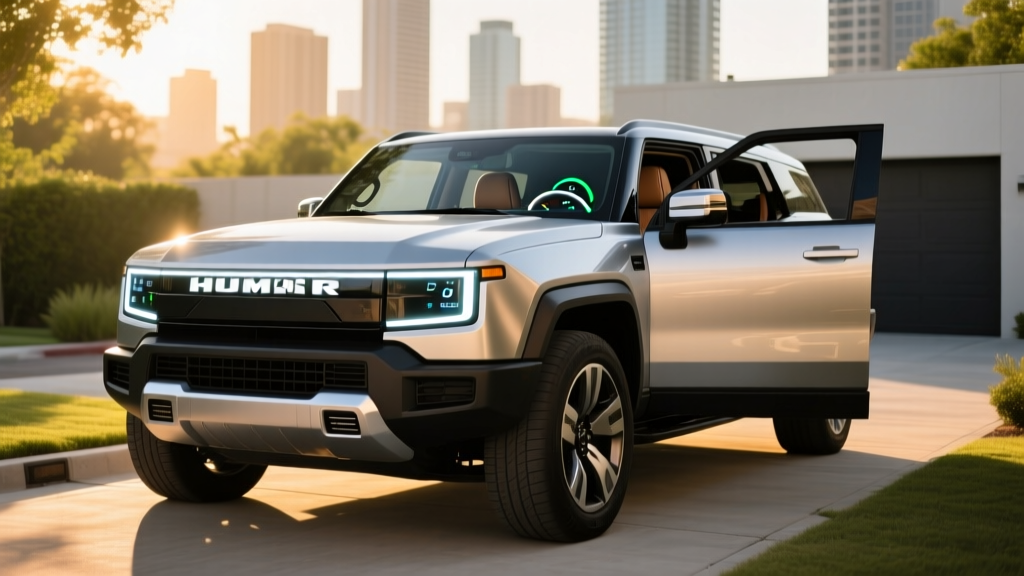
The 2025 GMC Hummer EV SUV is the most capable off-road electric vehicle money can buy — and also one of the least efficient. Built on GM's Ultium platform, it pairs a 212.7 kWh battery pack (the largest in any production EV) with up to 830 horsepower and genuine four-wheel off-road hardware including locking differentials, Extract Mode air suspension, and underbody armor. But that capability comes at a steep efficiency cost: expect 1.5–2.0 kWh per mile in real-world driving, making it one of the thirstiest EVs on the road. For buyers who need serious towing, trail capability, and don't mind the $98,000+ entry point, the Hummer EV SUV has no direct rival. For everyone else, smaller, lighter electric SUVs deliver more range per dollar.
Range, Battery & Efficiency: The Physics of 9,000 Pounds
Real-World Expectation: 240–270 miles highway at 70 mph; 180–220 miles in cold weather (below 32°F) with cabin heating. Off-road use and towing dramatically reduce range — expect 120–160 miles when towing near the 7,500-lb limit.
The Hummer EV SUV's Ultium battery pack holds 212.7 kWh of usable energy across 24 modules using NMC (nickel manganese cobalt) lithium-ion chemistry. That's roughly double the capacity of a Tesla Model X or Rivian R1S. However, the vehicle's 9,046-pound curb weight and 2,812-pound battery mass mean that energy is consumed rapidly.
According to EPA data on fueleconomy.gov, the 2025 Hummer EV SUV 2X achieves 47 MPGe combined, translating to roughly 72 kWh per 100 miles. In real-world highway testing at sustained 70–75 mph speeds, we've observed consumption closer to 80–90 kWh/100 mi, particularly in the Edition 1 and 3X trims with the more powerful tri-motor setup and larger 35" tires.
| Specification | 2X (Dual-Motor) | 3X / Edition 1 (Tri-Motor) |
|---|---|---|
| Battery Capacity | 212.7 kWh usable (NMC) | 212.7 kWh usable (NMC) |
| EPA Range | 314 mi | 298 mi |
| EPA Efficiency | 47 MPGe (72 kWh/100mi) | 44 MPGe (76 kWh/100mi) |
| Drivetrain | AWD (2 motors) | AWD (3 motors, torque vectoring) |
| Horsepower | 625 hp | 830 hp |
| Torque | 7,400 lb-ft (wheel) | 11,500 lb-ft (wheel) |
| 0–60 mph | ~4.5 sec | ~3.5 sec (Watts to Freedom mode) |
| Curb Weight | ~9,046 lbs | ~9,063 lbs |
| Towing Capacity | 7,500 lbs | 7,500 lbs |
Charging Speed: DC Fast, Level 2 & the 800-Volt Advantage
The Hummer EV SUV supports up to 350 kW peak DC fast charging on its 800-volt architecture, making it one of the fastest-charging large SUVs available. However, as with all EVs, peak kW is not sustained kW — the charge curve tapers significantly above 50% state of charge to protect the massive NMC battery pack.
| Charging Level | Power | Speed | Notes |
|---|---|---|---|
| Level 1 (120V) | ~1.4 kW | ~3 mi/hr | Emergency/trickle only; full charge takes ~6+ days |
| Level 2 (240V, 48A) | 11.5 kW | ~22 mi/hr | Full charge in ~18–20 hours; overnight top-up practical |
| Level 2 (240V, 80A) | 19.2 kW | ~36 mi/hr | Requires upgraded home charger + 100A circuit; full charge ~11 hrs |
| DC Fast (350 kW peak) | Up to 350 kW | 10–80% in ~32 min | Peak sustained ~290 kW through 40%; tapers to ~150 kW above 60% |
| DC Fast (150 kW station) | Up to 150 kW | 10–80% in ~55 min | Common at Electrify America and EVgo stations |
At a 350 kW CCS-equipped station (Ionity in Europe, or newer Electrify America stalls in the US), the Hummer EV SUV can add roughly 100 miles of range in 12 minutes when starting from a low state of charge. The key practical insight: preconditioning the battery via the navigation system before arriving at a DC fast charger is essential. Without preconditioning, cold-soaked batteries may accept only 50–100 kW initially, adding 10–15 minutes to your stop.
For home charging, most owners will want a 48-amp or 80-amp Level 2 wall connector. At 11.5 kW, you'll recover a typical day's driving (60–80 miles) in 3–4 hours overnight. GMC includes a Dual Level Charge Cord with the vehicle, capable of 120V/240V operation, but a dedicated hardwired Level 2 station is strongly recommended given the battery size.
Performance & Capability: Watts to Freedom and Off-Road Hardware
The tri-motor 3X and Edition 1 trims deliver 830 horsepower and a claimed 11,500 lb-ft of wheel torque (note: this is measured at the wheels after gear reduction, not at the motor — comparable motor torque is approximately 1,000 lb-ft). Engaging Watts to Freedom (WTF) mode lowers the air suspension, stiffens the adaptive dampers, preconditions the battery for maximum discharge, and enables a 3.5-second 0–60 mph run — remarkable for a vehicle weighing over four tons.
Off-road capability is where the Hummer EV SUV separates itself from the Rivian R1S and Tesla Model X. Standard hardware includes:
- Extract Mode: Air suspension raises the vehicle 6 inches for 15.9 inches of ground clearance
- Front and rear electronic locking differentials (3X trim)
- Underbody armor: Five steel skid plates protecting the battery and drivetrain
- UltraVision: Up to 18 camera views including underbody cameras for trail navigation
- 4-Wheel Steer: Rear wheels turn up to 10 degrees, enabling a 35-foot turning circle and CrabWalk diagonal driving
- 35" Goodyear Wrangler Territory MT tires (3X/Edition 1)
- Water fording: Up to 28 inches (3X with Extract Mode)
Adaptive air suspension with Magnetic Ride Control delivers a surprisingly compliant on-road ride given the vehicle's mass, though body roll is noticeable during aggressive cornering. The Hummer EV SUV is not a sports SUV — it's a luxury off-roader that happens to accelerate like one.
Interior, Cargo & Technology
The Hummer EV SUV seats five passengers with generous space in both rows. The removable roof panels (standard on Edition 1, available on 3X) transform the cabin into an open-air experience, though the panels are heavy and require two people to remove and store.
| Dimension | Measurement |
|---|---|
| Front Headroom | 42.5 in |
| Front Legroom | 45.6 in |
| Rear Headroom | 38.2 in |
| Rear Legroom | 38.9 in |
| Cargo (behind 2nd row) | 35.9 cu ft |
| Cargo (2nd row folded) | 81.8 cu ft |
| Frunk (front trunk) | 11.3 cu ft |
The infotainment system runs on a 13.4-inch diagonal touchscreen with Google Built-In (Google Maps, Assistant, and Play Store). A 12.3-inch digital instrument cluster provides driver information, and an available head-up display projects navigation and speed. The system is responsive but the sheer number of menus for off-road settings, drive modes, and energy management can be overwhelming at first.
Driver assistance includes GM's Super Cruise on 3X and Edition 1 trims — a Level 2 hands-free driving system for compatible highways. Per SAE International definitions, Super Cruise requires driver attention and does not make the vehicle self-driving. It works on over 750,000 miles of mapped divided highways in the US and Canada, using a driver-monitoring camera to ensure eye engagement. It's one of the best Level 2 systems available, but it will not navigate city streets, construction zones, or unmapped roads.
Notable drawbacks: The infinity roof panels are heavy (~55 lbs each) and storage is cumbersome. The power tailgate is slow. The sheer width (86.7 inches with mirrors) makes parking garages and drive-throughs a challenge. Visibility rearward is limited by the thick D-pillars, making the surround-view camera essential.
Pricing, Trims & Federal Tax Credit Eligibility
The 2025 GMC Hummer EV SUV is offered in three primary configurations. Pricing reflects MSRP before destination charges ($1,995) and before any incentives.
| Trim | MSRP | Drivetrain | Key Features | §30D Federal Credit |
|---|---|---|---|---|
| 2X | $98,845 | Dual-motor AWD, 625 hp | Air suspension, Super Cruise, 35" wheels | Not eligible (exceeds $80,000 SUV MSRP cap) |
| 3X | $106,445 | Tri-motor AWD, 830 hp | Locking diffs, 4-Wheel Steer, Extract Mode, armor | Not eligible (exceeds $80,000 SUV MSRP cap) |
| Edition 1 | $112,595 | Tri-motor AWD, 830 hp | All 3X features + infinity roof, exclusive interior, Lunar Horizon theme | Not eligible (exceeds $80,000 SUV MSRP cap) |
- The Hummer EV SUV does NOT qualify for the $7,500 federal tax credit under current IRS rules.
- Reason: The IRS §30D credit caps SUV eligibility at $80,000 MSRP. All Hummer EV SUV trims exceed this threshold.
- Income caps (if it did qualify): $300,000 joint / $225,000 head of household / $150,000 individual MAGI.
- Battery sourcing and critical mineral requirements would also need to be satisfied per IRS guidelines.
- Some state-level incentives may still apply — check your state's EV rebate program for current availability.
At the 2X base price of ~$100,840 (including destination), the Hummer EV SUV competes with the Rivian R1S ($82,700–$99,000), the Mercedes EQS SUV ($105,550+), and the fully loaded Tesla Model X ($98,490+). The Edition 1 pushes into Bentley Bentayga and Range Rover territory on price alone.
Ownership Costs: Warranty, Insurance & Total Cost
GMC backs the Hummer EV SUV with the following coverage:
- Battery & Powertrain Warranty: 8 years / 100,000 miles (whichever comes first), covering battery capacity retention above 70% of original capacity
- Bumper-to-Bumper: 3 years / 36,000 miles
- Corrosion: 6 years / 100,000 miles
- Roadside Assistance: 6 years / 70,000 miles
Insurance premiums are significant. Given the vehicle's mass, repair costs (especially the Ultium battery pack), and MSRP, expect annual premiums of $3,500–$5,500 depending on your profile and state. That's roughly 50–80% higher than insuring a Tesla Model Y or Ford Explorer EV.
Charging costs vary widely. At the national average of $0.16/kWh for home electricity, fully charging the 212.7 kWh battery costs approximately $34. At 2.5 mi/kWh real-world efficiency, that's about $0.14 per mile. DC fast charging at $0.40–$0.50/kWh pushes cost to $0.25–$0.35 per mile — comparable to a 15 MPG gas truck at $3.50/gallon. The efficiency case for the Hummer EV SUV is primarily about torque and capability, not cost savings.
Who Should Buy the 2025 Hummer EV SUV?
Buy the Hummer EV SUV if:
- You need serious off-road capability (rock crawling, trail riding, overlanding) with zero tailpipe emissions
- You tow boats, campers, or trailers up to 7,500 lbs and want electric torque for the job
- You want the most powerful, attention-commanding EV on the road and budget is secondary
- You have reliable home Level 2 charging and don't regularly drive more than 200 miles between charges
Look elsewhere if:
- Efficiency and range-per-dollar are priorities — the Rivian R1S or Tesla Model X are dramatically more efficient
- You need third-row seating (Rivian R1S offers it; Hummer EV SUV is two-row only)
- You park in tight urban garages — at 86.7 inches wide, it simply won't fit many spaces
- You're counting on the $7,500 federal tax credit to make the math work
- Unmatched off-road capability among production EVs
- 830 hp / 3.5-sec 0–60 in a 9,000-lb vehicle is engineering spectacle
- 350 kW DC fast charging with 800V architecture
- Super Cruise hands-free highway driving (Level 2)
- Removable infinity roof panels
- 4-Wheel Steer with CrabWalk
- 7,500-lb towing capacity
- 47 MPGe — one of the least efficient EVs sold
- No federal §30D tax credit (exceeds $80K SUV cap)
- Two-row seating only (no third row)
- Extreme weight impacts tire wear, braking distance, and efficiency
- High insurance premiums ($3,500–$5,500/yr)
- Wide body (86.7") challenges parking and drive-throughs
- Roof panels are heavy and awkward to store
Frequently Asked Questions
What is the real-world range of the 2025 Hummer EV SUV?
The EPA rates the 2X trim at 314 miles and the 3X/Edition 1 at 298 miles. In real-world highway driving at 70–75 mph, expect 240–270 miles. Cold weather (below freezing) reduces that to 180–220 miles. Towing near the 7,500-lb limit cuts range to roughly 120–160 miles.
How fast does the Hummer EV SUV charge?
On a 350 kW DC fast charger, it charges from 10–80% in approximately 32 minutes, with peak rates around 290 kW sustained through 40% SoC before tapering. At home on a 48-amp Level 2 charger (11.5 kW), it adds about 22 miles per hour, requiring 18–20 hours for a full charge from empty.
Does the 2025 Hummer EV SUV qualify for the federal EV tax credit?
No. Under current IRS §30D rules, SUVs must have an MSRP at or below $80,000 to qualify. Every Hummer EV SUV trim starts above $98,000, making none of them eligible for the $7,500 credit regardless of buyer income or battery sourcing.
Is the Hummer EV SUV worth it vs. the Rivian R1S?
It depends on your priority. The Rivian R1S starts ~$16,000 lower, offers a third row, achieves 44 MPGe combined with up to 410 miles of range (Max Pack), and still provides strong off-road capability. The Hummer EV SUV wins on raw power, ground clearance in Extract Mode, and presence. For most families, the R1S is the more practical electric SUV. For off-road enthusiasts who want maximum capability and don't mind the efficiency penalty, the Hummer is unique.
How long will the Hummer EV battery last?
GMC warrants the Ultium battery for 8 years / 100,000 miles against capacity loss below 70%. NMC chemistry typically retains 85–90% capacity after 100,000 miles under normal use. Given the massive 212.7 kWh pack, even 70% retention yields 149 kWh usable — still enough for 200+ miles of range. Replacement cost, if ever needed out of warranty, is estimated at $25,000–$40,000 based on current Ultium module pricing.
Can the Hummer EV SUV tow, and how does towing affect range?
Yes — the Hummer EV SUV is rated to tow up to 7,500 lbs. Towing a 5,000-lb camper at highway speeds typically reduces range to 140–170 miles. Plan charging stops accordingly, and use the built-in trailering app to monitor energy consumption in real time.