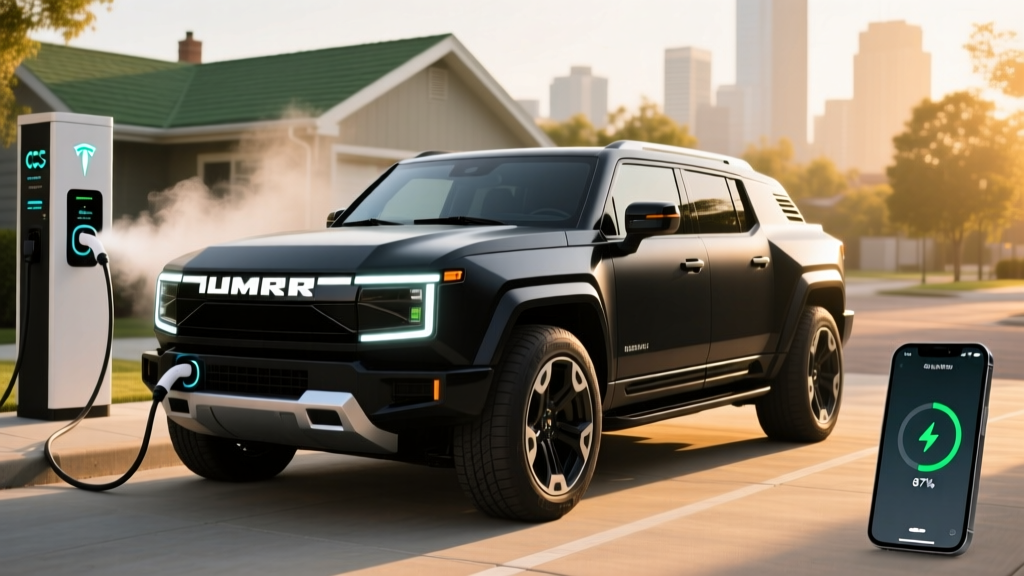
The GMC Hummer EV remains one of the most polarizing electric vehicles on the road. It is simultaneously a 9,000-pound engineering showcase and a conspicuous consumption statement wrapped in military-style body cladding. For 2025, GMC continues to offer the Hummer EV in both Pickup and SUV body styles across 2X and 3X trims, with the extreme-range 3X module still commanding headlines. But beyond the CrabWalk parlor tricks and Watts to Freedom launch mode, how does this truck actually function as a daily-driver EV? We break down the real numbers — range, charging curves, ownership costs, and tax-credit reality — so you can decide whether the Hummer EV earns a spot in your garage or stays on your YouTube feed.
Range and Efficiency: EPA Sticker vs. Real-World Miles
EPA Estimated Range: Up to 381 miles (Pickup 3X with 24-module Ultium pack)
Real-World Expectation: Plan for 300–330 miles on mixed highway driving at 70–75 mph. In cold weather (below 30°F), expect a 20–30% reduction, bringing usable range down to roughly 230–270 miles before you need to find a charger.
The 2025 Hummer EV Pickup in 3X trim carries a massive 24-module double-stacked Ultium battery pack with approximately 212.7 kWh of usable capacity, using nickel-manganese-cobalt (NMC) lithium-ion chemistry. That enormous energy reservoir is what delivers the EPA-estimated 381 miles on the window sticker, according to fueleconomy.gov. The 2X trim uses a 20-module pack with roughly 178 kWh usable and an EPA range of approximately 314 miles.
Efficiency is where physics catches up with mass. The Hummer EV Pickup 3X rates at roughly 47 MPGe combined, translating to about 72 kWh per 100 miles — among the least efficient EVs sold today. For context, a Tesla Model Y Long Range uses around 28 kWh per 100 miles. The Hummer's aerodynamic profile (aerodynamic drag coefficient estimated at 0.40+) and 9,000+ lb curb weight mean you are pushing a lot of metal through a lot of air. City driving with regenerative braking recovers some energy, but highway cruising at 75 mph is where this truck thirsts for electrons.
If you live in a cold-weather state, preconditioning the battery before departure and using the heat pump (standard on 3X) will help, but the sheer thermal mass of a 212 kWh pack means cold-soak losses are significant. Budget-conscious buyers should factor in that charging a pack this large at public DC rates of $0.40–$0.50/kWh can cost $85–$106 for a full fill-up.
Charging Speed: DC Fast Charge and Home Level 2
Charging a 212 kWh battery is a logistical event, not a quick pit stop. The 2025 Hummer EV supports DC fast charging at up to 350 kW peak on the 3X trim via its 800-volt architecture, but sustained rates tell the real story.
| Charging Level | Max Rate | Estimated Time / Rate |
|---|---|---|
| DC Fast Charge (350 kW station) | ~350 kW peak | 10–80% in approximately 35–45 minutes (3X) |
| DC Fast Charge (150 kW station) | ~150 kW sustained | 10–80% in approximately 70–80 minutes |
| Level 2 Home (11.5 kW / 48A) | 11.5 kW | ~14 miles of range per hour; full charge in ~18–20 hours (3X) |
| Level 2 Home (19.2 kW / 80A) | 19.2 kW | ~23 miles of range per hour; full charge in ~11–12 hours (3X) |
| Level 1 (120V / 12A) | ~1.4 kW | ~2 miles per hour — emergency/trickle only |
The charge curve on the 24-module pack peaks near 350 kW only in a narrow state-of-charge window (roughly 10–25%), then tapers progressively. Above 50% SoC, expect sustained rates closer to 150–175 kW, and above 80%, charging slows dramatically to protect cell longevity. This is normal for large NMC packs, but it means the advertised "350 kW" figure is a momentary peak, not a sustained average.
For home charging, the onboard charger accepts up to 19.2 kW on the 3X trim (80-amp circuit required). Most residential installations use a 48-amp / 11.5 kW setup on a 60-amp breaker, which adds roughly 14 miles of range per hour. A full 0–100% charge at 11.5 kW takes approximately 18–20 hours for the 24-module pack. If you drive 50 miles daily, an overnight session easily replenishes your commute — but if you drain the pack on a road trip, plan for a full day of home recovery.
Home charging infrastructure for a truck this power-hungry often requires a 200-amp electrical panel at minimum. If your home has a 100-amp panel, budget $2,000–$4,000 for a service upgrade before installing a Level 2 charger.
Performance: Watts to Freedom and Straight-Line Muscle
The 2025 Hummer EV 3X features a tri-motor all-wheel-drive powertrain — one motor on the front axle and two on the rear — producing up to 1,000 horsepower and an estimated 1,200 lb-ft of torque. In Watts to Freedom (WTF) launch mode, GMC claims a 0–60 mph time of approximately 3.0 seconds for the Pickup variant, making it one of the quickest production trucks ever built.
| Trim | Drivetrain | Horsepower | Torque (lb-ft) | 0–60 mph |
|---|---|---|---|---|
| Pickup 2X | Dual-motor AWD | 625 hp | 775 | ~5.5 sec |
| Pickup 3X | Tri-motor AWD | 1,000 hp | 1,200 | ~3.0 sec (WTF mode) |
| SUV 2X | Dual-motor AWD | 625 hp | 775 | ~5.8 sec |
| SUV 3X | Tri-motor AWD | 830 hp | 1,200 | ~3.5 sec (WTF mode) |
Beyond straight-line speed, the Hummer EV offers genuine off-road capability. Four-wheel steering enables CrabWalk — diagonal movement at low speeds — and a ground clearance of up to 15.9 inches in Extract Mode (Adaptive Air Ride suspension fully raised). The approach, departure, and breakover angles rival dedicated off-road SUVs. Underbody armor, 35-inch tires, and torque vectoring via the twin rear motors make this a legitimate trail rig, not just a boulevard cruiser.
However, 9,000+ pounds of curb weight shows in braking distances and cornering dynamics. This is a truck that rewards anticipation over reflexes. Energy consumption also spikes dramatically during aggressive driving — expect MPGe to drop below 40 if you frequently engage WTF mode or tow near the 7,500-lb max rating.
Pricing, Trims, and Federal Tax Credit Eligibility
The 2025 Hummer EV starts at approximately $98,845 for the Pickup 2X trim (including destination) and climbs to roughly $106,495 for the Pickup 3X. The SUV variant starts around $98,845 (2X) and $106,495 (3X). Fully optioned 3X models with the Extreme Off-Road Package, Infinity Roof with removable panels, and premium interior upgrades can push the as-tested price past $115,000.
| Trim / Body | Base MSRP (est.) | Est. As-Tested High |
|---|---|---|
| Pickup 2X | ~$98,845 | ~$107,000 |
| Pickup 3X | ~$106,495 | ~$118,000 |
| SUV 2X | ~$98,845 | ~$107,000 |
| SUV 3X | ~$106,495 | ~$115,000 |
Regarding the federal EV tax credit under IRS §30D, the Hummer EV faces a significant hurdle: the credit's MSRP cap for trucks is $80,000. Since every 2025 Hummer EV trim exceeds that cap, the vehicle does not qualify for the $7,500 new clean vehicle credit regardless of the buyer's income or battery-sourcing compliance. This is a flat disqualifier — no trim, no configuration, no workaround.
Buyers who still want a tax benefit may consider the Hummer EV on the used market, where the separate §25E used clean vehicle credit offers up to $4,000 (30% of sale price, capped at $4,000) on vehicles priced at $25,000 or less — a threshold the Hummer EV will not reach for years. State-level incentives vary by jurisdiction and should be verified through your state's energy or DMV office.
Cargo, Passenger Space, and Daily Practicality
The Hummer EV Pickup offers a 5-foot bed with an estimated 37.8 cubic feet of cargo volume behind the cab, plus a front trunk (frunk) with approximately 11.3 cubic feet of lockable storage — one of the largest frunks in the EV truck segment. The MultiPro tailgate provides six configurations for loading and tailgating. Towing capacity is rated at up to 7,500 pounds when properly equipped.
The SUV variant trades the bed for enclosed cargo space: approximately 81.8 cubic feet with the rear seats folded and 35.9 cubic feet behind the second row. Both body styles seat five passengers with generous front and rear legroom (estimated 45.6 inches front / 38.9 inches rear for the Pickup), though the high floor height makes entry and exit a step-up affair — running boards are strongly recommended.
At 216.8 inches long (Pickup) and 86.7 inches wide (excluding mirrors), the Hummer EV simply does not fit in many standard parking spaces, single-car garages, or urban drive-throughs. Measure your garage before ordering. The turning circle is large despite four-wheel steering, and visibility is compromised by thick A-pillars and the tall hood — the surround-view camera system is essential, not optional.
Tech, Driver Assistance, and Standout Features
The 2025 Hummer EV comes equipped with GMC's 13.4-inch diagonal infotainment touchscreen running Google Built-In (Google Maps, Google Assistant, Play Store apps), a 12.3-inch driver information center, and an available 18-speaker Bose audio system. The UltraVision camera system provides up to 18 camera views, including underbody cameras for off-road navigation — a genuinely useful feature on trails.
Driver assistance falls under the Super Cruise umbrella on equipped trims: GM's hands-free highway driving system that operates on over 750,000 miles of compatible divided highways in North America. Super Cruise is an SAE Level 2 system — it requires the driver to remain attentive, with an infrared camera monitoring eye gaze. It is not autonomous driving. When the system requests you to take over, you must respond immediately.
Super Cruise Limitation Notice: Super Cruise is an SAE Level 2 driver-assist system. It does not make the Hummer EV self-driving. The driver must remain alert, keep eyes on the road, and be prepared to steer, brake, or accelerate at any time. System availability is limited to pre-mapped divided highways and may disengage in construction zones, poor weather, or unclear lane markings.
Other standout tech includes the Infinity Roof with removable modular sky panels (four panels stored in the frunk), Adaptive Air Ride suspension with Extract Mode for extreme ground clearance, and over-the-air (OTA) software updates that can add features and refine performance post-purchase.
Notable drawbacks include the sheer energy cost of operation, limited public charger compatibility at peak speeds (many stations cap at 150 kW), the absence of a third row in the SUV, and an interior that, while improved over early-build models, still shows some hard plastics and panel-gap inconsistencies at a $100,000+ price point.
Warranty, Battery Longevity, and Ownership Costs
GMC backs the 2025 Hummer EV with a 3-year/36,000-mile limited bumper-to-bumper warranty and a 5-year/60,000-mile powertrain warranty. The Ultium battery pack carries an 8-year/100,000-mile warranty guaranteeing minimum 70% capacity retention — consistent with industry norms for NMC chemistry packs.
Real-world degradation data for the Ultium platform is still accumulating given the Hummer EV's 2022 launch, but NMC chemistry in a thermally managed pack with active liquid cooling typically retains 85–92% capacity after 100,000 miles based on data from comparable GM EVs and third-party battery-health studies. Replacement cost for the 24-module pack, should it fall outside warranty coverage, is estimated at $25,000–$35,000 based on current Ultium module pricing — a figure that should concern high-mileage buyers.
Insurance premiums for the Hummer EV are elevated, averaging $2,800–$3,800 annually depending on state, driving record, and coverage level, reflecting the vehicle's repair costs, mass, and performance potential. Tire replacement for the 35-inch all-terrain tires runs $400–$600 per corner.
Who Should Buy the 2025 Hummer EV?
Choose the Hummer EV if:
- You want a genuine off-road-capable electric truck with class-leading ground clearance and trail tech
- You need 7,500-lb towing capacity in an EV pickup
- You value the statement-making presence and have the garage space to accommodate it
- Most of your driving is within 250 miles of home, where overnight Level 2 charging covers your needs
- You want Super Cruise for hands-free highway commuting
Look elsewhere if:
- Efficiency and low operating cost are priorities — a Rivian R1T or Ford F-150 Lightning uses far less energy per mile
- You need a third row — the Hummer EV SUV seats only five
- You want federal tax credit eligibility — the MSRP cap disqualifies every trim
- You live in an apartment or lack access to home Level 2 charging — public-charging this 212 kWh pack is expensive and time-consuming
- Urban parking and tight garages are part of your daily routine
Pros
- Up to 381 miles EPA range (3X Pickup) — longest-range EV truck available
- Genuine off-road hardware: 15.9" ground clearance, underbody armor, 35" tires
- Tri-motor 1,000 hp with 3.0-second 0–60 in WTF mode
- Massive frunk and versatile MultiPro tailgate
- Super Cruise hands-free driving on 750,000+ miles of highway
- 800V architecture supports up to 350 kW DC fast charging
Cons
- No federal tax credit — all trims exceed the $80,000 MSRP cap
- 72 kWh/100mi efficiency makes it one of the least efficient EVs sold
- 9,000+ lb curb weight impacts braking, handling, and tire wear
- Does not fit standard parking spaces or many home garages
- Interior quality inconsistent with $100,000+ price point
- Full home charge takes 18–20 hours on standard Level 2
Frequently Asked Questions
What is the real-world range of the 2025 Hummer EV?
The EPA estimates up to 381 miles for the Pickup 3X with the 24-module pack. In real-world mixed highway driving at 70–75 mph, expect 300–330 miles. In cold weather below 30°F, plan for 230–270 miles. The 2X trim with the 20-module pack rates at approximately 314 miles EPA, with real-world highway figures around 250–275 miles.
How fast does the 2025 Hummer EV charge?
On a 350 kW DC fast charger, the 3X peaks at approximately 350 kW but sustains that rate only briefly. A 10–80% charge takes roughly 35–45 minutes. On a more common 150 kW station, expect 70–80 minutes for 10–80%. At home on an 11.5 kW Level 2 charger, the 24-module pack takes approximately 18–20 hours from empty to full, adding about 14 miles of range per hour.
Does the 2025 Hummer EV qualify for the federal EV tax credit?
No. Under current IRS §30D rules, the new clean vehicle credit has an MSRP cap of $80,000 for trucks, vans, and SUVs. Every 2025 Hummer EV trim starts well above $98,000, making it ineligible regardless of buyer income or battery sourcing. State incentives may still apply — check your local programs.
How much does the 2025 Hummer EV cost?
The Pickup 2X starts at approximately $98,845 and the 3X at roughly $106,495, both including destination. The SUV is priced similarly. With options like the Extreme Off-Road Package and premium interior, as-tested prices can exceed $115,000 on 3X models. There is no federal tax credit to offset this.
Is the Hummer EV worth buying vs. the Rivian R1T or Ford F-150 Lightning?
It depends on priorities. The Hummer EV offers the longest range of any EV truck (381 mi EPA), the most off-road capability, and the most presence. The Rivian R1T is more efficient, more refined on-road, and offers a quad-motor option. The F-150 Lightning is significantly cheaper, more practical for daily use, and qualifies for the federal tax credit on certain trims. If you want a statement vehicle with genuine trail chops and maximum range, the Hummer EV is unique. If you want value and efficiency, the Lightning or R1T are stronger choices.
What battery chemistry does the Hummer EV use?
The Hummer EV uses GM's Ultium platform with nickel-manganese-cobalt (NMC) lithium-ion chemistry in a double-stacked pouch-cell configuration. NMC offers high energy density suited to the Hummer's massive range target but is more expensive and has a lower cycle-life ceiling than LFP (lithium iron phosphate) chemistry found in some competitors' standard-range models.
Can the Hummer EV tow, and how does towing affect range?
Yes — the Hummer EV is rated to tow up to 7,500 pounds when properly equipped. Towing a heavy trailer will reduce range significantly, often by 35–50% depending on trailer weight, aerodynamics, speed, and terrain. Plan for 150–200 miles of range when towing near maximum capacity, and verify charger availability along your route.