Quick Verdict: Honda's First EV Gets the Cabin Right
The 2025 Honda Prologue is Honda's first mass-market battery-electric vehicle, and while the Ultium-based powertrain draws attention, it's the 2025 Honda Prologue interior that makes or breaks the ownership experience. After spending time with this midsize electric SUV, the cabin impresses with thoughtful ergonomics, generous space, and materials that punch above its price class — even if the infotainment system shows its GM-sourced roots. With an EPA-estimated range of up to 296 miles and DC fast charging to 150 kW, the Prologue is a credible daily driver and road-trip companion. But how does it stack up against the Hyundai Ioniq 5, Tesla Model Y, and Ford Mustang Mach-E when you look past the spec sheet?
EPA Estimate: 296 miles (FWD EX/EX-L) | 281 miles (AWD Touring)
Real-World Expectation: Plan for ~240–260 miles on sustained highway driving at 70+ mph. In cold weather (below 32°F), expect a 15–25% reduction, dropping effective range to roughly 200–220 miles for the FWD model. City driving with regen braking recovers energy and often matches or exceeds the EPA sticker.
2025 Honda Prologue Interior: Space, Materials, and Tech
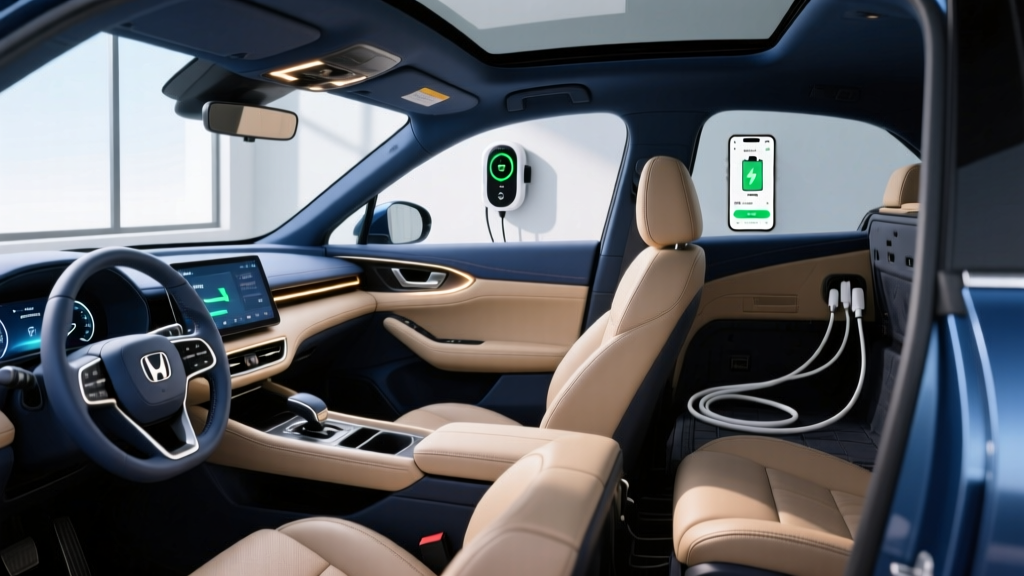
The keyword on every prospective buyer's mind — the 2025 Honda Prologue interior — delivers a cabin that feels distinctly Honda despite sharing its BEV3 platform with the Chevrolet Blazer EV and Cadillac Lyriq. Honda's design team reworked the dashboard, center console, and seat bolsters to avoid the parts-bin feel that often plagues badge-engineered vehicles.
Dimensions and Passenger Space
The Prologue is a midsize two-row SUV with generous proportions:
- Front legroom: 45.2 inches
- Rear legroom: 38.6 inches
- Front headroom: 40.0 inches
- Rear headroom: 38.1 inches
- Cargo volume (rear seats up): 25.2 cu ft
- Cargo volume (rear seats folded): 57.7 cu ft
That rear legroom is competitive with the Hyundai Ioniq 5 (39.4 in) and significantly more usable than the Tesla Model Y's tighter second row. The flat floor — a benefit of the dedicated EV platform — means the middle rear passenger gets actual foot space rather than straddling a tunnel.
Materials and Build Quality
Soft-touch materials cover the upper dash and door panels on all trims. The Touring trim adds leather-trimmed seats with perforated inserts and a heated steering wheel. Panel gaps are tight and consistent — a notable improvement over some early Ultium-based vehicles from GM. The honeycomb-pattern accent strip across the dashboard adds visual interest without feeling gimmicky.
Infotainment and Displays
A standard 11.3-inch touchscreen (11.3-inch on EX, upgraded to a higher-resolution unit on Touring) runs Google built-in, which includes Google Maps navigation, Google Assistant, and access to the Play Store. Wireless Apple CarPlay and Android Auto are standard on EX-L and Touring trims. A 10.2-inch digital instrument cluster sits behind the steering wheel.
The drawback: the Google-based system can feel sluggish on cold starts, and Honda's decision to move climate controls into the touchscreen (rather than physical knobs) frustrates some drivers. The available head-up display on the Touring trim is a welcome addition for highway cruising.
Honda Sensing ADAS Suite
Every Prologue includes Honda Sensing, which bundles adaptive cruise control with low-speed follow, lane-keeping assist, collision mitigation braking, traffic sign recognition, and blind-spot monitoring. This is an SAE Level 2 driver-assistance system — it does not drive the car autonomously. You must keep your hands on the wheel and eyes on the road at all times.
Battery, Range, and Efficiency
| Specification | EX / EX-L (FWD) | Touring (AWD) |
|---|---|---|
| EPA Range | 296 miles | 281 miles |
| Battery (usable) | 85 kWh (NMC) | 85 kWh (NMC) |
| Horsepower | 212 hp | 288 hp |
| Torque | 236 lb-ft | 333 lb-ft |
| 0–60 mph | ~7.9 sec | ~6.0 sec |
| Drivetrain | Single-motor FWD | Dual-motor AWD |
| MPGe (combined) | 107 MPGe | 97 MPGe |
| Efficiency | ~32 kWh/100 mi | ~35 kWh/100 mi |
| Max DC Charge Rate | 150 kW | 150 kW |
| 10–80% DC Time | ~32 min | ~32 min |
| Level 2 Home Rate | 11.5 kW (~34 mi/hr) | 11.5 kW (~34 mi/hr) |
| Towing Capacity | 1,500 lbs | 1,500 lbs |
The Prologue uses an 85 kWh (usable capacity) nickel-manganese-cobalt (NMC) lithium-ion battery pack built on GM's Ultium platform. NMC chemistry offers strong energy density and cold-weather performance compared to LFP alternatives, though it typically carries a higher replacement cost and slightly faster long-term degradation curves.
Efficiency of roughly 32 kWh per 100 miles (FWD) is middling for the segment — the Hyundai Ioniq 5 RWD achieves about 30 kWh/100 mi, and the Tesla Model Y RWD sits around 28 kWh/100 mi. The Prologue's weight (~4,900 lbs for the AWD Touring) and relatively boxy profile explain the gap.
Charging Speed: DC Fast and Home Level 2
| Charging Level | Power / Voltage | Speed (miles added per hour) | Notes |
|---|---|---|---|
| Level 1 (120V) | ~1.4 kW | ~4 mi/hr | Emergency/trickle only |
| Level 2 (240V, 48A) | 11.5 kW | ~34 mi/hr | Full charge in ~8.5 hours |
| DC Fast Charge | 150 kW peak | ~180 mi in 30 min | 10–80% in ~32 min |
The Prologue's 150 kW peak DC fast-charge rate is adequate but not class-leading. The Hyundai Ioniq 5 peaks at 240 kW (10–80% in ~18 minutes), and the Kia EV6 matches that figure. The Prologue's charge curve tapers noticeably above 80% state of charge — a common NMC battery behavior to protect cell longevity — meaning a 10–90% session will take closer to 45–50 minutes.
At home on a Level 2 charger (240V, 48-amp circuit), the onboard 11.5 kW charger replenishes the pack from empty in roughly 8.5 hours, which is overnight-friendly. Honda includes a dual-level charge cord (120V/240V) with the vehicle, though you'll need a NEMA 14-50 outlet installed for the 240V capability.
Connector note: The 2025 Prologue uses the CCS1 connector. Honda has committed to adopting NACS (Tesla's connector) for future models, but for 2025, CCS is the standard. You'll have access to Electrify America, EVgo, and ChargePoint DC networks. Tesla Supercharger access requires an adapter (included or available depending on network agreements).
Pricing, Trims, and Federal Tax Credit Eligibility
| Trim | MSRP | Est. After §30D Credit* | Key Features |
|---|---|---|---|
| EX (FWD) | $47,400 | ~$39,900 | 19" wheels, heated front seats, Honda Sensing, 11.3" screen |
| EX-L (FWD) | $50,400 | ~$42,900 | Leather seats, power liftgate, wireless CarPlay/Android Auto |
| Touring (AWD) | $57,400 | ~$49,900 | Dual-motor AWD, 21" wheels, HUD, Bose 12-speaker audio, panoramic roof |
*Federal tax credit estimates assume buyer eligibility under IRS §30D rules. Credit amounts and eligibility are subject to change. Always verify current rules at IRS.gov and consult a tax professional.
Federal EV Tax Credit (§30D) — Key Eligibility Rules
The 2025 Honda Prologue may qualify for up to $7,500 in federal tax credits, but eligibility depends on several factors:
- MSRP Cap: SUVs must be priced at or below $80,000. All Prologue trims qualify.
- Buyer Income Cap: Modified AGI must not exceed $150,000 (single), $225,000 (head of household), or $300,000 (married filing jointly).
- Battery Sourcing: Critical minerals and battery components must meet escalating domestic-content thresholds. As of the 2025 model year, the Prologue's Ultium battery (assembled in the U.S.) has generally met these requirements, but specific build dates and supply-chain shifts can affect eligibility. Check the VIN-specific lookup on fueleconomy.gov.
- Point-of-Sale Transfer: Buyers can transfer the credit to the dealer at purchase, reducing the out-of-pocket price immediately rather than waiting to claim it on their tax return.
Pros and Cons
- Spacious, well-finished interior with competitive rear legroom (38.6 in)
- Strong EPA range of 296 miles (FWD) for daily and highway use
- Competitive pricing with potential ~$7,500 federal credit
- Honda Sensing ADAS standard on all trims
- Comfortable ride quality; well-tuned suspension for a heavy EV
- Google built-in infotainment with native Google Maps navigation
- DC fast charging (150 kW peak) lags Ioniq 5 and EV6 (~240 kW)
- Climate controls buried in touchscreen — no physical knobs
- Efficiency (~32 kWh/100 mi) trails segment leaders
- No front trunk (frunk) — cargo space limited to rear area
- Towing limited to 1,500 lbs (below truck-based EV SUVs)
- AWD Touring trim pushes $57,400 before options
How the Prologue Compares to Key Rivals
The midsize electric SUV segment is crowded. Here's how the Prologue measures up against three benchmarks:
- vs. Hyundai Ioniq 5: The Ioniq 5 charges far faster (240 kW vs. 150 kW) and offers V2L capability. The Prologue counters with more rear legroom and a more traditional SUV driving position. If road-trip charging speed matters, the Ioniq 5 wins.
- vs. Tesla Model Y: The Model Y is more efficient, has access to the Supercharger network natively, and offers more cargo space. The Prologue offers a quieter cabin, more physical controls, and a less polarizing interior design. Supercharger access is narrowing as Tesla opens its network via NACS adapters.
- vs. Ford Mustang Mach-E: The Mach-E is sportier to drive and offers a BlueCruise hands-free option (Level 2, eyes-off on approved highways). The Prologue is roomier in the back seat and offers a plusher ride. The Mach-E's extended-range battery delivers up to 320 miles EPA.
Who Should Buy the 2025 Honda Prologue?
The Prologue is best suited for suburban commuters and small families who prioritize interior comfort, straightforward ergonomics, and a trusted brand name. If you drive 40–80 miles round trip daily, have Level 2 home charging access, and take occasional road trips of 200–250 miles, the Prologue's range and cabin comfort align well with your needs.
It's less ideal for frequent long-distance travelers who need rapid DC charging (look at the Ioniq 5 or EV6), buyers who need serious towing capacity (consider the Rivian R1S or F-150 Lightning), or those who want cutting-edge efficiency and the lowest cost per mile (the Model Y remains the benchmark).
Warranty and Battery Coverage
Honda backs the Prologue with a competitive warranty package:
- Limited Vehicle Warranty: 3 years / 36,000 miles
- Powertrain Warranty: 5 years / 60,000 miles
- Battery Warranty: 8 years / 100,000 miles (retains at least 70% of original capacity)
The 8-year/100,000-mile battery warranty is standard for the industry and mandated in California and states that follow CARB emissions rules (where it extends to 10 years / 150,000 miles). Honda's 70% capacity-retention threshold is typical, though some competitors guarantee 70% while others offer slightly more generous terms. NMC batteries generally degrade 1.5–2.5% per year under normal use, meaning most owners will see 88–92% state of health at the 8-year mark — well within warranty.
Frequently Asked Questions
What is the real-world range of the 2025 Honda Prologue?
The EPA rates the FWD Prologue at 296 miles and the AWD Touring at 281 miles. In real-world highway driving at 70–75 mph, expect roughly 240–260 miles (FWD) and 225–245 miles (AWD). Cold weather below freezing can reduce range by 15–25%, so winter highway range may dip to around 200 miles. Preconditioning the battery while plugged in helps mitigate cold-weather losses.
How fast does the Prologue charge at home and on the road?
On a Level 2 home charger (240V, 48A), the Prologue charges at up to 11.5 kW, adding about 34 miles of range per hour — a full charge takes roughly 8.5 hours overnight. On DC fast chargers, it peaks at 150 kW and charges from 10–80% in approximately 32 minutes. That's slower than the Ioniq 5's ~18-minute 10–80% time at 240 kW.
Does the 2025 Honda Prologue qualify for the federal EV tax credit?
The Prologue is eligible for up to $7,500 under IRS §30D, provided the buyer meets income caps ($150K single / $300K joint), the MSRP is under $80,000 (all trims qualify), and the battery meets critical-mineral and component sourcing requirements. The credit can be transferred to the dealer at point of sale. Always verify eligibility for your specific VIN at IRS.gov and consult a tax professional.
Is the 2025 Honda Prologue worth buying vs. the competition?
If interior comfort, passenger space, and Honda brand trust are your top priorities, the Prologue is a strong choice. It sacrifices some charging speed and efficiency compared to the Hyundai Ioniq 5 and Tesla Model Y. For road-trip-heavy buyers, the Ioniq 5's 240 kW charging is a meaningful advantage. For efficiency-focused buyers, the Model Y's ~28 kWh/100 mi is hard to beat. The Prologue occupies a comfortable middle ground for daily commuters who value cabin quality over spec-sheet dominance.
What are the biggest pros and cons of the Prologue?
Pros: Spacious, quiet interior; 296-mile EPA range (FWD); standard Honda Sensing ADAS; competitive pricing after tax credit; comfortable ride quality. Cons: 150 kW DC charging is slower than rivals; no frunk; touchscreen-only climate controls; efficiency trails segment leaders; 1,500-lb towing limit.
Does the Prologue have a front trunk (frunk)?
No. The Prologue does not offer a front trunk. All cargo space (25.2 cu ft behind the rear seats, 57.7 cu ft with seats folded) is in the rear cargo area. This is a notable omission compared to the Ford Mustang Mach-E and Hyundai Ioniq 5, both of which offer usable frunk storage.