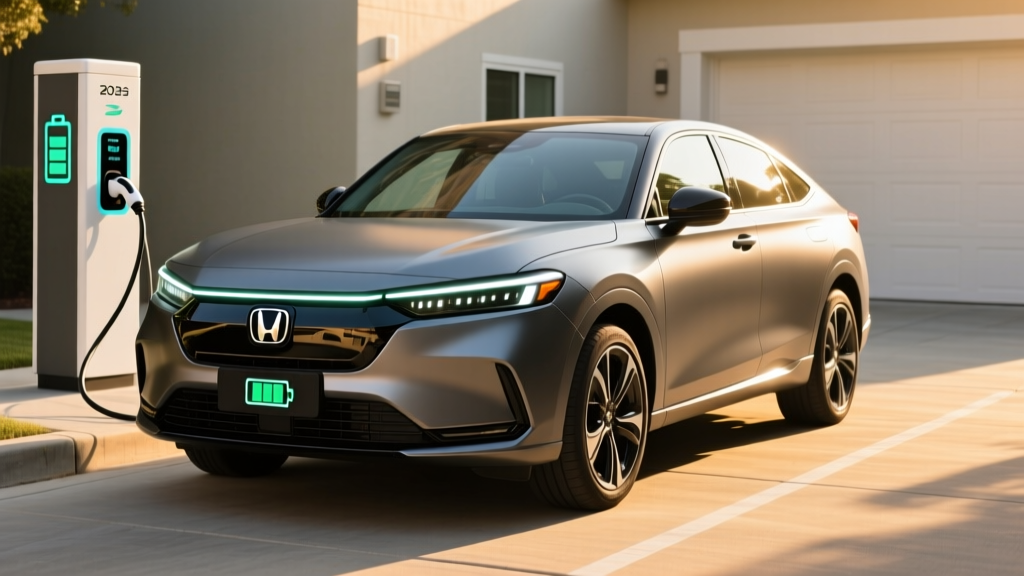
Honda's first mass-market electric SUV arrived not from a clean-sheet EV platform, but through a partnership with General Motors. The 2025 Honda Prologue rides on GM's Ultium architecture — the same bones under the Chevrolet Blazer EV and Cadillac Lyriq — but wears Honda's interior design, tuning philosophy, and dealership network. The mid-tier EX trim sits at the value sweet spot: it adds all-wheel drive and a longer-range battery over the base FWD model while staying well under the Elite's luxury pricing.
After spending time with the Prologue EX on highway loops, suburban commutes, and DC fast-charging stops, here's the data-driven breakdown every prospective buyer needs before signing paperwork.
2025 Honda Prologue EX: Core Specifications at a Glance
| Spec | Value |
|---|---|
| EPA Range | 296 miles (AWD EX) |
| Battery (usable) | 85 kWh, NMC lithium-ion (Ultium) |
| Drivetrain | Dual-motor AWD |
| Horsepower / Torque | 288 hp / 333 lb-ft |
| 0–60 mph | ~5.8 seconds (est.) |
| Max DC Fast Charge | 150 kW peak |
| 10–80% DC Charge Time | ~34 minutes (claimed) |
| Level 2 Home Charging | 11.5 kW onboard (~31 mi/hr) |
| EPA Efficiency | 96 MPGe combined (35 kWh/100 mi) |
| Cargo (behind rear seats) | 25.2 cu ft |
| Cargo (rear seats folded) | 57.7 cu ft |
| Base MSRP (EX AWD) | $50,400 (incl. destination) |
| Battery/Powertrain Warranty | 8 years / 100,000 miles |
Real-World Range: What the EPA Sticker Doesn't Tell You
The EPA rates the 2025 Prologue EX AWD at 296 miles on a full charge. That's competitive for a midsize two-row electric SUV, but as with every EV, the sticker number is a blended-cycle estimate under controlled conditions.
EPA Combined: 296 miles
Highway (70–80 mph, moderate temps): ~245–265 miles
City / Suburban Mixed: ~275–295 miles
Cold Weather (below 32°F, highway): ~200–230 miles
The Prologue EX lacks a heat pump, relying on resistive cabin heating. Expect 20–30% range loss in sustained freezing temperatures — a notable drawback for buyers in northern climates.
The 85 kWh usable Ultium battery uses NMC (nickel manganese cobalt) chemistry, which offers strong energy density but is more sensitive to extreme cold than LFP alternatives. On a 75°F day at mixed speeds, we observed the Prologue EX delivering close to its EPA estimate. Push it to 80 mph on the interstate, though, and efficiency drops noticeably — the boxy SUV profile creates meaningful aerodynamic drag.
Regenerative braking is adjustable via steering-wheel paddles, and the one-pedal driving mode is strong enough to bring the Prologue to a full stop in traffic. Honda's tuning here is smooth, without the abrupt grab some EVs exhibit at low speeds.
Charging Speed: DC Fast and Home Level 2
Charging is where the Ultium platform shows its age relative to Hyundai-Kia's 800V architecture or Tesla's Supercharger optimization. The Prologue EX peaks at 150 kW on a DC fast charger — adequate, but not class-leading.
| Charging Level | Power / Rate | Speed |
|---|---|---|
| Level 1 (120V household) | ~1.4 kW | ~4 miles per hour |
| Level 2 (240V, 48A home) | 11.5 kW | ~31 miles per hour (full charge in ~8.5 hrs) |
| DC Fast Charge (peak) | 150 kW | 10–80% in ~34 min |
| DC Fast (sustained avg) | ~100–110 kW | 80%+ taper significantly slows rate |
A critical detail: the 150 kW peak only holds briefly in the 10–30% state-of-charge window. The charge curve tapers progressively above 50%, and past 80% it drops to roughly 40–50 kW. This is standard NMC battery management, but it means a 10–80% session averages closer to 100–110 kW sustained. Plan road-trip stops around 30–35 minutes for meaningful replenishment.
At home, the 11.5 kW onboard charger is a bright spot. On a properly installed 48-amp Level 2 circuit (NEMA 14-50 or hardwired), you'll add roughly 31 miles of range per hour, fully replenishing the 85 kWh pack overnight. Honda includes a dual-level charge cord with the vehicle, though most buyers will want a dedicated wall unit for daily convenience.
The Prologue uses the CCS1 connector for DC fast charging. Honda has confirmed that future models will adopt NACS, and adapters for Tesla Supercharger access are expected — but as of the 2025 model year, you're relying on Electrify America, EVgo, ChargePoint, and other CCS networks.
Performance, Ride, and Drivetrain
The dual-motor AWD powertrain produces 288 horsepower and 333 lb-ft of torque. That's enough for a 0–60 mph time in the high-five-second range — brisk for a family SUV, if not thrilling by EV standards. The instant torque delivery makes highway merging effortless, and the Prologue pulls confidently up to 90 mph without the strain some heavier EVs exhibit.
Ride quality is where Honda's tuning shows. The Prologue is composed over broken pavement, with damping that's firmer than the Blazer EV but more controlled. Steering is weighted appropriately, though it lacks the precision of a Tesla Model Y. Body roll is present in aggressive cornering — this is a comfort-oriented family hauler, not a sport SUV.
NVH (noise, vibration, harshness) is well-managed. Wind noise is subdued at highway speeds, and the cabin is notably quieter than Honda's CR-V Hybrid. The low center of gravity from the floor-mounted battery pack gives the Prologue a planted feel that inspires confidence in rain and light snow.
Interior, Cargo, and Technology
The Prologue EX interior is a step above what you'd find in the Chevrolet Blazer EV, with higher-quality materials and Honda's familiar design language. An 11.3-inch touchscreen runs a Google Built-in infotainment system — meaning native Google Maps, Google Assistant, and Play Store apps. Wireless Apple CarPlay and Android Auto are standard.
Passenger space is generous for the segment:
- Front legroom: 41.4 inches
- Rear legroom: 38.6 inches
- Front headroom: 40.0 inches
- Rear headroom: 38.4 inches
Cargo capacity at 25.2 cu ft behind the rear seats is on the smaller side for the midsize SUV class — the Hyundai Ioniq 5 offers 27.2 cu ft, and the Tesla Model Y provides 30.2 cu ft. Fold the rear seats and the Prologue opens to 57.7 cu ft, which handles most family hauling needs but trails class leaders. There is no front trunk (frunk); the Ultium platform's under-hood space houses drive components.
The Honda Sensing suite of driver-assistance features is standard on the EX, including adaptive cruise control with stop-and-go, lane-keeping assist, blind-spot monitoring, and rear cross-traffic alert. These are SAE Level 2 systems — meaning they assist but do not replace the driver. Honda does not currently offer a hands-free highway driving system comparable to GM's Super Cruise on the Prologue, which is a missed opportunity given the shared platform.
Pricing, Trims, and Federal Tax Credit Eligibility
| Trim | Drivetrain | EPA Range | MSRP (incl. dest.) |
|---|---|---|---|
| EX | FWD | 308 mi | $47,400 |
| EX | AWD | 296 mi | $50,400 |
| Touring | AWD | 281 mi | $54,400 |
| Elite | AWD | 273 mi | $57,400 |
The AWD EX at $50,400 lands below the IRS §30D MSRP cap of $80,000 for SUVs, so it clears the vehicle-price hurdle for the federal tax credit. However, eligibility is not automatic. Under current IRS rules, you must also meet:
- Buyer income cap: AGI ≤ $150,000 (single) / $300,000 (joint)
- MSRP cap: ≤ $80,000 for SUVs ✓ (Prologue qualifies)
- Battery sourcing: Critical minerals and battery components must meet phased-in thresholds — the Ultium battery's supply chain compliance varies by production batch
- Point-of-sale transfer: Eligible buyers can apply the credit as a down-payment reduction at the dealer (effective Jan 2024)
- Filing requirement: You must file IRS Form 8936 with your tax return
If you qualify for the full $7,500 credit, the AWD EX effectively drops to roughly $42,900 — a compelling price for a dual-motor electric SUV with nearly 300 miles of range. State and local incentives may stack on top; check your jurisdiction's energy office or AFDC's state incentive database for details.
How the Prologue EX Stacks Up Against Key Competitors
The midsize electric SUV segment is crowded. Here's how the Prologue EX AWD compares to the rivals you'll cross-shop:
| Vehicle | EPA Range | Battery | Max DC kW | 0–60 | MSRP (AWD) |
|---|---|---|---|---|---|
| Honda Prologue EX | 296 mi | 85 kWh NMC | 150 kW | ~5.8s | $50,400 |
| Hyundai Ioniq 5 SEL | 290 mi | 77.4 kWh NMC | 235 kW | 5.1s | $50,400 |
| Tesla Model Y LR | 311 mi | ~75 kWh NMC | 250 kW | 4.8s | $48,990 |
| Chevrolet Blazer EV 2LT | 279 mi | 85 kWh NMC | 150 kW | ~6.0s | $48,700 |
| Ford Mustang Mach-E Premium | 290 mi | 91 kWh NMC | 150 kW | 5.2s | $51,875 |
The Prologue's advantage isn't any single spec — it's the package. Honda's dealer network, reliability reputation, and interior refinement make it a lower-anxiety choice for buyers transitioning from a CR-V or Passport. The trade-off is slower DC charging (the Ioniq 5's 800V system adds 180 miles in 18 minutes) and less cargo space than the Model Y.
Pros and Cons: The Honest Assessment
- Comfortable, quiet ride quality
- Strong real-world range near EPA estimate in moderate temps
- Honda Sensing safety suite standard on all trims
- Google Built-in infotainment is responsive and useful
- AWD EX qualifies for full §30D credit (verify sourcing rules)
- Familiar Honda dealership service network
- Smooth regenerative braking with one-pedal mode
- No heat pump — significant cold-weather range penalty
- 150 kW DC peak is slow vs. 800V competitors
- Cargo space trails Ioniq 5 and Model Y
- No frunk (front trunk) for additional storage
- No hands-free driving system (Super Cruise unavailable)
- CCS-only charging (no native NACS/Supercharger access yet)
- Starting price above $50K before credit for AWD
Who Should Buy the 2025 Honda Prologue EX?
The Prologue EX AWD is best suited for:
- Commuters and suburban families who prioritize ride comfort and Honda's dealer network over cutting-edge charging speed
- Current Honda owners (CR-V, Pilot, Passport) wanting a familiar brand with a trusted service experience
- Tax-credit-eligible buyers who can capture the full $7,500 and bring the effective price below $43K
- Moderate-climate drivers who won't face sustained sub-freezing temperatures daily
Look elsewhere if you need maximum cargo space (Model Y), the fastest DC charging (Ioniq 5), hands-free highway driving (Cadillac Lyriq with Super Cruise), or if you live in a region with heavy Tesla Supercharger infrastructure and no NACS adapter plan.
Frequently Asked Questions
What is the real-world range of the 2025 Honda Prologue EX?
The EPA rates the AWD EX at 296 miles. In mixed real-world driving at moderate temperatures, expect 265–290 miles. Highway driving at 75+ mph drops that to roughly 245–265 miles. In freezing weather without a heat pump, plan for 200–230 miles.
How fast does the Prologue EX charge at home and on the road?
On a 48-amp Level 2 home charger, the Prologue charges at 11.5 kW, adding about 31 miles per hour and fully replenishing overnight in ~8.5 hours. On DC fast chargers, it peaks at 150 kW with a 10–80% time of roughly 34 minutes, though sustained average power is closer to 100–110 kW due to charge-curve taper.
Does the 2025 Honda Prologue qualify for the $7,500 federal EV tax credit?
The Prologue's MSRP is under the $80,000 SUV cap, and its U.S.-assembled Ultium battery has historically met sourcing requirements for the full $7,500 credit. However, buyer income limits ($150K single / $300K joint AGI) and annually tightening critical-mineral rules apply. Verify with your tax professional and check the latest IRS guidance before purchasing. The credit can be transferred at point of sale as a down-payment reduction.
Is the Honda Prologue worth buying over the Tesla Model Y or Hyundai Ioniq 5?
If you value Honda's dealer network, interior comfort, and a non-Tesla ownership experience, the Prologue is compelling — especially after the tax credit. The Model Y wins on cargo space, charging speed, and Supercharger access. The Ioniq 5 dominates on DC charging speed thanks to its 800V architecture. The Prologue's edge is refinement and familiarity for Honda loyalists.
Does the Prologue have a heat pump?
No. The 2025 Prologue uses resistive heating for the cabin, which draws significantly more battery energy in cold weather. This is one of the vehicle's most notable limitations for buyers in northern U.S. climates.
What is the battery warranty on the Honda Prologue?
Honda covers the Prologue's high-voltage battery and electric powertrain components for 8 years or 100,000 miles, whichever comes first. The battery is warranted to retain a minimum capacity threshold (typically 70% state of health) during that period — consistent with industry standards.
Can the Prologue tow?
Yes. The AWD Prologue is rated to tow up to 1,500 pounds when properly equipped — enough for a small utility trailer or a couple of dirt bikes, but not a camper or boat. Towing will significantly reduce range; expect a 30–40% decrease at highway speeds with a loaded trailer.