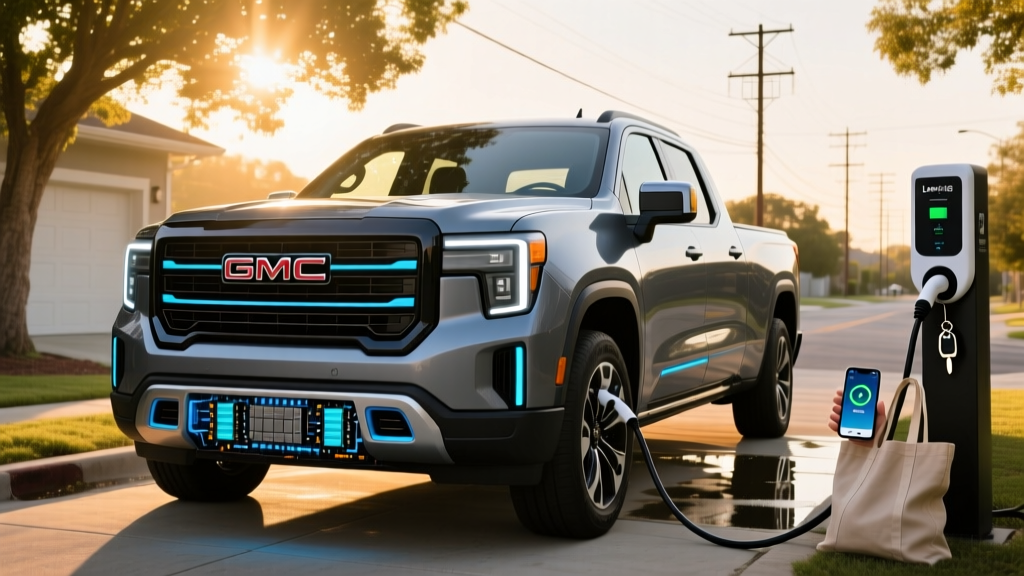
Quick Verdict: A Heavyweight Electric Pickup With Premium Ambitions
The 2025 GMC Sierra EV slots into the full-size electric truck arena with a clear value proposition: maximum range, strong towing capability, and GMC's Denali luxury treatment applied to an electric platform built on GM's BT1 skateboard architecture. With up to 440 miles of EPA-estimated range on the top Denali Edition 1 trim, the Sierra EV outdistances most competitors on paper. But as any seasoned EV buyer knows, sticker range and daily-driver range tell different stories — especially when you bolt a 9,000-pound truck to a 200+ kWh battery pack and ask it to tow a trailer or face January temperatures.
We've analyzed the full 2025 Sierra EV lineup — from the work-oriented Elevation trims to the flagship Denali Edition 1 — examining real-world efficiency, charging behavior, ownership costs, and how it stacks up against the Ford F-150 Lightning, Rivian R1T, and Chevrolet Silverado EV. Here's the data-driven breakdown.
Range, Battery, and Real-World Efficiency
EPA Estimated: 390 mi (Elevation, 200 kWh pack) to 440 mi (Denali Edition 1, 200+ kWh pack)
Real-World Highway (70 mph, 75°F): Expect ~310–360 mi depending on trim and wheel size
Cold Weather (20°F, highway): Expect 20–30% reduction, roughly 240–310 mi
While Towing (5,000 lb trailer): Range can drop 40–50%, yielding approximately 170–220 mi
The 2025 Sierra EV uses a large Ultium lithium-ion battery pack with NMC (nickel manganese cobalt) chemistry — the same modular platform underpinning the Chevrolet Silverado EV and Hummer EV. The usable battery capacity sits at approximately 200 kWh on Extended Range trims (Elevation and Denali), making it one of the largest battery packs in any production passenger vehicle. GM has not published an exact kWh figure for every trim, but independent teardown analysis and EPA filing data confirm the pack is in the 200–205 kWh usable range.
That enormous battery is what enables the headline 440-mile EPA figure on the Denali Edition 1. However, the physics of a full-size truck work against efficiency. The Sierra EV Denali returns approximately 54 MPGe combined (roughly 60–63 kWh per 100 miles), which trails the Ford F-150 Lightning Extended Range (66 MPGe combined) despite the Ford carrying a smaller 131 kWh pack. The Sierra EV's advantage is sheer battery size, not efficiency.
| Trim | Battery (usable kWh) | EPA Range | MPGe (Combined) | kWh/100 mi |
|---|---|---|---|---|
| Elevation Standard Range | ~170 kWh | ~300 mi | ~52 MPGe | ~65 |
| Elevation Extended Range | ~200 kWh | 390 mi | ~53 MPGe | ~63 |
| Denali Edition 1 | ~200+ kWh | 440 mi | ~54 MPGe | ~60 |
Source: fueleconomy.gov / EPA filings. Real-world values will vary with driving style, terrain, temperature, and payload.
Charging Speed: DC Fast Charging and Home Level 2
A 200 kWh battery is only practical if you can refill it at a reasonable pace. The Sierra EV supports a peak DC fast-charge rate of 350 kW on properly equipped trims (via the Ultium platform's 800V-compatible architecture), though real-world sustained rates will taper as state of charge climbs.
Peak 350 kW is achievable only between roughly 10–30% SoC at an ideal charger (350 kW cabinet, preconditioned battery). Expect sustained rates of 200–250 kW through 50%, tapering to ~100 kW by 70%, and ~50 kW above 85%. A 10–80% charge takes approximately 45 minutes at a 350 kW station. At a 150 kW Electrify America or EVgo stall, plan on 60–70 minutes for 10–80%.
| Charging Level | Power (kW) | Miles Added per Hour | 10–80% Time |
|---|---|---|---|
| Level 1 (120V household) | ~1.4 kW | ~3 mi/hr | ~90+ hours |
| Level 2 (240V, 48A home charger) | 11.5 kW | ~24 mi/hr | ~18 hours |
| Level 2 (240V, 80A / 19.2 kW onboard) | 19.2 kW | ~40 mi/hr | ~10–11 hours |
| DC Fast (150 kW station) | 150 kW peak | ~300+ mi/hr (peak) | ~65 min |
| DC Fast (350 kW station) | 350 kW peak | ~700+ mi/hr (peak) | ~45 min |
The Sierra EV uses a CCS1 connector for DC fast charging and a J1772 inlet for Level 2. With GM's transition to the NACS (North American Charging Standard) port beginning on 2025 models, Sierra EV owners gain native access to Tesla Supercharger stations via the included adapter (or native NACS port on later-production units). This is a significant practical advantage — Tesla's Supercharger network remains the most reliable DC fast-charging infrastructure in the U.S.
For home charging, the Sierra EV's onboard charger supports up to 19.2 kW (80A) on equipped trims, which is among the fastest Level 2 acceptance rates in the EV market. To achieve this, you'll need a hardwired Level 2 wall connector on a 100-amp circuit. Most home installations use a 48A/11.5 kW setup on a 60-amp circuit, which still fully replenishes the Extended Range pack overnight in about 18 hours — practical for daily commuting patterns where you're refilling 50–80 miles, not the full pack.
Performance, Towing, and Drivetrain
The 2025 Sierra EV Denali Edition 1 features a dual-motor all-wheel-drive powertrain producing 675 horsepower and 780 lb-ft of torque in Max Power mode. That translates to a 0–60 mph time of approximately 4.5 seconds — remarkable for a truck with a curb weight approaching 9,000 pounds. The Elevation trims offer a dual-motor AWD setup producing approximately 510 hp and 615 lb-ft, with a 0–60 time around 5.4 seconds.
| Specification | Elevation | Denali Edition 1 |
|---|---|---|
| Drivetrain | Dual-motor AWD | Dual-motor AWD |
| Horsepower | 510 hp | 675 hp |
| Torque | 615 lb-ft | 780 lb-ft |
| 0–60 mph | ~5.4 sec | ~4.5 sec |
| Max Towing Capacity | ~10,000 lb (with Max Tow pkg) | ~10,000 lb |
| Max Payload | ~1,450 lb | ~1,300 lb |
| Bed Length | 5'11" (MultiPro tailgate) | 5'11" (MultiPro tailgate) |
| Cargo Volume (bed + frunk) | ~57 cu ft bed + ~11 cu ft frunk | ~57 cu ft bed + ~11 cu ft frunk |
| Ground Clearance | ~8.3 in | ~8.3 in (Adaptive Air Ride) |
Towing capacity peaks at approximately 10,000 pounds with the available Max Tow package — competitive with the F-150 Lightning (10,000 lb) but below the Rivian R1T's 11,000-pound rating. As noted in our range section, towing at capacity will roughly halve your driving range. The Sierra EV's available 4-Wheel Steer system (crabbing diagonally at low speeds, tightening turning radius) is a genuine maneuverability advantage in tight campsite or boat-ramp situations.
Pricing, Trim Levels, and Federal Tax Credit
The 2025 GMC Sierra EV lineup spans a wide price range, from fleet-oriented work trucks to the premium Denali flagship:
| Trim | Base MSRP | §30D Credit Eligible? | Est. After Max Credit |
|---|---|---|---|
| Elevation Standard Range | ~$58,200 | Potentially (see below) | ~$50,700 |
| Elevation Extended Range | ~$68,200 | Potentially (see below) | ~$60,700 |
| Denali Edition 1 | ~$99,495 | No — exceeds MSRP cap | ~$99,495 |
- MSRP Cap: Pickup trucks must have an MSRP of $80,000 or less to qualify. This immediately disqualifies the Denali Edition 1 (~$99,495).
- Buyer Income Cap: Modified AGI must not exceed $150,000 (single), $225,000 (head of household), or $300,000 (joint filers).
- Battery Sourcing: The credit is split into two $3,750 halves — one for critical minerals and one for battery component assembly, both with increasing domestic-content thresholds each year. GM's Ultium batteries are U.S.-manufactured, but critical-mineral sourcing requirements tighten annually.
- Point-of-Sale Transfer: Eligible buyers can transfer the credit to the dealer at purchase for an immediate price reduction, rather than waiting to claim it on their tax return.
Source: IRS.gov — Clean Vehicle Credits. Verify current eligibility at the time of purchase, as sourcing rules update annually.
The Denali Edition 1's price tag puts it squarely in luxury-truck territory — competing with the Rivian R1T Quad-Motor (~$99,000) and the Ford F-150 Lightning Platinum (~$96,000). At this price point, the federal credit is unavailable regardless of income, which shifts the value equation toward features, range, and brand preference rather than incentives.
Interior, Technology, and Driver Assistance
The Sierra EV Denali's interior represents GMC's most ambitious digital cockpit yet. A portrait-oriented 16.8-inch infotainment touchscreen dominates the dash, running GM's latest Google Built-in software with native Google Maps navigation, Google Assistant voice control, and access to the Play Store for apps like Spotify and Audible. A 11-inch digital instrument cluster sits behind the steering wheel, and an available 14-inch head-up display projects speed, navigation, and ADAS information onto the windshield.
The Denali cabin features premium materials: open-pore wood trim, aluminum accents, perforated leather seats with 16-way power adjustment, massage, heating, and ventilation. Rear-seat legroom measures approximately 43.4 inches, competitive with crew-cab gas Sierra models. The flat floor (enabled by the skateboard platform) makes the middle rear seat genuinely usable for adults.
Driver Assistance (ADAS): The Sierra EV offers GM's Super Cruise — a hands-free highway driving system on over 750,000 miles of mapped divided highways in the U.S. and Canada. Super Cruise is an SAE Level 2 system: it controls steering, acceleration, and braking on compatible roads, but the driver must remain attentive, with an infrared camera monitoring eye gaze.
Super Cruise is a hands-free driver-assistance system. You must remain alert, keep your eyes on the road, and be prepared to take over immediately. It does not navigate unmapped roads, handle construction zones autonomously, or function as a Level 4 robotaxi. Think of it as an exceptionally good highway cruise control with lane centering — not a chauffeur.
Additional ADAS features include automatic emergency braking with pedestrian detection, lane-keep assist, adaptive cruise control (even without Super Cruise), blind-spot monitoring with trailer coverage, and a comprehensive surround-view camera system that's invaluable when maneuvering a truck this size.
Warranty and Long-Term Battery Outlook
GM backs the Sierra EV with a competitive warranty package:
- Battery & Electric Powertrain: 8 years / 100,000 miles (whichever comes first), covering defects and capacity loss below a specified threshold (typically 60–70% of original capacity, per GM's Ultium warranty terms).
- Bumper-to-Bumper: 3 years / 36,000 miles
- Rust-Through Corrosion: 6 years / 100,000 miles
- Roadside Assistance: 5 years / 100,000 miles
The NMC chemistry in the Ultium pack offers high energy density but historically shows slightly faster degradation than LFP (lithium iron phosphate) chemistries. That said, GM's thermal management system — liquid cooling with active preconditioning — is among the most sophisticated in the industry, and real-world data from Bolt EV and Hummer EV owners suggests Ultium packs retain 90%+ state of health after 50,000 miles. For a truck designed for 200,000+ mile lifespans, long-term degradation data is still accumulating.
Sierra EV vs. Key Competitors
| Spec | GMC Sierra EV Denali | Ford F-150 Lightning Ext. Range | Rivian R1T Dual-Motor | Chevy Silverado EV 4WT |
|---|---|---|---|---|
| EPA Range | 440 mi | 320 mi | 352 mi (Max Pack: 410 mi) | 450 mi |
| Battery (usable kWh) | ~200+ kWh | 131 kWh | ~149 kWh (Max: ~180 kWh) | ~200+ kWh |
| Peak DC Charge Rate | 350 kW | 150 kW | ~200 kW | 350 kW |
| Horsepower | 675 hp | 563 hp | 533 hp | 510 hp |
| Max Towing | 10,000 lb | 10,000 lb | 11,000 lb | 10,000 lb |
| Starting MSRP (top trim shown) | ~$99,495 | ~$96,875 (Platinum) | ~$79,900 (Dual-Motor Max) | ~$97,300 (RST) |
| §30D Credit Eligible? | No (MSRP cap) | No (MSRP cap) | Yes (under $80K trims) | No (MSRP cap) |
- Class-leading 440-mile EPA range (Denali)
- 350 kW peak DC fast-charging capability
- 19.2 kW onboard Level 2 charging (fastest in class)
- Super Cruise hands-free highway driving
- 4-Wheel Steer for tight maneuvering
- Premium Denali interior with 16.8" display
- NACS adapter included — Supercharger access
- Denali Edition 1 near $100K; no federal tax credit
- Heavy curb weight (~9,000 lb) hurts efficiency
- Towing cuts range by 40–50%
- Lower payload capacity than gas Sierra counterparts
- Large battery means very long Level 2 charge times
- Limited real-world long-term battery data
- Base Elevation trims still costly vs. gas trucks
Who Should Buy the 2025 GMC Sierra EV?
Choose the Sierra EV if:
- You need maximum electric range for long-distance commuting or road trips and want the longest-range electric pickup available.
- You have reliable home Level 2 charging and can accommodate a 60–100 amp circuit for overnight replenishment.
- You value Super Cruise for frequent highway driving and want hands-free capability on mapped routes.
- You want a luxury-truck experience (Denali) and accept the ~$100,000 price tag without tax-credit assistance.
- You tow occasionally (under 5,000 lb) and can plan charging stops around the reduced range.
Look elsewhere if:
- Budget is a primary concern — the F-150 Lightning XLT starts under $55,000 and qualifies for the §30D credit on eligible builds.
- You tow heavy trailers regularly — the Rivian R1T offers 11,000 lb towing and available tri-motor power.
- You need maximum payload for commercial work — gas-powered Sierra HD trucks still dominate here.
- You lack home charging access and rely exclusively on public infrastructure — refilling 200 kWh at public rates gets expensive fast.
Frequently Asked Questions
What is the real-world range of the 2025 GMC Sierra EV?
The EPA rates the Denali Edition 1 at 440 miles and the Elevation Extended Range at 390 miles. In real-world highway driving at 70 mph in moderate temperatures, expect roughly 310–360 miles. Cold weather (below 30°F) can reduce range by 20–30%, and towing a trailer at capacity can cut range nearly in half, to approximately 170–220 miles.
How fast does the Sierra EV charge at home and on the road?
At a 350 kW DC fast charger, the Sierra EV can add up to 100 miles of range in approximately 10 minutes during peak charging (10–30% SoC). A full 10–80% session takes about 45 minutes. At home on a 48A Level 2 charger (11.5 kW), expect roughly 24 miles of range per hour, or a full charge in about 18 hours. The available 19.2 kW (80A) onboard charger cuts that to ~10–11 hours.
Does the 2025 GMC Sierra EV qualify for the $7,500 federal tax credit?
It depends on the trim. The Elevation trims (MSRP under $80,000) may qualify, provided the buyer meets income caps ($150K single / $300K joint) and the battery meets current-year critical-mineral and component sourcing thresholds under IRS §30D. The Denali Edition 1 at ~$99,495 exceeds the $80,000 MSRP cap for pickup trucks and does not qualify. Always verify current eligibility on IRS.gov before purchasing.
How does the Sierra EV compare to the Ford F-150 Lightning?
The Sierra EV offers significantly more range (440 vs. 320 miles EPA) and faster DC charging (350 kW vs. 150 kW peak), but at a substantially higher price. The F-150 Lightning is lighter, more efficient per mile, and starts at a lower price point with tax-credit eligibility on trims under $80K. If range and charging speed are your top priorities, the Sierra EV wins. If value and practicality matter more, the Lightning remains the volume leader.
Is the Sierra EV good for towing?
The Sierra EV can tow up to 10,000 pounds, which is competitive for the class. However, towing at or near capacity will reduce range to roughly 170–220 miles, requiring careful route planning around DC fast chargers. For light towing (boat, small camper under 4,000 lb), the Sierra EV handles well with strong torque delivery and trailer-integrated ADAS features. For heavy daily towing, a diesel or gas HD truck remains more practical.
What connector does the Sierra EV use?
The 2025 Sierra EV comes equipped with a CCS1 inlet for DC fast charging and includes a NACS adapter for access to Tesla Supercharger stations. Later-production 2025 units may feature a native NACS port. For Level 2 home charging, it uses the standard J1772 connector (or NACS on native-port vehicles).