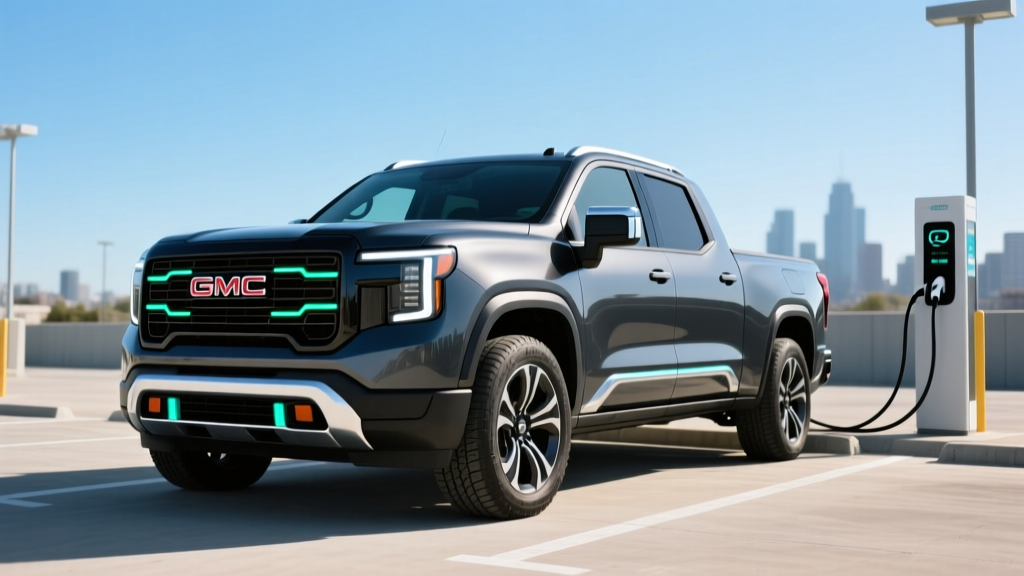
The 2025 GMC Sierra EV arrives with a bold promise: full-size truck capability without a drop of gasoline. But electrifying a vehicle class defined by payload and towing introduces a physics problem that no marketing campaign can hide — mass. The 2025 GMC Sierra EV curb weight lands between approximately 8,600 and 8,930 pounds depending on trim, making it one of the heaviest production light-duty pickups ever sold in the United States. That number shapes everything from efficiency and tire wear to bridge-weight restrictions and garage-floor loading.
After spending time with the specs, cross-referencing EPA data, and analyzing how this mass affects real-world ownership, we've assembled everything buyers need to know before signing a purchase order. From the Ultium battery platform to the available 440-mile range target, here is the complete picture.
2025 GMC Sierra EV Curb Weight: Why It Matters
The headline number demands context. At roughly 8,600–8,930 lbs (depending on trim and equipment), the Sierra EV outweighs a comparable gas-powered Sierra 1500 crew cab by approximately 3,000–3,500 lbs. That delta comes primarily from the Ultium battery pack, which GMC has confirmed at over 200 kWh of total capacity — one of the largest battery packs ever fitted to a production vehicle.
Why does curb weight matter for truck buyers specifically?
- Payload capacity: The Sierra EV's maximum payload is rated at approximately 1,800 lbs (Denali Edition 1) to 1,450 lbs (Elevation). Heavy batteries consume a significant portion of the Gross Vehicle Weight Rating (GVWR), leaving less room for cargo in the bed.
- Towing dynamics: The Sierra EV is rated to tow up to 12,500 lbs (Denali Edition 1 with max trailering). High curb weight actually helps with trailer stability — a heavy tow vehicle resists push from a loaded trailer — but it also means more energy is required to move the combined mass, which directly impacts range while towing.
- Tire wear and maintenance: Heavier vehicles wear tires faster. Expect to replace tires more frequently than on a gas Sierra, and budget for EV-rated tires with higher load indexes (typically XL or reinforced sidewall construction).
- Infrastructure limits: Some older parking structures, residential garage slabs, and rural bridges post weight limits in the 8,000–10,000 lb range. Know your routes.
| Trim | Curb Weight (lbs) | GVWR (lbs) | Max Payload (lbs) |
|---|---|---|---|
| Elevation (2WT) | ~8,600 | ~10,100 | ~1,450 |
| Denali Edition 1 | ~8,930 | ~10,400 | ~1,800 |
| AT4 (upcoming) | ~8,800 (est.) | TBD | TBD |
GMC has not published a single unified curb-weight figure for every configuration, and final numbers vary with options like the available 24-module battery vs. smaller pack configurations planned for later model years. Always confirm the door-jamb sticker on the specific truck you're evaluating.
Range, Efficiency, and Real-World Expectations
The Sierra EV Denali Edition 1 targets an EPA-estimated range of up to 440 miles on a full charge when equipped with the largest available battery pack. The Elevation 2WT trim, optimized for fleet and commercial use with a slightly different battery configuration, targets approximately 400 miles. These are among the highest range figures of any production electric vehicle, let alone a full-size pickup.
EPA 440 miles (Denali Edition 1, max battery) | Expect 350–390 miles in mixed highway driving at 70–75 mph. Towing a 7,000-lb trailer? Plan for 180–230 miles before needing a charge. Cold-weather (below 30°F) range loss of 15–25% is typical for a pack this large without aggressive preconditioning.
Efficiency for a vehicle this heavy is inherently constrained by physics. Moving nearly 9,000 lbs requires energy, and early estimates place the Sierra EV Denali Edition 1 at approximately 48–52 MPGe combined, or roughly 65–70 kWh per 100 miles. That's significantly less efficient than a midsize EV sedan (which can achieve 120+ MPGe), but it's competitive within the electric truck segment — the Ford F-150 Lightning extended-range achieves around 49 MPGe combined, and the Rivian R1T dual-motor lands near 47 MPGe.
The Sierra EV's advantage is sheer battery capacity. Even with mediocre efficiency, a 200+ kWh pack delivers exceptional range. The trade-off is charging time and electricity cost — filling a pack this large from empty is neither fast nor cheap.
Battery, Charging Speed, and Infrastructure
The Sierra EV rides on GM's Ultium platform using a dual-layer battery architecture with up to 24 battery modules. GM has not published the exact usable kWh figure, but total pack capacity exceeds 200 kWh. The chemistry is NMC (nickel manganese cobalt), which offers higher energy density than LFP — a critical consideration when you're trying to fit 440 miles of range into a truck chassis.
NMC trade-offs to understand: this chemistry is more sensitive to sustained 100% state of charge and extreme heat. For daily driving, GM recommends charging to 80–90% to maximize long-term battery health. Reserve 100% charges for road-trip days.
| Charging Level | Power / Rate | Estimated Time / Miles Added |
|---|---|---|
| Level 1 (120V household) | ~1.4 kW | ~3–4 miles per hour of charging |
| Level 2 (240V home, 48A) | ~11.5 kW | ~28–32 miles per hour; full charge ~18–20 hours |
| Level 2 (240V, 80A capable) | ~19.2 kW | ~47–52 miles per hour; full charge ~11–12 hours |
| DC Fast Charge (peak) | Up to 350 kW | 10–80% in approximately 35–45 minutes* |
*DC fast-charge times depend heavily on battery temperature, state of charge, and charger capability. The Sierra EV's massive battery means it can sustain high charge rates longer than smaller-pack EVs, but the absolute energy required to go from 10% to 80% (~140+ kWh) means even at sustained 250+ kW averages, the session takes longer than a smaller-pack vehicle charging at similar peak rates.
The Sierra EV uses the NACS (North American Charging Standard) connector natively, giving it direct access to Tesla's Supercharger network — a major advantage for road-trip charging infrastructure. At home, the available 19.2 kW onboard charger is one of the fastest in the segment, but it requires a 100-amp dedicated circuit and a hardwired Level 2 station. Budget $2,000–$4,500 for professional installation depending on your electrical panel's capacity. Many Sierra EV buyers will need a panel upgrade to 200A or 400A service, which can add $1,500–$4,000.
Performance and Drivetrain
The Sierra EV Denali Edition 1 features a dual-motor all-wheel-drive powertrain producing an estimated 754 horsepower and 785 lb-ft of torque. GMC claims a 0–60 mph time of under 4.5 seconds — remarkable for a vehicle that weighs nearly 9,000 lbs. The instant torque delivery of electric motors is especially effective here, as there's no turbo spool-up or transmission downshift delay when you need to merge or pass.
The Elevation 2WT trim offers a dual-motor AWD configuration with a more modest output (estimated ~510 hp, though GMC has not finalized all powertrain specs for lower trims). Fleet buyers prioritizing range and payload over performance will find this configuration more cost-effective.
| Specification | Denali Edition 1 | Elevation (Est.) |
|---|---|---|
| Drivetrain | Dual-motor AWD | Dual-motor AWD |
| Horsepower | 754 hp | ~510 hp |
| Torque | 785 lb-ft | ~600 lb-ft |
| 0–60 mph | Under 4.5 sec | ~5.5–6.0 sec (est.) |
| Max Towing | 12,500 lbs | 10,000 lbs (est.) |
| Max Payload | ~1,800 lbs | ~1,450 lbs |
One standout capability feature: GMC's CrabWalk four-wheel steering system (available on Denali trims) allows the rear wheels to turn in phase with the front wheels at low speeds, enabling diagonal movement — useful for tight trail obstacles and parallel parking a truck this size. The Sierra EV also features an available adaptive air suspension that can raise the ride height for off-road clearance or lower it for highway efficiency and easier bed access.
Pricing, Trims, and Federal Tax Credit Eligibility
The 2025 GMC Sierra EV launched with the Denali Edition 1 as the initial halo trim, carrying a starting MSRP of approximately $99,495 (including destination). The more accessible Elevation trim is expected to start around $55,000–$60,000 when it becomes widely available, though exact pricing depends on battery configuration.
| Trim | Base MSRP | As-Tested (Typical) | Est. Federal Credit |
|---|---|---|---|
| Elevation (2WT, standard battery) | ~$55,000–$60,000 | ~$62,000–$68,000 | Up to $7,500* |
| Denali Edition 1 | $99,495 | $100,000–$105,000 | Up to $7,500* |
*Federal tax credit eligibility under IRS §30D is subject to multiple requirements. Consult IRS.gov and a tax professional before relying on credit estimates.
- MSRP cap: Pickup trucks must have an MSRP at or below $80,000 to qualify. The Denali Edition 1 at $99,495 exceeds this cap and does NOT qualify.
- Buyer income limits: Modified AGI must not exceed $300,000 (joint filers), $225,000 (head of household), or $150,000 (individual).
- Battery sourcing: A percentage of critical minerals and battery components must be sourced from the US or free-trade-agreement countries. These percentages increase annually. Verify current-year requirements on IRS.gov.
- Point-of-sale transfer: As of 2024, buyers can transfer the credit to the dealer at purchase, reducing the upfront price rather than waiting for a tax refund.
- Assembly: Vehicle must undergo final assembly in North America. The Sierra EV is assembled at GM's Factory ZERO in Detroit-Hamtramck, Michigan — this requirement is met.
The Denali Edition 1's six-figure price tag puts it squarely in luxury-truck territory, competing with the Ford F-150 Lightning Platinum (~$97,000), Rivian R1T tri-motor (~$99,000+), and the Tesla Cybertruck Cyberbeast (~$100,000). The upcoming Elevation trim at ~$55,000–$60,000 is where the Sierra EV becomes genuinely competitive with mainstream truck buyers — and where the $7,500 federal credit (if eligible) meaningfully changes the value equation.
Interior, Cargo, and Technology
The Sierra EV's cabin reflects GMC's Denali luxury ambitions. The centerpiece is a standard 16.8-inch diagonal infotainment touchscreen running GM's latest Google Built-in interface with native Google Maps, Google Assistant, and access to the Play Store. A secondary 11-inch digital instrument cluster sits behind the steering wheel, and an available head-up display projects speed and navigation onto the windshield.
Passenger space is generous, consistent with the crew-cab configuration:
- Front legroom: ~44.5 inches
- Rear legroom: ~43.4 inches
- Front headroom: ~42.8 inches
- Rear headroom: ~40.2 inches
The bed measures approximately 5 feet 11 inches (71 inches) with the standard MultiPro tailgate closed, extending to over 8 feet with the available MidGate folded down — a pass-through between the bed and cabin that allows the Sierra EV to carry items up to approximately 10 feet long with the tailgate down. This MidGate feature is borrowed from the Chevrolet Avalanche playbook and is a genuine differentiator vs. competitors.
Under the hood, the Sierra EV offers a front trunk (frunk) with approximately 10.7 cubic feet of lockable, weather-sealed storage — enough for a large cooler or multiple carry-on bags. The frunk includes a drain plug for use as an ice chest and available power outlets.
Driver-assistance technology includes GM's Super Cruise — a Level 2 hands-free driving system on compatible mapped highways. Note: Super Cruise is not autonomous driving. The driver must remain attentive, and the system monitors engagement via a driver-facing camera. Super Cruise coverage now spans over 750,000 miles of compatible roads in North America. Available Trailering Super Cruise extends hands-free operation while towing — a segment first.
Warranty and Long-Term Ownership
GM backs the Sierra EV with competitive warranty coverage:
- Battery & propulsion system: 8 years / 100,000 miles (whichever comes first), covering defects and capacity loss below a specified threshold (typically 60–70% retained capacity, though GM's exact degradation threshold for the Sierra EV has not been publicly detailed).
- Bumper-to-bumper: 3 years / 36,000 miles
- Powertrain (non-battery): 5 years / 60,000 miles
- Rust-through corrosion: 6 years / 100,000 miles
- Roadside assistance: 5 years / 60,000 miles
For a vehicle at this price point, the 8-year/100,000-mile battery warranty is standard for the segment but not exceptional. Hyundai and Kia offer 10-year/100,000-mile battery coverage on their EVs. Given the Sierra EV's massive battery pack — a potential $30,000–$50,000+ replacement cost out of warranty — buyers planning long-term ownership should factor this into their total cost calculations.
On the positive side, EVs have far fewer moving parts than internal-combustion trucks. No oil changes, no transmission fluid, no exhaust system, no spark plugs. Brake wear is significantly reduced thanks to regenerative braking. The primary ongoing maintenance costs are tire replacement (expect accelerated wear due to curb weight), cabin air filters, windshield washer fluid, and brake fluid checks.
Sierra EV vs. Key Competitors
| Spec | GMC Sierra EV Denali Ed. 1 | Ford F-150 Lightning Platinum | Rivian R1T Dual-Motor | Tesla Cybertruck AWD |
|---|---|---|---|---|
| EPA Range | ~440 mi (target) | ~320 mi (ext. range) | ~352 mi (max pack) | ~340 mi |
| Curb Weight | ~8,930 lbs | ~6,500 lbs | ~7,150 lbs | ~6,600 lbs |
| Battery (kWh) | 200+ (NMC) | 131 (NMC) | ~141 (NMC/LFP) | ~123 (NMC) |
| Peak DC Charge | 350 kW | 150 kW | 220 kW | 250 kW |
| 0–60 mph | <4.5 sec | ~3.8 sec | ~5.0 sec | ~3.9 sec |
| Max Towing | 12,500 lbs | 10,000 lbs | 11,000 lbs | 11,000 lbs |
| Base MSRP | $99,495 | ~$97,874 | ~$79,900 | ~$79,990 |
| Connector | NACS (native) | CCS → NACS adapter | NACS (2025+) | NACS (native) |
The Sierra EV's range advantage is significant — 440 miles eclipses every competitor by 90+ miles. Its 350 kW peak charging capability is also best-in-class for electric trucks. But the curb weight penalty is equally dramatic: at nearly 9,000 lbs, it's 1,800–2,400 lbs heavier than its rivals. That mass affects tire costs, efficiency, and the driving feel, particularly on winding roads or in emergency maneuvers.
- Segment-leading 440-mile EPA range target
- 350 kW DC fast-charging capability
- 12,500-lb max towing rating
- MidGate pass-through for long cargo
- Native NACS / Supercharger access
- Super Cruise with trailering support
- Generous frunk and cabin space
- Extreme curb weight (~8,930 lbs) impacts efficiency and tire wear
- Denali Edition 1 exceeds $80K MSRP cap — no federal tax credit
- Real-world towing range drops dramatically (~200 mi)
- Full Level 2 charge takes 11–20 hours depending on amperage
- Limited initial trim availability; Elevation not yet widely available
- High purchase price vs. gas Sierra 1500 equivalents
Who Should Buy the 2025 GMC Sierra EV?
Choose the Sierra EV if: You need maximum electric range in a full-size truck, you tow moderately (under 8,000 lbs for most trips), you value Super Cruise for highway commuting, and you have reliable access to Level 2 home charging with a 200A+ electrical panel.
Look elsewhere if: Your budget is under $60,000 (wait for the Elevation trim), you tow heavy trailers long distances regularly (towing range drops to ~200 miles), you need a lighter truck for off-road agility, or you want immediate availability across a broad trim lineup.
The Sierra EV is best suited for truck buyers who primarily use their vehicle as a daily driver and commuter with occasional towing and hauling needs. The 440-mile range eliminates range anxiety for most daily and weekly driving patterns, and the NACS connector opens up the most reliable DC fast-charging network in the country. Commercial fleet buyers should watch for the Elevation 2WT trim, which promises a compelling combination of range, payload, and operating-cost savings at a more accessible price point.
For dedicated heavy-towing applications — think 10,000+ lb trailers on 200+ mile trips — the Sierra EV's range advantage diminishes quickly. Towing at highway speeds with a heavy trailer can cut range by 50–60%, meaning even 440 EPA miles becomes roughly 180–220 real-world towing miles. Plan your routes and charging stops accordingly.
Frequently Asked Questions
What is the real-world range of the 2025 GMC Sierra EV?
The Denali Edition 1 targets an EPA-estimated 440 miles. In real-world highway driving at 70–75 mph, expect 350–390 miles. Cold weather (below 30°F) can reduce range by 15–25%. Towing cuts range dramatically — plan for 180–230 miles with a moderately loaded trailer.
How fast does the Sierra EV charge at home and on the road?
At home on a 240V Level 2 charger at 48 amps (~11.5 kW), expect roughly 28–32 miles of range per hour of charging, or a full charge in 18–20 hours. With an 80-amp Level 2 station (~19.2 kW), that improves to ~47–52 miles per hour and 11–12 hours for a full charge. On DC fast chargers, the Sierra EV can accept up to 350 kW peak, achieving 10–80% in approximately 35–45 minutes under ideal conditions.
Does the 2025 GMC Sierra EV qualify for the federal EV tax credit?
It depends on the trim. Under IRS §30D rules, pickup trucks must have an MSRP at or below $80,000 to qualify for the up-to-$7,500 credit. The Denali Edition 1 at $99,495 exceeds this cap and is NOT eligible. The upcoming Elevation trim, expected around $55,000–$60,000, should qualify — subject to buyer income limits, battery-sourcing requirements, and North American final assembly (which the Sierra EV meets). Always verify current rules on IRS.gov and consult a tax professional.
Is the Sierra EV worth buying over the F-150 Lightning or Rivian R1T?
If maximum range is your top priority, the Sierra EV's 440-mile target is unmatched. The F-150 Lightning offers a more proven track record with wider availability and lower curb weight, but tops out around 320 miles. The Rivian R1T excels in off-road capability and build quality but can't match the Sierra's range or towing rating. Your choice depends on whether you prioritize range (Sierra EV), proven reliability and dealer network (Lightning), or off-road versatility (R1T).
How does the Sierra EV's weight affect daily driving?
At ~8,930 lbs, the Sierra EV feels planted and stable on the highway, and the mass aids trailer stability. However, expect higher tire wear (budget for replacements every 25,000–35,000 miles), increased energy consumption (roughly 65–70 kWh/100mi), and reduced agility on twisty roads compared to lighter electric trucks. The air suspension and adaptive dampers help manage the weight, but physics is physics.
What connector does the Sierra EV use?
The Sierra EV uses the NACS (North American Charging Standard) connector natively, providing direct access to Tesla Superchargers without an adapter. This is a significant advantage for road-trip charging, as the Supercharger network remains the most reliable and widely available DC fast-charging infrastructure in the US.