The Real Math Behind 2025 GMC Hummer EV Lease Deals
The GMC Hummer EV is a 9,000-pound electric supertruck that commands attention — and a premium price. With MSRPs ranging from roughly $98,000 for the 2X trim to over $112,000 for the 3X and Edition 1 variants, many buyers are turning to leasing as a way to get behind the wheel without absorbing the full depreciation hit. But before you sign any 2025 GMC Hummer EV lease deal, you need to understand the total ownership picture: what you'll actually spend on charging, insurance, and maintenance over the lease term, and whether the federal tax credit applies to your situation.
This guide breaks down the exact numbers — from the Ultium battery specs to real-world range expectations, from IRS §30D eligibility rules to per-mile charging costs — so you can evaluate any Hummer EV lease offer with clear eyes.
Battery: 246 kWh gross / ~212 kWh usable (NMC lithium-ion, Ultium platform)
EPA Range: 329 miles (Pickup 3X) / 381 miles (Pickup 2X)
Peak DC Fast Charge: 350 kW (800V architecture)
10–80% DC Charge: ~32 minutes (at 350 kW-capable station)
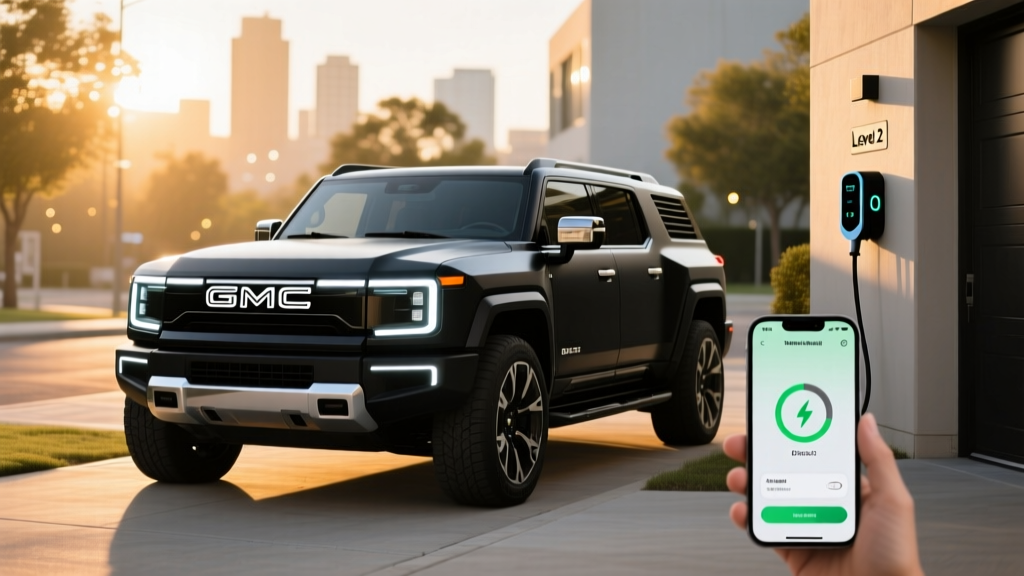
Level 2 Charge Rate: 11.5 kW (adds ~31 miles/hour)
Horsepower: 830 hp (3X, tri-motor) / 625 hp (2X, dual-motor)
0–60 mph: ~3.0 seconds (3X with Watts to Freedom mode)
Base MSRP: ~$106,400 (3X) / ~$98,545 (2X)
Battery/Powertrain Warranty: 8 years / 100,000 miles
How Much Does a Hummer EV Really Cost Over 5 Years?
Leasing a Hummer EV typically means a 36-month commitment, but understanding the 5-year cost picture helps you evaluate whether a lease or purchase makes more financial sense — and what you'll actually pay beyond the monthly payment. Here's a realistic total cost of ownership (TCO) breakdown for the 2025 GMC Hummer EV Pickup 3X, assuming 15,000 miles driven annually and home Level 2 charging as the primary method.
| Category | Estimated 5-Year Cost | Notes |
|---|---|---|
| Vehicle Purchase (MSRP) | $106,400 | 3X trim, before incentives |
| Federal Tax Credit (§30D) | −$7,500 | If eligible — see eligibility section |
| Home Charging Electricity (5 yrs) | $5,250 | At $0.16/kWh avg, 3 mi/kWh efficiency |
| Insurance (5 yrs) | $18,000–$24,000 | $3,600–$4,800/year typical |
| Maintenance (5 yrs) | $1,500–$2,500 | Tires, cabin filter, wiper fluid, brake fluid |
| Depreciation (5 yrs) | $45,000–$55,000 | ~45–52% loss based on luxury EV trends |
| Net 5-Year Cost (After Credit) | $69,950–$82,150 | Excluding state registration/taxes |
If you're leasing rather than buying, the depreciation risk falls on the lessor — which is precisely why Hummer EV lease deals can be attractive. A well-structured 36-month lease might run $1,200–$1,800/month depending on money factor, residual value, and down payment, insulating you from the steep depreciation curve that luxury EVs typically experience.
Federal Tax Credit: Do You Qualify for §30D on the Hummer EV?
The federal EV tax credit under IRS §30D offers up to $7,500 for qualifying new EVs, but the Hummer EV's six-figure price tag puts it in a complicated position. The rules are strict, and they've evolved significantly since the Inflation Reduction Act reshaped eligibility. Here's what you need to know for 2025 model-year purchases and leases.
- Vehicle MSRP Cap: Trucks, SUVs, and vans must have an MSRP ≤ $80,000. The Hummer EV's MSRP ($98,000+) exceeds this cap, making it ineligible for the purchase credit.
- Lease Loophole (Commercial Clean Vehicle Credit §45W): When you lease, the lessor (bank/finance company) may claim the $7,500 commercial credit and pass savings to you as a capitalized-cost reduction. This is not guaranteed — confirm with the dealer that the lease includes the credit pass-through.
- Buyer Income Limits (purchase credit): AGI ≤ $150,000 (single) / $300,000 (married filing jointly) / $225,000 (head of household). Not applicable to the lease/§45W pathway.
- Battery Sourcing Requirements: Critical minerals and battery components must meet phased-in percentages from US/free-trade partners. GM's Ultium batteries use cells manufactured in the US (Lansing, MI and Spring Hill, TN), improving compliance odds.
- Point-of-Sale Transfer: For purchase credits, you can now transfer the credit to the dealer at sale for an immediate price reduction rather than waiting for tax filing. For leases, the §45W credit flows through the lessor.
Source: IRS.gov — Clean Vehicle Credits. Rules are subject to change; consult a tax professional before committing.
The critical takeaway: if you buy a Hummer EV outright, the MSRP cap almost certainly disqualifies it from the $7,500 §30D purchase credit. However, leasing may unlock the $7,500 savings through the §45W commercial credit pathway, which has no MSRP cap and no buyer income cap. This is one of the strongest arguments in favor of 2025 GMC Hummer EV lease deals over outright purchase. Always verify with the leasing company that they intend to pass the credit through to your lease terms.
Charging Costs vs. Gas: The Per-Mile Reality
The Hummer EV is no efficiency champion — at roughly 47 MPGe combined (per fueleconomy.gov), it consumes about 2.1 kWh per mile, or approximately 3 miles per kWh. That's thirsty by EV standards. But compared to a gas truck getting 14–17 MPG combined, the math still favors electrons over gasoline in most scenarios.
| Scenario | Cost/Mile | 5-Year Total (75k mi) |
|---|---|---|
| Hummer EV — Home Charging ($0.16/kWh avg) | $0.070 | $5,250 |
| Hummer EV — Public DC Fast Charging ($0.40/kWh avg) | $0.175 | $13,125 |
| Gas Truck (15 MPG combined, $3.60/gallon) | $0.240 | $18,000 |
| Gas Truck (15 MPG combined, $4.20/gallon) | $0.280 | $21,000 |
The savings are substantial — but only if you charge at home. If you rely primarily on public DC fast charging (at networks like Electrify America or EVgo, where rates often run $0.35–$0.50/kWh), the Hummer EV's massive battery becomes a wallet-drainer. A full 0–100% session at $0.40/kWh would cost roughly $85–$95. Home charging that same battery at $0.16/kWh? About $34.
For context, the Hummer EV's 246 kWh gross battery pack is roughly 3.5 times the size of a Tesla Model Y's pack. That capacity enables its 329-mile EPA range (3X) but means every charging session costs proportionally more. Plan your charging strategy before signing the lease.
Real-World Range: What the EPA Sticker Doesn't Tell You
EPA Rated Range: 329 miles (3X, tri-motor) / 381 miles (2X, dual-motor)
Expected Real-World Highway (70 mph, 70°F): ~260–290 miles (3X)
Expected Cold-Weather Range (30°F, mixed driving): ~220–255 miles (3X)
Heavy Towing/Payload Range: ~150–200 miles (varies by load)
The Hummer EV's 9,000+ lb curb weight and brick-like aerodynamics hit efficiency hard at highway speeds. The dual-motor 2X trades some performance for a longer EPA rating and will deliver better real-world miles per kWh.
GM's 800V architecture and 350 kW peak DC fast-charge capability partially offset the range limitations. On a compatible 350 kW charger, the Hummer EV can add roughly 100 miles of range in 10 minutes, with the 10–80% session taking approximately 32 minutes. However, expect significant tapering above 80% SoC — that last 20% can add another 25–35 minutes. For road trips, plan to charge to 80% and go.
Insurance Costs: The Unpleasant Surprise
EVs generally cost more to insure than their gas counterparts, and the Hummer EV sits at the extreme end. Expect annual premiums of $3,600–$4,800 (or $300–$400/month) for a typical driver profile — significantly above the national average of ~$1,700 for all vehicles.
Why the premium?
- Repair costs: The Hummer EV's specialized Ultium battery pack, tri-motor powertrain, and advanced suspension (adaptive air ride with Extract Mode) require specialized technician training and parts.
- Vehicle value: At $100,000+, comprehensive and collision coverage premiums scale accordingly.
- Weight: At over 9,000 lbs, the Hummer EV poses greater liability risk in multi-vehicle collisions — insurers price this in.
- Limited collision repair network: Fewer body shops are certified for high-voltage EV structural repairs, driving up claim costs.
Before signing any lease, get an insurance quote using the exact VIN. Rates vary wildly by ZIP code, driving history, and insurer. Some companies (like Geico and Progressive) have begun offering EV-specific policies, but don't assume discounts — shop at least three quotes.
Maintenance Savings: Where EVs Actually Deliver
This is where the Hummer EV — and EVs in general — genuinely save money. With no internal combustion engine, there are no oil changes, no spark plugs, no timing belts, no exhaust system repairs, and no transmission fluid swaps. Regenerative braking dramatically extends brake pad life, often pushing rotor and pad replacement beyond 100,000 miles.
| Service Item | Hummer EV Cost | Gas Truck Cost |
|---|---|---|
| Oil Changes | $0 | $750–$1,200 |
| Brake Pads/Rotors | $0–$400 | $1,200–$2,000 |
| Transmission Fluid | $0 | $200–$400 |
| Tires (heavy EV wear) | $1,200–$2,000 | $800–$1,400 |
| Cabin Air Filter / Wipers / Fluids | $200–$400 | $200–$400 |
| Coolant / Misc. Fluids | $100–$200 | $150–$300 |
| Total Estimated (5 yrs) | $1,500–$3,000 | $3,300–$5,700 |
The one caveat: tires. The Hummer EV's massive weight (over 9,000 lbs for the pickup) and instant torque chew through tires faster than a gas truck. Budget for at least one full tire replacement during a 5-year ownership period, with 35-inch all-terrain rubber running $300–$500 per tire.
Depreciation and Resale: The Luxury EV Problem
Luxury EVs have experienced steeper-than-average depreciation in recent years, driven by rapid technology advancement, aggressive price competition (especially from Tesla), and consumer uncertainty about long-term battery health. The Hummer EV is no exception.
Based on observed trends for comparable luxury EVs (Rivian R1T, Tesla Model X, BMW iX), expect the Hummer EV to retain approximately 48–55% of its original MSRP after 5 years and 75,000 miles. On a $106,400 3X model, that translates to $45,000–$55,000 in depreciation — a significant sum.
Factors working against the Hummer EV's resale:
- Niche appeal — not everyone wants a 9,000-lb, 17-foot-long supertruck
- Rapidly evolving EV tech — 2027+ models will likely offer more range and faster charging at lower prices
- High energy consumption makes it less attractive as used-EV buyers prioritize efficiency
Factors working in its favor:
- Limited production volume creates scarcity
- GM's 8-year/100,000-mile battery warranty transfers to second owners
- Cultural cachet as a halo vehicle
This depreciation profile is precisely why leasing can be the financially smarter move. You lock in the residual value at lease signing, and any value drop beyond that is the lessor's problem, not yours.
State, Local, and Utility Incentives
Beyond the federal credit, many states, municipalities, and electric utilities offer additional rebates and incentives for EV purchases and leases — plus for home charging equipment installation. These vary by ZIP code and change frequently. Examples include:
California: CVRP rebate (income-dependent, up to $7,000 for qualifying buyers — though MSRP caps may exclude the Hummer EV), plus utility rebates for Level 2 charger installation ($500–$1,500 from PG&E, SCE, SDG&E).
Colorado: State EV tax credit of up to $5,000 (MSRP caps apply — check current rules).
New York: NYSERDA Drive Clean Rebate (up to $2,000, income/MSRP-dependent).
Utility Programs: Many utilities offer off-peak charging rates ($0.08–$0.10/kWh) and Level 2 charger rebates ($250–$1,000).
Always check your state's energy office website and your utility provider's EV programs page for current offerings. These incentives can stack with federal credits to reduce your effective cost by $1,000–$10,000+ depending on location.
Should You Lease or Buy the Hummer EV?
Lease the Hummer EV if:
- You want to access the $7,500 credit via the §45W commercial lease pathway regardless of MSRP or income caps
- You want to avoid the 45–52% depreciation risk
- You plan to drive 10,000–15,000 miles/year (within standard lease limits)
- You want to upgrade to newer EV tech in 3 years
- Your employer offers a salary-sacrifice or fleet lease program
- You drive more than 15,000 miles/year (lease overage penalties are expensive)
- You plan to keep the vehicle 7+ years, riding out the depreciation curve
- You want to modify the vehicle (lift kits, wraps, aftermarket wheels)
- You can absorb the higher upfront cost and don't qualify for the §45W lease credit anyway
Frequently Asked Questions
Can I get the $7,500 federal tax credit if I lease a 2025 GMC Hummer EV?
Potentially, yes — but through a different mechanism than a purchase. When you lease, the lessor (typically GM Financial or another bank) owns the vehicle and may claim the $7,500 Commercial Clean Vehicle Credit under IRS §45W. This credit has no MSRP cap and no buyer income cap, unlike the §30D purchase credit. The lessor may pass this savings to you as a capitalized-cost reduction (effectively lowering your monthly payment), but this is not automatic. Always confirm with the dealer and lessor that the lease structure includes the §45W credit pass-through before signing.
How much will I spend charging the Hummer EV at home per month?
Assuming you drive 1,250 miles per month and achieve roughly 3 miles per kWh (the Hummer EV's real-world efficiency), you'll consume about 417 kWh monthly. At the US average residential electricity rate of $0.16/kWh, that's approximately $67/month for home charging. If your utility offers off-peak EV rates ($0.08–$0.10/kWh), you could reduce that to $33–$42/month by scheduling overnight charging sessions.
Does the Hummer EV qualify for HOV lane access?
In most states that offer HOV lane stickers or decals for EVs (California, Colorado, Virginia, etc.), the Hummer EV qualifies as a zero-emission vehicle. However, California's Clean Air Vehicle decal program has income caps for new applicants. Check your state's DMV for current eligibility and decal availability.
What happens if the battery degrades during my lease?
GM covers the Ultium battery pack for 8 years or 100,000 miles against defects and excessive capacity loss (typically defined as dropping below 60–70% of original capacity). During a 3-year lease, you're well within this warranty window. Meaningful degradation in the first 36 months is extremely unlikely based on observed Ultium platform performance. If you purchase rather than lease, the remaining warranty transfers to subsequent owners.
How much does a 2025 GMC Hummer EV lease typically cost per month?
Lease payments vary significantly based on trim, down payment (capitalized-cost reduction), money factor, lease term, and whether the §45W credit is applied. Expect monthly payments in the range of $1,200–$1,800 for a 36-month lease on a 3X trim with $5,000–$10,000 due at signing. The 2X trim, with its lower MSRP, may lease for $1,000–$1,500/month under similar terms. Always compare the total lease cost (monthly × term + due at signing) rather than focusing on the monthly payment alone.
Is the Hummer EV good for towing, and how does it affect range?
The Hummer EV 3X is rated to tow up to 7,500 lbs. However, towing at or near max capacity will reduce your effective range by 40–55%, bringing real-world range down to roughly 150–200 miles depending on trailer weight, terrain, and speed. If towing is a primary use case, plan charging stops accordingly and understand that the 350 kW DC fast-charge capability becomes essential for maintaining reasonable trip times.