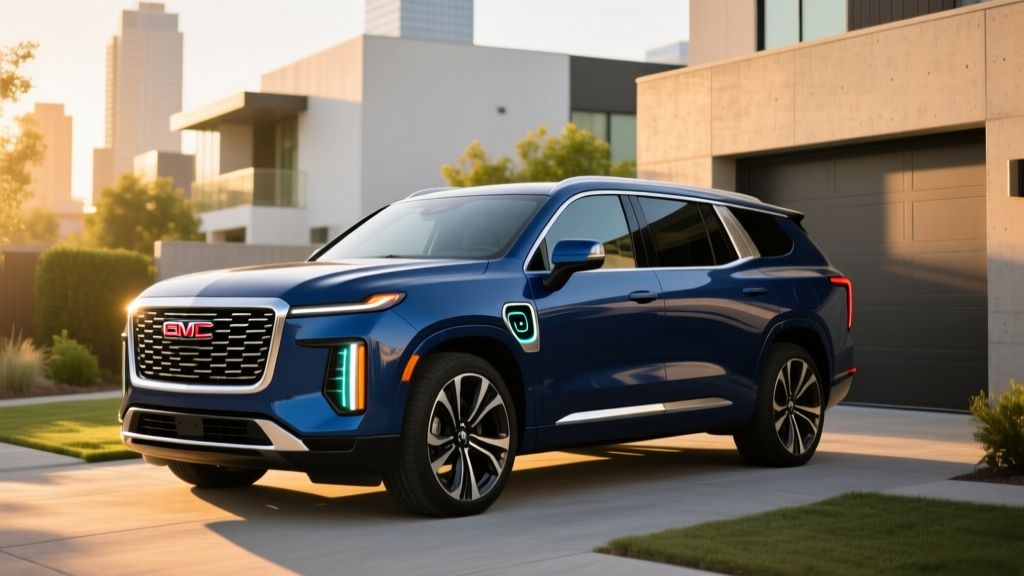
If you're searching for the 2025 GMC Denali EV, you're looking at the GMC Sierra EV Denali Edition 1 — GMC's flagship electric pickup built on GM's Ultium platform. Here's the quick answer: it offers an EPA-estimated 440 miles of range, peaks at 350 kW DC fast charging (10–80% in roughly 20 minutes), produces up to 754 horsepower, and starts at $99,495 before incentives. It's one of the longest-range electric trucks on the market, but its six-figure price and massive footprint make it a niche proposition. Below, we break down every number you need to decide whether it fits your driveway and budget.
2025 GMC Sierra EV Denali: Core Specifications
GMC positions the Sierra EV Denali as a luxury electric truck that can tow, haul, and cross the country without range stress. The Edition 1 trim is the only configuration available for the 2025 model year, loaded with features that would be optional on lesser trims. Here are the exact figures from fueleconomy.gov and GMC's official specifications:
| Spec | Value |
|---|---|
| EPA Range | 440 miles (est.) |
| Battery Capacity | ~200 kWh usable (NMC chemistry, Ultium platform) |
| Max DC Fast Charge Rate | 350 kW peak |
| 10–80% DC Charge Time | ~20 minutes (at 350 kW-capable station) |
| Level 2 Charging (240V) | 19.2 kW onboard charger (~11.5 hours 0–100%) |
| Horsepower | 754 hp (max, with launch mode) |
| Torque | 785 lb-ft |
| 0–60 mph | ~4.5 seconds |
| Towing Capacity | 9,500 lbs (Edition 1); up to 12,000 lbs future trims |
| Payload | ~1,800 lbs |
| Base MSRP | $99,495 (Edition 1, incl. destination) |
| Battery/Powertrain Warranty | 8 years / 100,000 miles |
| Charging Port | CCS1 (NACS adapter available for Tesla Supercharger access) |
Charging the Sierra EV Denali: Speed, Infrastructure & Home Setup
The Sierra EV's 800-volt Ultium architecture enables 350 kW peak DC fast charging — among the fastest of any production electric truck. But peak rate isn't sustained rate. Here's what the charging curve actually looks like and what you'll experience at different charger types:
| Charging Level | Power | Miles Added per Hour | Notes |
|---|---|---|---|
| Level 1 (120V household) | ~1.4 kW | ~3 mi/hr | Emergency/trickle only; full charge takes ~6 days |
| Level 2 (240V home) | Up to 19.2 kW | ~42 mi/hr | Requires 100A circuit for max rate; 60A circuit yields ~11.5 kW / ~25 mi/hr |
| DC Fast (150 kW station) | 150 kW sustained | ~320 mi/hr | 10–80% in ~40 min; common at Electrify America, EVgo |
| DC Fast (350 kW station) | 350 kW peak | ~750 mi/hr | 10–80% in ~20 min; rate tapers significantly above 80% SoC |
Home charging reality: To unlock the Sierra EV's full 19.2 kW Level 2 rate, you need a hardwired wall connector on a dedicated 100-amp circuit. Most residential electrical panels are 200 amps total — a 100A EV circuit may require a panel upgrade ($2,000–$5,000) or a smart load-management device. A more common 60A circuit delivers about 11.5 kW, which still adds roughly 25 miles per hour — enough to fully replenish overnight for most daily driving.
Public charging access: The Sierra EV ships with a CCS1 port. GMC provides a NACS adapter, enabling access to Tesla's Supercharger network (15,000+ stalls nationwide). This is a significant advantage: combined CCS and NACS coverage makes the Sierra EV one of the best-connected electric trucks for road trips. At Electrify America or EVgo 350 kW stations, you'll see peak speeds; at older 50–150 kW stations, charging will take 35–60 minutes for a 10–80% session.
Sierra EV Denali vs. Gas Sierra Denali: 5-Year Cost Breakdown
The most common question from truck buyers: does the electric Sierra save money over the gas Sierra Denali? Let's compare the 2025 Sierra EV Denali Edition 1 against a similarly equipped 2025 Sierra 1500 Denali Ultimate (6.2L V8, ~$82,000 MSRP) over five years and 75,000 miles.
| Cost Category | Sierra EV Denali ($99,495) | Gas Sierra Denali Ultimate (~$82,000) |
|---|---|---|
| Purchase Price | $99,495 | $82,000 |
| Federal Tax Credit (§30D) | Up to $7,500 (see eligibility below) | $0 |
| Effective Purchase | ~$91,995 | $82,000 |
| Fuel/Energy (75k mi) | $4,500–$6,750 (home + public mix) | $13,500–$16,875 (15 mpg avg, $3.60–$4.50/gal) |
| Maintenance (5 yr) | ~$1,200 (cabin filter, tires, wipers) | ~$4,500 (oil, trans fluid, brakes, filters) |
| Insurance (est. avg) | ~$14,000 ($2,800/yr) | ~$10,500 ($2,100/yr) |
| Estimated Depreciation | ~$35,000 | ~$30,000 |
| 5-Year Total Cost | ~$146,695–$148,945 | ~$140,500–$143,875 |
The verdict on cost: The Sierra EV Denali costs roughly $5,000–$8,000 more to own over five years, primarily because of the higher purchase price and steeper insurance premiums. Fuel savings of $7,000–$12,000 and lower maintenance narrow the gap significantly, but they don't fully overcome the $17,495 price delta. The EV makes financial sense if you drive more than 15,000 miles annually (amplifying fuel savings), have cheap home electricity ($0.10–$0.15/kWh), or plan to keep the truck beyond five years (where maintenance savings compound).
Insurance is consistently higher for the EV variant — typically 25–40% more — due to higher repair costs, specialized parts, and the battery's replacement value. Get quotes from your insurer before committing.
Federal Tax Credit Eligibility: What You Actually Qualify For
The Sierra EV Denali Edition 1's $99,495 MSRP clears the IRS §30D price cap for pickup trucks ($80,000). However, several other requirements determine whether you receive the full $7,500, a partial credit, or nothing at all. As of current IRS rules referenced at irs.gov:
- MSRP Cap: Must be ≤$80,000 for SUVs/pickups — Sierra EV Denali at $99,495 exceeds this cap. This is a critical issue: the Edition 1 trim likely does NOT qualify for the federal credit.
- Buyer Income Limits: AGI must not exceed $300,000 (married filing jointly), $225,000 (head of household), or $150,000 (individual).
- Battery Sourcing: Critical minerals and battery components must meet phased-in percentage thresholds from US or FTA-partner countries.
- Point-of-Sale Transfer: Eligible buyers can transfer the credit to the dealer for an immediate price reduction at purchase.
EV Truck vs. Gas Truck: Common Misconceptions, Corrected
Electric trucks generate more myths than any other EV segment. Here are the facts behind the most common claims you'll encounter while researching the Sierra EV Denali:
| Myth | Fact |
|---|---|
| "EV trucks can't tow anything real." | The Sierra EV Denali tows 9,500 lbs (Edition 1) — enough for most boat, horse, and travel trailers. Range drops ~50% while towing, so plan charging stops accordingly. |
| "The battery will need replacing in 5 years." | GM's Ultium battery is warrantied for 8 years/100,000 miles with a capacity retention threshold (typically 60–70%). Real-world degradation data from similar Ultium packs suggests 10–15% loss over 150,000 miles. |
| "Charging takes hours on road trips." | At a 350 kW station, 10–80% takes ~20 minutes. At a 150 kW station, ~40 minutes. You'll stop every 3–4 hours anyway; a 20–30 minute break aligns with normal driving patterns. |
| "EVs are worse in cold weather." | Range drops 15–25% in sub-freezing temps — real, but manageable with the Sierra EV's massive battery. Preconditioning while plugged in recovers much of the loss. The truck's heat pump (standard) helps significantly. |
| "Home charging requires a full panel upgrade." | Not always. A 60A circuit (common in 200A panels) delivers ~11.5 kW — sufficient for overnight charging. A 100A circuit for max 19.2 kW may need a panel upgrade or load-management device. Get an electrician assessment ($200–$400) before assuming the worst. |
Real-World Ownership: Who the Sierra EV Denali Actually Fits
After analyzing the specs, costs, and infrastructure realities, the Sierra EV Denali serves a specific buyer profile. It's not universally the right truck — and that's fine. Here's a practical decision framework:
Choose the Sierra EV Denali If:
- You have home Level 2 charging (or can install it) — daily driving under 100 miles means you'll almost never visit a public charger for routine use.
- You drive 15,000+ miles per year — higher mileage amplifies the per-mile energy savings vs. a 15-mpg gas V8.
- You value instant torque and quiet operation — 754 hp and 785 lb-ft from a standstill, with no engine drone. It's a fundamentally different driving experience.
- You want cutting-edge truck tech — the Sierra EV features a MultiPro Midgate (extends the bed into the cabin), 4-wheel steering (CrabWalk capability), and a 16.8-inch infotainment screen.
- You can absorb the $99,495 price without relying on the federal tax credit to make the math work.
- You rarely tow long distances — or you're willing to plan charging stops on towing days.
Stick With the Gas Sierra Denali (or Consider a Hybrid) If:
- You lack reliable home charging access — apartment dwellers and street parkers will find public-only charging frustrating and more expensive ($0.35–$0.50/kWh at DC stations vs. $0.12–$0.18/kWh at home).
- You regularly tow over 200+ miles — towing halves your range and doubles your charging stops. A gas or diesel truck remains more practical for frequent heavy towing.
- You need a sub-$80,000 truck — the gas Sierra Denali Ultimate starts around $82,000 and often transacts below MSRP with dealer incentives.
- You live in a charging desert — rural areas with sparse DC fast-charging infrastructure make road trips in any EV stressful. Check PlugShare or the DOE charging map for coverage in your area.
- You want maximum payload — the Sierra EV's ~1,800-lb payload trails the gas Sierra 1500's ~2,200-lb capacity, and the EV's heavy battery eats into GVWR.
First-Time EV Buyer Checklist: What to Know Before Ordering
If the Sierra EV Denali is your first electric vehicle, these practical steps will prevent costly surprises:
- Get an electrical assessment. Have a licensed electrician evaluate your panel capacity for a Level 2 charger. Budget $500–$2,500 for a straightforward install, or $3,000–$7,000 if a panel upgrade is needed.
- Check your daily driving pattern. The average American drives 37 miles per day (FHWA data). The Sierra EV's 440-mile range covers nearly two weeks of average commuting without charging.
- Download charging apps before delivery. PlugShare, Electrify America, EVgo, and the Tesla app (for Supercharger access via adapter) are essential. Know where your nearest DC fast chargers are.
- Understand the charge curve. Charging from 10–80% at a fast charger is quick; 80–100% is painfully slow (the battery management system restricts current to protect the cells). Plan to charge to 80% on road trips and only top up to 100% when you need the full range.
- Get insurance quotes early. EV insurance is 25–40% higher on average. Shop multiple carriers — some offer EV-specific discounts.
- Verify state incentives. Some states offer rebates, HOV lane access, or reduced registration fees for EVs. Check your state's energy office or AFDC incentive database.
Frequently Asked Questions
Is the 2025 GMC Sierra EV Denali available to order now?
Yes. The Sierra EV Denali Edition 1 began deliveries in 2024 as a 2025 model year vehicle. Availability varies by dealer; expect wait times or markups in high-demand markets. Lower-priced trims (Elevation, AT4) are expected for the 2026 model year, potentially starting in the $55,000–$75,000 range.
What's the real-world range of the Sierra EV Denali?
EPA-estimated at 440 miles, but expect 350–380 miles in real-world highway driving at 70–75 mph. Cold weather (below freezing) reduces this to 330–375 miles. Towing a 6,000-lb trailer drops range to approximately 200–220 miles. The massive battery provides a generous buffer, but aerodynamic drag and weight are unavoidable physics for a full-size truck.
Does the Sierra EV Denali qualify for the $7,500 federal tax credit?
Likely not. The Edition 1's $99,495 MSRP exceeds the §30D cap of $80,000 for trucks and SUVs. Future lower-priced trims may qualify. Always check the current IRS qualified vehicle list and consult a tax professional before relying on the credit in your purchase decision.
How long does it take to charge the Sierra EV Denali at home?
On a 60A Level 2 circuit (~11.5 kW), a full charge takes approximately 17 hours. On a 100A circuit (19.2 kW), about 10–11 hours. For most owners charging overnight after daily driving of 40–80 miles, a 60A circuit replenishes the battery in 4–7 hours — well within a single overnight session.
Can the Sierra EV Denali use Tesla Superchargers?
Yes. GMC provides a NACS adapter that enables Sierra EV owners to charge at Tesla Supercharger stations. This significantly expands the available fast-charging network, adding over 15,000 Supercharger stalls to the CCS-based Electrify America, EVgo, and ChargePoint networks.
What is the battery replacement cost?
GM has not published an exact replacement figure for the Sierra EV's ~200 kWh Ultium pack, but industry estimates for batteries of this capacity range from $20,000 to $35,000 (parts and labor). The 8-year/100,000-mile warranty covers defects and excessive degradation (below the stated retention threshold). Battery prices continue to decline, and replacement should become more affordable over the truck's lifespan.