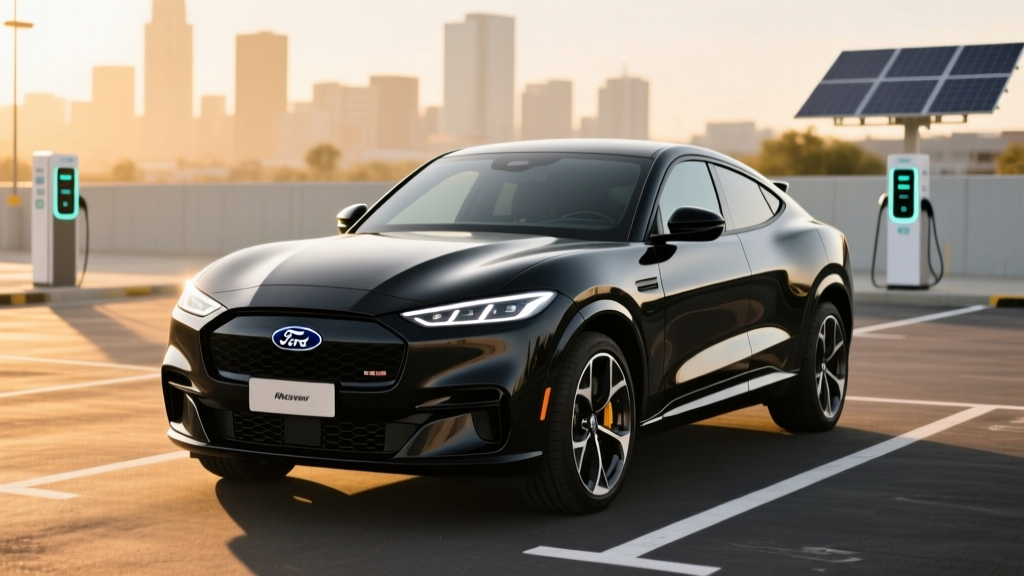
The 2025 Ford Mustang Mach-E enters its fifth model year with meaningful updates that address the most common complaints from early adopters: faster DC charging, standard Tesla Supercharger access via the native NACS port, and a revised battery pack. For buyers researching 2025 Ford Mustang Mach-E specs, the headline is a 320-mile EPA-estimated range on the California Route 1 Extended Range trim — but as with any EV, the real story lives in the details of charging curves, cold-weather behavior, and total cost after incentives.
This review breaks down every number that matters — from usable battery chemistry to real-world highway efficiency — so you can decide whether the Mach-E earns a spot in your driveway or whether a Tesla Model Y, Hyundai Ioniq 5, or Chevrolet Equinox EV fits better.
2025 Mustang Mach-E Spec Sheet at a Glance
| Attribute | Value |
|---|---|
| EPA Range (max) | 320 mi (CA Route 1 Ext. Range RWD) |
| Usable Battery | 91 kWh (NMC lithium-ion) |
| Standard Battery | 72 kWh usable (NMC) |
| Peak DC Fast Charge | 150 kW |
| 10–80% DC Charge Time | ~36 minutes |
| Level 2 Home Charge Rate | 10.5 kW / ~30 mi/hr |
| 0–60 mph (GT Perf.) | 3.3 seconds |
| Horsepower (GT) | 480 hp / 634 lb-ft |
| MPGe (Select AWD Ext.) | 98 MPGe combined (2.9 kWh/mi) |
| Cargo Volume (rear seats up) | 29.7 cu ft |
| Frunk | 4.7 cu ft (drainable) |
| Base MSRP | $39,995 (Select SR RWD) |
| Battery Warranty | 8 yr / 100,000 mi (≥70% retention) |
Range, Efficiency, and Real-World Expectations
Ford offers two battery sizes for 2025: a 72-kWh Standard Range pack and a 91-kWh Extended Range pack. Both use NMC (nickel-manganese-cobalt) chemistry — the industry standard for balancing energy density with longevity. Unlike the LFP packs found in some Tesla Model Y Standard Range variants, NMC delivers higher energy density but benefits from daily charge limits around 80–90% to maximize cycle life.
- Select Extended Range AWD: EPA 305 mi → expect ~255–275 mi at 70 mph highway; ~215–240 mi in sub-30°F winter driving.
- California Route 1 Extended Range RWD: EPA 320 mi → expect ~270–290 mi highway; ~230–255 mi in cold weather.
- GT Extended Range AWD: EPA 280 mi → expect ~230–250 mi highway with aggressive driving.
- Standard Range AWD: EPA 250 mi → expect ~205–225 mi highway.
These estimates assume no preconditioning. Using the Mach-E's battery preconditioning feature before DC fast charging or in extreme cold recovers some of that loss by warming the pack to optimal operating temperature.
Efficiency on the Extended Range AWD Select lands at 98 MPGe combined (roughly 34 kWh/100 mi or 2.9 kWh/mi) per EPA fueleconomy.gov data. That puts it slightly behind the Hyundai Ioniq 5 Long Range AWD (110 MPGe) but competitive with the Volkswagen ID.4 AWD Pro (100 MPGe). On the highway, expect closer to 3.2–3.5 kWh/mi depending on speed, elevation, and climate control usage.
Charging Speed: DC Fast, Level 2, and NACS Access
The 2025 Mach-E's biggest hardware change is the native NACS (North American Charging Standard) port, replacing the previous CCS1 connector. This means 2025 owners get plug-and-play access to Tesla's Supercharger network — over 20,000 stalls in North America — without any adapter. For the roughly 30% of U.S. drivers who live in areas where Electrify America or EVgo coverage is sparse, this is a practical ownership advantage.
| Charge Level | Power / Rate | Time / Range Added |
|---|---|---|
| Level 1 (120V household) | ~1.4 kW | ~4 mi/hr — overnight trickle only |
| Level 2 (240V, 48A home) | 10.5 kW | ~30 mi/hr; full 0–100% in ~9.5 hr (ER) |
| Level 2 (240V, 32A mobile) | 7.7 kW | ~22 mi/hr; full 0–100% in ~12.5 hr |
| DC Fast Charge (peak) | 150 kW | 10–80% in ~36 min; 80–100% tapers sharply |
| DC Fast (sustained avg 10–80%) | ~110–120 kW | Real-world average on 350-kW EA stalls |
Understanding the charge curve: The Mach-E peaks at 150 kW only between roughly 10–35% State of Charge. From 35–60%, it sustains around 120 kW. Above 80%, the rate drops below 50 kW to protect the NMC cells. If you're road-tripping, plan DC stops to arrive at 10–15% SoC and depart at 80% — charging past 80% at a public stall is rarely time-efficient. At home on a 10.5-kW Level 2 wall connector, expect a full overnight charge in under 10 hours, which covers virtually all daily driving needs.
For home Level 2 installation, budget $800–$2,000 for the charger hardware plus $500–$2,500 for electrician labor and permitting, depending on whether your electrical panel needs a 200-amp upgrade. Ford recommends the Ford Connected Charge Station or any J3400 (NACS) compatible wall unit.
Performance and Drivetrain Options
The 2025 lineup offers four distinct powertrain configurations:
- Select Standard Range RWD: 266 hp, single rear motor, 0–60 in ~6.1 sec
- Select/ Premium Extended Range RWD: 290 hp, single rear motor, 0–60 in ~5.8 sec
- Premium/GT Extended Range AWD (dual-motor): 365 hp (Premium) or 480 hp (GT), 0–60 in 4.8 sec or 3.3 sec
- Rally (limited): 480 hp, raised suspension, off-road-oriented AWD tuning, 0–60 in ~3.4 sec
The GT with Performance Upgrade delivers 634 lb-ft of instant torque, making it one of the quickest SUVs under $65,000. All AWD models use a dual-motor setup with a front induction motor that decouples during cruising to reduce drag — a clever efficiency trick that helps the Mach-E AWD achieve better highway range than many competitors with permanently engaged front motors.
Handling remains a strong suit. The Mach-E's low center of gravity (battery pack under the floor), 50/50 weight distribution, and available MagneRide dampers on the GT give it genuinely sporty dynamics for a two-row crossover. The steering is precise if slightly numb — a common EV trait due to the lack of engine feedback through the column.
Pricing, Trims, and Federal Tax Credit Eligibility
Ford simplified the 2025 trim structure. Here's what each trim costs before destination charges ($1,395) and before any incentives:
| Trim | Battery / Drivetrain | MSRP | Est. After §30D Credit* |
|---|---|---|---|
| Select | Standard Range / RWD | $39,995 | ~$32,495 |
| Select | Extended Range / AWD | $45,995 | ~$38,495 |
| Premium | Extended Range / RWD | $47,995 | ~$40,495 |
| Premium | Extended Range / AWD | $49,995 | ~$42,495 |
| GT | Extended Range / AWD | $57,995 | ~$50,495 |
| Rally | Extended Range / AWD | $59,995 | ~$52,495 |
*§30D credit estimates assume full $7,500 eligibility. Actual credit depends on battery sourcing, buyer income, and MSRP caps — see checklist below.
- MSRP cap: SUVs/crossovers must be ≤ $80,000. All Mach-E trims qualify.
- Buyer AGI cap: $150,000 single / $225,000 head of household / $300,000 joint filers.
- Battery sourcing: Critical minerals and battery components must meet escalating domestic-content thresholds (≥60% critical minerals from U.S./FTA partners, ≥75% battery components manufactured/assembled in North America for 2025).
- Point-of-sale transfer: As of 2024, you can transfer the credit to the dealer for an immediate price reduction at purchase — no need to wait for tax filing.
- FEOC restriction: Vehicles with battery components from a Foreign Entity of Concern (primarily Chinese suppliers) are disqualified.
Ford has confirmed that most 2025 Mach-E configurations qualify for the full $7,500, but battery sourcing can vary by production batch. Always verify the specific VIN on the IRS's eligible vehicle list at irs.gov before signing paperwork. Consult a tax professional for your personal eligibility.
Interior, Tech, and Cargo Practicality
The cabin is a clear step above the outgoing Escape-based platform, with a minimalist layout dominated by a 15.5-inch portrait touchscreen running SYNC 4A. Wireless Apple CarPlay and Android Auto are standard. The digital instrument cluster is a 10.2-inch display positioned high on the dash — a better sightline than most competitors that bury the cluster low.
Cargo and passenger dimensions:
- Rear cargo (seats up): 29.7 cu ft
- Rear cargo (seats folded): 59.7 cu ft
- Front trunk (frunk): 4.7 cu ft — drainable, useful for wet gear or groceries
- Rear legroom: 38.1 inches
- Front legroom: 43.3 inches
- Ground clearance: 5.7 inches (6.0 in on Rally)
The frunk is a genuine differentiator — most competing EVs (Ioniq 5, Model Y) have eliminated theirs. The drain plug lets you use it as a cooler for tailgating, a feature Ford owners consistently praise.
Driver assistance: Ford Co-Pilot360 Active 2.0 is standard, bundling adaptive cruise, lane centering, and evasive steering assist. The available BlueCruise hands-free system (SAE Level 2) works on over 130,000 miles of pre-mapped divided highways. BlueCruise allows hands-off driving but requires eyes-on attention — a camera monitors your gaze. This is not autonomous driving; you remain responsible for the vehicle at all times. A 90-day trial is included; thereafter, it's $75/month or $800 for a two-year subscription.
Warranty and Ownership Costs
Ford's EV powertrain warranty is competitive with the segment:
- Battery: 8 years / 100,000 miles (whichever comes first), covering capacity loss below 70% of original.
- Powertrain (motors, power electronics): 8 years / 100,000 miles
- Bumper-to-bumper: 3 years / 36,000 miles
- Corrosion perforation: 5 years / unlimited miles
The 70% retention threshold is standard across the industry (Tesla, Hyundai, and GM use the same benchmark). Real-world degradation data from Mach-E fleets suggests NMC packs lose roughly 5–8% capacity over the first 100,000 miles under normal use — well within warranty tolerance. Owners who regularly DC fast-charge above 150 kW or routinely charge to 100% in hot climates may see slightly faster degradation.
Insurance: Expect premiums 15–25% higher than a comparable gas-powered Ford Edge, per industry averages. The Mach-E's higher repair costs (battery proximity, aluminum panels) drive this. Get quotes before purchasing — EV insurance varies dramatically by ZIP code and carrier.
Maintenance: No oil changes, no transmission fluid, no spark plugs. Expect cabin air filter replacement ($30–60), wiper fluid, tire rotation, and brake fluid checks. Regenerative braking significantly extends brake pad life — many EV owners report original pads lasting 80,000+ miles.
Pros, Cons, and Who Should Buy
- 320-mi max EPA range is best-in-class for non-Tesla SUVs
- Native NACS port = Supercharger access without adapter
- Drainable frunk adds genuine utility
- GT Performance is legitimately quick (3.3 sec 0–60)
- All trims fall under $80K MSRP cap for §30D credit
- BlueCruise hands-free on 130K+ highway miles
- Sporty handling defies crossover expectations
- 150-kW peak DC charge is slower than Ioniq 5 (240 kW) and Model Y (250 kW)
- 10–80% in 36 min trails the segment's fastest (18–20 min)
- No LFP battery option for buyers who prefer 100% daily charging
- Rear visibility is compromised by thick C-pillars
- BlueCruise requires paid subscription after trial
- Cargo space (29.7 cu ft) trails Model Y (30.2 cu ft, 76 cu ft folded)
- Commuters (30–80 mi round-trip): Select Extended Range RWD. Charge nightly at home; rarely visit a DC charger. Best value after $7,500 credit.
- Active families: Premium Extended Range AWD. Dual-motor traction, 305-mi range, BlueCruise for highway drives, drainable frunk for sports gear.
- Enthusiasts who need practicality: GT with Performance Upgrade. 480 hp, MagneRide, 3.3-sec 0–60, and still seats five comfortably.
- Frequent road-trippers: Consider the Ioniq 5 or Model Y instead — faster DC charging saves 15–20 min per stop on long trips.
- Towing: Rated for 2,200 lb (AWD) — light-duty only. Not suitable for boats or large trailers.
How It Stacks Up Against Key Competitors
The Mach-E competes in the most crowded EV segment in America. Here's how it compares on the metrics that matter most:
- vs. Tesla Model Y Long Range AWD: Model Y wins on charging speed (250 kW peak, 15-min 10–80%), cargo space, and Supercharger ecosystem maturity. Mach-E wins on build quality, physical controls, frunk, and a more car-like driving position. Both qualify for the $7,500 credit.
- vs. Hyundai Ioniq 5 Long Range AWD: Ioniq 5 dominates on DC charging (240 kW, 18-min 10–80%) and interior space. Mach-E wins on max range (320 vs. 290 mi), NACS native access, and BlueCruise availability. Ioniq 5 may lose partial credit eligibility depending on assembly location.
- vs. Chevrolet Equinox EV 3RS: Equinox EV undercuts on price (~$36,000 after credit) and offers 319-mi range. Mach-E is more engaging to drive and charges faster. Equinox is the value play; Mach-E is the driver's choice.
Frequently Asked Questions
What is the real-world range of the 2025 Mustang Mach-E?
The best-case EPA rating is 320 miles (California Route 1 Extended Range RWD). In real-world highway driving at 70 mph, expect 270–290 miles in mild weather and 230–255 miles in freezing temperatures. The AWD Extended Range models deliver 255–275 real-world highway miles in moderate conditions. Battery preconditioning and moderate climate-control use help recover 10–15 miles of range in cold weather.
How fast does the 2025 Mach-E charge at home and on the road?
On a DC fast charger, the Mach-E peaks at 150 kW and charges from 10–80% in approximately 36 minutes. The sustained average is closer to 110–120 kW due to charge-curve tapering above 35% SoC. At home on a 240V/48A Level 2 charger, it adds about 30 miles of range per hour, fully recharging the 91-kWh Extended Range pack in roughly 9.5 hours overnight.
Does the 2025 Mustang Mach-E qualify for the $7,500 federal EV tax credit?
Most 2025 Mach-E configurations qualify for the full $7,500 under IRS §30D rules, as all trims fall below the $80,000 SUV MSRP cap and Ford has worked to meet North American battery-sourcing requirements. However, buyer income caps apply ($150K single / $300K joint), and sourcing can vary by production batch. Verify your specific VIN on the IRS eligible vehicle list and consult a tax professional before purchasing.
Is the 2025 Mach-E worth buying over the Tesla Model Y or Ioniq 5?
If you prioritize driving dynamics, build quality, a usable frunk, and native Supercharger access without an adapter, the Mach-E is a compelling choice. If maximum DC charging speed is your top priority for frequent road trips, the Ioniq 5 (18-min 10–80%) or Model Y (15-min 10–80%) will save you significant time at charging stops. The Mach-E is the best all-rounder for buyers who want something that doesn't feel like a tech appliance.
What battery chemistry does the 2025 Mach-E use, and how long will it last?
Both the Standard Range (72 kWh) and Extended Range (91 kWh) packs use NMC (nickel-manganese-cobalt) lithium-ion chemistry. NMC offers higher energy density than LFP but benefits from daily charge limits of 80–90%. Real-world fleet data suggests 5–8% degradation over 100,000 miles under normal use. Ford warrants the battery for 8 years or 100,000 miles against capacity loss below 70%.
Can the 2025 Mach-E use Tesla Superchargers?
Yes. The 2025 model year is the first Mach-E with a native NACS (J3400) charge port, meaning it plugs directly into any Tesla Supercharger V3 or V4 stall without an adapter. Ford's FordPass app integrates Supercharger routing and payment. This replaces the previous CCS1 port and eliminates the need for the adapter Ford provided to 2021–2024 owners.
Sources: EPA range and efficiency data from fueleconomy.gov; MSRP and specifications from Ford's official 2025 Mach-E page; federal tax credit rules from IRS §30D guidance. Safety ratings: NHTSA 5-Star Overall; IIHS Top Safety Pick (2024 carryover). Prices and credit eligibility reflect 2025 model-year rules and are subject to change. Verify all figures with your dealer and tax professional before purchasing.