The 2025 Mustang Mach-E: Ford's Electric Crossover Grows Up
The 2025 Ford Mustang Mach-E enters its fifth model year with meaningful updates that address the most common owner complaints from earlier generations. Ford has standardized the extended-range battery across more trims, improved DC fast-charging speeds, and refined the BlueCruise hands-free driving system. For buyers cross-shopping the Tesla Model Y, Hyundai IONIQ 5, and Chevrolet Equinox EV, the Mach-E now presents a compelling case — particularly for those who want a mainstream dealer network and proven all-wheel-drive capability.
But how does it actually perform in daily driving, road trips, and cold weather? We break down every spec that matters.
Range, Battery, and Real-World Efficiency
The 2025 Mach-E offers two battery packs and three drivetrain configurations, each with distinct EPA range ratings:
| Trim / Config | Battery (usable kWh) | Drivetrain | EPA Range | MPGe (combined) |
|---|---|---|---|---|
| Select RWD | 75.7 kWh (LFP) | Rear-Wheel Drive | 250 mi | 100 MPGe |
| Premium RWD (ER) | 91 kWh (NMC) | Rear-Wheel Drive | 320 mi | 104 MPGe |
| Premium AWD (ER) | 91 kWh (NMC) | Dual-Motor AWD | 290 mi | 97 MPGe |
| GT AWD | 91 kWh (NMC) | Dual-Motor AWD | 280 mi | 93 MPGe |
| Rally AWD | 91 kWh (NMC) | Dual-Motor AWD | 265 mi | 89 MPGe |
Chemistry note: The Select trim's standard-range pack uses lithium iron phosphate (LFP) cells, which trade energy density for longer cycle life and less degradation over time. LFP also tolerates daily charging to 100% without accelerated wear. The Extended Range (ER) packs use nickel-manganese-cobalt (NMC) chemistry, which delivers higher energy density — hence the longer range — but benefits from an 80% daily charge ceiling for longevity.
The EPA 320-mile figure on the Premium RWD Extended Range is achievable in mild weather with mixed city/highway driving. Expect ~270–285 miles on the highway at 70–75 mph, where aerodynamic drag dominates. In freezing temperatures (below 30°F), plan for 20–30% range loss, bringing the ER AWD down to roughly 200–230 miles per charge. City regenerative braking recovers energy and partially offsets cold-weather losses in stop-and-go traffic.
Efficiency across the lineup ranges from 29 to 36 kWh per 100 miles, according to fueleconomy.gov. The RWD Extended Range model is the efficiency sweet spot, squeezing over 3 miles per kWh — competitive with the Hyundai IONIQ 5 RWD and notably better than the dual-motor variants.
Charging Speed: DC Fast, Level 2, and Home Setup
Charging is where the 2025 Mach-E makes its biggest generational leap. Ford upgraded the DC fast-charging architecture to accept higher peak rates, narrowing the gap with Hyundai's E-GMP platform.
| Charging Level | Power / Rate | 10–80% Time | Miles Added per Hour |
|---|---|---|---|
| Level 1 (120V household) | ~1.4 kW | N/A (overnight top-up) | ~3–5 mi/hr |
| Level 2 (240V home/public) | 10.5 kW (48A) | ~8.5 hrs (0–100%, ER) | ~32 mi/hr |
| DC Fast Charge (Standard Range) | Peak 135 kW | ~32 min (10–80%) | ~150 mi in 20 min |
| DC Fast Charge (Extended Range) | Peak 150 kW | ~28 min (10–80%) | ~170 mi in 20 min |
Charging curve reality: The peak 150 kW rate on Extended Range models holds from roughly 10–40% state of charge, then tapers progressively. From 60–80%, expect sustained rates closer to 80–100 kW. This is typical for 400V-architecture EVs; 800V competitors like the IONIQ 5 and Kia EV6 sustain higher rates longer and complete 10–80% in roughly 18 minutes. If you road-trip frequently, the Mach-E's charging speed is adequate but not class-leading.
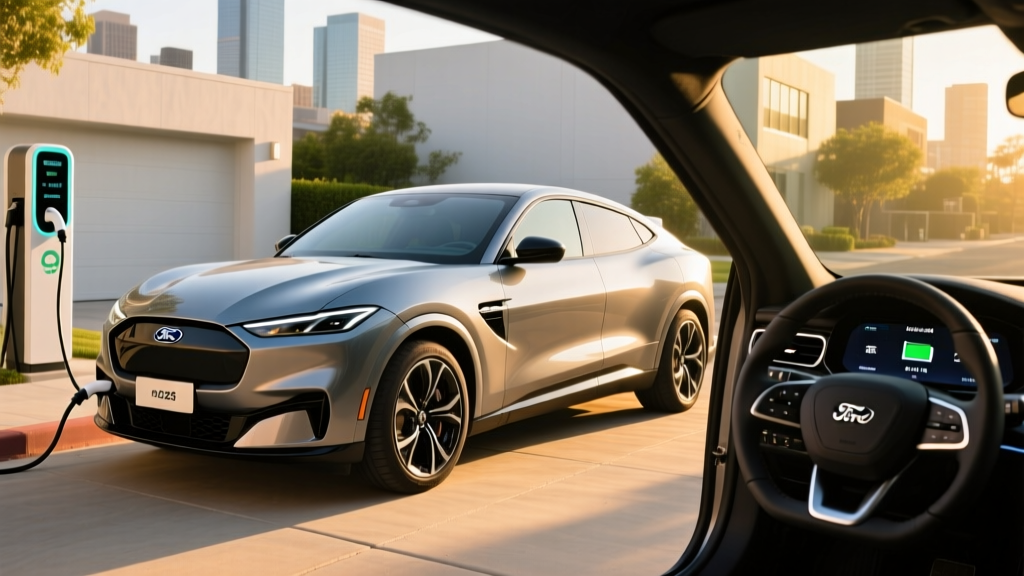
Home charging: The onboard 10.5 kW charger is a strong point. On a 48-amp Level 2 home circuit (requiring a 60-amp breaker), you'll recover roughly 32 miles of range per hour — enough to fully replenish even the 91 kWh pack overnight. Ford includes the Mobile Power Cord with NACS and J1772 adapters. Most buyers will want a dedicated wall-mounted Level 2 unit; expect $500–$1,200 for equipment plus $800–$2,500 for electrician installation, depending on panel capacity and run length.
The 2025 Mach-E comes with a NACS (Tesla Supercharger) charge port as standard equipment, granting access to over 20,000 Supercharger stalls without an adapter. This is a significant practical advantage over CCS-only competitors in regions where Electrify America or EVgo coverage is sparse.
Performance and Drivetrain
| Trim | Horsepower | Torque (lb-ft) | 0–60 mph | Drivetrain |
|---|---|---|---|---|
| Select RWD | 266 hp | 387 | 6.3 sec | RWD |
| Premium RWD (ER) | 290 hp | 387 | 5.8 sec | RWD |
| Premium AWD (ER) | 346 hp | 428 | 4.8 sec | Dual-Motor AWD |
| GT | 480 hp | 600 | 3.3 sec | Dual-Motor AWD |
| Rally | 480 hp | 700 | 3.4 sec | Dual-Motor AWD |
The GT and Rally trims deliver genuine sports-car acceleration — the GT's 3.3-second 0–60 time rivals a Porsche Cayenne Turbo. But the volume seller is the Premium AWD, which offers a satisfying 4.8-second sprint with 290 miles of range and a price that stays within the federal tax credit window. Regenerative braking is adjustable via steering-wheel paddles, and one-pedal driving mode is strong enough to bring the car to a complete stop without touching the brake pedal.
Ride quality is firm but well-damped. The Mach-E is tuned more for sporty handling than plush comfort — you'll feel expansion joints, but body roll is minimal for a crossover. The Rally trim adds 0.8 inches of ground clearance, rally-tuned MagneRide dampers, and underbody protection for light gravel and snow-road use.
Pricing, Trims, and Federal Tax Credit Eligibility
| Trim | Base MSRP | As-Tested (typical) | §30D Credit Eligible? | Effective Price* |
|---|---|---|---|---|
| Select RWD (SR) | $39,995 | $41,500 | Yes (up to $7,500) | ~$32,495 |
| Premium RWD (ER) | $46,995 | $48,500 | Yes (up to $7,500) | ~$39,495 |
| Premium AWD (ER) | $49,995 | $51,500 | Yes (up to $7,500) | ~$42,495 |
| GT | $59,995 | $63,000 | Yes (up to $7,500) | ~$52,495 |
| Rally | $58,995 | $61,500 | Yes (up to $7,500) | ~$51,495 |
*Effective price assumes full $7,500 credit; actual amount depends on battery-sourcing compliance and buyer income. Point-of-sale transfer available.
All 2025 Mach-E trims fall under the $80,000 MSRP cap for SUVs/crossovers under IRS §30D rules. However, the full $7,500 credit is not guaranteed. It splits into two $3,750 halves:
- $3,750 — Battery components: A percentage of battery components must be manufactured or assembled in North America. Ford has been progressively shifting Mach-E battery production to U.S. plants, and most 2025 models are expected to qualify.
- $3,750 — Critical minerals: A percentage of critical minerals must be sourced from the U.S. or a free-trade-agreement country. This threshold tightens annually; verify current-year compliance on the IRS qualified vehicles list.
- Buyer income caps: Modified AGI must not exceed $150,000 (single), $225,000 (head of household), or $300,000 (joint).
- Point-of-sale transfer: You can apply the credit as a down-payment reduction at the dealer rather than waiting for a tax refund.
Always confirm your specific vehicle's VIN on the IRS qualified list before purchase — battery sourcing can change mid-model-year. Consult a tax professional for your personal eligibility.
Interior, Cargo, and Technology
The Mach-E's interior is a mixed bag of genuinely premium materials and cost-cutting shortcuts. The dashboard is dominated by a 15.5-inch vertical touchscreen running SYNC 4A, which is responsive, supports wireless Apple CarPlay and Android Auto, and integrates over-the-air updates. A 10.2-inch digital instrument cluster sits behind the steering wheel. Physical buttons are minimal — climate controls are buried in the touchscreen, which frustrates some drivers.
Passenger space is generous for the class:
- Front legroom: 43.3 inches
- Rear legroom: 38.9 inches
- Cargo (rear seats up): 29.7 cu ft
- Cargo (rear seats folded): 59.7 cu ft
- Front trunk (frunk): 4.7 cu ft (drainable, useful for wet gear or groceries)
Compared to the Tesla Model Y (30.2 cu ft cargo, 76.2 cu ft max), the Mach-E gives up a small amount of utility. The Hyundai IONIQ 5 offers similar rear-seat room but less total cargo volume. The Mach-E's frunk is smaller than the Model Y's but includes a drain plug — handy for tailgating or hauling ice.
BlueCruise (Ford's SAE Level 2 hands-free driving system) is available on Premium, GT, and Rally trims. On pre-mapped divided highways (over 130,000 miles of coverage in the U.S. and Canada), the system allows true hands-off operation with driver monitoring via an infrared camera. It handles lane centering, adaptive cruise, and lane changes smoothly. However, this is not autonomous driving — you must remain attentive, and the system disengages on unmapped roads, in construction zones, or if the driver-monitoring camera detects you looking away for too long. A 90-day trial is included; after that, expect roughly $75/month or $800/year for continued access.
Warranty, Ownership Costs, and Who Should Buy
| Coverage | Term |
|---|---|
| Bumper-to-Bumper | 3 years / 36,000 miles |
| Powertrain | 5 years / 60,000 miles |
| Battery & Electric Components | 8 years / 100,000 miles (≥70% capacity retention) |
| Corrosion Perforation | 5 years / unlimited miles |
| Roadside Assistance | 5 years / 60,000 miles |
The 8-year/100,000-mile battery warranty guarantees at least 70% state of health, which aligns with industry standards set by Hyundai, Kia, and Tesla. Real-world degradation data from 2021–2023 Mach-E owners suggests NMC packs lose roughly 5–8% capacity over the first 60,000 miles, with LFP packs showing even less measurable loss. Ford has not published a battery replacement cost, but based on comparable 91 kWh NMC packs from other manufacturers, expect $12,000–$18,000 out of warranty — a figure that should continue declining as cell prices fall.
Insurance costs run 10–20% higher than a comparable gas-powered Ford Edge, according to industry averages. Shop quotes before purchasing — EV insurance premiums vary widely by carrier and zip code.
- Commuters with home charging: The Select RWD at ~$32,500 after the tax credit is an outstanding value for a 250-mile daily driver with minimal running costs.
- Families needing AWD and space: The Premium AWD ER provides 290 miles, 346 hp, and excellent rear-seat room for two car seats and cargo.
- Road trippers in moderate climates: Supercharger access via NACS makes long-distance travel practical, though the 28-minute 10–80% charge time means slightly longer stops than an IONIQ 5.
- Performance seekers: The GT's 3.3-second 0–60 and MagneRide suspension deliver genuine thrills with zero tailpipe emissions.
Look elsewhere if: You need maximum cargo volume (Model Y wins), 800V ultra-fast charging (IONIQ 5/EV6), or the lowest possible price (Equinox EV starts lower).
- NACS Supercharger access standard — no adapter needed
- Strong real-world range on ER trims (270–285 mi highway)
- BlueCruise is one of the best SAE Level 2 systems available
- Competitive pricing after $7,500 tax credit
- Engaging driving dynamics for a crossover
- Drainable frunk is genuinely practical
- DC fast charging (150 kW peak) trails 800V competitors
- Climate controls buried in touchscreen — no physical buttons
- BlueCruise subscription cost after trial period
- Cargo volume trails Tesla Model Y
- Ride is firm on rough pavement (especially GT with 20" wheels)
- LFP battery only available on base Select RWD trim
Frequently Asked Questions
What is the real-world range of the 2025 Ford Mustang Mach-E?
The EPA rates the Extended Range RWD at 320 miles, but expect 270–285 miles in real-world highway driving at 70–75 mph. In freezing weather, plan for 20–30% less, dropping the ER AWD to roughly 200–230 miles. The Standard Range RWD delivers about 210–225 real-world highway miles.
How fast does the 2025 Mach-E charge?
Extended Range models peak at 150 kW on DC fast chargers, achieving 10–80% in approximately 28 minutes. Standard Range models peak at 135 kW with a 10–80% time of about 32 minutes. At home on a 240V Level 2 charger (48 amps), the onboard 10.5 kW charger adds roughly 32 miles of range per hour.
Does the 2025 Mach-E qualify for the federal EV tax credit?
All trims fall under the $80,000 MSRP cap for SUVs. Most 2025 Mach-E models are expected to qualify for the full $7,500 §30D credit, but eligibility depends on battery-sourcing compliance (which can change mid-year) and buyer income limits ($150K single / $300K joint). Always verify your VIN on the IRS qualified vehicles list before purchasing.
Is the 2025 Mach-E worth buying vs the Tesla Model Y or Hyundai IONIQ 5?
The Mach-E wins on driving engagement, BlueCruise quality, and mainstream dealer support. The Model Y offers more cargo space, slightly better range, and access to the most mature Supercharger network (though the Mach-E now shares this via NACS). The IONIQ 5 charges faster thanks to its 800V architecture (10–80% in ~18 min) and has a more distinctive design. If you value a traditional dealer experience and hands-free highway driving, the Mach-E is an excellent choice. If charging speed is your top priority, the IONIQ 5 edges ahead.
What are the biggest pros and cons of the 2025 Mach-E?
Top pros: native NACS Supercharger access, strong range on ER trims, BlueCruise hands-free driving, engaging performance, and competitive post-credit pricing. Top cons: DC charging speed trails 800V rivals, touchscreen-only climate controls, BlueCruise subscription cost, and cargo volume trails the Model Y.
Can the Mach-E tow?
Yes. With the optional Class II tow package, the AWD Mach-E is rated for up to 3,500 pounds — enough for a small utility trailer, a pair of jet skis, or a lightweight camping trailer. RWD models are rated lower. Keep in mind that towing significantly reduces range; expect a 30–50% reduction depending on trailer weight and aerodynamics.
What is the battery warranty?
Ford covers the high-voltage battery and electric powertrain components for 8 years or 100,000 miles, whichever comes first. The warranty guarantees the battery will retain at least 70% of its original capacity. If it falls below that threshold within the warranty period, Ford will repair or replace it at no cost.