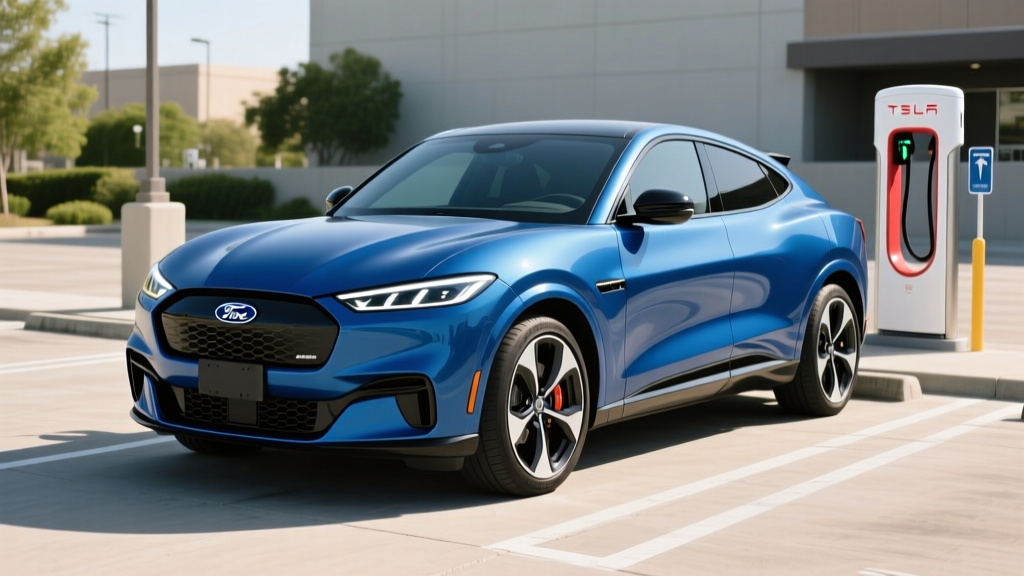
The 2025 Ford Mustang Mach-E Premium occupies a narrow but critical lane in the mid-size electric SUV segment: a comfort-oriented, long-range daily driver that undercuts luxury rivals on price while matching them on refinement. After spending time with the rear-wheel-drive Extended Range configuration — the volume-selling Premium variant — it's clear Ford has prioritized real-world usability over spec-sheet theatrics. The result is an EV that excels at commuting, family hauling, and road-trip charging, even if it doesn't chase the Tesla Model Y on 0-60 times.
2025 Mustang Mach-E Premium: Core Specifications at a Glance
| Specification | Premium RWD Extended Range | Premium AWD Extended Range |
|---|---|---|
| EPA Range | 320 miles | 290 miles |
| Battery (usable) | 91 kWh (NMC) | 91 kWh (NMC) |
| Horsepower | 290 hp / 317 lb-ft | 365 hp / 428 lb-ft |
| 0-60 mph | 5.9 sec | 5.1 sec |
| DC Fast Charge Peak | 150 kW | 150 kW |
| 10-80% DC Time | ~36 min | ~36 min |
| Level 2 Home Charge | 10.5 kW (~30 mi/hr) | 10.5 kW (~30 mi/hr) |
| MPGe (city/hwy/combined) | 111 / 94 / 103 | 103 / 89 / 97 |
| Efficiency | 33 kWh/100 mi | 35 kWh/100 mi |
| Cargo (behind rear seats) | 29.7 cu ft | 29.7 cu ft |
| Cargo (rear seats folded) | 59.7 cu ft | 59.7 cu ft |
| Front Trunk (Frunk) | 4.7 cu ft | 4.7 cu ft |
| Base MSRP (incl. destination) | $44,490 | $47,490 |
Source: fueleconomy.gov, Ford Motor Company 2025 specs.
Real-World Range: What the EPA Number Doesn't Tell You
EPA Sticker: 320 miles (RWD Extended Range)
Real-World Expectation: 260–285 miles on sustained highway driving at 70+ mph; 200–230 miles in sub-30°F winter conditions with climate control active.
The 320-mile EPA figure on the RWD Extended Range is legitimate for mixed suburban driving in moderate temperatures. But like most EVs, the Mach-E Premium reveals its true temperament on the highway and in cold weather. In 70°F conditions on a flat interstate at 72 mph, expect roughly 270–285 miles before you're hunting for a charger at 5% SoC. Push speeds to 80 mph or tackle elevation changes, and that number drops closer to 250.
Cold weather is the bigger variable. Nickel-manganese-cobalt (NMC) chemistry — which the Mach-E uses across all trims — loses efficiency in freezing temperatures because the battery's internal resistance increases and cabin heating draws heavily from the pack. The Mach-E Premium includes a heat pump on 2025 models, which recovers waste heat from the powertrain to warm the cabin more efficiently than resistive heating. Even so, expect a 25–35% range reduction in sustained sub-freezing conditions. A 320-mile EPA car becomes roughly a 210–240-mile car in a Minneapolis January. This isn't a Mach-E-specific problem — it applies to nearly every NMC-based EV on the market — but buyers in northern climates should plan routes and charging stops accordingly.
The AWD Extended Range's 290-mile EPA rating reflects the energy penalty of the front motor. Real-world highway range lands in the 240–260 mile band in fair weather, dropping to roughly 180–210 miles in deep cold. For most daily commutes under 80 miles round-trip, either configuration provides a comfortable buffer.
Charging Speed: DC Fast Charging and Home Level 2
The Mach-E Premium's 150 kW peak DC fast-charging rate places it solidly in the mid-pack for 2025. It won't match the Hyundai Ioniq 5's 800-volt architecture (which sustains 230+ kW), but it charges quickly enough for practical road-trip use.
| Charging Level | Power / Rate | Miles Added | Typical Use Case |
|---|---|---|---|
| Level 1 (120V household) | ~1.4 kW | ~3 mi/hr | Emergency / overnight trickle |
| Level 2 (240V, 48A) | 10.5 kW | ~30 mi/hr | Home daily charging (full in ~9 hrs) |
| DC Fast Charge (peak) | 150 kW | ~190 mi in 30 min | Road trips, 10-80% in ~36 min |
The charging curve matters more than peak kW. The Mach-E Premium hits 150 kW only at low state-of-charge (roughly 10–30% SoC) and optimal battery temperature. As the pack fills, the rate tapers: by 60% SoC, you're typically seeing 90–110 kW; above 80%, it drops below 50 kW. This is why Ford quotes a 10-80% time of approximately 36 minutes rather than a peak-kW headline. On a Tesla Supercharger (via Ford's NACS adapter, standard on 2025 models) or an Electrify America CCS station, you'll add roughly 150–170 miles of range in a 20-minute stop — enough for most highway stretches between chargers.
At home, the onboard 10.5 kW AC charger is a strong point. With a hardwired 48-amp Level 2 wall connector on a 60-amp circuit, the Mach-E Premium recovers about 30 miles of range per hour. A full 10–100% charge takes roughly 9 hours — meaning an overnight session replenishes even a nearly depleted pack by morning. If your home electrical panel supports it, this is the most cost-effective and convenient way to own the Mach-E. Installation typically runs $800–$2,000 depending on panel proximity and local permitting; a 200-amp panel upgrade (if needed) adds $1,500–$3,000.
Performance and Driving Dynamics
The RWD Extended Range Premium delivers 290 horsepower and 317 lb-ft of torque from its rear-mounted permanent-magnet synchronous motor. The 0-60 mph time of 5.9 seconds is brisk by any measure — quicker than a base Porsche Macan — and the instant torque delivery makes highway merging effortless. The single-motor setup also contributes to the longer 320-mile range rating by eliminating the energy draw of a front motor.
The AWD variant adds a front induction motor for a combined 365 hp and 428 lb-ft, dropping the 0-60 to 5.1 seconds. The extra traction is valuable in rain and snow, and the dual-motor torque vectoring sharpens cornering feel. However, the 30-mile range penalty and $3,000 price premium mean AWD should be a deliberate choice based on climate and driving conditions, not a reflexive upgrade.
Ride quality is where the Premium trim earns its name. Ford tuned the suspension for compliance over sportiness — the Mach-E Premium absorbs highway expansion joints and potholes with less harshness than the Tesla Model Y or the BMW iX. The cabin is well-isolated from road noise, and the steering is light and predictable. This is a cruiser, not a track car, and that's appropriate for its buyer profile.
Interior, Cargo, and Technology
The Mach-E Premium's interior is a step above the Select trim, with ActiveX synthetic leather seating, a heated steering wheel, ambient lighting, and a panoramic fixed-glass roof. The 15.5-inch vertically oriented touchscreen runs Ford's SYNC 4A system, which supports wireless Apple CarPlay and Android Auto, over-the-air updates, and a conversational voice assistant. The interface is responsive, though some drivers may find the climate controls buried in the touchscreen rather than having physical buttons.
Passenger space is competitive for the segment:
- Front headroom: 40.4 inches
- Front legroom: 43.3 inches
- Rear headroom: 38.2 inches
- Rear legroom: 38.9 inches
Two adults in the rear seats will find ample room; three across is tight for long trips. The 29.7 cu ft of cargo behind the rear seats accommodates a week's worth of groceries or two large suitcases. Folding the 60/40 rear bench opens 59.7 cu ft — enough for furniture-store runs. The 4.7 cu ft front trunk (frunk) includes a drain plug, making it useful for ice and beverages at outdoor events.
Driver-assistance technology includes Ford Co-Pilot360 2.0 as standard: automatic emergency braking, blind-spot monitoring, lane-keeping assist, and adaptive cruise control with stop-and-go. The available BlueCruise system (a $2,100 option or included in certain packages) enables hands-free driving on approximately 130,000 miles of pre-mapped divided highways in the U.S. and Canada.
SAE Automation Level: BlueCruise is a Level 2 driver-assistance system. Despite the hands-free capability, the driver must remain attentive and ready to take over at any time. An infrared camera monitors eye gaze and will issue escalating warnings — then bring the vehicle to a controlled stop — if the driver looks away or closes their eyes. This is not autonomous driving (Level 4); it is supervised highway assistance.
Pricing, Trims, and Federal Tax Credit Eligibility
| Configuration | MSRP (incl. destination) | Est. Federal Credit (§30D) | Effective Price (if eligible) |
|---|---|---|---|
| Premium RWD Extended Range | $44,490 | Up to $7,500 | ~$36,990 |
| Premium AWD Extended Range | $47,490 | Up to $7,500 | ~$39,990 |
The 2025 Mustang Mach-E Premium qualifies for analysis under the IRS §30D Clean Vehicle Credit, but eligibility is not automatic. Several conditions must align:
- MSRP Cap: The vehicle must have an MSRP at or below $80,000 for SUVs — the Mach-E Premium clears this easily.
- Buyer Income Cap: Adjusted gross income must not exceed $150,000 (single), $225,000 (head of household), or $300,000 (joint filing).
- Battery Sourcing: The vehicle must meet critical-mineral and battery-component requirements that phase in annually. For 2025, at least 60% of critical minerals and 75% of battery components must be sourced from the U.S. or free-trade-agreement partners. Ford has adjusted Mach-E battery supply chains, but the exact credit amount ($3,750 for meeting one requirement, $7,500 for both) can vary by production batch. Confirm with your dealer and reference IRS §30D guidance.
- Point-of-Sale Transfer: As of 2024, eligible buyers can transfer the credit to the dealer at purchase, reducing the purchase price directly rather than waiting for a tax refund. The dealer must be IRS-registered.
- Final Assembly: The Mach-E is assembled in Cuautitlán, Mexico. Under §30D, final assembly in North America (U.S., Canada, Mexico) satisfies this requirement.
Key caveat: Tax credit rules are subject to change, and battery-sourcing compliance can shift with supply-chain updates. Always verify eligibility with a tax professional before finalizing your purchase. Do not assume the full $7,500 without confirming your specific vehicle's VIN against the IRS/Fueleconomy.gov eligibility tool.
Warranty and Long-Term Ownership
Ford backs the Mach-E's electric powertrain with an 8-year/100,000-mile warranty covering the battery pack, electric motor, and power electronics. The battery warranty guarantees that the pack will retain at least 70% of its original capacity during the coverage period. If degradation exceeds 30%, Ford will repair or replace the battery at no cost.
The bumper-to-bumper limited warranty covers 3 years/36,000 miles. For context, Hyundai and Kia offer 10-year/100,000-mile EV powertrain coverage, which is the segment benchmark. Ford's 8/100,000 is standard for American and European automakers and reflects confidence in the NMC pack's longevity.
Long-term degradation data on the Mach-E is still maturing (the model launched for the 2021 model year), but early owner reports and third-party analyses suggest roughly 5–8% capacity loss over the first 100,000 miles under normal use patterns — well within the 70% retention warranty threshold. Avoiding frequent DC fast-charging to 100% and minimizing prolonged storage at very high or very low SoC will help preserve battery health.
Pros, Cons, and the Verdict
Pros
- 320-mile EPA range (RWD ER) is among the best in its price class
- Comfortable, quiet ride tuned for daily driving and road trips
- 10.5 kW Level 2 onboard charger enables fast overnight home charging
- NACS adapter (standard 2025) unlocks Tesla Supercharger network access
- Generous rear-seat legroom (38.9 in) and practical cargo/frunk layout
- BlueCruise hands-free highway driving is well-executed (SAE Level 2)
- Below $80K MSRP — eligible for §30D credit analysis
Cons
- 150 kW peak DC charging trails 800V rivals (Ioniq 5, EV6 at 230+ kW)
- AWD range penalty (30 mi) and $3,000 premium are steep
- Cold-weather range loss (25–35%) is significant for northern-climate buyers
- Climate controls lack physical buttons — touchscreen-dependent
- 8/100K battery warranty trails Hyundai/Kia's 10/100K coverage
- BlueCruise requires subscription renewal after trial period
Who the 2025 Mustang Mach-E Premium suits best: Daily commuters and small families who prioritize ride comfort, cabin quietness, and reliable 300+ mile range over maximum performance. It's an excellent primary vehicle for households with home Level 2 charging access and moderate road-trip habits (2–4 trips per year, 200–500 miles each). Buyers in Sun Belt and temperate climates will extract the most value; those in harsh-winter regions should consider the AWD option or a dedicated winter-charging plan.
Who should look elsewhere: Buyers who prioritize cutting-edge DC charging speed (look at the Ioniq 5 or EV6 with 800V architecture), those who need 3-row seating (Kia EV9, Rivian R1S), or performance-focused drivers who want sub-4-second 0-60 times (Tesla Model Y Performance, Porsche Macan EV).
Frequently Asked Questions
What is the real-world range of the 2025 Mustang Mach-E Premium?
The EPA rates the RWD Extended Range at 320 miles and the AWD at 290 miles. In real-world highway driving at 70–75 mph in moderate temperatures, expect 260–285 miles (RWD) and 240–260 miles (AWD). In sustained freezing weather, subtract 25–35% from those figures.
How fast does the Mach-E Premium charge on DC fast chargers and at home?
DC fast-charging peaks at 150 kW, with a 10–80% session taking approximately 36 minutes. At home on a 240V Level 2 charger (48A hardwired), the 10.5 kW onboard charger adds about 30 miles per hour, fully replenishing the pack in roughly 9 hours.
Does the 2025 Mustang Mach-E Premium qualify for the $7,500 federal EV tax credit?
It can, but eligibility depends on your income (under $150K single / $300K joint), the vehicle's battery-sourcing compliance (which varies by production batch), and MSRP (under $80K — the Mach-E clears this). The credit can be transferred to the dealer at point-of-sale. Always verify your specific VIN and consult a tax professional. See IRS §30D rules.
How does the Mach-E Premium compare to the Tesla Model Y Long Range?
The Model Y Long Range offers slightly more EPA range (330 miles), faster DC charging via the Supercharger network natively, and more cargo space (30.2 cu ft rear / 72.1 cu ft total). However, the Mach-E Premium delivers a more comfortable ride, a quieter cabin, physical build quality that many reviewers rate higher, and a lower starting MSRP ($44,490 vs ~$48,000 for the Model Y LR). The gap has narrowed significantly with Ford's 2025 NACS adapter inclusion, which grants Mach-E owners access to 15,000+ Superchargers.
Is BlueCruise standard on the Mach-E Premium?
No. BlueCruise (Ford's SAE Level 2 hands-free highway driving system) is available as part of an option package on the Premium trim, typically adding $2,100 or bundled with other features. It includes a trial period (usually 90 days), after which a subscription is required to continue using hands-free mode. Standard Co-Pilot360 2.0 adaptive cruise and lane-centering do not require a subscription.
What is the battery chemistry, and does it affect longevity?
The Mach-E Premium uses NMC (nickel-manganese-cobalt) lithium-ion cells. NMC offers higher energy density than LFP (lithium iron phosphate), which is why the Mach-E achieves 320 miles in a relatively compact pack. The trade-off is that NMC degrades slightly faster than LFP over thousands of cycles and is more sensitive to high SoC and high temperatures. Ford's 8-year/100,000-mile battery warranty with a 70% retention floor provides meaningful protection. For maximum longevity, charge to 80–90% for daily use and reserve 100% charges for road trips.
Can the Mach-E Premium tow?
Yes, with limitations. The Mach-E Premium with the factory tow package is rated for up to 2,300 pounds (AWD) — sufficient for a small utility trailer or a pair of dirt bikes, but not a full-size camper. Towing significantly reduces range (expect a 30–50% reduction depending on trailer weight and aerodynamics). If towing is a priority, the Rivian R1S or Ford F-150 Lightning are far more capable alternatives.