Quick Verdict: The Mach-E's 2025 Refresh Adds Range and Refinement
The 2025 Ford Mustang Mach-E enters its fifth model year with meaningful upgrades: a larger battery, faster DC charging, and a revised interior that addresses earlier complaints about material quality. It remains one of the most driver-focused electric crossovers available, with EPA range now reaching 320 miles on Extended Range models. For buyers cross-shopping the Tesla Model Y, Hyundai Ioniq 5, and Kia EV6, the Mach-E's blend of cargo practicality, engaging chassis, and improving fast-charge capability keeps it firmly in contention — though its public charging curve and back-seat packaging deserve close inspection before signing.
2025 Ford Mustang Mach-E Key Specifications
| Spec | Select (RWD, Std Range) | Premium (RWD, Ext Range) | GT (AWD, Ext Range) |
|---|---|---|---|
| EPA Range | 250 mi | 320 mi | 290 mi |
| Battery (Usable) | 72 kWh (LFP) | 91 kWh (NMC) | 91 kWh (NMC) |
| Horsepower | 266 hp | 290 hp | 480 hp |
| 0–60 mph | 6.3 sec | 5.9 sec | 3.5 sec |
| Drivetrain | RWD (single motor) | RWD (single motor) | AWD (dual motor) |
| Max DC Fast Charge | 140 kW | 150 kW | 150 kW |
| 10–80% DCFC Time | ~36 min | ~37 min | ~37 min |
| Level 2 Home Charge | 10.5 kW (~30 mi/hr) | 10.5 kW (~30 mi/hr) | 10.5 kW (~30 mi/hr) |
| EPA Efficiency | 101 MPGe | 104 MPGe | 84 MPGe |
| Base MSRP | $42,495 | $47,995 | $57,995 |
Source: fueleconomy.gov and Ford Motor Company, 2025 model year. Prices exclude $1,595 destination.
Interior Quality, Tech, and Cargo: What Changed for 2025
The 2025 Ford Mustang Mach-E interior carries forward the large 15.5-inch portrait touchscreen running SYNC 4A, wireless Apple CarPlay and Android Auto, and a configurable 10.2-inch digital instrument cluster. What's new is the material story: Ford has upgraded soft-touch surfaces on the dashboard and door panels, replaced the previous gloss-black center console trim with a matte finish that resists fingerprints, and added new upholstery options including ActiveX with contrast stitching on Premium and GT trims.
Front-seat comfort is strong, with 43.3 inches of legroom and well-bolstered seats that hold up on long highway stints. The rear seat is where the Mach-E shows its age against the Hyundai Ioniq 5's flat-floor architecture — rear legroom measures 38.9 inches, adequate for adults but tighter than rivals with dedicated EV platforms. The panoramic fixed-glass roof creates an airy cabin feel and adds headroom, though it offers no shade; on hot summer days, solar heat gain through that glass is noticeable, and aftermarket tint or a removable shade is a common owner modification.
Cargo Capacity by the Numbers
- Behind rear seats: 29.7 cu ft
- Rear seats folded: 59.7 cu ft
- Front trunk (frunk): 4.7 cu ft (drainable, useful for wet gear or charging cables)
The frunk includes a drain plug — a practical touch for hauling ice or muddy equipment. Total cargo volume trails the Tesla Model Y (76 cu ft max) but matches or exceeds most compact crossovers in this segment.
Standout Tech Features
- Ford BlueCruise (Level 2): Hands-free highway driving on over 130,000 miles of pre-mapped divided highways in the U.S. and Canada. Includes a driver-facing camera to monitor eye attention. Requires a subscription after the trial period ($75/month or $800/year as of 2025).
- Phone-as-a-Key (PaaK): Uses your smartphone's Bluetooth to lock, unlock, and start the vehicle. Generally reliable, though some owners report occasional connection delays in dense urban environments.
- SYNC 4A with cloud-connected navigation: Real-time traffic, over-the-air (OTA) updates, and EV-specific route planning that factors in charging stops and battery preconditioning.
- Pro Power Onboard (optional): 120V outlet in the cargo area for powering tools, tailgating gear, or small appliances — rated up to 1.5 kW.
Ford BlueCruise is a Level 2 driver-assistance system. It provides hands-free steering and speed control on qualified highways, but the driver must remain attentive and ready to take over at any time. The in-cabin camera monitors your eyes. This is not autonomous driving — it is an advanced cruise-and-lane-keeping system.
Range, Battery Chemistry, and Real-World Efficiency
Ford offers two battery packs for the 2025 Mach-E:
- Standard Range (LFP): 72 kWh usable, lithium iron phosphate chemistry. Heavier but more thermally stable, longer cycle life, and cheaper to produce. EPA range: 250 miles (Select RWD).
- Extended Range (NMC): 91 kWh usable, nickel manganese cobalt chemistry. Higher energy density, lighter weight, but slightly more sensitive to sustained high SoC storage. EPA range: up to 320 miles (Premium RWD).
EPA Sticker: 320 miles (Premium RWD, Extended Range)
Expect in practice:
- Mixed city/suburban driving, moderate temps: ~300–310 miles
- Sustained 75-mph highway: ~260–280 miles
- Cold weather (below 30°F), highway + cabin heat: ~210–240 miles
The Mach-E uses a heat pump on Extended Range models, which helps reduce cold-weather range loss compared to resistive cabin heating. Standard Range models use resistive heating — expect a steeper winter penalty (~30–35% loss vs. ~20–25% on Extended Range with heat pump).
Efficiency on the Premium RWD Extended Rate is rated at 104 MPGe combined (33 kWh/100 mi) by the EPA. The GT AWD, with its 480 hp and stickier summer tires, drops to 84 MPGe (40 kWh/100 mi). For context, the Tesla Model Y Long Range RWD achieves 122 MPGe — a meaningful gap if electricity cost per mile is a priority.
Charging Speed: DC Fast Charging and Home Level 2
The 2025 Mach-E supports a peak DC fast-charge rate of 150 kW on Extended Range models (140 kW on Standard Range). That's a meaningful step up from the pre-2024 models, which peaked around 115–130 kW. In practice, here's what to expect at a public DC fast charger:
2025 Mach-E Charging Speeds
| Charging Level | Power (kW) | Speed / Notes |
|---|---|---|
| Level 1 (120V household outlet) | 1.4 kW | ~3–4 miles per hour |
| Level 2 (240V home/public) | 10.5 kW (48A) | ~30 miles per hour; full charge in ~9 hours (Ext Range) |
| DC Fast Charge (peak) | 150 kW (Ext Range) / 140 kW (Std Range) | 10–80% in ~37 minutes; tapers significantly above 80% |
Charge-curve reality check: The 150 kW peak is sustained roughly between 10% and 45% SoC. From 45% to 80%, the rate tapers progressively — you might see 80–100 kW in the middle band and 40–50 kW approaching 80%. This is why the 10–80% time is ~37 minutes rather than the ~20 minutes a sustained 150 kW rate would suggest. Charging from 80% to 100% on DC adds another 25–30 minutes and is best reserved for overnight Level 2 sessions.
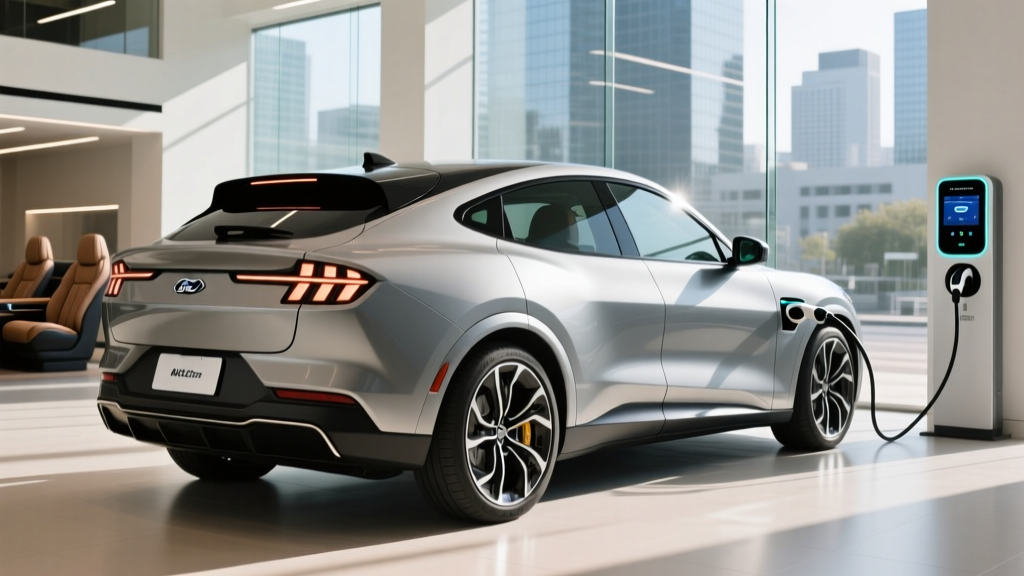
NACS adapter: Ford began shipping NACS (Tesla Supercharger-compatible) adapters to Mach-E owners in early 2024. All 2025 Mach-E models come with a native NACS charge port, granting access to Tesla's Supercharger network — a major practical advantage over competitors still reliant on CCS-only infrastructure. The adapter (for older models) supports up to 150 kW on V3 Superchargers.
Home charging: The included Ford Mobile Power Cord delivers up to 30 miles of range overnight on a 240V/30A outlet (NEMA 14-50). For the full 10.5 kW / ~30 mi/hr rate, Ford recommends the Charge Station Pro (hardwired, 48A). Installation of a 240V/48A circuit typically runs $800–$2,000 depending on panel capacity and run length — budget for a licensed electrician and a potential panel upgrade if your home has a 100A service.
Performance and Driving Dynamics
The Mach-E has always been one of the more engaging electric crossovers to drive, and the 2025 model continues that tradition. Steering is well-weighted, body control is firm without being harsh, and the low center of gravity (battery pack under the floor) keeps it planted through corners.
- Select RWD: 266 hp, 0–60 in 6.3 seconds. More than adequate for merging and passing.
- Premium RWD (Extended Range): 290 hp, 0–60 in 5.9 seconds. The sweet spot for daily driving.
- GT (AWD, dual motor): 480 hp, 580 lb-ft of torque, 0–60 in 3.5 seconds. Genuinely quick — comparable to a Porsche Macan GTS in straight-line acceleration.
Regenerative braking is adjustable via steering-wheel paddles (a welcome feature) and offers a true one-pedal-driving mode when set to maximum. The brake pedal feel is progressive and avoids the grabby regen-to-friction handoff that plagues some EVs.
Pricing, Trims, and Federal Tax Credit Eligibility
The 2025 Mach-E lineup starts at $42,495 (Select Standard Range RWD, before destination) and tops out at $59,995 (Rally, a limited-edition off-road-oriented variant). Here's the core pricing:
2025 Mach-E Pricing and Estimated Tax-Credit Adjusted Price
| Trim | Drivetrain | Battery | MSRP | Est. After §30D Credit* |
|---|---|---|---|---|
| Select | RWD | Std Range (LFP) | $42,495 | $34,995 |
| Premium | RWD | Ext Range (NMC) | $47,995 | $40,495 |
| Premium | AWD | Ext Range (NMC) | $50,995 | $43,495 |
| GT | AWD | Ext Range (NMC) | $57,995 | $50,495 |
| Rally | AWD | Ext Range (NMC) | $59,995 | $52,495 |
*Estimated price assumes full $7,500 IRS §30D federal tax credit. Eligibility depends on buyer income, MSRP caps, and battery critical-mineral/component sourcing. See checklist below. Point-of-sale transfer is available for 2025, reducing the purchase price at the dealer.
- MSRP cap: Vehicle MSRP must be ≤ $80,000 for SUVs/pickups/vans, ≤ $55,000 for sedans. All Mach-E trims qualify (classified as SUV).
- Buyer income cap: Modified AGI must be ≤ $150,000 (single), $225,000 (head of household), $300,000 (joint).
- Battery sourcing: At least 50% of critical minerals must be extracted/processed in the U.S. or an FTA partner, or recycled in North America. At least 100% of battery components must be manufactured or assembled in North America (for full $7,500). These thresholds increase annually.
- Point-of-sale transfer: Buyers can transfer the credit to the dealer at purchase, receiving the benefit as a price reduction rather than waiting for a tax refund.
- Verification: Confirm eligibility at irs.gov and ask your dealer for the vehicle's IRS compliance report before signing.
Tax rules change. Consult a tax professional for your specific situation.
Battery Warranty and Long-Term Ownership
Ford covers the Mach-E's high-voltage battery and electric powertrain components for 8 years or 100,000 miles, whichever comes first. The warranty guarantees the battery will retain at least 70% of its original capacity during that period. If capacity drops below that threshold due to a defect or excessive degradation, Ford will repair or replace the battery at no cost.
Real-world degradation data from Mach-E owner communities (Mach-E Forum, Reddit r/MachE) suggests that after 40,000–60,000 miles, most Extended Range (NMC) packs show approximately 5–8% capacity loss — well within the 70% warranty floor. LFP packs in the Standard Range model tend to degrade more slowly due to the chemistry's inherent stability, though long-term data is still accumulating for the 2024+ LFP packs.
For peace of mind, Ford's OTA update capability allows the company to refine battery management algorithms over time, which can help optimize longevity. Avoid routinely charging to 100% on NMC packs (set a daily limit of 80–90%) and use 100% only for road trips. LFP packs, by contrast, can be charged to 100% regularly without significant degradation penalty — Ford recommends a full charge at least once per month for LFP calibration.
Pros and Cons: The Honest Assessment
- Engaging driving dynamics for an EV crossover
- Native NACS port (2025) — full Tesla Supercharger access
- Generous frunk with drain plug
- BlueCruise hands-free highway capability on 130,000+ miles of roads
- Improved DC fast-charge speed (150 kW peak)
- LFP battery option for cost-conscious buyers who don't need max range
- Competitive pricing after federal tax credit
- DC charge curve tapers early — 10–80% in ~37 min trails the Ioniq 5's ~18 min
- Efficiency (MPGe) lags Tesla Model Y by ~15–20%
- Rear-seat legroom tighter than Ioniq 5 and EV6
- Panoramic glass roof has no shade — hot in summer
- BlueCruise requires paid subscription after trial
- Standard Range uses resistive heating (no heat pump) — bigger winter range hit
- Infotainment can lag during heavy navigation + media use
Who Should Buy the 2025 Mustang Mach-E?
Choose the Mach-E if:
- You want an engaging, sporty-driving electric crossover and value steering feel over pure efficiency.
- You plan to road-trip frequently and want native access to the Tesla Supercharger network.
- You need a usable frunk for gear, wet items, or charging cables.
- You commute on highways covered by BlueCruise and want hands-free driving without the Tesla brand.
- Your budget lands in the $40,000–$50,000 range after tax credits.
Look elsewhere if:
- Maximum efficiency (MPGe) and lowest cost per mile are your top priorities → Tesla Model Y.
- You need the fastest possible DC charging for frequent road trips → Hyundai Ioniq 5 (800V architecture, 10–80% in ~18 min).
- Rear-seat space for tall passengers is critical → Kia EV6 or Ioniq 5 (flat-floor EV platform).
- You want a three-row electric SUV → Kia EV9.
Frequently Asked Questions
What is the real-world range of the 2025 Ford Mustang Mach-E?
The EPA rates the Premium RWD Extended Range at 320 miles. In mixed real-world driving at moderate temperatures, expect approximately 300–310 miles. Sustained highway driving at 75 mph reduces that to roughly 260–280 miles. In cold weather (below 30°F) with cabin heating, expect 210–240 miles. The heat pump on Extended Range models helps mitigate winter losses compared to the Standard Range's resistive heater.
How fast does the 2025 Mach-E charge at home and on the road?
At home on a 240V Level 2 charger (48A), the Mach-E charges at 10.5 kW, adding about 30 miles of range per hour — a full charge from empty takes roughly 9 hours for the Extended Range pack. On a DC fast charger, it peaks at 150 kW and charges from 10–80% in approximately 37 minutes. The rate tapers significantly above 80% SoC.
How much does the 2025 Mach-E cost after tax credits?
The base Select RWD starts at $42,495 MSRP. If you qualify for the full $7,500 federal tax credit under IRS §30D (meeting income, MSRP, and battery-sourcing requirements), the effective price drops to approximately $34,995. Point-of-sale transfer is available, meaning the credit can reduce your purchase price at the dealership rather than waiting for a tax refund.
Does the 2025 Ford Mustang Mach-E qualify for the federal EV tax credit?
The Mach-E is classified as an SUV and all trims fall under the $80,000 MSRP cap. As of 2025, Ford's North American battery assembly meets the component requirement, and critical-mineral sourcing thresholds are met for the full $7,500 credit on most configurations. However, eligibility depends on your modified AGI (≤$150K single / ≤$300K joint) and the specific vehicle's battery compliance. Always verify with your dealer and consult irs.gov before purchasing.
Is the 2025 Mach-E worth buying vs. the Tesla Model Y and Hyundai Ioniq 5?
It depends on your priorities. The Model Y wins on efficiency (122 MPGe vs. 104 MPGe), Supercharger network maturity, and cargo volume (76 cu ft vs. 59.7). The Ioniq 5 wins on DC charging speed (18-minute 10–80% on 350 kW chargers) and rear-seat space. The Mach-E wins on driving engagement, steering feel, frunk practicality, and — for many buyers — a more conventional crossover aesthetic. All three qualify for the federal tax credit. Test-drive all three before deciding.
Does BlueCruise make the Mach-E self-driving?
No. BlueCruise is an SAE Level 2 driver-assistance system. It allows hands-free driving on pre-mapped divided highways, but you must remain attentive — the cabin camera monitors your eyes, and the system will disengage if you look away for too long. You are always responsible for the vehicle. True self-driving (Level 4) is currently limited to geofenced robotaxi services like Waymo in select cities.
Bottom Line
The 2025 Ford Mustang Mach-E is a well-rounded electric crossover that has matured meaningfully since its 2021 debut. The interior is more refined, the battery options cover both budget and range priorities, and native NACS compatibility opens up the best public charging network in the country. Its 150 kW peak DC charge rate is a step forward, though the charge-curve taper means road-trip stops still take longer than an Ioniq 5 or EV6 on a 350 kW charger. If driving enjoyment, frunk utility, and Supercharger access matter to you, the Mach-E earns a close look — especially at the post-credit price of the Premium RWD Extended Range.