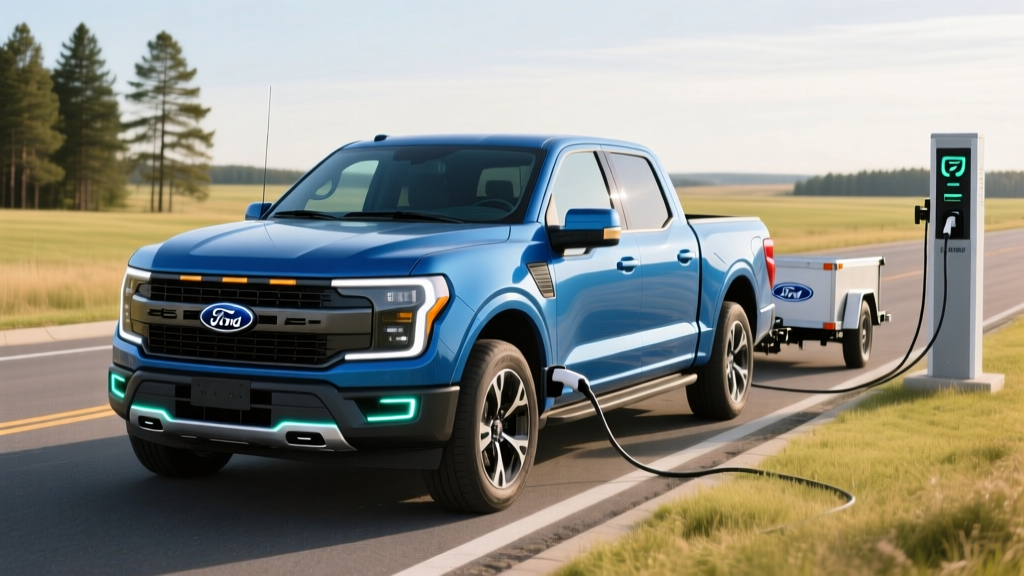
The Ford F-150 Lightning proved that a full-size electric pickup doesn't have to be a compromise — it just has to be a truck that happens to use electrons. For 2025, Ford has refined the formula with updated software, slightly revised pricing, and continued availability of both the Standard Range and Extended Range battery packs. If you're researching the 2025 Ford F-150 Lightning as a daily driver, worksite hauler, or family adventure rig, this review covers every number that matters: real-world range, charging curves, towing penalties, tax credit eligibility, and whether it still holds up against the growing electric truck competition.
Quick Verdict: Who Should Buy the 2025 F-150 Lightning?
The Lightning is best suited for truck buyers who need genuine utility — a 5.5-foot bed, available Pro Power Onboard for job-site or camping power, and a front trunk (frunk) large enough to swallow luggage or gear — but who primarily drive within a 200-mile daily radius and have access to home Level 2 charging. It's an excellent commuter truck, a capable light-duty workhorse, and a surprisingly refined family hauler. It is not ideal for frequent long-distance towing or buyers in remote areas with sparse DC fast-charging infrastructure. If you regularly tow over 7,000 pounds on highway trips exceeding 250 miles, a diesel or hybrid truck still makes more logistical sense.
Range and Efficiency: EPA Numbers vs. Real-World Reality
The 2025 Lightning offers two battery configurations, and your choice dramatically affects both range and price:
| Spec | Standard Range | Extended Range |
|---|---|---|
| Battery (usable) | 98 kWh (NMC) | 131 kWh (NMC) |
| EPA Range | ~240 miles | ~320 miles |
| MPGe (combined) | 68 MPGe | 70 MPGe |
| Efficiency | ~49 kWh/100 mi | ~48 kWh/100 mi |
| Drivetrain | Dual-motor AWD | Dual-motor AWD |
Source: EPA / fueleconomy.gov. Figures vary by trim and wheel size.
The EPA's 320-mile estimate for the Extended Range model assumes mixed city/highway driving in moderate temperatures. In our experience and consistent with independent testing:
• Highway cruising (70–75 mph): Expect 260–280 miles on a full charge. The Lightning's boxy aerodynamics penalize efficiency at speed.
• Cold weather (below 30°F): Range drops 20–30%, bringing the Extended Range down to roughly 220–255 miles. Preconditioning while plugged in mitigates this somewhat.
• Towing (5,000–7,700 lb trailer): Range can fall 40–55%. Plan for 130–180 miles between charges when towing heavy on the highway.
• City/commuter driving: You'll see results at or slightly above EPA estimates thanks to regenerative braking.
The Lightning uses NMC (nickel manganese cobalt) lithium-ion cells in both packs. NMC offers higher energy density than LFP chemistry, which is essential in a truck this size, but it also means Ford recommends charging to 80% for daily use and only going to 100% when you need maximum range — a best practice for long-term battery health.
Charging Speed: DC Fast Charging and Home Level 2
Charging speed is where the Lightning's practicality as a daily truck gets tested. Here's what the numbers look like across all charging levels:
| Charging Level | Power | Speed (mi/hr added) | Notes |
|---|---|---|---|
| Level 1 (120V household) | ~1.4 kW | ~3 mi/hr | Emergency/trickle only |
| Level 2 (240V, 48A) | 11.5 kW | ~26 mi/hr | Full charge overnight (~10–13 hrs) |
| Level 2 (240V, 80A)* | 19.2 kW | ~44 mi/hr | Requires Ford Charge Station Pro + 100A circuit |
| DC Fast Charge (Std Range) | Peak 120 kW | 10–80% in ~36 min | CCS connector (NACS adapter available) |
| DC Fast Charge (Ext Range) | Peak 150 kW | 10–80% in ~41 min | Tapers significantly above 80% SoC |
*80A Level 2 requires the optional Ford Charge Station Pro and a dedicated 100-amp electrical circuit. Installation costs vary — consult a licensed electrician.
Charging curve reality check: The Extended Range Lightning peaks at 150 kW only between roughly 15–40% state of charge. From 40–65%, it sustains around 100–120 kW, and above 80%, speeds drop sharply to under 40 kW. This is standard behavior for NMC packs with large buffers, but it means that charging from 10–90% takes considerably longer than 10–80% — plan your road-trip stops around the 80% mark and move on.
For 2025, Ford continues to offer a CCS Combo connector as standard. A NACS (Tesla Supercharger) adapter is available, and access to Tesla's Supercharger network significantly expands the Lightning's road-trip viability in many regions. Ford's onboard navigation includes route planning with automatic battery preconditioning when a DC fast charger is set as your destination — this warms the pack for optimal charge acceptance and can shave 5–10 minutes off your stop.
Performance: Power, Towing, and Payload
The dual-motor all-wheel-drive powertrain is standard across every 2025 Lightning trim. There is no single-motor, rear-wheel-drive option.
| Performance Spec | Standard Range | Extended Range |
|---|---|---|
| Horsepower | 452 hp | 580 hp |
| Torque | 775 lb-ft | 775 lb-ft |
| 0–60 mph | ~5.0 sec | ~3.8 sec |
| Max Towing | 7,700 lb | 10,000 lb (Max Trailer Tow Pkg) |
| Max Payload | ~2,235 lb | ~1,800 lb |
The Extended Range's 580 hp and 3.8-second 0–60 time make it the quickest F-150 Ford has ever built — quicker than the Raptor. That torque is instantly available, which matters both on highway on-ramps and when pulling a trailer up a grade.
Towing honesty: Ford rates the Lightning up to 10,000 pounds with the Max Trailer Tow Package on XLT and Lariat trims (Extended Range). But towing at or near that capacity will slash your range to roughly 130–160 miles at highway speeds. The available Pro Trailer Hitch Assist and Smart Hitch features are genuinely useful — they automate much of the trailer-hookup process. If you tow frequently, the onboard scale feature (which estimates payload and displays it via the taillights or SYNC screen) is a standout utility feature.
Interior, Cargo, and Technology
The Lightning's cabin mirrors the gas F-150 SuperCrew, meaning you get identical passenger space and a familiar layout with EV-specific software enhancements.
Passenger space:
- Front headroom: 40.8 inches | Legroom: 43.9 inches
- Rear headroom: 40.4 inches | Legroom: 43.6 inches
- Seating for five adults comfortably; rear seat is genuinely spacious for long trips
Cargo:
- Bed: 5.5 feet (67.1 inches), with available spray-in liner
- Mega Power Frunk (front trunk): 14.1 cubic feet — lockable, drainable, with four 120V outlets and two USB ports. This is one of the Lightning's most practical features and a genuine advantage over competitors with smaller or nonexistent frunks.
- Total cargo volume (frunk + bed): best-in-class for electric pickups
Tech highlights:
- SYNC 4 / SYNC 4A: 12-inch touchscreen standard; 15.5-inch portrait touchscreen on Lariat and above (borrowed from the Mustang Mach-E). Wireless Apple CarPlay and Android Auto.
- BlueCruise: Ford's Level 2 hands-free highway driving assist is available on prequalified divided highways. It's competent for long stretches of interstate, but you must remain attentive — this is SAE Level 2, not autonomous driving. A 90-day trial is included; subscription required afterward.
- Pro Power Onboard: Available 2.4 kW or 9.6 kW of exportable power via bed and frunk outlets. The 9.6 kW option can run power tools at a job site, power a camper, or even provide backup home power during outages (with the Ford Home Integration System and transfer switch).
- Intelligent Range: Ford's range estimator factors in weather, terrain, payload, and driving style — and it's notably more accurate than the optimistic guesses some competitors display.
• Ride quality: The independent rear suspension improves on-ride comfort over the gas F-150, but the Lightning still feels heavy over sharp bumps — you feel the 6,000+ lb curb weight.
• Charging speed vs. rivals: At 150 kW peak, the Lightning charges slower than the Rivian R1T (which can peak over 200 kW on newer models) and the Silverado EV (up to 350 kW on compatible chargers).
• Weight: The Extended Range weighs over 6,800 lbs, which increases tire wear and reduces efficiency compared to lighter EVs.
• No single-motor option: AWD is mandatory, which means slightly lower efficiency than a RWD-only truck could achieve.
Pricing, Trims, and Federal Tax Credit Eligibility
The 2025 F-150 Lightning is offered in four main trims. Pricing below reflects MSRP before any incentives, including the mandatory destination charge (~$1,995):
| Trim | Battery | Starting MSRP | Est. After §30D Credit |
|---|---|---|---|
| Pro | Standard Range | ~$54,995 | ~$47,495* |
| XLT | Std / Ext Range | ~$62,995–$72,995 | ~$55,495–$65,495* |
| Lariat | Ext Range | ~$76,995 | ~$69,495* |
| Platinum | Ext Range | ~$96,874 | ~$89,374* |
*Estimated after potential $7,500 federal tax credit. Actual eligibility depends on buyer income, battery sourcing, and MSRP caps. See details below.
Does the 2025 F-150 Lightning Qualify for the Federal EV Tax Credit?
- MSRP cap: Vans, SUVs, and pickup trucks have an $80,000 MSRP cap. The Pro, XLT, and most Lariat configurations qualify. The Platinum trim (~$96,874) exceeds the cap and does not qualify.
- Buyer income limits: Modified AGI must not exceed $300,000 (joint filers), $225,000 (head of household), or $150,000 (single). Check your tax situation with a professional.
- Battery sourcing: The credit is split into two halves — $3,750 for critical minerals sourcing and $3,750 for battery component assembly. Sourcing requirements tighten annually. Ford has worked to domestify its supply chain, but the exact credit amount (full $7,500, partial $3,750, or $0) depends on the specific build date and battery lot. Always verify at purchase.
- Point-of-sale transfer: As of 2024, eligible buyers can transfer the credit to the dealer at purchase, reducing the sale price upfront rather than waiting for a tax refund. This is available for the Lightning if all criteria are met.
Source: IRS.gov — New Clean Vehicle Credit. Rules subject to change; consult a tax professional.
Warranty and Long-Term Ownership
Ford backs the Lightning with a warranty package designed to reassure truck buyers new to EVs:
- Battery: 8 years / 100,000 miles (whichever comes first), covering defects and capacity loss below 70% of original state of health.
- Electric powertrain components: 8 years / 100,000 miles.
- Bumper-to-bumper: 3 years / 36,000 miles.
- Corrosion perforation: 5 years / unlimited miles.
The 70% battery capacity retention threshold is standard for the industry. Real-world data from early Lightning owners (2022–2024 models) suggests degradation is tracking well — most owners report less than 5% loss after 30,000–50,000 miles, though long-term data for the 131 kWh pack is still accumulating. Ford's battery thermal management system (liquid cooling/heating) is critical here, and preconditioning features help protect the pack.
Insurance costs: Expect premiums 15–25% higher than a comparable gas F-150, driven by repair costs for the battery pack and aluminum body. Get quotes before purchasing — they vary significantly by insurer and state.
Maintenance savings: No oil changes, no transmission fluid, no spark plugs. Brake wear is dramatically reduced thanks to regenerative braking. Ford estimates EV maintenance costs at roughly 40% less than ICE equivalents over five years.
How the 2025 Lightning Stacks Up Against Rivals
| Spec | F-150 Lightning (Ext Range) | Rivian R1T (Dual-Motor Max) | Chevy Silverado EV (4WT) |
|---|---|---|---|
| EPA Range | ~320 mi | ~410 mi | ~492 mi |
| Peak DC Charge | 150 kW | ~200+ kW | ~350 kW |
| 0–60 mph | ~3.8 sec | ~3.5 sec | ~4.5 sec |
| Max Towing | 10,000 lb | 11,000 lb | 10,000 lb |
| Starting MSRP | ~$54,995 | ~$79,900 | ~$60,000 (Work Truck) |
| Frunk | 14.1 cu ft | 11.0 cu ft (tunnel) | 10.7 cu ft |
Source: Manufacturer specifications, fueleconomy.gov.
The Lightning's biggest advantage remains price and familiarity. It starts thousands below the Rivian R1T, looks and feels like a conventional F-150 (which matters to fleet buyers and traditional truck owners), and is serviced through Ford's massive dealer network. The Silverado EV offers superior range and charging speed but has a more polarizing design and limited consumer trim availability. The Rivian R1T is more adventurous and tech-forward but costs significantly more and has a smaller service footprint.
Pros and Cons at a Glance
- Mega Power Frunk (14.1 cu ft) — best in class
- Pro Power Onboard (up to 9.6 kW) for worksite/camping/home backup
- Quick Extended Range model (3.8 sec 0–60)
- Familiar F-150 ergonomics and dealer network
- Competitive starting price among electric trucks
- Useful BlueCruise hands-free highway assist
- Onboard scales and Smart Hitch for towing
- DC fast charging peaks at 150 kW — slower than rivals
- Severe range loss when towing heavy (40–55%)
- Heavy curb weight affects tire wear and efficiency
- Platinum trim exceeds $80K tax credit cap
- No single-motor/RWD option for maximum efficiency
- Insurance premiums higher than gas F-150
- Real-world highway range well below EPA sticker
Frequently Asked Questions
What is the real-world range of the 2025 Ford F-150 Lightning?
The Extended Range model's EPA estimate is approximately 320 miles. In real-world highway driving at 70–75 mph, expect 260–280 miles. In cold weather (below 30°F), that drops to 220–255 miles. The Standard Range model (EPA ~240 miles) delivers roughly 190–210 miles on the highway. City driving with regenerative braking gets you closest to — or slightly above — the EPA sticker.
How fast does the F-150 Lightning charge at home and on the road?
At home on a standard 240V/48A Level 2 charger, the Lightning adds about 26 miles of range per hour, with a full charge taking 10–13 hours depending on pack size. With Ford's optional 80A Charge Station Pro (requiring a 100A circuit), that jumps to ~44 miles per hour. On DC fast chargers, the Extended Range peaks at 150 kW and charges from 10–80% in roughly 41 minutes. The Standard Range peaks at 120 kW with a 10–80% time of about 36 minutes.
Does the 2025 F-150 Lightning qualify for the $7,500 federal tax credit?
It depends on the trim and your situation. The Pro, XLT, and most Lariat trims fall under the $80,000 MSRP cap for pickup trucks. The Platinum trim does not qualify. You must also meet IRS income limits ($300K joint / $150K single) and the battery must satisfy critical-mineral and component-sourcing requirements, which tighten yearly. The credit can be transferred to the dealer at point of sale to reduce your purchase price. Always verify eligibility at the time of purchase — IRS rules are subject to change.
Is the F-150 Lightning worth buying over the Rivian R1T or Silverado EV?
If price, dealer support, and familiar truck ergonomics are your priorities, yes — the Lightning offers the best value proposition in the electric truck segment. Choose the Rivian R1T if you want more range (~410 mi), faster charging, and off-road capability, and are willing to pay $20K+ more. Choose the Silverado EV if maximum range (~492 mi) and DC charging speed (350 kW) are non-negotiable, and you can find a consumer-friendly trim. For most buyers who commute, occasionally tow, and want a truck that doesn't scream "I'm different," the Lightning is the pragmatic pick.
How does towing affect the Lightning's range?
Significantly. Towing a 5,000-pound trailer at highway speeds can reduce range by 40–55%. With the Extended Range pack, plan for 130–180 miles between charges when towing. The Standard Range pack drops to roughly 100–140 miles. DC fast charging infrastructure near your route becomes essential for any tow trip exceeding 150 miles one-way.
Can the F-150 Lightning power my home during an outage?
Yes, with the available 9.6 kW Pro Power Onboard system and the Ford Home Integration System (which includes a transfer switch, sold separately and requiring professional installation). The Extended Range battery can power an average home for approximately three days during an outage, according to Ford's estimates. This is a genuine differentiator for buyers in areas with unreliable grid power.