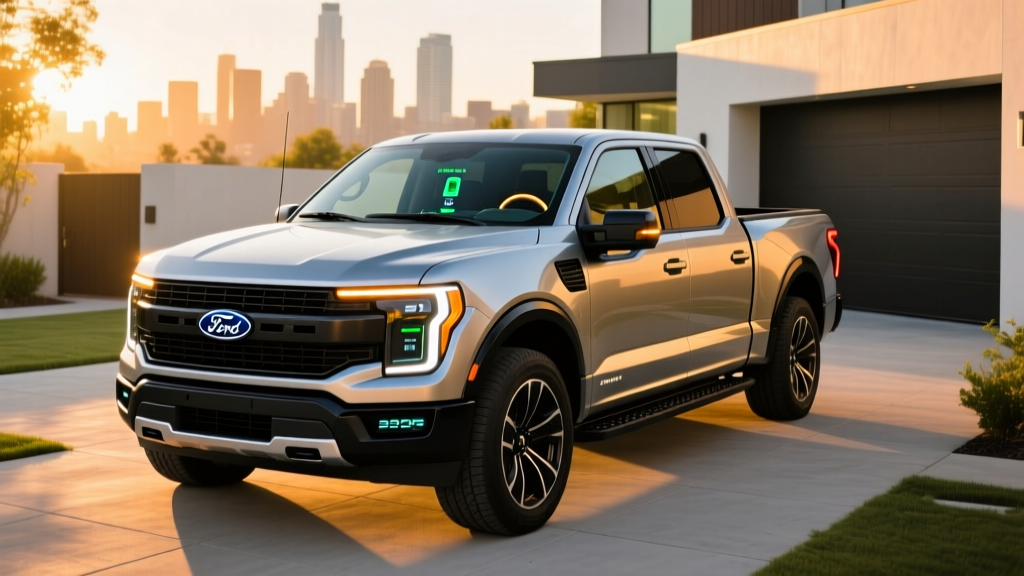
The 2025 Ford F-150 Lightning Lariat sits at the intersection of daily-driver comfort and genuine truck capability. It's the trim where Ford stops apologizing for the electric powertrain and starts loading in the features buyers actually want: the extended-range battery, the 15.5-inch SYNC 4A screen, leather-trimmed seats, and the 80-amp onboard charger that makes home replenishment genuinely fast. After spending time with the specs, the charging curves, and the ownership math, the Lariat emerges as the sweet-spot Lightning — if you can stomach the price and the real-world range compromises that come with a 6,500-pound aerodynamic brick.
Quick Verdict: Who Should Buy the Lightning Lariat
Buy it if: You need a full-size crew-cab truck for daily commuting and weekend projects, want to fuel at home for under $0.05/mile (on utility-rate electricity), value the Mega Power Frunk and Pro Power Onboard, and can install a Level 2 charger at home.
Skip it if: You regularly tow over 7,000 lbs on highway trips, live in an apartment without charging access, need more than 260 real-world highway miles between stops, or your budget caps below $60,000 after incentives.
Range, Battery, and Real-World Efficiency
The 2025 Lightning Lariat comes standard with the Extended Range battery pack — a 131 kWh usable lithium-ion NMC (nickel manganese cobalt) pack that the EPA rates at 320 miles for the Lariat trim. This is the same pack used in the Platinum and is a significant upgrade over the Standard Range 98 kWh pack (230 miles EPA) found on the base Pro and XLT trims.
Real-World Range Reality Check
EPA Sticker: 320 miles (Extended Range, Lariat)
Expect in practice:
- Mixed city/suburban driving (55-65 mph, mild weather): 280-310 miles
- Sustained highway at 75 mph: 240-270 miles
- Highway in freezing temps (below 30°F): 190-230 miles
- Towing a 5,000-lb trailer at 65 mph: 130-160 miles
The Lightning's 6,500+ lb curb weight and boxy profile punish it at highway speeds. Unlike a sedan-shaped EV, you'll see consumption climb sharply above 70 mph. Cold weather compounds this — the resistive cabin heater and battery thermal management draw heavily from the pack. Plan conservatively for road trips.
| Spec | Value |
|---|---|
| EPA Range (Extended Range) | 320 miles |
| Battery Usable Capacity | 131 kWh (NMC chemistry) |
| MPGe (Combined) | 70 MPGe |
| Efficiency | 48 kWh/100 mi |
| Horsepower | 580 hp (Extended Range) |
| Torque | 775 lb-ft |
| 0-60 mph | ~3.8 seconds |
| Drivetrain | AWD (dual-motor) |
| Max Towing (w/ Max Trailer Tow) | 10,000 lbs |
| Max Payload | ~1,800 lbs |
| Base MSRP (Lariat Ext. Range) | $69,995 |
Efficiency lands at roughly 48 kWh per 100 miles combined, translating to 70 MPGe on the EPA cycle. That's thirsty by EV standards — a Tesla Model Y manages 28 kWh/100 mi — but expected for a full-size truck. At the national average residential electricity rate of ~$0.16/kWh, you're paying roughly $0.077 per mile to fuel at home. On a public DC fast charger averaging $0.40/kWh, that jumps to ~$0.19/mile, still below the ~$0.22/mile a comparable gas F-150 (18 mpg combined at $3.50/gal) would cost.
Charging Speed: DC Fast, Level 2, and the Charge Curve
Charging speed is where the Lightning's age shows relative to newer 800-volt platforms, but the Lariat compensates with one of the best home-charging stories in the EV market.
| Charging Level | Power | Speed |
|---|---|---|
| Level 1 (120V household) | ~1.4 kW | ~3 mi/hr |
| Level 2 (240V, 48A mobile charger) | 11.5 kW | ~26 mi/hr |
| Level 2 (240V, 80A Ford Charge Station Pro) | 19.2 kW | ~44 mi/hr (full in ~7 hr) |
| DC Fast Charge (peak) | 150 kW | 15-80% in ~41 min |
DC fast charging: The Lightning uses a 400-volt architecture (not the 800V systems in the Hyundai Ioniq 5 or Porsche Taycan), capping peak DC charge rate at 150 kW. On a 150+ kW station, you'll see the truck accept close to peak power from roughly 15-50% State of Charge, then taper progressively. The 15-80% session takes approximately 41 minutes per Ford's published data. That's adequate for road-trip meal-and-restroom breaks but noticeably slower than the ~18-25 minute sessions 800V competitors manage. The truck uses the CCS1 connector natively; a NACS adapter is available for Tesla Supercharger access.
Home Level 2 charging — the standout feature: The Lariat's onboard dual-80-amp charger (standard with Extended Range) accepts up to 19.2 kW from Ford's Charge Station Pro. This is among the fastest AC charge rates available on any consumer EV. A full 0-100% recharge takes roughly 7 hours — meaning you plug in at 10 PM and wake up to a full battery every single morning. The trade-off: installing a 100-amp dedicated circuit for the Charge Station Pro typically requires a 200-amp (or larger) home electrical panel and costs $1,200-$2,500 for the electrician work, on top of the ~$1,200 hardware cost. Budget for a panel upgrade if your home still runs on 100-amp service.
Charge curve reality: Don't expect 150 kW sustained. The pack's large 131 kWh capacity means the C-rate (charge rate relative to capacity) stays modest, which is good for battery longevity but means the kW number tapers early. Expect an average of ~90-100 kW across the full 15-80% session, not the peak number.
Performance and Drivetrain
The Extended Range Lariat runs a dual-motor all-wheel-drive setup producing 580 horsepower and 775 lb-ft of torque. Ford quotes 0-60 mph in approximately 3.8 seconds — sports-car territory from a truck that weighs over three tons. The instant torque delivery makes merging and passing effortless, and the low center of gravity (battery pack under the floor) keeps body roll surprisingly controlled for a body-on-frame truck.
The independent rear suspension (a first for the F-150) improves ride quality noticeably over the solid-axle gas models, particularly when the bed is empty. Regenerative braking offers one-pedal driving capability, though the transition between regen and friction braking can feel slightly grabby in stop-and-go traffic — a characteristic of the heavy vehicle mass.
Towing: Rated at 10,000 lbs with the Max Trailer Tow Package (standard on Lariat). The onboard scales and Smart Hitch features are genuinely useful. But understand the range penalty: towing at highway speeds effectively halves your range. Plan for a charging stop every 130-160 miles when towing near capacity.
Interior, Cargo, and Technology
The Lariat's cabin is where the ~$15,000 premium over the XLT becomes tangible. You get leather-trimmed seats (heated and ventilated up front, heated rear), a 15.5-inch portrait SYNC 4A touchscreen, 12-inch digital instrument cluster, wireless Apple CarPlay and Android Auto, a 10-speaker B&O audio system, and a power moonroof.
Cargo dimensions:
- Mega Power Frunk: 14.1 cu ft (400 lbs capacity) — lockable, drainable, with power open/close. This is the Lightning's party trick: a weather-sealed cargo area where the engine used to be.
- Bed: 5.5 ft (67.1 inches) with 52.8 cu ft volume. The aluminum bed includes built-in scales and a tailgate work surface.
- Pro Power Onboard: 9.6 kW of exportable power (240V and 120V outlets in the bed and cabin). Enough to run power tools at a job site, a campsite, or serve as a backup home generator during outages.
Passenger space: SuperCrew configuration only — full four-door cab with 43.9 inches of rear legroom and 40.4 inches of rear headroom. Genuinely comfortable for four adults on long drives.
Driver assistance: Ford Co-Pilot360 Assist 2.0 is standard, including adaptive cruise control with stop-and-go, lane centering, evasive steering assist, and intersection assist. This is SAE Level 2 — you must keep your hands on the wheel and eyes on the road. Ford's BlueCruise hands-free driving (on pre-mapped divided highways) is available as part of the Lariat's equipment or as a subscription add-on depending on build date. BlueCruise is competent on long highway stretches but requires driver monitoring via the cabin camera and disengages on complex interchanges.
Pricing, Trim Levels, and Federal Tax Credit
| Trim | Battery | EPA Range | MSRP |
|---|---|---|---|
| Pro (Standard Range) | 98 kWh | 240 mi | $54,995 |
| XLT (Standard Range) | 98 kWh | 240 mi | $59,995 |
| XLT (Extended Range) | 131 kWh | 320 mi | $69,995 |
| Lariat (Extended Range) | 131 kWh | 320 mi | $69,995 |
| Platinum (Extended Range) | 131 kWh | 300 mi | $84,995 |
The Lariat Extended Range starts at $69,995 before the $2,095 destination charge. A well-equipped Lariat with the Tow/Haul package, BlueCruise, and a few accessories typically lands in the $73,000-$76,000 range before incentives.
Federal EV Tax Credit (§30D) Eligibility
The F-150 Lightning has historically qualified for the full $7,500 federal tax credit under IRS §30D, and as of the 2025 model year, it continues to meet the critical-minerals and battery-component sourcing requirements due to its US assembly (Rouge Electric Vehicle Center, Dearborn, MI).
Eligibility requirements you must meet:
- MSRP cap: Trucks/vans/SUVs must have MSRP ≤ $80,000. The Lariat qualifies at $69,995. The Platinum ($84,995) does NOT qualify.
- Buyer income cap: Modified AGI ≤ $300,000 (married filing jointly), ≤ $225,000 (head of household), ≤ $150,000 (single).
- Point-of-sale transfer: You can transfer the credit to the dealer at purchase, reducing the sale price by $7,500 upfront (effective price ~$62,495 for the Lariat). This works regardless of your tax liability.
- Battery sourcing: Verify current-year compliance on fueleconomy.gov — rules tighten annually on critical minerals and foreign-entity-of-concern (FEOC) components.
Rules change frequently. Confirm eligibility with your tax professional and the IRS before purchase. State incentives (California, Colorado, Massachusetts, etc.) may stack on top.
Warranty and Long-Term Ownership
Ford backs the Lightning with:
- Battery/Powertrain: 8 years / 100,000 miles (whichever comes first), covering defects and capacity loss below 70% of original capacity.
- Bumper-to-bumper: 3 years / 36,000 miles.
- Corrosion perforation: 5 years / unlimited miles.
The 70% capacity retention threshold is industry-standard and matches what GM, Hyundai, and Tesla offer. Real-world degradation data on the Lightning's NMC pack is still accumulating — most owners report 3-5% loss in the first 30,000 miles, which is typical. The large 131 kWh pack provides a buffer: even at 70% health, you'd still have ~224 EPA-equivalent miles of range.
Maintenance costs are low: No oil changes, no spark plugs, no transmission fluid. Brake pad life extends significantly thanks to regenerative braking — many owners report 80,000+ miles on original pads. The main maintenance items are cabin air filters, tire rotations (EVs eat tires faster due to weight and instant torque), and wiper fluid. Budget ~$0.03/mile for tires, which wear faster on a 6,500-lb vehicle.
Pros and Cons
Pros
- Class-leading 19.2 kW home Level 2 charging (with 80A station)
- Mega Power Frunk — 14.1 cu ft of secure, weather-sealed storage
- Pro Power Onboard 9.6 kW — works as a job-site generator or home backup
- Instant 775 lb-ft torque; 0-60 in 3.8 seconds
- 10,000-lb towing capacity with smart trailer tech
- Qualifies for $7,500 federal tax credit (point-of-sale eligible)
- Comfortable SuperCrew cabin with premium Lariat amenities
- Low per-mile fueling cost on home electricity
Cons
- Real-world highway range drops to ~240-270 mi (well below 320 EPA)
- DC fast charging capped at 150 kW — 41 min for 15-80% on road trips
- Towing above 5,000 lbs effectively halves range
- Cold-weather range loss significant (25-35% below freezing)
- Heavy tire wear from 6,500+ lb curb weight and instant torque
- 80A home charger requires expensive electrical panel upgrade for many homes
- BlueCruise subscription adds ongoing cost after trial period
- CCS1 connector requires adapter for Tesla Supercharger network
Competition: Lightning Lariat vs. the Field
The Lightning Lariat's direct competitors are limited — it's the only full-size electric pickup currently in volume production. The Rivian R1T is smaller (midsize) and more expensive. The Chevrolet Silverado EV (RST) targets a similar buyer but with a different platform philosophy.
| Spec | F-150 Lightning Lariat | Rivian R1T Dual-Motor Max | Chevy Silverado EV 4WT |
|---|---|---|---|
| EPA Range | 320 mi | 410 mi | 450 mi |
| Peak DC Charge | 150 kW | 220 kW | 350 kW |
| Max Towing | 10,000 lbs | 11,000 lbs | 10,000 lbs |
| Base Price | $69,995 | $89,000 | $74,800 |
| Home Level 2 Max | 19.2 kW | 11.5 kW | 19.2 kW |
| Truck Class | Full-size | Midsize | Full-size |
The Silverado EV charges faster and goes farther on paper, but it's a unibody design with a smaller bed and no traditional truck frunk. The Rivian is more capable off-road but costs $20,000+ more and is a midsize platform. For traditional full-size truck buyers who want an EV today at the most accessible price point, the Lightning Lariat remains the default answer.
Frequently Asked Questions
What is the real-world range of the 2025 F-150 Lightning Lariat?
The EPA rates the Extended Range Lariat at 320 miles. In real-world mixed driving, expect 280-310 miles. At sustained highway speeds of 75 mph, plan for 240-270 miles. In freezing weather, highway range drops to 190-230 miles. When towing a 5,000-lb trailer, expect 130-160 miles between charges.
How fast does the Lightning Lariat charge at home and on the road?
At home with the Ford Charge Station Pro (80A, 240V), the Lariat accepts 19.2 kW — adding roughly 44 miles of range per hour and fully recharging in about 7 hours. On a DC fast charger, it peaks at 150 kW and takes approximately 41 minutes to go from 15% to 80% State of Charge.
How much does the Lightning Lariat cost after the federal tax credit?
The base MSRP is $69,995 plus $2,095 destination. If you qualify for the full $7,500 §30D credit (income and sourcing requirements met) and use the point-of-sale transfer, the effective price drops to approximately $62,495 before dealer fees, taxes, and accessories. A typical well-equipped Lariat lands around $65,000-$68,000 after credit.
Does the 2025 F-150 Lightning qualify for the $7,500 federal EV tax credit?
Yes, the Lariat (MSRP $69,995, under the $80,000 truck cap) qualifies for the full $7,500 credit as of the 2025 model year, assuming you meet the income caps ($150K single / $300K married) and the battery sourcing requirements remain satisfied. The credit can be transferred to the dealer at point of sale. Always verify current eligibility on fueleconomy.gov before purchasing, as sourcing rules tighten annually.
Is the Lightning Lariat worth buying over a gas F-150?
It depends on your use case. If you commute daily, can charge at home, rarely tow over 5,000 lbs on long trips, and value the frunk and Pro Power Onboard, the Lightning saves significantly on fuel and maintenance — typically $1,500-$2,500 per year in fuel savings alone. If you regularly tow heavy loads on highway trips, live without home charging access, or need maximum range flexibility in rural areas, the gas F-150 or the F-150 PowerBoost hybrid may serve you better today.
How long will the Lightning's battery last?
Ford warranties the battery for 8 years or 100,000 miles against defects and capacity loss below 70%. Early owner data suggests 3-5% degradation in the first 30,000 miles, which is typical for NMC chemistry. The large 131 kWh pack means even at 70% health, you'd retain roughly 224 miles of EPA-equivalent range. Battery replacement cost, if needed out of warranty, is estimated at $15,000-$25,000 based on current pack pricing, though this is expected to decline as battery costs fall.