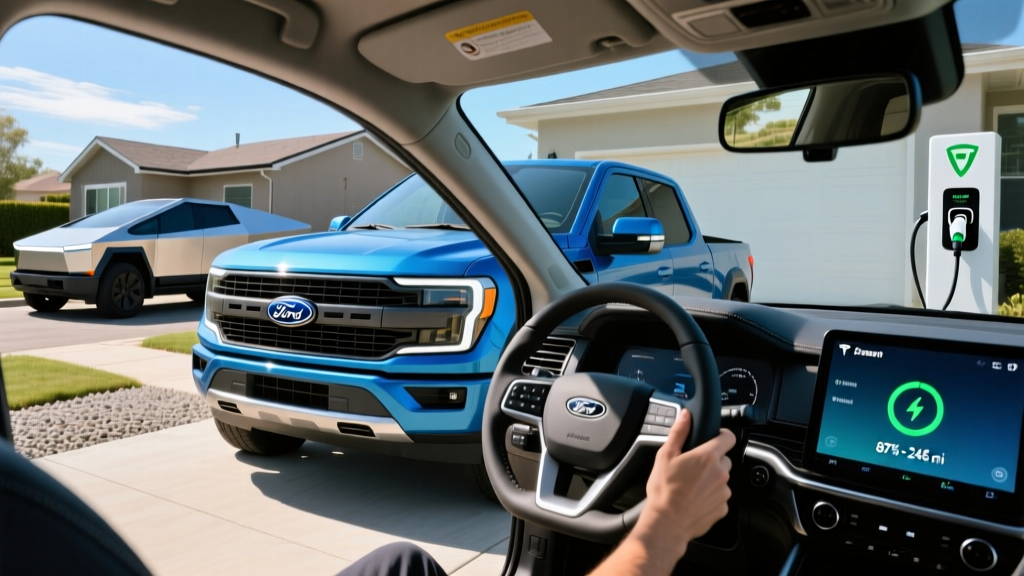
The Ford F-150 Lightning enters the 2025 model year as the most mature electric pickup on the U.S. market — a full-size, body-on-frame truck that happens to be battery-electric rather than a skateboard concept wearing a bed. After three years of production tweaks, Ford has stabilized build quality, expanded the Extended Range battery's availability, and kept pricing competitive against the Tesla Cybertruck and Rivian R1T. But with a 5,000-plus-pound curb weight and a boxy aerodynamic profile, the Lightning lives or dies on how its EPA stickers translate into highway miles, cold mornings, and loaded trailers. We break down every number that matters.
Quick Verdict: Who the 2025 F-150 Lightning Is For
The Lightning rewards a specific buyer: someone with home Level 2 charging, a daily commute under 100 miles, periodic towing under 7,500 pounds, and a preference for a conventional truck layout over the Cybertruck's wedge or the R1T's quad-motor complexity. It is the most "normal" electric pickup to live with — familiar cab, familiar controls, a usable frunk, and BlueCruise for long highway stints. If your use case involves 300-mile one-way road trips through sparse charging networks or frequent 10,000-pound towing, the Lightning's real-world range ceiling will demand careful planning.
Range, Battery Chemistry, and Real-World Expectations
Ford offers two battery packs for 2025, both using NMC (nickel-manganese-cobalt) lithium-ion chemistry — chosen for energy density over the cycle-life longevity of LFP. The Standard Range pack is EPA-rated at 240 miles (Pro and XLT trims), while the Extended Range pack pushes to 320 miles on the Lariat and 320 miles on the Platinum (per fueleconomy.gov).
Standard Range (98 kWh usable): EPA 240 mi → expect ~200–215 mi mixed highway, ~160–180 mi at 75 mph sustained, ~150–170 mi in sub-30°F weather.
Extended Range (131 kWh usable): EPA 320 mi → expect ~270–290 mi mixed, ~230–255 mi highway at 70–75 mph, ~195–220 mi in freezing temps.
Towing a 5,000-lb trailer cuts range roughly 40–50%, landing the Extended Range around 150–170 miles per charge under load.
| Spec | Standard Range | Extended Range |
|---|---|---|
| Battery (usable) | 98 kWh NMC | 131 kWh NMC |
| EPA range | 240 mi | 320 mi |
| MPGe (combined) | 76 MPGe | 70–73 MPGe |
| Efficiency | 44 kWh/100 mi | 46–48 kWh/100 mi |
| Horsepower | 452 hp | 563 hp |
| Torque | 775 lb-ft | 775 lb-ft |
| 0–60 mph | ~3.8 sec | |
| Drivetrain | Dual-motor AWD | Dual-motor AWD |
| Max towing | 7,700 lb | 10,000 lb (Max Trailer Tow) |
| Payload | ~2,235 lb | ~1,952 lb |
Charging Speed: DC Fast, Level 2, and the Curve Reality
The Lightning's DC fast-charging peak is 150 kW on the Extended Range pack and 120 kW on the Standard Range. That puts it behind the 250–350 kW peaks of rivals like the Hyundai Ioniq 5 or the Cybertruck's 400-volt/800-volt architecture, but Ford's charge curve is relatively flat through the mid-state-of-charge, so 10–80% times remain competitive for a truck this size.
| Level | Power / Rate | Time / Miles Added |
|---|---|---|
| Level 1 (120V, 12A) | ~1.4 kW | ~3 mi/hr |
| Level 2 (240V, 48A mobile) | 11.5 kW | ~23 mi/hr; 0–100% in ~11 hr (Std) / ~14 hr (Ext) |
| Level 2 (80A Wall Charger) | 19.2 kW | ~38 mi/hr; 0–100% in ~6 hr (Std) / ~8 hr (Ext) |
| DC Fast (peak) | 150 kW (Ext) / 120 kW (Std) | 15–80% in ~41 min (Ext) |
Curve caveat: Peak 150 kW holds roughly from 15% to 45% SoC on the Extended Range pack, then tapers to ~110 kW through 65%, and drops below 60 kW past 80%. Plan highway stops around 15–75% windows; the last 5% takes nearly as long as the middle 30%. Preconditioning the battery via the navigation-routed charging feature is essential in cold weather — without it, peak rate can be cut in half until the pack warms.
Performance, Towing, and Payload
Every 2025 Lightning is dual-motor all-wheel drive. The Standard Range's 452 hp is adequate for a daily-driver truck; the Extended Range's 563 hp and 3.8-second 0–60 time make it genuinely quick for a 6,500-pound vehicle. The low center of gravity from the under-floor pack gives the Lightning better body control than any gas F-150 through corners, though the steering is numb and the ride can be stiff when unladen — the rear leaf springs prefer a few hundred pounds in the bed.
Towing is where physics bites back. The Max Trailer Tow Package on Extended Range trims is rated for 10,000 pounds, but real-world range with a 6,000–8,000-pound box trailer at highway speed is typically 130–170 miles. The onboard scales and Pro Trailer Hitch Assist are genuinely useful, and the regenerative braking handles trailer weight well on descents. For frequent heavy towing beyond 200-mile round trips, a diesel remains the pragmatic choice.
Interior, Cargo, Tech, and Driver Assistance
The cabin is stock F-150 — which is a compliment. Rear legroom measures 43.6 inches in the SuperCrew, front headroom is 40.8 inches, and the bed is a familiar 5.5-foot box (67.1 cu ft). The frunk (front trunk) adds 14.1 cu ft of lockable, drainable storage with 400 lb capacity — a genuine differentiator versus gas trucks. Max payload is around 2,235 lb on Standard Range trims.
Infotainment runs SYNC 4 on a 12-inch touchscreen (15.5-inch portrait screen on Lariat and Platinum). Wireless Apple CarPlay and Android Auto are standard. The available BlueCruise 1.2 is an SAE Level 2 hands-free highway assist — the driver must remain attentive and eyes-on-camera. It covers 130,000+ miles of divided highways and handles lane changes, but it is not self-driving and does not operate on surface streets autonomously. Pro Power Onboard (up to 9.6 kW) turns the truck into a jobsite or tailgate generator, and the available Intelligent Backup Power can feed a home through a Ford Charge Station Pro during outages (requires professional transfer-switch installation).
Pricing, Trims, and Federal Tax Credit Eligibility
2025 F-150 Lightning MSRP spans a wide range, and the §30D federal credit applies unevenly depending on trim, buyer income, and battery-component sourcing. Under current IRS rules (irs.gov), the credit is up to $7,500, split between critical-minerals and battery-component requirements — both of which have tightened yearly. The Lightning's U.S. assembly in Dearborn helps, but buyers must verify the specific VIN's sourcing status at the point of sale.
| Trim | Battery | MSRP | Potential §30D Credit | Effective Price |
|---|---|---|---|---|
| Pro | Standard Range | ~$57,090 | Up to $7,500* | ~$49,590 |
| XLT | Standard Range | ~$65,090 | Up to $7,500* | ~$57,590 |
| Lariat | Extended Range | ~$77,090 | Up to $7,500* | ~$69,590 |
| Platinum | Extended Range | ~$97,090 | Up to $7,500* | ~$89,590 |
- MSRP cap: Trucks/vans/SUVs must be ≤$80,000. Pro, XLT, and most Lariat builds qualify; Platinum exceeds the cap.
- Buyler income caps (MAGI): $150,000 single / $225,000 head of household / $300,000 joint.
- Battery sourcing: Critical-minerals and battery-component thresholds phase up annually; confirm VIN eligibility on fueleconomy.gov before signing.
- Point-of-sale transfer: Buyers can apply the credit as a down-payment reduction at the dealer, subject to IRS registration.
*Consult a tax professional; rules are subject to change and vary by VIN and buyer.
Warranty, Ownership Costs, and Longevity
Ford covers the Lightning's battery and electric powertrain for 8 years or 100,000 miles, whichever comes first, with a capacity-retention threshold of 70% of original kWh — consistent with the industry norm. The basic vehicle warranty is 3 years/36,000 miles, and the powertrain (non-battery) is 5 years/60,000 miles. NMC chemistry typically sees 8–12% degradation over the first 100,000 miles based on fleet data from earlier model years; avoiding routine 100% charges and DC fast-charging above 80% extends longevity. Insurance premiums run 10–20% higher than a comparable gas F-150, per IIHS and industry averages, so factor that into your five-year TCO.
Pros, Cons, and Key Competitors
- Most conventional-truck feel of any EV pickup
- Massive 14.1 cu-ft frunk with 400-lb capacity
- Pro Power Onboard / home backup capability
- BlueCruise hands-free highway driving
- Strong dealer/service network nationwide
- 150 kW DC peak is outpaced by rivals
- Heavy towing slashes range 40–50%
- Platinum trim exceeds §30D MSRP cap
- Rear ride harsh when bed is empty
- Extended Range battery adds ~$10K+ and weight
vs. Tesla Cybertruck: Cybertruck's AWD and Cyberbeast trims offer faster charging (up to 250+ kW at V4 Superchargers), more angular cargo geometry, and stronger range-per-kWh, but polarizing styling and a stainless-steel learning curve. Lightning wins on interior familiarity, dealer service, and frunk utility.
vs. Rivian R1T: R1T's quad-motor variants deliver 1,025 hp and superior off-road capability, plus a longer ~400-mile Max Pack option. But R1T is smaller, pricier, and has a far smaller service footprint. Lightning is the better daily-driver workhorse; R1T is the adventure toy.
vs. Chevrolet Silverado EV: Chevy's 4WT and upcoming RST offer up to 400 miles of EPA range on the Max pack — a significant advantage for road-trippers — but availability is limited and pricing often climbs past the Lightning's.
Frequently Asked Questions
What is the real-world range of the 2025 F-150 Lightning?
Expect ~270–290 mixed miles from the Extended Range pack under normal conditions, ~230–255 highway, and ~195–220 in freezing weather. Standard Range trims deliver ~200–215 mixed. Towing a 6,000-lb trailer drops that to roughly 150–170 miles.
How fast does the F-150 Lightning charge at home and on the road?
At home on a 48A Level 2 circuit, roughly 23 miles per hour; an 80A Ford Charge Station Pro adds ~38 miles per hour. DC fast-charging peaks at 150 kW (Extended Range) for a 15–80% session in about 41 minutes, with significant taper past 80%.
Does the 2025 F-150 Lightning qualify for the $7,500 federal tax credit?
Pro, XLT, and most Lariat trims (under the $80,000 truck MSRP cap) are potentially eligible for up to $7,500 under IRS §30D, subject to buyer income caps ($150K single / $300K joint) and battery-sourcing rules that tighten annually. The Platinum trim exceeds the MSRP cap. Confirm the VIN on fueleconomy.gov before purchase.
Is the Lightning worth buying over the Cybertruck or Silverado EV?
Yes, if you value a conventional truck layout, a large frunk, home-backup power capability, and a broad dealer network. No, if maximum DC charging speed or 400-mile EPA range is your priority — the Silverado EV Max pack and Cybertruck's Supercharger access lead there.
What are the biggest ownership costs to budget for?
Beyond MSRP, plan for home Level 2 installation ($800–$2,500 depending on panel capacity), insurance 10–20% above a gas F-150, and — for home backup — a transfer switch and Charge Station Pro ($2,000–$4,000 installed). Tires wear faster than on gas trucks due to the Lightning's weight and instant torque.
Can the Lightning power my home during an outage?
Yes, with the available Ford Charge Station Pro and a professionally installed transfer switch via the Intelligent Backup Power system, the Extended Range pack can supply up to 9.6 kW to a home for roughly three days of average use.