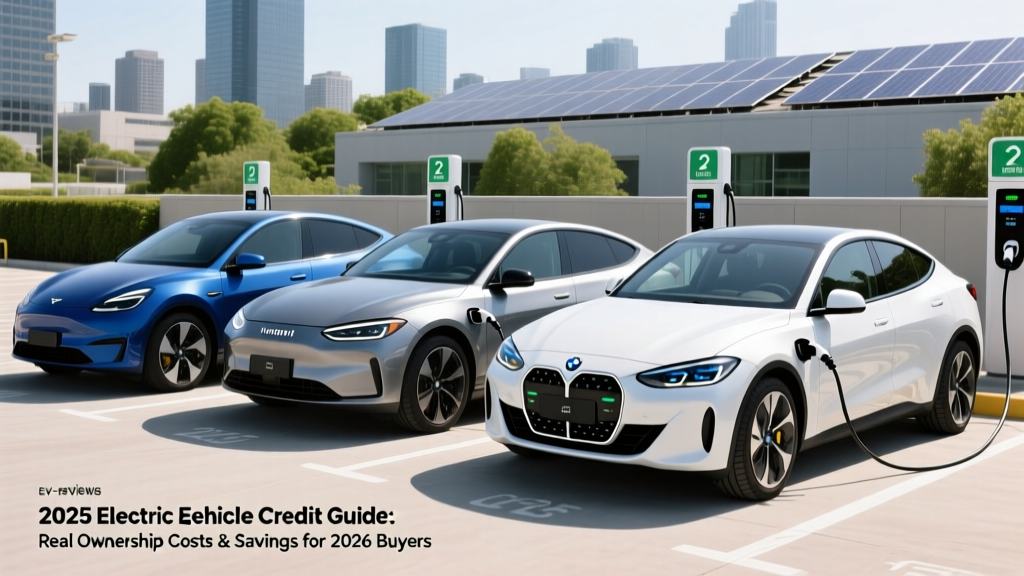
Buying an electric vehicle is no longer just an environmental statement — it is a financial calculation. Between shifting federal incentive rules, volatile electricity and gas prices, and rapidly evolving battery technology, the math behind EV ownership changes every model year. If you are researching the 2025 electric vehicle credit and planning a purchase in the 2026 model year, this guide gives you the exact numbers you need: tax credit eligibility, five-year total cost of ownership, per-mile fuel and maintenance savings, insurance realities, and resale-value trends.
We will use the 2026 Hyundai Ioniq 5 SEL (one of the most popular mainstream EVs with consistent credit eligibility) as our baseline example, and compare it against its closest gas-powered rival, the 2026 Toyota RAV4 XLE AWD, to ground every figure in reality.
The 2025 Electric Vehicle Credit: What Changed and What You Need to Know
The federal EV tax credit, officially known as the IRC §30D Clean Vehicle Credit, underwent significant restructuring beginning in 2023 and continued evolving through 2025 and into 2026. The headline number — up to $7,500 — remains, but qualifying for the full amount is far from guaranteed. The credit is now split into two halves: $3,750 for meeting critical-minerals sourcing requirements and another $3,750 for meeting battery-component sourcing requirements. A vehicle might qualify for one half, both halves, or neither.
Starting in 2024, buyers gained the option to transfer the credit to the dealer at the point of sale, effectively turning it into an instant rebate that reduces your out-of-pocket cost at signing — rather than waiting to claim it on your tax return. This transfer option remains available for 2025 and 2026 purchases, and it has been a major factor in making EVs accessible to buyers who lack the tax liability to use a nonrefundable credit.
§30D Federal EV Tax Credit Eligibility Checklist (2025–2026 Rules)
- Vehicle type: New battery-electric (BEV) or plug-in hybrid (PHEV) with at least 7 kWh battery capacity
- MSRP caps: Vans, SUVs, and pickup trucks ≤ $80,000 MSRP; sedans and other vehicles ≤ $55,000 MSRP
- Buyer income limits (modified AGI): $300,000 joint / $225,000 head of household / $150,000 single filer
- Battery sourcing: Critical minerals and battery components must meet phased-in domestic/free-trade-partner sourcing thresholds — thresholds tighten each year
- Final assembly: Vehicle must undergo final assembly in North America
- Transfer option: Credit can be transferred to dealer at point of sale (reduces purchase price directly)
- One credit per vehicle, one credit per taxpayer per year
Source: IRS Clean Vehicle Tax Credits. Rules are subject to change; always verify current eligibility on the IRS website or with a tax professional before purchasing.
For the 2026 Hyundai Ioniq 5 SEL (MSRP approximately $46,650), the vehicle has historically qualified for the full $7,500 credit thanks to its North American assembly (at Hyundai's Metaplant in Georgia) and battery-sourcing compliance. However, sourcing thresholds tighten annually, and eligibility can shift mid-year. Always check the DOE's fueleconomy.gov tax credit lookup for the specific VIN and model year before signing a purchase agreement.
Five-Year Total Cost of Ownership: EV vs. Gas Side by Side
Sticker price alone tells you almost nothing about what a vehicle actually costs. The real number is total cost of ownership (TCO) — the sum of purchase price (after incentives), fuel/energy, insurance, maintenance, and depreciation over your ownership period. Below, we model five years and 75,000 miles for both the Ioniq 5 SEL and the RAV4 XLE AWD.
| Cost Category | 2026 Ioniq 5 SEL (BEV) | 2026 RAV4 XLE AWD (Gas) |
|---|---|---|
| Base MSRP | $46,650 | $33,425 |
| Federal tax credit (§30D) | −$7,500 | $0 |
| Estimated state/utility rebates | −$1,000 | $0 |
| Effective purchase price | $38,150 | $33,425 |
| Fuel / electricity (75,000 mi) | $3,940 | $9,375 |
| Insurance (5-year total) | $10,250 | $7,750 |
| Maintenance & repairs | $1,400 | $3,800 |
| Estimated 5-year depreciation | $17,500 | $12,200 |
| 5-Year Total Cost of Ownership | $71,240 | $66,550 |
| Cost per mile (all-in) | $0.95 | $0.89 |
Assumptions: 15,000 miles/year; electricity at $0.16/kWh national average (home Level 2 charging, ~3.5 mi/kWh); gasoline at $3.50/gal (RAV4 at 28 MPG combined); insurance sourced from AAA and NerdWallet averages for each vehicle class; depreciation based on Kelley Blue Book and iSeeCars 5-year EV resale data. Actual costs vary significantly by region, driving habits, and electricity rates.
The Ioniq 5 comes out approximately $4,690 more expensive over five years in this scenario. However, this gap narrows or reverses entirely depending on three variables: your local electricity rate, whether your state offers additional rebates, and how long you hold the vehicle (EVs tend to have lower ongoing maintenance costs that compound over time). Let us break down each line item.
Charging vs. Gas: The Per-Mile Math That Matters
The single largest operational advantage of an EV is energy cost — but only if you charge at home. Public DC fast charging can erode or even eliminate the savings.
Cost Per Mile: Ioniq 5 vs. RAV4
| Scenario | Ioniq 5 (BEV) | RAV4 (Gas) | EV Savings |
|---|---|---|---|
| Home Level 2 ($0.16/kWh) | $0.046/mi | $0.125/mi | $0.079/mi |
| Home + solar ($0.06/kWh) | $0.017/mi | $0.125/mi | $0.108/mi |
| Public DC fast ($0.48/kWh) | $0.137/mi | $0.125/mi | −$0.012/mi (EV costs more) |
| Time-of-use off-peak ($0.09/kWh) | $0.026/mi | $0.125/mi | $0.099/mi |
Ioniq 5 efficiency: ~3.5 miles per kWh (EPA combined 114 MPGe). RAV4 AWD: 28 MPG combined at $3.50/gallon. Source: fueleconomy.gov
At 15,000 miles per year on home charging at the national average rate of $0.16/kWh, you would spend roughly $788/year on electricity for the Ioniq 5 versus $1,875/year on gasoline for the RAV4. That is a $1,087 annual fuel savings, or $5,435 over five years.
However, if you rely exclusively on public DC fast charging at rates around $0.48/kWh (common on Electrify America and EVgo without a subscription plan), your annual energy cost jumps to roughly $2,055 — actually exceeding the gas car. This is why home charging access is the single most important factor in EV economics. If you cannot install a Level 2 charger at home or access affordable workplace charging, the fuel-cost argument collapses.
Maintenance Savings: Where EVs Quietly Win
EVs have dramatically fewer moving parts than internal-combustion vehicles. There is no engine oil, no transmission fluid, no spark plugs, no timing belt, no exhaust system, and no catalytic converter. Regenerative braking significantly reduces wear on friction brake pads and rotors — many EV owners report original brake pads at 80,000+ miles.
| Service Item | Ioniq 5 (BEV) | RAV4 (Gas) |
|---|---|---|
| Oil changes (every 5,000–10,000 mi) | $0 | $750–$1,200 |
| Brake pad replacement | $0 (regen preserves pads) | $400–$700 |
| Transmission fluid | $0 | $200–$400 |
| Coolant flush | $100 | $200 |
| Cabin air filter | $150 | $150 |
| Tire rotation & replacement | $1,000 (EVs wear tires faster due to torque/weight) | $700 |
| Wiper blades, misc. | $150 | $200 |
| Total estimated | $1,400 | $3,800 |
The net maintenance savings for the EV is approximately $2,400 over five years. One caveat: EVs tend to wear through tires faster than gas cars due to instant torque and higher curb weight (the Ioniq 5 weighs approximately 4,400 lbs). Budget for a tire replacement around 40,000–50,000 miles, and consider EV-specific tire compounds like the Michelin Pilot Sport EV or Hankook iON, which are designed for the weight and torque profile of electric vehicles.
Insurance Costs: The Uncomfortable Reality
This is where the honest math hurts. EVs are typically 15–25% more expensive to insure than comparable gas vehicles. According to data from the Insurance Information Institute and NerdWallet's 2026 rate analysis, the average annual premium for a Hyundai Ioniq 5 is approximately $2,050, compared to roughly $1,550 for a Toyota RAV4 — a difference of about $500/year or $2,500 over five years.
The reasons are structural, not arbitrary:
- Higher repair costs: EV battery packs, power electronics, and specialized sensors are expensive to replace after a collision
- Fewer qualified body shops: Not all repair facilities are certified for high-voltage system work, limiting competition
- Higher vehicle values: Even after the tax credit, the insured value of the EV is typically higher
- Total-loss thresholds: Minor battery damage can push a claim past the total-loss threshold, increasing insurer payouts
Before purchasing, get quotes from at least three insurers. Some companies (Geico, Progressive, State Farm) offer EV-specific discounts of 5–10% that partially offset the premium gap. Bundling home and auto, maintaining a clean driving record, and choosing a higher deductible can also narrow the gap significantly.
Depreciation and Resale Value: What the Data Shows
EV depreciation has been a moving target. In 2023–2024, aggressive price cuts by Tesla and increased competition caused used EV values to drop sharply — some models lost 40–50% of their value within two years. That volatility has largely stabilized by 2026, but EVs still generally depreciate faster than top-selling gas vehicles like the RAV4.
According to iSeeCars depreciation data, the average EV retains approximately 55–65% of its value after five years, compared to 60–70% for mainstream gas crossovers. For the Ioniq 5, we estimate a five-year depreciation of roughly $17,500 (from the effective $38,150 purchase price), leaving a residual value around $20,650. The RAV4, starting at $33,425, is projected to depreciate about $12,200, retaining roughly $21,225.
Key factors affecting EV resale value:
- Battery health (State of Health / SoH): Buyers and appraisers increasingly check battery degradation. A vehicle with 90%+ SoH commands a premium
- Charging standard: Vehicles with NACS (Tesla-compatible) connectors are gaining resale appeal as the industry standardizes; CCS-only vehicles may see softer demand
- Remaining warranty: The Ioniq 5's 10-year/100,000-mile battery warranty transfers to the second owner, supporting resale value
- Federal credit phase-out risk: If the §30D credit is modified or expires, new-EV pricing shifts, which cascades into used values
State, Local, and Utility Incentives: The Stacked Savings
Important: State, local, and utility incentives vary enormously by jurisdiction and change frequently. The examples below are illustrative — always verify current programs with your state energy office, local air quality district, and utility provider before relying on them in your purchase math.
Beyond the federal §30D credit, many buyers can stack additional incentives:
- State rebates: California's Clean Fuel Reward (up to $1,000 at point of sale), Colorado's innovative EV tax credit (up to $5,000 for income-qualified buyers), Massachusetts MOR-EV rebate (up to $3,500), New York Drive Clean Rebate (up to $2,000)
- Utility rebates: Many electric utilities offer $250–$1,500 rebates for purchasing an EV and/or installing a home Level 2 charger. PG&E, ConEdison, Xcel Energy, and Dominion are among utilities with active programs
- HOV lane access: States including California, Colorado, Virginia, and Maryland offer solo HOV lane access for qualifying EVs — a significant time savings for commuters
- Home charger installation credits: Some states and utilities offer rebates covering 50–100% of Level 2 charger equipment and installation costs (up to $1,000–$2,000)
- Used EV credit (§25E): A separate federal credit of up to $4,000 (30% of sale price, capped) is available for qualifying used EVs purchased from a dealer — this is a strong option for budget-conscious buyers
When stacked, a buyer in Colorado with utility rebates might reduce the effective price of an Ioniq 5 by $12,000–$14,000 total (federal + state + utility), bringing the effective purchase price below $33,000 and flipping the five-year TCO advantage decisively in the EV's favor.
Who Should Buy an EV Now — and Who Should Wait?
The Decision Framework
Buy an EV now if:
- You can install a Level 2 home charger (240V, 32–48 amp circuit)
- You qualify for the full or partial §30D credit (check income and MSRP caps)
- Your daily commute is under 200 miles round-trip
- You live in a state with stacked incentives that close the purchase-price gap
- You plan to keep the vehicle 5+ years (amortizing the higher upfront cost)
Consider waiting or choosing a PHEV if:
- You live in an apartment or lack reliable home/workplace charging access
- Your income exceeds the §30D caps and no state incentives apply
- You frequently drive 300+ miles in cold weather (range loss of 20–30%)
- You need maximum towing capacity on a tight budget
- You are concerned about near-term depreciation volatility
Frequently Asked Questions
How much does it really cost to own an EV over 5 years?
Based on our modeling of a 2026 Hyundai Ioniq 5 SEL versus a Toyota RAV4 XLE AWD over 75,000 miles, the EV's five-year total cost of ownership is approximately $71,240 compared to $66,550 for the gas vehicle — a gap of roughly $4,690. However, with aggressive state/utility incentives or lower electricity rates (e.g., solar or time-of-use plans), the EV can break even or come out ahead. The EV saves approximately $5,435 in fuel and $2,400 in maintenance but costs about $2,500 more in insurance and $5,300 more in depreciation.
Do I qualify for the federal 2025 electric vehicle credit?
Qualification depends on three factors: your income (modified AGI must be ≤$300,000 joint / $225,000 head of household / $150,000 single), the vehicle's MSRP (≤$80,000 for SUVs/trucks/vans, ≤$55,000 for sedans), and the vehicle's battery sourcing compliance (critical minerals and components from domestic or free-trade-partner sources). The vehicle must also be assembled in North America. Use the IRS's official lookup tool and consult a tax professional, as sourcing thresholds tighten annually.
How much do I save on fuel and maintenance?
At 15,000 miles per year with home Level 2 charging at $0.16/kWh, expect to save approximately $1,087 per year on fuel ($5,435 over five years) compared to a gas crossover averaging 28 MPG at $3.50/gallon. Maintenance savings add another $480 per year ($2,400 over five years), primarily from eliminating oil changes and extending brake life through regenerative braking. Total operational savings: approximately $7,835 over five years.
Are EVs more expensive to insure?
Yes, typically 15–25% more expensive than comparable gas vehicles. For the Ioniq 5 vs. RAV4, that translates to roughly $500 more per year ($2,500 over five years). Higher repair costs for battery packs and power electronics, fewer certified body shops, and higher insured values all contribute. Shop multiple insurers and ask about EV-specific discounts.
How well do EVs hold their value?
EVs retain approximately 55–65% of their purchase value after five years, compared to 60–70% for mainstream gas crossovers. Battery health, the vehicle's charging connector (NACS gaining appeal), and remaining warranty coverage are the biggest factors. The Hyundai/Kia 10-year/100,000-mile battery warranty, which transfers to second owners, provides meaningful resale support. Depreciation has stabilized since the 2023–2024 price-war volatility, but remains a weak spot in EV economics.
Can I get the tax credit as a point-of-sale discount?
Yes. Since 2024, buyers can elect to transfer the §30D credit to the dealer at the point of sale. The dealer then reduces your purchase price or down payment by the credit amount ($3,750 or $7,500 depending on eligibility). You must still meet all income and eligibility requirements, and the dealer must be registered with the IRS Energy Credits Online system. This is effectively an instant rebate — no need to wait until tax filing.
Disclaimer: All prices, incentives, and tax rules referenced reflect 2025–2026 model-year information available at time of writing. Federal and state incentive programs change frequently. Always verify current eligibility at irs.gov and consult a licensed tax professional before making purchase decisions based on tax credit availability.