Quick Answer: Is a 2025 Electric Cadillac Worth It?
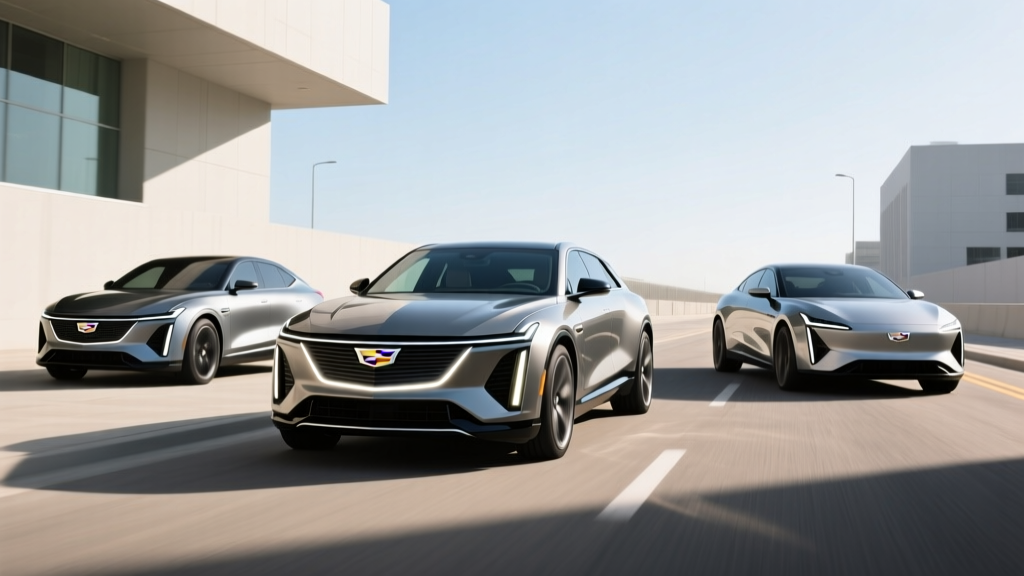
Cadillac's 2025 EV lineup spans three Ultium-platform models: the Lyriq midsize SUV (314 mi EPA, from ~$58,590), the Optiq compact SUV (~300 mi EPA, from ~$53,000), and the Vistiq three-row SUV (~300 mi EPA, from ~$78,000). All three ride on GM's BEV3 architecture with 102 kWh usable NMC batteries, 190 kW peak DC fast charging, and access to the Tesla Supercharger network via NACS. The Lyriq is the most proven and widely available; the Optiq targets buyers priced out of the Lyriq; and the Vistiq fills the luxury three-row gap. Expect real-world highway range of 250–275 miles in mild weather, dropping to 200–230 miles in sub-freezing conditions. Federal §30D tax credit eligibility varies by battery sourcing and buyer income — verify at IRS.gov before purchasing.
2025 Cadillac EV Lineup: Side-by-Side Specs
Cadillac has moved aggressively to electrify its portfolio using GM's Ultium battery platform. Here's how the three core models stack up on paper before we dig into real-world ownership.
| Spec | 2025 Lyriq | 2025 Optiq | 2025 Vistiq |
|---|---|---|---|
| Segment | Midsize 2-row SUV | Compact 2-row SUV | Midsize 3-row SUV |
| EPA Range | 314 mi (RWD) | ~300 mi (est.) | ~300 mi (est.) |
| Battery (Usable) | 102 kWh NMC | 102 kWh NMC | 102 kWh NMC |
| Drivetrain | RWD or AWD | AWD | AWD |
| Horsepower | 340 (RWD) / 500 (AWD) | ~400 (est.) | ~600 (est.) |
| 0–60 mph | 6.0s (RWD) / 4.6s (AWD) | ~5.0s | ~3.7s |
| Peak DC Fast Charge | 190 kW | 190 kW | 190 kW |
| 10–80% DC Charge | ~30 min | ~30 min | ~30 min |
| Level 2 (240V) | 19.2 kW (11.5 kW std) | 19.2 kW | 19.2 kW |
| Charging Port | NACS (Supercharger access) | NACS | NACS |
| Cargo Volume | 28 cu ft / 60.8 cu ft (rear folded) | ~26 cu ft (est.) | ~43 cu ft / ~80 cu ft (est.) |
| Base MSRP | $58,590 (Luxury RWD) | ~$53,000 | ~$78,000 |
| Battery Warranty | 8 yr / 100,000 mi | 8 yr / 100,000 mi | 8 yr / 100,000 mi |
Sources: EPA / fueleconomy.gov, Cadillac official specifications. Optiq and Vistiq figures marked (est.) are based on GM's preliminary announcements and may shift at final certification.
Real-World Range: What the EPA Sticker Doesn't Tell You
The Lyriq's 314-mile EPA rating applies to the rear-wheel-drive Luxury trim on 20-inch wheels. Choose AWD or step up to 22-inch wheels, and that number drops to approximately 307 miles. But EPA ratings assume a mixed driving cycle with moderate temperatures — real-world results diverge based on how and where you drive.
Lyriq RWD Real-World Range Expectations
- City/suburban, 65°F: 290–310 mi (near EPA)
- Highway 70–75 mph, 65°F: 250–275 mi (aerodynamic drag dominates)
- Highway, 30°F: 220–250 mi (battery cold + cabin heat)
- Highway, 10°F: 190–220 mi (significant cold-weather loss)
AWD models lose roughly 5–8% range across all conditions. The Lyriq's heat pump helps mitigate cold-weather losses compared to resistive heating, but physics still applies.
On a 300-mile road trip in the Lyriq AWD, plan for one DC fast-charge stop. The 190 kW peak rate sounds competitive, but sustained charging matters more: the Lyriq holds roughly 150–170 kW from 10–40% SoC, then tapers progressively. A 10–80% session takes approximately 30 minutes at a properly functioning 350 kW station — but expect 35–40 minutes at older 150 kW hardware. Always precondition the battery via navigation routing to a charger; skipping this step can add 5–10 minutes to your session in cool weather.
Charging at Home and on the Road
Every 2025 Cadillac EV ships with NACS (North American Charging Standard), meaning native access to Tesla Superchargers — currently the most reliable DC fast-charging network in the US. This is a significant advantage over CCS-equipped competitors still dependent on Electrify America or EVgo reliability.
| Level | Power | Miles Added/Hour | Use Case |
|---|---|---|---|
| Level 1 (120V) | 1.4 kW | ~3–4 mi/hr | Overnight trickle, emergencies |
| Level 2 (240V, 48A) | 11.5 kW | ~30–33 mi/hr | Daily home charging |
| Level 2 (240V, 80A) | 19.2 kW | ~50–55 mi/hr | Fast home fill, requires 100A circuit |
| DC Fast (190 kW peak) | 190 kW | ~190 mi in 30 min | Road trips |
Home Charging Installation Reality
Most Lyriq, Optiq, and Vistiq owners will want a Level 2 home charger. Here's what that actually costs:
| Item | Low End | High End |
|---|---|---|
| Level 2 EVSE (48A hardwired) | $400 | $750 |
| Electrician labor (standard install) | $600 | $1,500 |
| Electrical panel upgrade (if needed, 200A) | $1,500 | $3,500 |
| Permit & inspection | $100 | $350 |
| Total (no panel upgrade) | $1,100 | $2,600 |
| Total (with panel upgrade) | $2,600 | $6,100 |
Final installation specs must be determined by a licensed electrician based on your panel capacity, conduit run length, and local code. A 48A charger requires a 60A dedicated circuit; stepping up to 19.2 kW charging demands an 80A charger on a 100A circuit, which many older homes cannot support without a panel upgrade.
Cost of Ownership: Electric Cadillac vs. Gas Equivalent
Let's compare the Lyriq AWD against its closest gas-powered competitor — the Cadillac XT5 AWD — over a 5-year / 75,000-mile ownership period.
| Category | 2025 Lyriq AWD | 2025 XT5 AWD (Gas) |
|---|---|---|
| Base MSRP | $62,090 | $49,995 |
| Federal Tax Credit (§30D) | Up to $7,500 (see eligibility below) | $0 |
| Effective Purchase Price | ~$54,590 | $49,995 |
| Fuel/Energy (75,000 mi) | ~$4,200 (home L2 at $0.16/kWh) | ~$9,900 (22 MPG avg, $3.50/gal) |
| Maintenance (5 yr) | ~$800 (tire rotation, cabin filter, wipers) | ~$3,200 (oil, filters, brakes, fluids) |
| Insurance (5 yr avg) | ~$11,500 | ~$9,200 |
| Estimated Depreciation | ~$22,000 | ~$18,000 |
| 5-Year Total Cost | ~$93,090 | ~$90,295 |
Energy costs assume 80% home charging at national average electricity rates and 20% DC fast charging at $0.40/kWh. Insurance premiums for EVs run 15–25% higher on average. Depreciation estimates are preliminary for the Lyriq and based on early resale data. Your mileage — literally — will vary.
The Lyriq costs roughly $2,800 more over five years in this scenario, but that gap narrows significantly if you qualify for the full $7,500 tax credit, charge primarily at home with cheap electricity, or live in a state with additional rebates. It also widens if you lack home charging and rely exclusively on DC fast charging at $0.35–$0.50/kWh.
Federal §30D Tax Credit: Eligibility Is Not Guaranteed
To claim up to $7,500 on a new 2025 Cadillac EV, you must satisfy all of the following (per IRS §30D rules):
- MSRP cap: Vehicle MSRP must not exceed $80,000 for SUVs (all three Cadillacs qualify at base, but high-trim Vistiq models may exceed this)
- Buyer income cap: AGI must not exceed $300,000 (married filing jointly), $225,000 (head of household), or $150,000 (single)
- Battery sourcing: Critical minerals and battery components must meet phased-in US/free-trade-partner requirements — percentages increase annually
- Final assembly: Vehicle must be assembled in North America (all three Cadillacs qualify — Spring Hill, TN and Orion, MI)
- Point-of-sale transfer: You can transfer the credit to the dealer for an immediate price reduction, but you must still meet income requirements at tax filing time
Important: Battery sourcing requirements have eliminated some trims/model years from full credit eligibility. Always verify the specific VIN on fueleconomy.gov before signing a purchase agreement. Consult a tax professional for your personal situation.
Electric Cadillac vs. Gas Cadillac: Which Fits Your Life?
| Factor | Electric (Lyriq/Optiq/Vistiq) | Gas (XT5/XT6/Escalade) |
|---|---|---|
| Daily commute <50 mi | ✅ Ideal — charge overnight, never visit a gas station | ⚠️ Wastes fuel in stop-and-go |
| Road trips 300+ mi | ⚠️ 1–2 charge stops needed, add 30–60 min | ✅ 5-minute fill, 400+ mi range |
| Home charging available | ✅ Lowest fueling cost, most convenient | N/A |
| Apartment / no home charging | ❌ Public charging adds cost and time | ✅ Gas stations everywhere |
| Cold climate (<20°F winters) | ⚠️ 20–35% range loss, preconditioning required | ✅ Minimal range impact |
| Towing | ⚠️ Lyriq 3,500 lb max; range drops 40–50% while towing | ✅ XT6 tows 4,000 lb, Escalade 8,000 lb |
| Maintenance simplicity | ✅ No oil, fewer brake replacements (regen) | ⚠️ Regular oil, filters, brake wear |
| Upfront cost | ⚠️ Higher MSRP, partially offset by credits | ✅ Lower sticker price |
Common Misconceptions About Cadillac EVs
| Myth | Fact |
|---|---|
| "The battery will need replacing in 5 years" | GM's Ultium NMC batteries carry an 8-year/100,000-mile warranty against defects and excessive degradation (below 60% capacity). Industry data shows typical degradation of 5–10% over 100,000 miles. Full replacement, if ever needed, runs $15,000–$22,000 out of warranty. |
| "I can't take it on road trips" | With Supercharger access via NACS, a Lyriq can add ~150 miles in 20 minutes. A 600-mile trip requires two 30-minute stops — manageable with planning via the myCadillac app or A Better Routeplanner. |
| "Super Cruise means I don't have to pay attention" | Super Cruise is an SAE Level 2 driver-assistance system. You must remain attentive, and the driver-monitoring camera will alert you if your eyes leave the road. It works only on pre-mapped divided highways (~750,000 miles in North America). |
| "Charging is more expensive than gas" | At the national average of $0.16/kWh, the Lyriq's fuel cost is roughly $0.055/mile — about half the cost of a 22 MPG gas SUV at $3.50/gallon ($0.16/mile). DC fast charging at $0.40/kWh narrows the gap but still undercuts gas. |
| "All Cadillacs get the $7,500 tax credit" | Eligibility depends on battery sourcing, buyer income, MSRP cap, and final assembly. Not every trim or delivery month may qualify. Check the VIN on fueleconomy.gov. |
What First-Time EV Buyers Must Know Before Signing
If this is your first electric vehicle, the ownership experience differs from gas cars in ways that aren't obvious from a test drive:
- Charge where you park. The cheapest, most convenient "fueling" happens at home. If you can install a Level 2 charger (or already have a 240V outlet in your garage), an EV integrates seamlessly. If you can't charge at home, weigh whether nearby public charging is reliable and affordable enough for daily use.
- Understand kW vs. kWh. kWh measures battery capacity (energy stored — the Lyriq has 102 kWh usable). kW measures charging speed (power flowing in — the Lyriq peaks at 190 kW DC). A bigger kWh battery goes farther; a higher kW charger fills it faster.
- Charging curves are real. No EV charges at its peak rate for the full session. The Lyriq's 190 kW peak occurs between roughly 10–40% SoC, then tapers to ~100 kW by 60% and ~50 kW above 80%. This is why 10–80% times are the standard metric — charging above 80% is painfully slow and best reserved for home Level 2.
- Winter changes everything. Cold batteries charge slower and hold less usable energy. In single-digit temperatures, expect 20–35% range reduction and 5–10 extra minutes at a DC fast charger. Always precondition the battery before fast charging in cold weather.
- Tires wear faster. EVs are heavy (the Lyriq AWD weighs ~5,700 lbs) and deliver instant torque. Budget for tire replacement every 25,000–35,000 miles — roughly $1,200–$1,800 for a set of premium all-season tires.
Super Cruise Is NOT Self-Driving
Cadillac's Super Cruise is one of the best SAE Level 2 driver-assistance systems available — it handles steering, acceleration, and braking on compatible highways, and it allows hands-off operation with eye monitoring. However, you remain the driver. You must stay alert, be prepared to take over instantly, and cannot sleep, read, or use your phone. Only Waymo-style robotaxis operating in geofenced areas qualify as Level 4. No production Cadillac is self-driving.
Decision Framework: Which 2025 Electric Cadillac Is Right for You?
Choose the Lyriq if:
- You want the most proven, widely reviewed Cadillac EV with the longest EPA range
- You need a comfortable two-row luxury SUV for commuting and weekend trips
- You value Super Cruise availability and a 33-inch LED dashboard display
- Your budget is $58,000–$72,000 depending on trim
Choose the Optiq if:
- The Lyriq's size or price is too much, and you want a more compact, urban-friendly SUV
- You're cross-shopping the BMW iX1, Genesis GV60, or Volvo EX40
- You want Cadillac design and Super Cruise access at a ~$53,000 entry point
Choose the Vistiq if:
- You need three rows for family hauling but don't want to step up to a full Escalade IQ
- You want a quiet, torque-rich electric replacement for the XT6
- Your budget is $78,000+ and you accept that real-world range with three rows of passengers and cargo will be closer to 240–260 miles
Choose a gas Cadillac (XT5/XT6) instead if:
- You cannot install a home charger and lack reliable nearby public charging
- You regularly tow more than 3,500 pounds
- You drive 400+ miles in a single stretch frequently and cannot tolerate charge stops
- Your budget is firmly under $50,000
Frequently Asked Questions
Does the 2025 Cadillac Lyriq qualify for the $7,500 federal tax credit?
It can, but eligibility depends on your income (AGI caps apply), the vehicle's battery sourcing compliance for the delivery month, and MSRP not exceeding $80,000. The Lyriq is assembled in Spring Hill, Tennessee, satisfying the North American final assembly requirement. Verify the specific VIN at fueleconomy.gov and consult a tax professional before relying on the credit.
Can I charge a Cadillac EV at Tesla Superchargers?
Yes. All 2025 Cadillac EVs use the NACS connector natively, providing direct access to Tesla's Supercharger network without an adapter. This is one of the strongest practical advantages of GM's switch to NACS over the legacy CCS standard.
How long will the Ultium battery last?
GM warranties the battery for 8 years or 100,000 miles against defects and capacity loss below 60%. Real-world data from early Ultium vehicles and industry-wide NMC chemistry studies suggest 85–92% capacity retention at 100,000 miles under normal use. Avoid habitual DC fast charging and routine 100% SoC storage to maximize longevity.
Is the Lyriq AWD worth the range penalty?
If you live in a region with snow, ice, or frequent rain, AWD provides meaningful traction benefits. The range cost is roughly 5–8% (about 15–25 miles). For most owners charging at home, that's a negligible daily trade-off. If you live in a warm, dry climate and prioritize maximum range, stick with RWD.
What's the real charging cost on a road trip?
At a Tesla Supercharger averaging $0.35/kWh, a 10–80% session on the Lyriq (~71 kWh added) costs roughly $25. That buys you approximately 200–220 real-world miles. For comparison, 200 miles in a 22 MPG gas SUV at $3.50/gallon costs about $32. The EV is cheaper per mile, but the stop takes 30 minutes instead of 5.
Does Super Cruise work everywhere?
No. Super Cruise operates on approximately 750,000 miles of pre-mapped, divided highways in the US and Canada. It does not function on surface streets, in construction zones that have altered lane markings, or on unmapped roads. The system will alert you well in advance when a compatible section ends. This is an SAE Level 2 system requiring continuous driver supervision.