Quick Verdict: The 2025 Cybertruck in One Paragraph
The 2025 Cybertruck is a polarizing, angular electric pickup that delivers genuine truck capability wrapped in stainless steel and controversy. With up to 845 hp in the Cyberbeast trim, a usable battery around 123 kWh, and a starting price of $79,990 for the AWD trim, it's a premium EV that trades traditional truck refinement for raw performance and head-turning design. But the real story is in the details — the real-world range shortfall, the charging curve that tapers hard above 80%, and the IRS §30D tax credit eligibility that has shifted under buyers' feet. This review breaks down every number that matters before you sign a delivery agreement.
2025 Cybertruck Full Spec Table
| Spec | AWD | Cyberbeast |
|---|---|---|
| EPA Range | 340 mi (w/ range extender) | 320 mi |
| Battery (usable) | ~123 kWh, NMC | ~123 kWh, NMC |
| Drivetrain | Dual-Motor AWD | Tri-Motor AWD |
| Horsepower | 600 hp | 845 hp |
| 0-60 mph | 4.1 sec | 2.6 sec |
| Peak DC Fast Charge | 250 kW | 250 kW |
| 10-80% DC Time | ~30 min | ~30 min |
| Level 2 Home Charge | 11.5 kW (~34 mi/hr) | 11.5 kW (~34 mi/hr) |
| MPGe (combined) | 67 MPGe | 63 MPGe |
| Efficiency | 50 kWh/100mi | 53 kWh/100mi |
| Towing Capacity | 11,000 lb | 11,000 lb |
| Payload | 2,500 lb | 2,500 lb |
| Bed Length | 6 ft | 6 ft |
| Cargo Volume (bed+frunk) | ~67 cu ft bed + 7 cu ft frunk | ~67 cu ft bed + 7 cu ft frunk |
| Base MSRP | $79,990 | $99,990 |
| Battery Warranty | 8 yr / 120,000 mi | 8 yr / 120,000 mi |
Range: EPA Sticker vs What You'll Actually Get
EPA Estimate: 340 mi (AWD w/ range extender) / 320 mi (Cyberbeast)
Real-World Highway (70 mph, mild weather): ~260-290 mi
Real-World Cold Weather (below 32°F): ~220-250 mi
While Towing (5,000+ lb trailer): ~140-170 mi
The Cybertruck's EPA range figures look competitive on paper, but the truck's massive frontal area and 6,800+ lb curb weight work against it at highway speeds. In real-world highway testing at 70-75 mph, expect to see roughly 260-290 miles from the AWD trim before needing a charge — a meaningful drop from the 340-mile sticker. The Cyberbeast, with its tri-motor setup and stickier compound tires, tends to land around 240-270 miles in similar conditions.
Cold weather compounds the problem. The Cybertruck uses a heat pump for cabin and battery thermal management, which helps, but the enormous battery pack and heavy vehicle mass still result in 25-35% range reduction in sustained sub-freezing temperatures. If you live in the upper Midwest or Mountain West and plan winter road trips, budget for 220-250 miles of usable range per charge.
The most sobering number is towing range. With a 5,000 lb or heavier trailer, the Cybertruck's efficiency drops to roughly 90-110 kWh/100mi — meaning your 123 kWh pack delivers only 140-170 miles before depletion. This is physics, not a Tesla flaw; every electric truck suffers similarly. But it's a critical planning factor if you tow frequently.
The optional range extender (a bed-mounted auxiliary battery pack) adds approximately 40-70 miles of EPA-rated range depending on trim, bringing the AWD to its advertised 340-mile figure. However, it consumes a portion of bed space and adds weight. According to fueleconomy.gov, the Cybertruck AWD achieves 67 MPGe combined — translating to about 50 kWh per 100 miles driven.
Charging: DC Fast Charging, Home Level 2, and the Curve
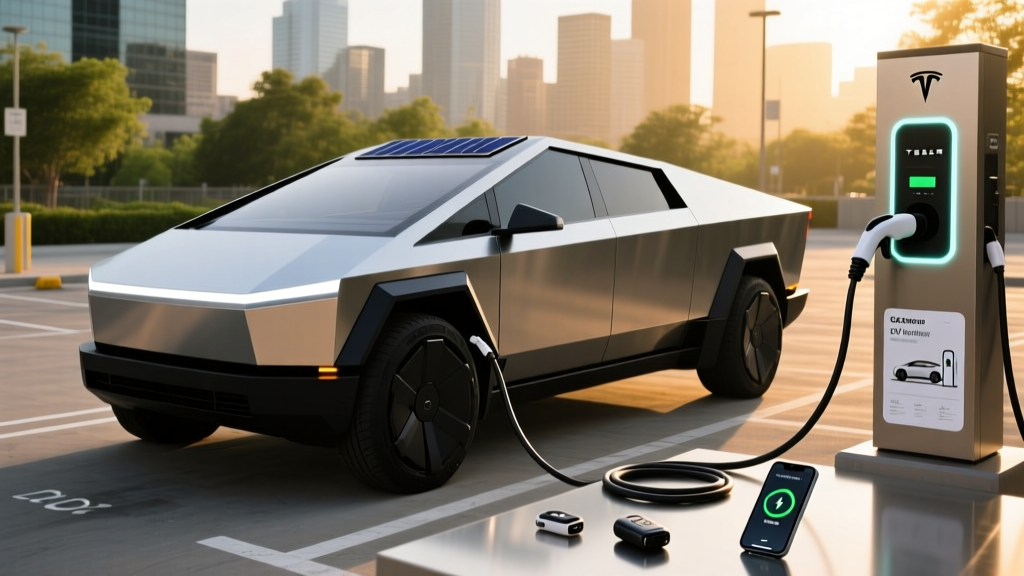
The Cybertruck supports a peak DC fast-charge rate of 250 kW on Tesla's V3 Superchargers (and via the NACS connector at compatible third-party networks like Electrify America and EVgo stations that now support NACS). However, peak rate and sustained rate are very different things — and this is where the Cybertruck's large 123 kWh battery reveals both its advantage and its limitation.
| Charging Method | Power (kW) | Miles Added Per Hour | Notes |
|---|---|---|---|
| Level 1 (120V outlet) | ~1.4 kW | ~3-4 mi/hr | Emergency/trickle only |
| Level 2 (240V, 48A) | 11.5 kW | ~34 mi/hr | Full charge in ~11 hours |
| DC Fast (V3 Supercharger) | Up to 250 kW peak | ~130 mi in 15 min | 10-80% in ~30 min |
| DC Fast (above 80%) | Tapers to ~50-70 kW | ~20-30 mi/hr | Charge curve protection |
At a V3 Supercharger, the Cybertruck can accept up to 250 kW, but that peak only sustains roughly between 10-40% state of charge. From 40-80%, the rate gradually tapers from ~200 kW down to ~100 kW. Above 80%, the battery management system aggressively reduces charge speed to protect the NMC cells, dropping to 50-70 kW. This is why a 10-80% session takes roughly 30 minutes, but 80-100% can add another 25-30 minutes. For road trips, plan your stops around the 10-80% window — never wait for a full charge at a DC station.
At home, the Cybertruck's onboard charger maxes out at 11.5 kW (48 amps on a 240V circuit). That translates to roughly 34 miles of range per hour of charging, meaning a full 0-100% replenishment takes about 11 hours on a Level 2 wall connector. Most owners will charge overnight from 20-80% in roughly 6-7 hours, which is practical for daily use. Installation of a 240V/60A circuit typically costs $800-$2,000 depending on your electrical panel capacity and run length — factor this into your purchase budget.
One critical preconditioning note: the Cybertruck's navigation system will automatically warm the battery when you route to a Supercharger. Always navigate to your charging stop rather than driving there manually — preconditioned batteries accept charge significantly faster, especially in cold weather. Skipping this step can add 10-15 minutes to your DC fast-charge session.
Performance: 0-60, Towing, and Daily Drivability
The Cyberbeast's 2.6-second 0-60 mph time is genuinely supercar territory, enabled by the tri-motor setup (one front, two rear) producing 845 horsepower. The dual-motor AWD trim still manages 4.1 seconds with 600 hp — faster than most sports sedans from a decade ago. Both trims use steer-by-wire, a first for a production vehicle in the US market, which eliminates the mechanical connection between the steering wheel and front wheels.
Steer-by-wire takes adjustment. The steering ratio is variable — fewer turns lock-to-lock at low speeds (parking is remarkably easy for a truck this size), but the feedback feel is synthetic compared to a traditional rack. Most drivers acclimate within a few days, but it's worth a thorough test drive before committing.
Towing capacity is rated at 11,000 lb across all trims, competitive with heavy-duty gas pickups. The Cybertruck includes an integrated trailer brake controller and a camera system for hitch alignment. However, as noted above, towing crushes range. If you tow more than a few times per year, seriously consider whether a diesel or gas truck better serves that use case.
The 6-foot composite bed with powered tonneau cover is practical for most cargo, and the powered frunk (front trunk) adds 7 cu ft of lockable, weatherproof storage — useful for groceries, charging cables, or tools. Rear-seat legroom measures approximately 41 inches, adequate for adults on shorter trips but tighter than a full-size crew cab like the Ford F-150 or Rivian R1T.
Pricing, Trims, and Federal Tax Credit Eligibility
The 2025 Cybertruck lineup has simplified after the initial launch-year pricing controversy. Here's where things stand:
| Trim | Base MSRP | As-Tested (typical options) | §30D Tax Credit Eligible? |
|---|---|---|---|
| AWD (Dual-Motor) | $79,990 | $83,000-$88,000 | See below |
| Cyberbeast (Tri-Motor) | $99,990 | $102,000-$108,000 | No — exceeds MSRP cap |
Under IRS §30D rules, the federal clean vehicle credit offers up to $7,500, but eligibility hinges on several requirements that affect the Cybertruck directly:
- MSRP Cap: Pickup trucks must have an MSRP at or below $80,000. The AWD trim at $79,990 qualifies on price; the Cyberbeast at $99,990 does not.
- Buyer Income Limits: Modified adjusted gross income must not exceed $150,000 (single), $225,000 (head of household), or $300,000 (joint filing).
- Battery Component & Critical Minerals Sourcing: The vehicle must meet progressively stricter requirements for North American battery component manufacturing and critical mineral sourcing. Tesla's supply chain has been evolving — verify current-year compliance on the DOE fueleconomy.gov credit lookup before purchasing.
- Point-of-Sale Transfer: As of 2024, eligible buyers can transfer the credit to the dealer at purchase, reducing the purchase price directly rather than waiting for a tax refund.
The Cybertruck AWD may qualify for the full $7,500, a partial credit, or no credit depending on the current sourcing compliance status. This changes periodically as Tesla adjusts battery suppliers. Always confirm eligibility on the official IRS and DOE resources at the time of purchase — do not rely on outdated forum posts or third-party summaries. Consult a tax professional for your specific situation.
Interior, Tech, and Driver Assistance
The Cybertruck interior is minimalist in a way that divides opinion. A single 18.5-inch touchscreen handles infotainment, climate, navigation, and vehicle settings. There are no physical buttons, no instrument cluster, and no traditional stalks — turn signals are on the steering wheel rim (a consequence of the yoke-style steer-by-wire wheel), and gear selection is via a touchscreen slider.
The infotainment system is Tesla's latest software, supporting streaming media, a built-in web browser, Sentry Mode dashcam recording, and over-the-air updates. A rear 9.4-inch touchscreen serves back-seat passengers. Audio is a 15-speaker premium system that is genuinely impressive for a truck cabin.
Driver assistance comes via Tesla's Autopilot (standard), which includes adaptive cruise control, lane centering, and automatic emergency braking — this is an SAE Level 2 system requiring full driver attention and hands-on-wheel engagement at all times. The optional Full Self-Driving (Supervised) capability adds automated lane changes, traffic light recognition, and city-street navigation, but it remains a Level 2 driver-assist feature, not autonomous driving. The driver must continuously supervise and be ready to intervene instantly.
Tesla Autopilot and FSD (Supervised) are SAE Level 2 driver-assistance systems. The driver must remain fully engaged, eyes on the road, hands available to steer. The Cybertruck does NOT drive itself. Only Level 4 services like Waymo operate without a human driver — and those are geofenced robotaxis, not consumer vehicles.
Ownership: Warranty, Reliability, and Who Should Buy
Tesla covers the Cybertruck's battery and drive unit with an 8-year / 120,000-mile warranty, with a guaranteed minimum 70% capacity retention over that period. The limited vehicle warranty is 4 years / 50,000 miles. These terms are competitive within the EV truck segment, though Rivian offers a similar 8-year battery warranty.
Insurance costs are a real factor: the Cybertruck's stainless steel body panels, steer-by-wire system, and high repair costs push premiums 25-40% above comparable pickups. Get a quote before ordering — several owners report annual premiums in the $3,000-$5,000 range depending on location and driving record.
Build quality has improved since the initial 2024 deliveries, but panel alignment variability, tonneau cover sealing issues, and the steer-by-wire learning curve remain noted concerns in owner communities. Tesla's service network is extensive, but wait times for body work (especially stainless steel panel replacement) can be lengthy.
- Class-leading acceleration (Cyberbeast: 2.6s 0-60)
- 11,000 lb towing capacity
- Stainless steel exoskeleton — no paint to chip or fade
- Excellent Supercharger network access
- Powered frunk + lockable bed with tonneau
- OTA updates continuously add features
- Real-world highway range well below EPA sticker
- Steer-by-wire takes significant acclimation
- High insurance premiums
- Cyberbeast exceeds $80K MSRP cap — no tax credit
- Rear seat room tighter than full-size crew cabs
- Stainless steel fingerprint magnet
- Limited third-party service options for bodywork
Who the Cybertruck suits best: Tech-forward buyers who want a daily-driver electric truck with serious performance, tow occasionally rather than daily, have reliable home Level 2 charging access, and value the Tesla Supercharger network for road trips. It's less ideal for buyers who regularly tow heavy loads long-distance, need maximum rear-seat space, or prioritize traditional truck refinement over novelty.
Frequently Asked Questions
What is the real-world range of the 2025 Cybertruck?
Expect 260-290 miles on the highway in mild weather for the AWD trim, and 240-270 miles for the Cyberbeast. In cold weather (below 32°F), plan for 220-250 miles. While towing, range drops to approximately 140-170 miles depending on trailer weight.
How fast does the Cybertruck charge at home and on the road?
On a DC fast charger (Tesla V3 Supercharger), it peaks at 250 kW and charges from 10-80% in approximately 30 minutes. At home on Level 2 (240V, 48A), it charges at 11.5 kW, adding about 34 miles per hour — a full charge takes roughly 11 hours.
Does the 2025 Cybertruck qualify for the $7,500 federal tax credit?
The AWD trim at $79,990 MSRP may qualify, depending on buyer income limits (under $150K single / $300K joint) and current battery-sourcing compliance. The Cyberbeast at $99,990 exceeds the $80,000 truck MSRP cap and does not qualify. Always verify on fueleconomy.gov at time of purchase.
Is the Cybertruck worth buying over the Rivian R1T or Ford F-150 Lightning?
It depends on priorities. The Cybertruck wins on raw acceleration and Supercharger network access. The Rivian R1T offers a more refined interior, better rear-seat space, and a more traditional driving feel. The F-150 Lightning provides a more familiar truck experience, greater rear-seat room, and lower starting prices. Test-drive all three before deciding.
What are the biggest Cybertruck drawbacks?
Real-world range falls notably short of EPA estimates, especially at highway speeds and in cold weather. Steer-by-wire requires an adjustment period. Insurance premiums are high. The Cyberbeast trim doesn't qualify for the federal tax credit. And the stainless steel body, while durable, shows fingerprints constantly.
How long will the Cybertruck battery last?
Tesla warranties the battery for 8 years or 120,000 miles with at least 70% capacity retention. Based on Tesla's track record with similar NMC packs in the Model S and Model X, most owners can expect 80-85% capacity after 100,000 miles. Full battery replacement (out of warranty) is estimated at $15,000-$25,000 based on current Tesla service pricing, though this may decrease as battery costs continue to fall.