The Quick Answer: Silverado RST EV Bed & Payload Reality
The 2025 Chevrolet Silverado EV RST (now called the RST Max Range) uses a fixed composite bed — not a traditional steel bed with a removable cap. The bed is 5'11" long (with the midgate closed), expanding to 9' with the midgate open. There is no factory "bed cap" option; instead, Chevy offers the eTrunk (front trunk) for secure, weatherproof storage. The RST Max Range delivers an EPA-estimated 440 miles of range, 10,200 lbs of max towing, and roughly 1,300 lbs of payload capacity. Pricing starts at $87,300 MSRP before destination and incentives.
Silverado EV RST Specs: Range, Battery, and Charging
The 2025 Silverado EV RST rides on GM's Ultium platform with a massive lithium-ion NMC battery pack. Here are the exact figures buyers need:
| Spec | 2025 Silverado EV RST Max Range |
|---|---|
| EPA Range | 440 miles |
| Real-World Highway (~70 mph) | ~340–370 miles |
| Battery Capacity (usable) | ~200 kWh (NMC) |
| Max DC Fast Charge Rate | 350 kW (peak) |
| 10–80% DC Fast Charge | ~45 minutes |
| Level 2 Home Charging (kW) | 19.2 kW (max, with compatible EVSE) |
| Level 2 Miles per Hour | ~37 mi/hr at 19.2 kW |
| Motor Output | 754 hp / 785 lb-ft torque |
| 0–60 mph | ~4.5 seconds |
| Max Towing | 10,200 lbs (with Max Trailering pkg) |
| Payload | ~1,300 lbs |
| Bed Length (midgate closed/open) | 5'11" / 9'0" |
| eTrunk Volume | 10.9 cu ft |
| Base MSRP | $87,300 |
| Battery/Powertrain Warranty | 8 years / 100,000 miles |
Real-World Range Caveat: The 440-mile EPA figure assumes mixed driving. In real-world highway testing at sustained 70–75 mph, expect 340–370 miles. In cold weather (below 32°F), range can drop 20–30%, potentially reducing highway range to 280–310 miles. The Silverado EV's enormous battery helps absorb this loss better than smaller-pack EVs, but physics still applies. Towing a 7,000-lb trailer can cut range by 40–50%.
The "Bed Cap" Question: What the Silverado EV Actually Offers
Searches for a "2025 Chevy Silverado RST EV bed cap" reflect a common misconception. The Silverado EV does not use a conventional truck bed with a separate cap or topper. Instead, it features a unibody-style composite bed that is structurally integrated into the vehicle. The key storage innovations are:
- Multi-Flex Midgate: The partition between the cab and bed can be folded down (60/40 split), extending the load floor from 5'11" to over 9 feet. This lets you haul long items like lumber or kayaks while keeping the rear window area sealed.
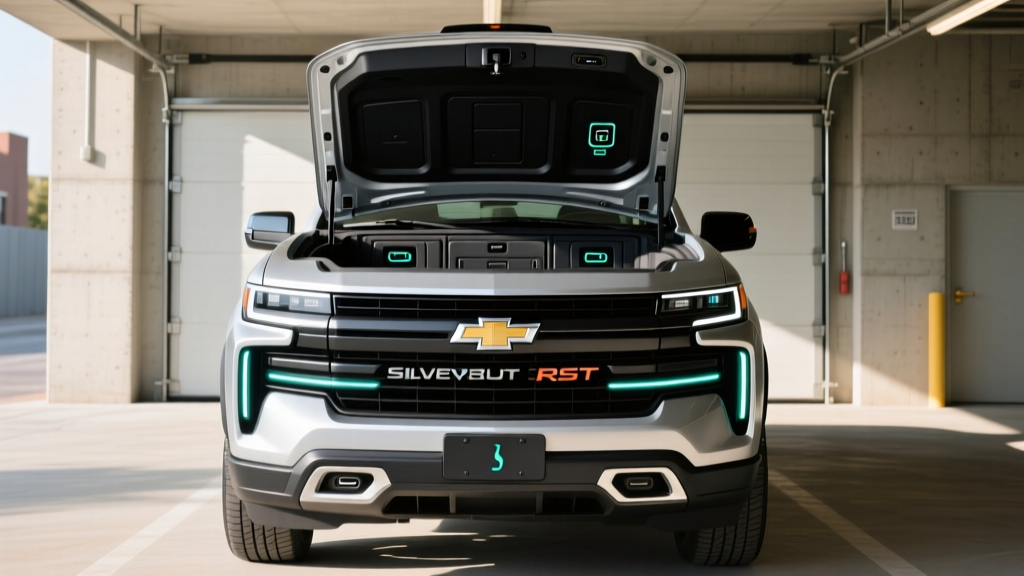
- eTrunk (Front Trunk): A 10.9 cu ft lockable, weatherproof compartment where the engine would sit on a gas truck. This is the functional equivalent of a bed cap for secure, dry storage — and it's accessible without opening the bed.
- Composite Bed: The bed floor is composite (not steel), which resists dents and corrosion but doesn't support traditional bed-cap clamping systems. Aftermarket toppers designed for the Silverado EV's specific bed dimensions may eventually become available, but none are factory-supported as of the 2025 model year.
If your goal with a bed cap is secure, lockable storage, the eTrunk plus a retractable tonneau cover (available as a dealer accessory) covers most use cases. If you need enclosed, climate-controlled cargo space, the Silverado EV's architecture isn't designed for that — a van-based EV like the Ford E-Transit may be more appropriate.
Silverado EV RST vs. Gas Silverado: Cost & Capability Comparison
How does the electric RST stack up against a comparably equipped gas Silverado? Here's a data-driven look:
| Factor | 2025 Silverado EV RST | 2025 Silverado 1500 RST (Gas, 5.3L V8) |
|---|---|---|
| Base MSRP | $87,300 | ~$54,900 |
| EPA Range / Fuel Economy | 440 mi / 74 MPGe (est.) | ~22 MPG combined |
| Energy/Fuel Cost per Mile | ~$0.05–$0.08 (home charging) | ~$0.16–$0.20 ($3.50/gal gas) |
| Max Towing | 10,200 lbs | 11,300 lbs |
| Payload | ~1,300 lbs | ~2,000 lbs |
| 0–60 mph | ~4.5 sec | ~6.5 sec |
| Maintenance (annual est.) | ~$200–$400 | ~$600–$1,000 |
| Federal Tax Credit (§30D) | Up to $7,500 (if eligible) | $0 |
| 5-Year Fuel/Energy Cost (15k mi/yr) | ~$3,750–$6,000 | ~$12,000–$15,000 |
The price gap is stark: roughly $32,400 before incentives. The federal §30D tax credit can reduce the Silverado EV's effective cost by up to $7,500 if you meet income thresholds (AGI ≤ $150,000 single / $300,000 joint), the vehicle's MSRP is within the truck cap ($80,000 — note: the RST at $87,300 exceeds this cap, which may disqualify it unless GM restructures pricing or trims), and battery sourcing requirements are met. Always verify current-year eligibility on the IRS site or with a tax professional.
Where the EV wins decisively: fuel cost savings (potentially $8,000–$10,000 over 5 years with home charging), dramatically lower maintenance (no oil changes, fewer brake replacements due to regen), and instant torque. Where the gas truck wins: lower upfront cost, higher payload, longer proven towing range without route planning, and no charging dependency.
Real-World Ownership: What First-Time EV Truck Buyers Must Know
Home Charging Is Nearly Mandatory
With a ~200 kWh battery, Level 1 (120V) charging is impractical — it would add only ~3 miles per hour, taking days for a full charge. A Level 2 home charger at 19.2 kW (requires a 100-amp circuit) can replenish the battery in roughly 11–12 hours. A more common 48-amp / 11.5 kW Level 2 setup takes ~18–20 hours for a full charge but is adequate for daily driving of 50–80 miles.
| Home Charging Setup | Equipment Cost | Electrician/Install | Total Est. | Charge Speed (mi/hr) |
|---|---|---|---|---|
| Level 1 (120V, included cordset) | $0 | $0 | $0 | ~3 mi/hr |
| Level 2, 48A (240V, 60A circuit) | $500–$800 | $800–$2,000 | $1,300–$2,800 | ~22 mi/hr |
| Level 2, 80A (240V, 100A circuit) | $700–$1,200 | $1,500–$3,500 | $2,200–$4,700 | ~37 mi/hr |
| Panel upgrade (if needed, 200A service) | — | $2,000–$5,000 | $2,000–$5,000 | — |
Panel upgrade warning: The Silverado EV's large battery and available 19.2 kW onboard charger demand significant electrical capacity. If your home has a 100-amp main panel, you'll almost certainly need an upgrade to 200-amp service before installing a high-power Level 2 charger. Get a licensed electrician's assessment before purchase.
Public Charging for Road Trips and Towing
The Silverado EV uses the NACS (Tesla-style) connector natively, giving it access to the Tesla Supercharger network — the most reliable DC fast-charging network in the US. At a 350 kW-capable Supercharger V4 or Electrify America station, the truck peaks near 350 kW but sustains high rates only up to roughly 30–40% SoC before tapering. Expect a 10–80% charge in approximately 45 minutes.
For towing, plan charging stops every 150–200 miles on the highway. The battery's size helps, but towing a trailer at highway speeds consumes energy at roughly double the normal rate.
Cold-Weather Considerations
The Silverado EV includes a heat pump for cabin heating and battery thermal management, which mitigates (but does not eliminate) cold-weather range loss. In sub-freezing conditions, precondition the battery while plugged in — this warms the pack for optimal charging speed and preserves range. Owners in northern climates should budget 20–30% less range in winter.
Common Misconceptions About the Silverado EV
| Myth | Fact |
|---|---|
| "The Silverado EV has a standard truck bed you can put any cap on." | The composite bed is unique to the EV platform. Traditional bed caps and toppers for the gas Silverado 1500 will not fit. The midgate and eTrunk replace the need for most cap use cases. |
| "It qualifies for the full $7,500 federal tax credit." | The RST Max Range MSRP of $87,300 exceeds the §30D truck MSRP cap of $80,000. Lower trims (WT, LT) may qualify. Always verify current-year rules on irs.gov. |
| "440 miles means I'll never need to charge on road trips." | Highway driving at 70+ mph yields ~340–370 real-world miles. Towing cuts that to ~220–260 miles. Plan charging stops accordingly. |
| "EV trucks can't tow as well as gas trucks." | The RST tows 10,200 lbs — competitive with many gas half-tons. The limitation isn't capability but range while towing. |
| "I can charge it on any regular outlet overnight." | Level 1 (120V) adds ~3 miles/hour — roughly 36 miles in 12 hours. For a 200 kWh pack, that's inadequate. Level 2 is essential for practical ownership. |
Decision Framework: Is the Silverado EV RST Right for You?
Choose the Silverado EV RST if:
- You have Level 2 home charging (or can install it) and drive under 150 miles round-trip daily
- You value the eTrunk and midgate for secure, flexible cargo without a bed cap
- You want truck capability with sports-car acceleration (4.5-sec 0–60) and low running costs
- You primarily tow short distances or can plan charging stops on towing routes
- You're comfortable with an $87,000+ purchase price and understand tax credit limitations
Choose the gas Silverado 1500 RST instead if:
- You regularly tow over 200 miles one-way and cannot afford charging downtime
- You need maximum payload (the gas truck offers ~700 lbs more)
- Your budget is closer to $55,000–$65,000
- You lack home charging access and rely on street parking or apartment living
- You need a traditional bed for aftermarket caps, racks, or commercial upfitting
Consider the Silverado EV LT or WT if:
- You want the EV platform at a lower MSRP (the WT starts around $39,900; the LT around $55,000–$60,000) and may qualify for the §30D credit
- You can accept less range (the LT with the smaller battery offers ~280–340 miles EPA) and fewer luxury features
Frequently Asked Questions
Can I install a bed cap or topper on the 2025 Silverado EV?
Not with any factory-supported accessory. The Silverado EV's composite bed has different dimensions and mounting points than the gas Silverado 1500. The eTrunk and available tonneau cover provide secure, weatherproof storage. Aftermarket solutions may emerge, but none are validated by GM as of the 2025 model year.
What is the real-world range of the Silverado EV RST?
EPA-rated at 440 miles, real-world highway driving yields approximately 340–370 miles. Cold weather (below 32°F) can reduce this to 280–310 miles. Towing a 7,000-lb trailer at highway speeds may drop range to 220–260 miles. These figures are based on the physics of a heavy truck pushing air at speed — the EPA's fueleconomy.gov testing cycle includes lower-speed urban driving that inflates the sticker number.
How long does it take to charge the Silverado EV at home?
On a 48-amp Level 2 charger (the most common home setup), expect roughly 18–20 hours for a full 0–100% charge. On an 80-amp / 19.2 kW setup, about 11–12 hours. Most owners charge nightly, topping up 30–50% — which takes 4–8 hours on a 48A charger. You rarely need a full 0–100% charge for daily use.
Does the Silverado EV RST qualify for the $7,500 federal tax credit?
Likely not at its current MSRP. The §30D credit caps eligible trucks at $80,000 MSRP, and the RST Max Range starts at $87,300. Lower trims like the LT may fall under the cap. Additionally, buyer income limits ($300,000 joint / $150,000 single AGI) and battery critical-mineral sourcing rules apply. The credit can now be transferred to the dealer at point of sale as an upfront discount. Always confirm current eligibility at irs.gov or with a qualified tax professional.
Can the Silverado EV power my home or tools?
GM has announced V2H (vehicle-to-home) capability via the Energy Transfer Pro accessory, which would allow the Silverado EV's massive battery to back up your home during outages. However, this requires a compatible bidirectional charger and home energy management system. V2L (vehicle-to-load) for powering tools and appliances at a job site or campsite is available with the proper adapter. Check GM's accessory catalog for current availability and pricing.