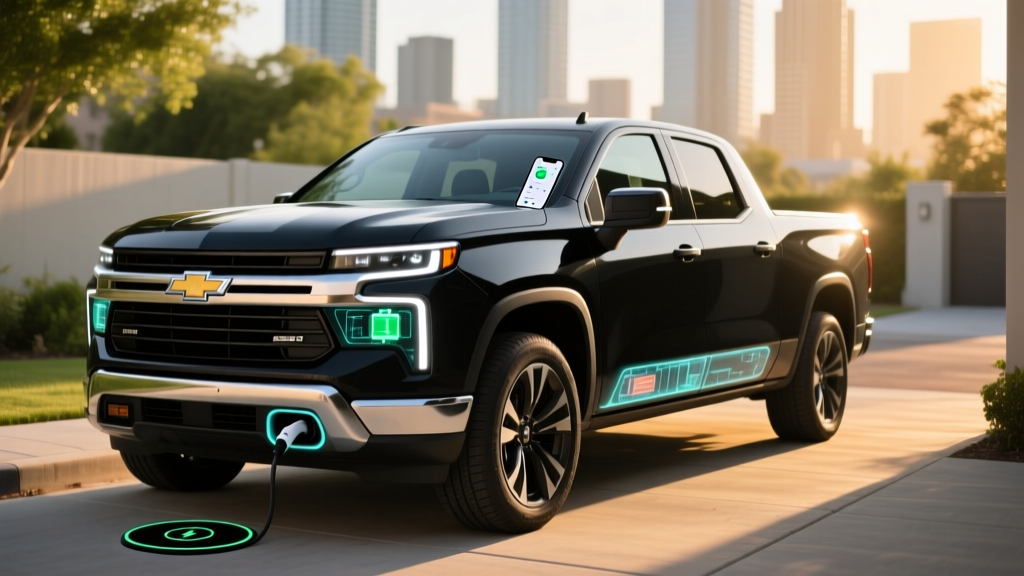
The 2025 Chevy Silverado EV isn't just Chevrolet's entry into the electric truck wars — it's a statement that full-size pickup buyers don't have to compromise on range or utility to go electric. Built on GM's dedicated BT1 electric platform (shared with the GMC Sierra EV and Hummer EV), the Silverado EV delivers up to 380 miles of EPA-estimated range, 350 kW DC fast-charging capability, and up to 10,000 pounds of towing capacity. But with a starting price near $57,000 and a massive footprint, does it earn its place in your driveway?
We've analyzed the official EPA data, GM's engineering specs, and real-world driving variables to give you the unvarnished picture of what owning a 2025 Silverado EV actually looks like — from highway range losses in January to the realities of its charging curve above 80% SoC.
Range, Efficiency, and the Real-World Reality Check
The headline number is compelling: the 2025 Silverado EV 4WT (Work Truck) with the larger battery pack carries an EPA-estimated 460 miles of range, while the more popular RST trim with its dual-motor AWD setup is rated at 380 miles EPA. The entry-level 3WT with the standard battery comes in at 266 miles EPA. These figures come from the EPA's official fuel economy database.
- EPA Sticker: 380 miles
- Real-World Highway (70 mph, 75°F): ~310–330 miles
- Real-World Highway (70 mph, 30°F): ~250–280 miles
- Real-World City/Mixed: ~340–365 miles
- Towing (5,000 lb trailer): ~160–200 miles
Full-size truck aerodynamics hit hard at highway speeds. Expect a 13–18% reduction from EPA on the interstate in mild weather, and 25–35% loss in freezing temperatures due to battery resistance and cabin heating demands. Towing cuts range roughly in half — plan charging stops accordingly.
Efficiency for the RST comes in at approximately 47 MPGe combined (roughly 71 kWh/100 miles). That's thirsty by EV standards but typical for an 8,700-pound truck pushing a large frontal area through the air. The 4WT with its less aggressive tires and lower-power tune squeezes out slightly better efficiency, helping it achieve that 460-mile rating.
Battery Pack, Chemistry, and Longevity
The Silverado EV uses GM's Ultium battery platform with NMC (nickel manganese cobalt) lithium-ion chemistry. Two pack sizes are available:
| Specification | Standard Battery (3WT) | Extended Battery (4WT / RST) |
|---|---|---|
| Usable Capacity | ~100 kWh | ~200 kWh |
| Chemistry | NMC (Ultium) | NMC (Ultium) |
| Cell Format | Large-format pouch | Large-format pouch |
| Thermal Management | Active liquid cooling/heating | Active liquid cooling/heating |
| EPA Range | 266 miles | 380–460 miles (trim-dependent) |
The ~200 kWh extended pack is one of the largest battery packs in any production vehicle. That capacity is what enables the 460-mile 4WT figure, but it also means longer charging sessions from low states of charge. GM includes a bottom buffer and top buffer to protect the NMC cells from deep discharge and sustained 100% states — expect roughly 5–8% of gross capacity to be locked out for longevity.
Battery Warranty: GM covers the Ultium battery for 8 years / 100,000 miles (whichever comes first) against defects and excessive capacity loss. GM defines excessive degradation as falling below approximately 60–70% of original capacity during the warranty period, though exact threshold language should be confirmed in your purchase agreement. The powertrain (motors, power electronics) carries the same 8-year/100,000-mile coverage.
Charging Speed: DC Fast, Level 2, and What You'll Actually Experience
The Silverado EV supports up to 350 kW peak DC fast charging on compatible chargers — but as with every EV, peak is not sustained. Here's the full charging picture:
| Charging Method | Power / Rate | Speed | Notes |
|---|---|---|---|
| DC Fast Charge (Peak) | Up to 350 kW | ~100 miles in 10 minutes (claimed peak) | Requires 350 kW+ station; preconditioning recommended |
| DC Fast Charge (10–80%) | Avg ~200–250 kW sustained | ~35–45 minutes (extended battery) | Curve tapers significantly above 80% SoC |
| Level 2 Home (240V, 48A) | 11.5 kW | ~27 miles/hour | Full charge in ~17–18 hours (extended pack) |
| Level 2 Home (240V, 80A) | 19.2 kW | ~45 miles/hour | Requires compatible hardwired charger + 100A circuit |
| Level 1 (120V, 12A) | 1.4 kW | ~3 miles/hour | Emergency/trickle only; full charge takes days |
Charging curve reality: The Silverado EV's massive battery actually works in its favor at DC fast chargers — because the pack is so large, it can sustain higher charge rates for longer before tapering. On a 350 kW Electrify America or EVgo station with a preconditioned battery, you'll see the truck pull close to 300+ kW in the 10–40% SoC window, then gradually taper. Expect the 10–80% session on the extended pack to take roughly 35–45 minutes. Above 80%, charging slows dramatically to protect the NMC cells — plan to charge to 80% on road trips and move on rather than wait for 100%.
Home charging note: To unlock the Silverado EV's 19.2 kW onboard charger capability, you'll need a hardwired Level 2 station on a dedicated 100-amp circuit. Most homes will require an electrical panel upgrade (200A service minimum recommended) to support this. Budget $1,500–$3,500 for a professional Level 2 installation depending on your panel condition and run distance — consult a licensed electrician for a site-specific quote.
Performance, Towing, and Drivetrain
The Silverado EV uses a dual-motor all-wheel-drive setup across most trims, with the 4WT offering a single-motor RWD configuration on the standard battery. Here's how the powertrain breaks down:
| Trim | Drivetrain | Horsepower | Torque (lb-ft) | 0–60 mph | Max Towing |
|---|---|---|---|---|---|
| 3WT (Standard Battery) | RWD (single motor) | ~360 hp | ~460 | ~7.0 sec (est.) | 8,000 lbs |
| 4WT (Extended Battery) | AWD (dual motor) | ~510 hp | ~615 | ~5.5 sec (est.) | 10,000 lbs |
| RST (Extended Battery) | AWD (dual motor) | ~664 hp | ~785 | ~4.5 sec | 10,000 lbs |
The RST's 664 horsepower and sub-5-second 0–60 time make it genuinely quick for a truck that weighs over 8,700 pounds. More importantly for truck buyers, the instant electric torque means strong low-speed pulling power — no turbo spool-up or transmission downshift lag when merging with a trailer.
Towing reality: The 10,000-pound max tow rating is competitive with mid-range F-150 Lightning and Rivian R1T configurations. However, towing at or near max capacity will slash your range to roughly 160–200 miles on the extended battery. The Silverado EV includes an integrated trailer brake controller and Chevy's Advanced Trailering System with camera views, but there's no Max Tow package rivaling the Lightning's 13,000-pound rating.
The truck also features four-wheel steering (available on RST), which dramatically tightens its turning circle despite the crew-cab, long-wheelbase footprint — a genuine practical advantage in parking lots and job sites.
Pricing, Trims, and Federal Tax Credit Eligibility
The 2025 Silverado EV lineup spans work-truck fleet pricing to premium personal-use territory:
| Trim | Base MSRP | Est. Federal Credit (§30D) | Effective Price* |
|---|---|---|---|
| 3WT (Standard Battery) | ~$57,100 | Up to $7,500 | ~$49,600 |
| 4WT (Extended Battery) | ~$72,100 | Up to $7,500 | ~$64,600 |
| RST (Extended Battery) | ~$87,300 | Up to $7,500 | ~$79,800 |
*Effective price assumes full $7,500 §30D credit eligibility. Actual credit depends on buyer income, vehicle MSRP caps, and battery component/critical mineral sourcing requirements. Prices exclude destination charge (~$1,995), dealer fees, and state/local incentives.
IRS §30D Tax Credit Rules (2025 tax year):
- MSRP Cap: Pickup trucks must have an MSRP at or below $80,000 to qualify. This means the RST trim (MSRP ~$87,300) does not qualify for the federal credit unless optioned down or reclassified. The 3WT and 4WT fall under the cap.
- Income Caps: Modified AGI must not exceed $150,000 (single), $225,000 (head of household), or $300,000 (joint filers).
- Battery Sourcing: The full $7,500 requires meeting both critical mineral ($3,750) and battery component ($3,750) sourcing thresholds as defined by the IRS under §30D. GM has been working to localize Ultium battery supply chains, but exact credit amounts should be verified at purchase via the IRS's eligible vehicle list.
- Point-of-Sale Transfer: As of 2024, buyers can transfer the credit to the dealer as a point-of-sale discount, reducing your out-of-pocket cost at delivery rather than waiting for a tax refund.
- ✅ 3WT ($57,100 MSRP): Under $80K truck cap — potentially eligible for up to $7,500
- ✅ 4WT ($72,100 MSRP): Under $80K truck cap — potentially eligible for up to $7,500
- ❌ RST ($87,300 MSRP): Exceeds $80K truck cap — not eligible for §30D federal credit
- ⚠️ Always verify current-year eligibility on fueleconomy.gov and consult a tax professional
Cargo, Interior Space, and Tech
The Silverado EV's BT1 platform gives it a flat floor and packaging advantages that the gas Silverado can't match:
- Bed: 5-foot-11-inch bed (shorter than the gas truck's standard 6'7" bed), but with a Multi-Flex Midgate that opens the cabin wall to extend the load floor to over 9 feet with the tailgate down
- eTrunk (Front Trunk): ~10.7 cubic feet of lockable, weatherproof storage under the hood — large enough for tools, charging cables, or groceries
- Rear Legroom: ~43.1 inches — competitive with crew-cab gas trucks and genuinely comfortable for adults
- Tonneau Cover: Available powered hard tonneau for secure, aerodynamic bed storage
Infotainment: The RST features a 17.7-inch diagonal center touchscreen (portrait orientation) paired with an 11-inch driver display. Wireless Apple CarPlay and Android Auto are standard. The system runs GM's latest Ultifi software platform with over-the-air update capability. Built-in Google Assistant and Google Maps navigation are included (subscription required after initial trial period).
Driver Assistance: The Silverado EV offers Super Cruise (on RST and available on 4WT) — GM's Level 2 hands-free driving system for mapped divided highways. Per NHTSA SAE definitions, this is a Level 2 system: the driver must remain attentive and ready to take over at all times. Super Cruise uses a driver-attention camera to monitor eye gaze and will issue escalating warnings if you look away from the road. It covers over 750,000 miles of compatible roads in North America — impressive, but it does not handle city streets, construction zones, or unmapped routes.
Pros, Cons, and the Bottom Line
- Class-leading 460-mile EPA range (4WT) / 380 miles (RST)
- 350 kW peak DC fast charging — among the fastest-charging trucks
- 10,000-lb towing with integrated trailering tech
- Multi-Flex Midgate and eTrunk add practical versatility
- Super Cruise hands-free highway driving available
- 3WT/4WT eligible for up to $7,500 federal tax credit
- Quiet, refined ride with instant torque
- RST ($87K+) exceeds the §30D MSRP cap — no federal credit
- Shorter 5'11" bed vs. gas Silverado's 6'7" standard bed
- ~8,700+ lb curb weight impacts efficiency and tire wear
- Towing cuts range to ~160–200 miles
- 19.2 kW home charging requires expensive panel/circuit upgrade
- RST pricing pushes into luxury truck territory
- No 460-mile option on AWD RST trim
Who Should Buy the 2025 Chevy Silverado EV?
- You need a full-size crew-cab truck with 300+ miles of daily range
- You want work-truck capability (10K towing, eTrunk, Midgate) with EV fuel savings
- You have reliable home Level 2 charging and a commute under 150 miles round-trip
- You value Super Cruise for long highway commutes
- You're buying a 3WT or 4WT and qualify for the §30D credit
- You regularly tow heavy loads over 200 miles without charging stops
- You need a full 6.5'+ bed for construction materials or ATV loading
- Your budget is under $50K (consider the F-150 Lightning base or a used EV truck)
- You lack access to home or workplace Level 2 charging
Against the Ford F-150 Lightning, the Silverado EV offers more range (380 vs. 320 EPA miles on extended battery) and faster DC charging, but the Lightning starts lower, has a larger bed, and offers the Pro Power Onboard V2L system. The Rivian R1T is more refined and off-road capable but is smaller, pricier, and offers less range. The Silverado EV's niche is maximum range in a full-size truck package — and on that metric, it currently leads the segment.
Frequently Asked Questions
What is the real-world range of the 2025 Chevy Silverado EV?
The EPA rates the RST at 380 miles and the 4WT at up to 460 miles. In real-world highway driving at 70 mph in mild weather, expect roughly 310–330 miles from the RST. In freezing temperatures, that drops to 250–280 miles. Towing a 5,000-pound trailer cuts range to approximately 160–200 miles.
How fast does the Silverado EV charge at home and on the road?
On a 350 kW DC fast charger, the Silverado EV can add roughly 100 miles in 10 minutes at peak rate, with a 10–80% session taking approximately 35–45 minutes for the extended battery. At home on a 19.2 kW Level 2 charger (80A circuit), it gains about 45 miles per hour. On a standard 48A Level 2 (11.5 kW), expect about 27 miles per hour.
Does the 2025 Silverado EV qualify for the $7,500 federal tax credit?
The 3WT (~$57,100 MSRP) and 4WT (~$72,100 MSRP) fall under the IRS §30D $80,000 MSRP cap for trucks and are potentially eligible for up to $7,500 — subject to buyer income limits and battery sourcing requirements. The RST (~$87,300 MSRP) exceeds the cap and does not qualify. Always verify current eligibility on fueleconomy.gov and consult a tax professional.
Is the Silverado EV worth buying vs. the F-150 Lightning or Rivian R1T?
If maximum range is your priority, the Silverado EV leads with 380–460 EPA miles vs. the Lightning's ~230–320 miles. If bed length matters more, the Lightning's 5.5' box with its larger available configurations and lower starting price may suit you better. The Rivian R1T is more nimble and off-road focused but is a midsize truck with less cargo room and higher pricing. Each fills a different use case.
Can the Silverado EV power my home or tools?
GM has announced vehicle-to-home (V2H) capability for Ultium-based trucks via the GM Energy ecosystem, allowing the Silverado EV to supply backup power during outages when paired with a compatible home energy management system. However, V2H hardware and availability should be confirmed with your dealer, as rollout timing and required equipment vary. Vehicle-to-load (V2L) for powering tools at a job site is available via bed-mounted outlets on select trims.
What does the Silverado EV cost to charge vs. gas?
At the US average residential electricity rate of ~$0.16/kWh (per EIA data), fully charging the ~200 kWh extended battery costs roughly $32, yielding a cost per mile of about $0.09. A comparable gas Silverado getting 19 MPG combined at $3.50/gallon costs about $0.18 per mile. Annual fuel savings for a 15,000-mile driver: approximately $1,350–$1,500, depending on local electricity and gas prices.