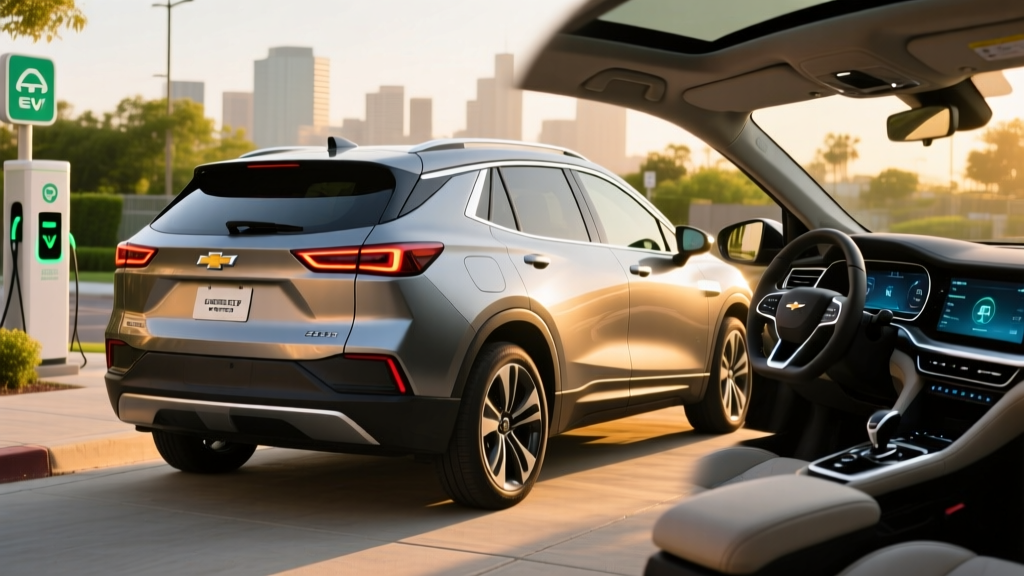
Quick Answer: The 2025 Chevrolet Equinox EV is one of the most affordable long-range electric SUVs on the market, starting at $33,600 (before incentives) with up to 319 miles of EPA-estimated range on the LT 2 trim. It uses an 85 kWh (usable) Ultium battery, charges at up to 150 kW on DC fast chargers (10–80% in roughly 30 minutes), and qualifies for the full $7,500 federal tax credit under current IRS §30D rules for eligible buyers — bringing the effective starting price as low as ~$26,100. For buyers who need a practical, daily-driver EV SUV without paying premium prices, the Equinox EV is a top contender. But real-world highway and cold-weather range will fall short of the sticker, and charging speeds trail rivals like the Hyundai Ioniq 5.
Range and Efficiency: EPA vs. Real World
The 2025 Equinox EV lineup offers three EPA range tiers depending on trim and drivetrain:
- LT 2 (FWD): 319 miles EPA — the range leader
- RS (FWD): 307 miles EPA
- RS (AWD): 285 miles EPA
All trims share the same 85 kWh usable Ultium battery pack (NMC chemistry). The range differences come down to weight, wheel size, and motor output. Front-wheel-drive models produce 213 hp and 236 lb-ft of torque, while the AWD RS bumps that to 288 hp and 355 lb-ft, trading roughly 30 miles of range for the extra traction and acceleration.
Real-World Range Reality Check: The EPA 319-mile figure for the LT 2 is achievable in mixed city/suburban driving at moderate temperatures. On sustained highway trips at 70–75 mph, expect closer to 260–280 miles. In freezing weather (below 32°F), cabin heating and battery thermal management can reduce range by 20–30%, dropping effective range to roughly 220–255 miles for the FWD trims. This is typical for NMC battery packs without a dedicated heat pump — the Equinox EV uses resistive heating, which draws more energy in cold climates than heat-pump-equipped rivals like the Tesla Model Y.
Efficiency ratings land around 111 MPGe combined (FWD), or roughly 30 kWh per 100 miles, according to fueleconomy.gov. That's competitive for the compact EV SUV segment, though the Hyundai Ioniq 5 (114 MPGe) and Tesla Model Y (122 MPGe) edge it out slightly.
Charging Speed and Infrastructure
Understanding charging requires distinguishing between kW (power — how fast energy flows) and kWh (energy — how much the battery holds). The Equinox EV's 85 kWh battery holds the energy; the charge rate in kW determines how quickly you refill it.
| Charging Level | Power | Speed (Approx.) | Use Case |
|---|---|---|---|
| Level 1 (120V) | ~1.4 kW | ~4 miles/hour | Emergency/overnight top-up |
| Level 2 (240V) | 11.5 kW (max onboard) | ~34 miles/hour | Home/workplace daily charging |
| DC Fast Charge | Up to 150 kW peak | 10–80% in ~30 min | Road trips, quick stops |
The 150 kW peak DC charge rate is the Equinox EV's most notable limitation versus rivals. The Hyundai Ioniq 5 peaks at 240 kW (10–80% in ~18 minutes), and the Tesla Model Y can sustain high rates on V3 Superchargers. The Equinox EV's charge curve tapers significantly above 80% state of charge — a 10–80% session takes about 30 minutes, but pushing from 80–100% can add another 25–30 minutes. For road trips, plan to charge to 80% and move on.
At home on a Level 2 (240V, 48-amp circuit), the 11.5 kW onboard charger replenishes the full 85 kWh battery in roughly 8.5 hours — easily an overnight session. A Level 2 home charger installation typically costs $800–$2,000 depending on your electrical panel capacity and run length. If your panel needs upgrading from 100A to 200A, add $1,500–$3,000.
The Equinox EV uses the CCS1 connector for DC fast charging and J1772 for Level 2. Chevrolet has confirmed future NACS (Tesla-style) adoption, but 2025 models ship with CCS. You can use Tesla Superchargers with a GM-approved CCS-to-NACS adapter, expanding your road-trip network significantly.
Pricing, Trims, and Federal Tax Credit
The 2025 Equinox EV is offered in three trims, all sharing the 85 kWh Ultium platform:
- LT 2 (FWD): $33,600 MSRP — 319 mi range, 213 hp
- RS (FWD): ~$41,900 MSRP — 307 mi range, 213 hp, sport styling
- RS (AWD): ~$43,400 MSRP — 285 mi range, 288 hp
Destination charges add approximately $1,395. The LT 2 is the value play — it comes well-equipped with a 17.7-inch infotainment screen, Super Cruise capability (subscription required), heated front seats, and a full suite of ADAS features.
Federal Tax Credit (§30D) Eligibility Checklist — 2025 Rules:
- Vehicle MSRP must be ≤ $80,000 for SUVs (all Equinox EV trims qualify)
- Buyer AGI must not exceed $150,000 (single) / $300,000 (joint)
- Battery components and critical minerals must meet sourcing thresholds (check IRS eligible vehicle list before purchasing)
- Credit can now be transferred to the dealer at point of sale as an upfront discount
- Full credit is $7,500; partial ($3,750) if only one sourcing requirement is met
Rules are subject to change. Always verify current eligibility on IRS.gov and consult a tax professional.
With the full $7,500 credit applied, the LT 2's effective price drops to roughly $26,100 — making it one of the cheapest 300+ mile EVs available in the U.S. market. Some states offer additional rebates (check AFDC's state incentive database), which can stack with the federal credit.
Equinox EV vs. Gas Equinox: 5-Year Cost Breakdown
How does the EV version compare to the gas-powered 2025 Equinox over a typical ownership period? Here's a data-driven look at total cost, assuming 15,000 miles/year, $0.14/kWh home electricity, $3.50/gallon gas, and 85% home / 15% public charging mix for the EV:
| Category | Equinox EV LT 2 (FWD) | Gas Equinox LT (FWD) |
|---|---|---|
| MSRP (before incentives) | $33,600 | $29,600 |
| Federal tax credit | −$7,500 | $0 |
| Effective purchase price | $26,100 | $29,600 |
| Fuel/energy (5 years) | $5,250 | $13,125 |
| Maintenance (5 years) | ~$1,800 | ~$3,500 |
| Insurance (5-year avg.) | ~$9,500 | ~$8,000 |
| Estimated 5-year total | ~$42,650 | ~$54,225 |
The EV wins decisively on operating costs — saving roughly $7,875 on fuel and $1,700 on maintenance over five years (no oil changes, fewer brake replacements due to regenerative braking). Insurance runs 15–20% higher on the EV, a common pattern that partially offsets savings. Even with higher insurance, the EV's 5-year total cost undercuts the gas model by approximately $11,500 when the tax credit applies.
Key caveat: This calculation assumes reliable home charging. If you rely entirely on public DC fast charging at $0.35–$0.50/kWh, your 5-year energy cost jumps to $9,000–$13,000, erasing much of the fuel savings.
Real Ownership Considerations
Home Charging Access
Home charging is the make-or-break factor for EV satisfaction. If you can install a Level 2 charger (240V, 48-amp circuit), the Equinox EV is a seamless daily driver — plug in at night, wake up to a full battery every morning. Renters, condo dwellers, and street parkers face a harder equation. Public Level 2 chargers (often free at workplaces or shopping centers) can supplement, and occasional DC fast charging is viable but adds time and cost. Before buying, audit your charging options honestly.
Climate and Driving Patterns
If you live in a mild climate and commute under 60 miles daily, the Equinox EV's range is more than adequate year-round. In cold northern states, budget for 25–30% range loss in winter and plan road trips accordingly. Preconditioning the battery (via the MyChevrolet app while plugged in) warms the pack before driving, improving both range and charge acceptance on DC fast chargers.
Super Cruise and Driver Assistance
The Equinox EV supports GM's Super Cruise on compatible highways — a hands-off, eyes-on SAE Level 2 system. This is not self-driving. You must remain attentive, and the system monitors your eyes via an infrared camera. Super Cruise covers over 750,000 miles of divided highways in North America, making it one of the most capable Level 2 systems available. It requires a subscription after the initial trial period (typically 3 years included).
ADAS Limitation Warning: Super Cruise and the standard Chevy Safety Assist suite are Level 2 driver-assistance systems. They do not replace an attentive driver. You are legally and operationally responsible for the vehicle at all times. Hands-free does not mean attention-free.
Common Misconceptions: Myth vs. Fact
| Myth | Fact |
|---|---|
| "The battery will need replacing in a few years." | GM warranties the Ultium battery for 8 years / 100,000 miles against defects and capacity loss below a defined threshold. Industry data shows modern NMC packs retain 85–90% capacity after 100,000 miles with normal use. |
| "EVs are worse in cold weather." | EVs start instantly in any temperature (no cold cranking), and cabin heating is immediate. Range does drop 20–30% in extreme cold, but 319 × 0.75 = ~240 miles is still sufficient for most daily needs. |
| "Charging takes too long for road trips." | A 10–80% DC fast charge takes ~30 minutes — roughly the time for a meal and restroom break. Plan stops around 200–240 miles apart for comfort. |
| "The Equinox EV qualifies for $7,500 for everyone." | Eligibility depends on buyer income, battery sourcing requirements, and MSRP caps. The credit is not guaranteed — verify on IRS.gov before purchase. |
Decision Framework: Is the 2025 Equinox EV Right for You?
Choose the Equinox EV if:
- You have home Level 2 charging (or can install it)
- Your daily commute is under 100 miles round-trip
- You qualify for the $7,500 federal tax credit (income ≤ $150K single / $300K joint)
- You want a 300+ mile EV SUV for under $35,000 (before incentives)
- You value a comfortable, quiet ride over sporty handling
Look elsewhere if:
- You cannot charge at home and have no reliable workplace charging
- You regularly drive 300+ miles in a single day in cold weather (consider the Ioniq 5 for faster charging or the Model Y for Supercharger access)
- You need towing capacity — the Equinox EV is rated for just 1,500 lbs
- You want the fastest DC charging in the segment (150 kW peak trails 240–350 kW rivals)
Warranty and Long-Term Outlook
Chevrolet backs the 2025 Equinox EV with a competitive warranty package:
- Battery & powertrain: 8 years / 100,000 miles
- Bumper-to-bumper: 3 years / 36,000 miles
- Roadside assistance: 5 years / 60,000 miles
The Ultium platform is GM's volume EV architecture, shared with the Blazer EV, Silverado EV, and Cadillac Lyriq. Parts availability and dealer service familiarity should improve as the platform scales. However, early-production EVs from any manufacturer can carry software-related growing pains — check owner forums and NHTSA for any active recalls or service bulletins before purchasing.
Frequently Asked Questions
What is the real-world range of the 2025 Equinox EV?
The EPA rates the FWD LT 2 at 319 miles. In real-world highway driving at 70 mph, expect 260–280 miles. In freezing temperatures, plan for 220–255 miles. City and suburban driving in mild weather will closely match the EPA sticker.
Does the 2025 Equinox EV qualify for the $7,500 tax credit?
It appears on the IRS eligible vehicle list, but your personal eligibility depends on adjusted gross income (≤ $150K single, ≤ $300K joint), battery sourcing compliance for the specific build, and the MSRP cap (≤ $80K for SUVs). Verify on IRS.gov and confirm with your dealer before signing.
How fast does the Equinox EV charge at home?
On a 240V Level 2 charger at its 11.5 kW max rate, a full charge (0–100%) takes about 8.5 hours. Most owners charge from 20–80% overnight, which takes roughly 4.5 hours and is more than enough for daily driving.
Can I use Tesla Superchargers with the Equinox EV?
Yes, with a GM-approved CCS-to-NACS adapter. GM has been rolling out Supercharger access for CCS-equipped vehicles, and future model years will ship with native NACS ports. Check GM's official adapter program for compatibility details.
Is the Equinox EV good for road trips?
It's adequate but not class-leading. The 150 kW peak charge rate means ~30-minute stops for 10–80%, compared to ~18 minutes in an Ioniq 5. With 260–280 real-world highway miles between stops, you'll charge roughly every 3.5–4 hours of driving, which aligns well with rest breaks. Use the MyChevrolet app or PlugShare to plan DC fast-charger stops along your route.