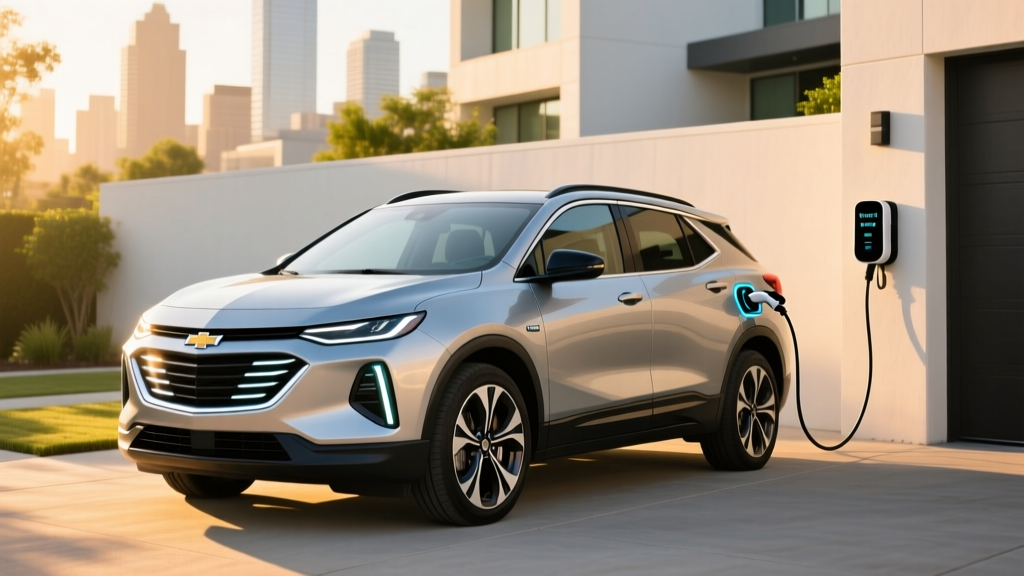
The 2025 Chevrolet Equinox EV LT occupies a rare position in the electric vehicle market: a mainstream compact crossover with over 300 miles of EPA-estimated range and a base price that undercuts many competitors by thousands. As Chevrolet's volume play in the electric crossover segment, the Equinox EV LT aims to convert budget-conscious ICE buyers without forcing them into a premium badge or a stripped-down compliance car.
After spending time with the specifications, charging behavior, and ownership economics of the LT trim—the entry point into the Equinox EV lineup—we have a clear picture of where it excels and where it falls short. Here's the full breakdown.
Quick Verdict: Who Should Consider the Equinox EV LT?
The Equinox EV LT is best suited for suburban commuters and small families who want long range without paying a Tesla or Hyundai Ioniq 5 premium. It works well for daily driving with occasional road trips, provided you can install a Level 2 home charger. It is not the right pick if you need fast DC charging for frequent highway travel, need all-wheel drive in the LT trim, or prioritize cutting-edge infotainment speed.
- You want 319 miles of range under $35,000 (before incentives)
- Most of your driving is commuting and errands within 100 miles of home
- You can charge at home overnight and don't rely on public fast charging daily
- You take frequent 400+ mile road trips and need 350 kW charging
- You need AWD in the base trim (upgrade to RS or 3RS required)
- You want the latest in vehicle-to-load (V2L) or bidirectional capability
Range, Battery, and Efficiency: The Numbers That Matter
| Spec | Value |
|---|---|
| EPA Range (LT FWD) | 319 miles |
| Battery (Usable) | ~85 kWh (Ultium, NMC chemistry) |
| EPA Efficiency | 96 MPGe combined / 35 kWh/100 mi |
| Max DC Fast Charge | 170 kW |
| 10–80% DC Charge Time | ~30 minutes |
| Level 2 Home Charge Rate | 11.5 kW (onboard AC charger) |
| Drivetrain (LT) | FWD, single motor |
| Horsepower / Torque | 213 hp / 236 lb-ft |
| 0–60 mph | ~8.2 seconds (est.) |
| Base MSRP (LT 2LT) | $33,600 (incl. destination) |
| Battery/Powertrain Warranty | 8 years / 100,000 miles |
The Ultium battery platform uses NMC (nickel manganese cobalt) chemistry across the Equinox EV lineup. NMC offers higher energy density than LFP (lithium iron phosphate), which is how Chevrolet packs ~85 kWh usable into a compact crossover footprint. The trade-off is that NMC batteries are generally recommended to be charged to 80% for daily use to maximize longevity, whereas LFP batteries tolerate regular 100% charges. For a 319-mile EPA vehicle, charging to 80% still leaves you with roughly 255 miles of daily usable range—plenty for most commutes.
Charging Speed: Adequate for Home, Modest on the Road
| Level | Power | Miles Added per Hour | Notes |
|---|---|---|---|
| Level 1 (120V) | ~1.4 kW | ~4 mi/hr | Emergency/top-off only |
| Level 2 (240V, 48A) | 11.5 kW | ~34 mi/hr | Full charge in ~9 hours |
| DC Fast Charge | 170 kW peak | N/A | 10–80% in ~30 min |
At home, the Equinox EV LT's 11.5 kW onboard AC charger is competitive. A full overnight charge from 10% to 100% takes roughly 9 hours on a Level 2 circuit—ideal for drivers who plug in when they get home and unplug in the morning. You'll need a 240V outlet or hardwired Level 2 station rated for at least 48 amps to achieve this rate. Most residential installations run $800–$2,000 depending on panel proximity and local permitting, according to industry estimates.
On the road, the 170 kW peak DC fast-charge rate is where the Equinox EV LT shows its budget-oriented positioning. Competitors like the Hyundai Ioniq 5 (peak 240 kW with 800V architecture) and Tesla Model Y (peak ~250 kW on V3 Superchargers) charge noticeably faster. On a 150+ kW station, the Equinox EV will peak near 170 kW early in the session (roughly 10–30% SoC), then taper. Expect the 10–80% session to take approximately 30 minutes—usable for a meal break, but longer than the ~18 minutes an Ioniq 5 requires.
Chevrolet has equipped the Equinox EV with the NACS (North American Charging Standard) connector for the 2025 model year, meaning native access to the Tesla Supercharger network (now open to non-Tesla EVs) without an adapter. This is a significant practical advantage for road-trip charging reliability, as the Supercharger network remains the most dependable public DC network in the U.S. according to owner surveys.
Performance and Driving Impressions
The LT trim sends 213 horsepower and 236 lb-ft of torque to the front wheels via a single permanent-magnet motor. This is adequate for merging and city driving but won't thrill anyone coming from a sport-tuned EV. The 0–60 mph time of approximately 8.2 seconds places it in the realm of a well-equipped compact gas crossover—functional, not fast.
If performance matters, stepping up to the RS or 3RS trims with the available dual-motor AWD powertrain bumps output to 288 hp and drops 0–60 to roughly 6.5 seconds. But the LT is deliberately tuned for efficiency over acceleration, and its regenerative braking system offers a one-pedal driving mode that most EV commuters will appreciate in stop-and-go traffic.
Ride quality is compliant, and the low center of gravity from the under-floor battery pack gives it confident cornering for a crossover in this price class. Road noise is well-managed, and the steering is light and predictable—exactly what the target buyer wants.
Interior, Cargo, and Technology
The Equinox EV LT features a 17.7-inch diagonal infotainment touchscreen running Google Built-In (Google Maps, Google Assistant, and Play Store apps). This is one of the largest standard screens in the segment and a genuine differentiator at this price point. The driver faces an 11-inch digital instrument cluster. Wireless Apple CarPlay and Android Auto are standard.
Interior materials are hard-plastic-heavy on the LT—this is where the price cutting shows. Cloth seating surfaces, manually adjusted front seats, and a simpler center console distinguish the LT from the soft-touch, leatherette-equipped RS trims. It's functional, not luxurious.
Cargo space: 26.4 cubic feet behind the rear seats, expanding to 57.2 cubic feet with the rear seats folded. This is competitive with the Hyundai Ioniq 5 (27.2 / 59.3 cu ft) and slightly behind the Tesla Model Y (30.2 / 76.2 cu ft). Notably, the Equinox EV does not offer a front trunk (frunk)—the space under the hood houses traditional HVAC and power electronics.
Passenger space: Rear legroom measures 37.8 inches, which is generous for the segment and will comfortably fit two adults or rear-facing child seats.
Driver assistance: The LT includes Chevy's Super Cruise hands-free driving system on mapped highways as an available option (standard on higher trims). The standard safety suite includes automatic emergency braking, lane-keep assist, adaptive cruise control, and rear parking sensors. Note: Super Cruise is an SAE Level 2 system—the driver must remain attentive and keep eyes on the road at all times. It is not autonomous driving.
Pricing, Trims, and Federal Tax Credit Eligibility
| Trim | MSRP (incl. dest.) | Drivetrain | Est. After §30D Credit* |
|---|---|---|---|
| LT 2LT (FWD) | $33,600 | FWD | ~$26,100 |
| LT 3LT (FWD) | $39,400 | FWD | ~$31,900 |
| RS (AWD) | $43,400 | AWD | ~$35,900 |
| 3RS (AWD) | $46,300 | AWD | ~$38,800 |
*Tax credit estimates assume full $7,500 §30D eligibility. Actual credit depends on buyer income, battery sourcing, and MSRP caps. See eligibility details below.
The Equinox EV LT 2LT's $33,600 starting price is one of the most affordable entry points into a 300+ mile EV in the U.S. market. For context, the Hyundai Ioniq 5 SE Standard Range starts around $42,000 with 290 miles of range, and the Tesla Model Y Long Range starts above $44,000.
Does the Equinox EV LT Qualify for the Federal EV Tax Credit?
Under current IRS §30D rules, the Equinox EV is eligible for up to $7,500 in federal tax credits, which can be transferred to the dealer at the point of sale as an immediate price reduction (effective 2024 onward). However, eligibility depends on several factors:
- MSRP cap: The vehicle must have an MSRP under $80,000 for SUVs/crossovers. All Equinox EV trims qualify.
- Buyer income cap: Modified adjusted gross income must not exceed $150,000 (single), $225,000 (head of household), or $300,000 (joint filers).
- Battery sourcing: The $7,500 credit is split into two halves ($3,750 each): one for critical minerals sourcing and one for battery component manufacturing. GM has worked to qualify both halves for the Ultium platform, but sourcing requirements tighten annually. Always verify current eligibility on IRS.gov or via the dealer before purchase.
If you qualify for the full $7,500, the Equinox EV LT 2LT effectively drops to approximately $26,100—a price point that makes it one of the most affordable long-range EVs available new in the U.S. market.
Equinox EV LT vs. Key Competitors
| Metric | Equinox EV LT | Hyundai Ioniq 5 SE | Tesla Model Y LR |
|---|---|---|---|
| Base MSRP | $33,600 | ~$42,000 | ~$44,000 |
| EPA Range | 319 mi | 303 mi | 320 mi |
| DC Fast Charge Peak | 170 kW | 240 kW | ~250 kW |
| 10–80% Time | ~30 min | ~18 min | ~22 min |
| Cargo (rear up/down) | 26.4 / 57.2 cu ft | 27.2 / 59.3 cu ft | 30.2 / 76.2 cu ft |
| NACS Native | Yes | No (adapter avail.) | Yes |
The Equinox EV LT wins decisively on price. If your budget is firm around $35,000 and you qualify for the tax credit, no competitor matches its combination of range and affordability. However, the Ioniq 5 and Model Y both charge significantly faster on DC, offer more cargo space, and (in the Ioniq 5's case) include V2L capability. If you road-trip frequently and DC charging speed is a priority, the $8,000+ premium for an Ioniq 5 may be justified.
Pros and Cons
✅ Pros
- 319 miles EPA at $33,600 — best range-per-dollar in segment
- Full $7,500 §30D tax credit eligibility (verify sourcing)
- Native NACS connector = Supercharger access
- 17.7-inch infotainment screen with Google Built-In
- Generous rear legroom (37.8 in)
- 8-yr/100,000-mi battery warranty
❌ Cons
- 170 kW DC peak is slow vs. 240–250 kW competitors
- No heat pump on LT trim (worse cold-weather efficiency)
- Hard-plastic interior on base LT
- No frunk (front trunk)
- FWD only on LT (AWD requires RS upgrade)
- ~8.2 sec 0–60 is leisurely
Ownership Costs and Warranty
Chevrolet provides an 8-year/100,000-mile warranty on the Ultium battery pack and electric powertrain components, with coverage for defects and capacity loss below a defined threshold (typically 60–70% State of Health, per GM's warranty documentation). The vehicle limited warranty is 3 years/36,000 miles bumper-to-bumper.
According to fueleconomy.gov, the Equinox EV LT's efficiency of 35 kWh/100 miles translates to roughly $0.045–$0.06 per mile when charging at home on a national-average electricity rate of $0.16/kWh. Compare this to a 28 MPG gas crossover at $3.40/gallon: approximately $0.12/mile. Over 15,000 miles per year, that's roughly $975 in annual electricity vs. $1,800 in gasoline—a savings of $825 per year before maintenance differences (no oil changes, fewer brake replacements with regen braking).
Insurance premiums for the Equinox EV are moderate. Early data suggests rates comparable to a gas Equinox, though EV insurance can be 5–15% higher depending on your state and insurer due to higher repair costs for battery-adjacent damage. Get a quote before purchasing.
Frequently Asked Questions
What is the real-world range of the 2025 Chevy Equinox EV LT?
Expect 270–295 miles in mixed driving, 245–265 miles at highway speeds, and 220–255 miles in freezing temperatures. The EPA sticker reads 319 miles, but real-world conditions—especially cold weather and highway driving—reduce this by 10–30%.
How fast does it charge at home and on the road?
At home on Level 2 (240V/48A), the Equinox EV charges at 11.5 kW, adding roughly 34 miles per hour and achieving a full charge in about 9 hours. On DC fast chargers, it peaks at 170 kW and charges from 10–80% in approximately 30 minutes.
How much does the Equinox EV LT cost after tax credits?
The LT 2LT starts at $33,600. If you qualify for the full $7,500 federal §30D credit (income, sourcing, and MSRP requirements met), the effective price drops to approximately $26,100. The credit can be applied at the point of sale as a down-payment reduction.
Is the Equinox EV LT worth buying vs. the Ioniq 5 or Model Y?
If your priority is minimizing upfront cost while maximizing range, the Equinox EV LT is the clear winner. If you frequently road-trip and value 18-minute DC charging, more cargo space, or AWD availability at lower trims, the Ioniq 5 or Model Y justify their higher price.
Does it qualify for the federal EV tax credit?
Yes, the Equinox EV is currently eligible for up to $7,500 under IRS §30D, provided the buyer meets income caps ($150K single / $300K joint), the vehicle MSRP is under $80,000 (it is), and battery sourcing requirements are satisfied. Always confirm current eligibility at IRS.gov or with your dealer, as sourcing rules tighten annually.
Does the Equinox EV have a heat pump?
The LT trim does not include a heat pump; it uses resistive cabin heating, which draws more energy from the battery in cold weather. Higher trims may offer improved thermal management, but buyers in cold climates should budget for 25–30% winter range loss.
What connector does the Equinox EV use?
The 2025 Equinox EV uses the NACS (North American Charging Standard) connector natively, meaning it can plug directly into Tesla Superchargers and other NACS-equipped stations without an adapter.