The 2025 Chevy Bolt EUV at a Glance
The 2025 Chevy Bolt EUV returns with a familiar formula: a practical, roomy electric crossover priced well below most competitors, with enough range for daily commuting and weekend trips. Built on GM's BEV2 platform, the Bolt EUV trades cutting-edge charging speeds for affordability, offering a 247-mile EPA range and a starting MSRP that undercuts rivals like the Hyundai Kona Electric and Kia Niro EV by thousands.
For 2025, Chevrolet has streamlined the lineup to two trims — LT and Premier — while retaining the 65 kWh lithium-ion battery pack and front-wheel-drive powertrain. The Bolt EUV remains one of the most accessible new EVs on the market, especially for buyers who can charge at home and don't rely heavily on DC fast charging.
Range and Efficiency: EPA vs. Real-World
Real-World Expectation: 210–235 miles highway; 180–200 miles in freezing temperatures
The Bolt EUV's 247-mile EPA rating is competitive for its price class, but real-world results vary based on driving conditions. In mixed suburban and city driving at moderate speeds, owners typically see 220–240 miles on a full charge. Highway driving at 70+ mph reduces that to roughly 210–235 miles due to aerodynamic drag and the lack of a heat pump (resistive cabin heating draws more energy in cold weather).
In sub-30°F conditions, expect a 20–30% range reduction, bringing usable range down to approximately 180–200 miles. Preconditioning the battery while plugged in can mitigate some cold-weather losses, but the Bolt EUV's thermal management system is less aggressive than competitors with active battery heating.
Efficiency is rated at 115 MPGe combined (29 kWh/100 miles) according to fueleconomy.gov. That's solid for a crossover, though slightly behind the Kona Electric's 120 MPGe.
Battery, Charging, and Drivetrain Specs
| Specification | 2025 Chevy Bolt EUV |
|---|---|
| Battery Capacity | 65 kWh (usable) |
| Battery Chemistry | NMC (Nickel Manganese Cobalt) |
| Drivetrain | Front-Wheel Drive (single motor) |
| Horsepower | 200 hp |
| Torque | 266 lb-ft |
| 0–60 mph | 7.0 seconds |
| Max DC Fast Charge Rate | 55 kW (peak) |
| 10–80% DC Charge Time | ~50 minutes |
| Level 2 Home Charge Rate | 11.5 kW (48A) |
| Level 2 Miles Added per Hour | ~37 miles/hr |
| Level 1 (120V) Miles per Hour | ~3–4 miles/hr |
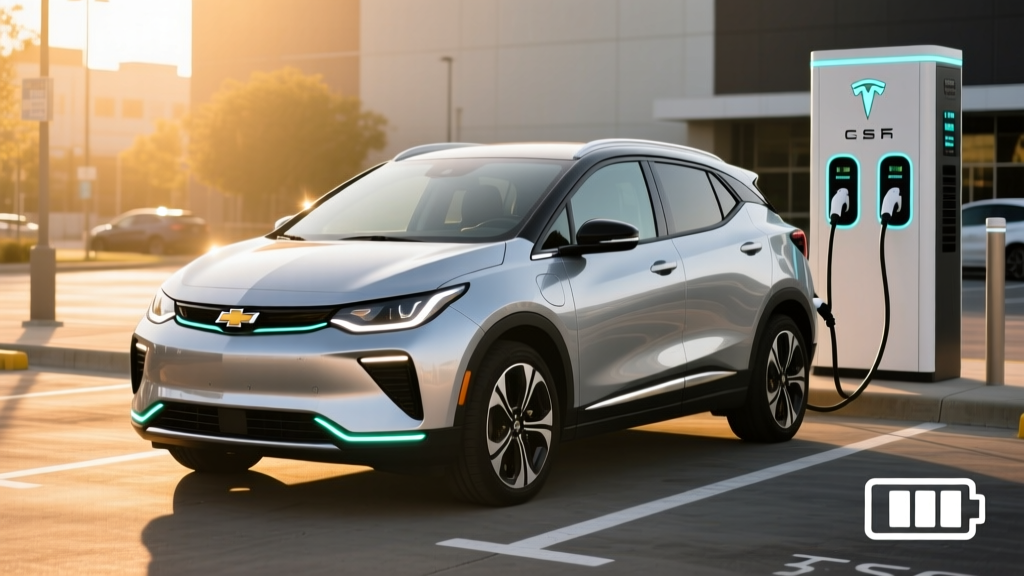
The Bolt EUV's 55 kW peak DC fast-charge rate is its most significant limitation. While competitors like the Hyundai Ioniq 5 and Kia EV6 can accept 200+ kW on 800V architectures, the Bolt EUV's 400V system tops out at 55 kW, making long road trips slower. A 10–80% charge takes approximately 50 minutes at a compatible DC fast charger, and the charge curve tapers noticeably above 60% state of charge.
For daily use, home Level 2 charging is where the Bolt EUV excels. With an 11.5 kW onboard charger, a full recharge from empty takes about 6 hours — easily manageable overnight on a 240V home charger. Level 1 trickle charging (120V) adds roughly 3–4 miles per hour, suitable for plug-in hybrids but impractical as a primary charging method for a 247-mile EV.
Pricing, Trims, and Federal Tax Credit
| Trim | Base MSRP | Est. After §30D Credit* |
|---|---|---|
| LT | $28,900 | $21,400 |
| Premier | $33,400 | $25,900 |
*Federal tax credit eligibility depends on buyer income, MSRP caps, and battery-sourcing requirements under IRS §30D. Verify eligibility with a tax professional and consult irs.gov for current rules.
The 2025 Bolt EUV LT starts at $28,900 (including destination), making it one of the least expensive new EVs in the U.S. market. The Premier trim adds leather seats, a panoramic sunroof, adaptive cruise control, and a 360-degree camera for $33,400.
Under current IRS §30D rules, the Bolt EUV qualifies for up to $7,500 in federal tax credits, but eligibility is not automatic. Key requirements include:
- MSRP Cap: Vans/SUVs/pickups must be under $80,000; sedans under $55,000. The Bolt EUV qualifies as an SUV under the $80,000 cap.
- Buyer Income Limits: Adjusted gross income must not exceed $150,000 (single), $225,000 (head of household), or $300,000 (joint).
- Battery Sourcing: A percentage of critical minerals and battery components must be sourced from the U.S. or free-trade-agreement countries. GM has worked to localize supply chains, but verify current-year compliance on the IRS qualified vehicles list.
- Point-of-Sale Transfer: As of 2024, buyers can transfer the credit to the dealer for an upfront price reduction, rather than waiting to claim it on their tax return.
Most Bolt EUV buyers will qualify for the full $7,500 credit, bringing the effective price of the LT trim to roughly $21,400 — a compelling value proposition. State and local incentives (e.g., California's CVRP, Colorado's state credit) may stack on top.
Interior, Cargo, and Technology
The Bolt EUV's cabin is functional if not luxurious. The LT trim features cloth seats, a 10.2-inch touchscreen with wireless Apple CarPlay and Android Auto, and a 6-speaker audio system. The Premier adds leather, heated front and rear seats, a heated steering wheel, and a Bose premium audio system.
| Dimension | Measurement |
|---|---|
| Front Legroom | 43.1 inches |
| Rear Legroom | 39.1 inches |
| Cargo Volume (behind rear seats) | 16.3 cu ft |
| Cargo Volume (rear seats folded) | 56.3 cu ft |
| Front Headroom | 40.0 inches |
| Rear Headroom | 39.1 inches |
Rear-seat space is a standout: 39.1 inches of legroom exceeds the Kona Electric (36.5 in) and approaches midsize sedan territory. Cargo volume is adequate for groceries and luggage, though the 16.3 cu ft behind the rear seats trails the Kia Niro EV's 19.2 cu ft.
Driver-assistance features include Chevy Safety Assist (automatic emergency braking, lane-keeping assist, following distance indicator, and front pedestrian braking) as standard. The Premier adds Super Cruise compatibility on compatible highways — a Level 2 hands-free system requiring driver attention. Note: Super Cruise is not autonomous driving; the driver must remain engaged and eyes on the road.
Pros and Cons
Pros
- Low starting price; strong value after tax credit
- Spacious rear seat and decent cargo room
- 247-mile EPA range is practical for most commutes
- Fast Level 2 home charging (11.5 kW)
- Standard Chevy Safety Assist suite
- Wireless Apple CarPlay/Android Auto
Cons
- Slow DC fast charging (55 kW peak) limits road-trip practicality
- No heat pump; cold-weather range loss is significant
- FWD only; no AWD option for snow-belt buyers
- Interior materials feel budget-tier, especially on LT trim
- CCS connector (no native NACS); requires adapter for Tesla Superchargers
Who Should Buy the 2025 Chevy Bolt EUV?
Choose the Bolt EUV if:
- You have home Level 2 charging and commute under 100 miles round-trip
- You want an affordable, practical EV with strong rear-seat space
- You qualify for the federal tax credit and want to minimize upfront cost
- Road trips are occasional, not weekly
Look elsewhere if:
- You rely on public DC fast charging for daily use
- You need AWD for snow or mountain driving
- You frequently drive 200+ miles in a single day and can't tolerate 50-minute charge stops
- You want premium interior materials or a luxury badge
The Bolt EUV is a strong choice for budget-conscious EV adopters with home charging access. Its combination of low price, practical range, and roomy interior makes it ideal as a commuter vehicle or second car. However, its slow DC charging and lack of AWD rule it out for frequent road-trippers or those in harsh winter climates.
Warranty and Ownership
Chevrolet covers the Bolt EUV with a 3-year/36,000-mile bumper-to-bumper warranty and a 5-year/60,000-mile powertrain warranty. The battery pack is warrantied for 8 years or 100,000 miles against defects and capacity loss below 60% of original capacity — standard for the industry, though some competitors (Hyundai/Kia) offer 10-year/100,000-mile battery coverage.
Maintenance costs are minimal: no oil changes, no transmission fluid, and regenerative braking extends brake pad life. According to IIHS, the Bolt EUV earns Good ratings in crashworthiness tests, though its headlights receive a Marginal rating on lower trims.
Frequently Asked Questions
What is the real-world range of the 2025 Chevy Bolt EUV?
In mixed driving, expect 220–240 miles. Highway driving at 70+ mph yields 210–235 miles, and freezing temperatures can drop range to 180–200 miles due to resistive cabin heating and battery chemistry limitations.
How fast does the Bolt EUV charge?
DC fast charging peaks at 55 kW, with a 10–80% charge taking about 50 minutes. Home Level 2 charging at 11.5 kW adds roughly 37 miles per hour, fully recharging the battery in about 6 hours.
Does the 2025 Bolt EUV qualify for the federal EV tax credit?
Yes, it qualifies for up to $7,500 under IRS §30D, provided the buyer meets income limits (under $150K single / $300K joint) and the vehicle's battery sourcing complies with current-year requirements. The credit can be transferred to the dealer at point of sale.
Is the Bolt EUV worth buying vs. the Hyundai Kona Electric or Kia Niro EV?
The Bolt EUV wins on price and rear-seat space, but the Kona Electric offers slightly better efficiency (120 MPGe vs. 115 MPGe) and faster DC charging (up to 100 kW). The Niro EV has more cargo room but costs $10,000+ more. If budget is the priority, the Bolt EUV is the clear value leader.
Does the Bolt EUV have all-wheel drive?
No. The Bolt EUV is front-wheel drive only. Buyers in snow-belt states may want to consider the Hyundai Ioniq 5 or Kia EV6, both of which offer AWD configurations.
Can the Bolt EUV use Tesla Superchargers?
The Bolt EUV uses a CCS1 connector. GM has begun providing NACS adapters for access to Tesla's Supercharger network, but availability varies. Confirm adapter compatibility with your dealer before relying on Superchargers for long trips.