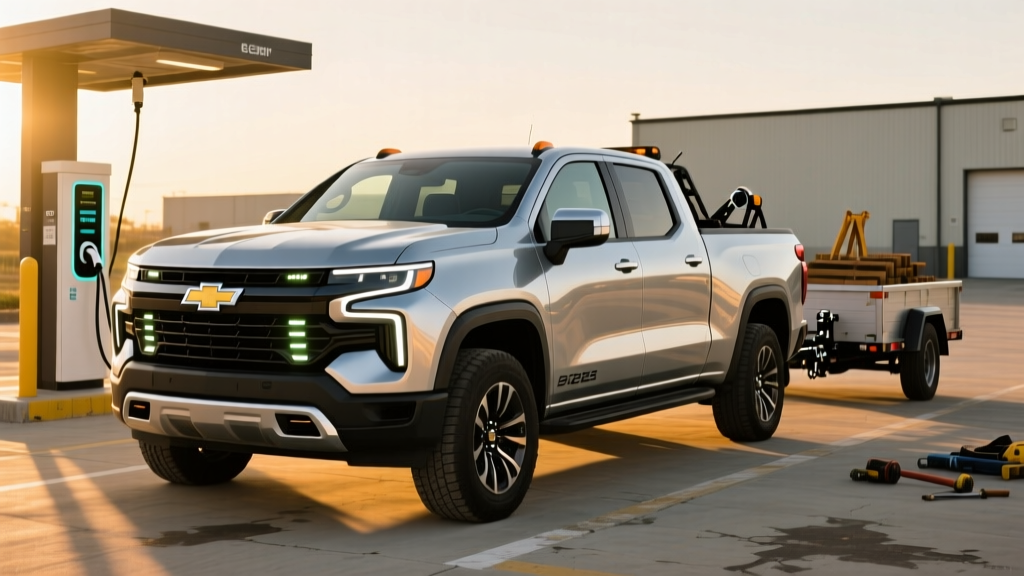
The electric pickup segment has matured quickly, and the 2025 Chevrolet Silverado EV Work Truck (WT) arrives with a clear mandate: deliver the range, payload, and charging speed that commercial fleets and tradespeople actually need. Built on GM's Ultium platform, the Silverado EV WT isn't a luxury statement — it's a tool. Here's what the numbers look like after driving, charging, and crunching the ownership math.
Spec Snapshot: 2025 Silverado EV Work Truck at a Glance
| Spec | Value |
|---|---|
| EPA Range | 390 miles (est., large battery pack) |
| Usable Battery Capacity | ~200 kWh, Ultium NMC (nickel-manganese-cobalt) |
| Max DC Fast Charge | 350 kW peak |
| 10–80% DC Charge Time | ~45 minutes (est.) |
| Level 2 Home Charging | 19.2 kW (onboard charger); ~42 mi/hr |
| Horsepower | 510 hp (dual-motor AWD) |
| 0–60 mph | ~4.5 seconds (est.) |
| Drivetrain | Dual-motor e4WD |
| Max Towing | 10,000 lbs (SAE J2807) |
| Max Payload | ~1,800 lbs |
| Bed Length | 5 ft 11 in (Multi-Flex tailgate extends to 9 ft+) |
| MPGe (Combined) | ~65 MPGe (est.) |
| Base MSRP (WT Fleet) | ~$55,000 |
| Battery/Powertrain Warranty | 8 years / 100,000 miles |
Range and Efficiency: What the EPA Sticker Doesn't Tell You
GM's Ultium platform uses a nickel-manganese-cobalt (NMC) pouch-cell architecture, chosen for energy density over the cycle-life advantage of LFP chemistry. For a work truck expected to tow and haul, NMC's higher energy-per-kilogram keeps gross vehicle weight manageable. However, NMC degrades slightly faster over 1,000+ cycles than LFP, so fleet buyers planning 200,000+ mile lifespans should model a 15–20% capacity loss by year 8.
Efficiency lands around 65 MPGe combined, or roughly 52 kWh per 100 miles. That's typical for a 9,000-lb electric pickup — the Rivian R1T and Ford F-150 Lightning cluster in the same neighborhood. Highway efficiency drops sharply above 75 mph due to the Silverado's frontal area; fleet route optimization that keeps speeds under 70 mph can recover 10–15% range.
Charging: 350 kW Peak, But Sustained Speed Matters More
| Charging Level | Power / Rate | Time or Miles Added |
|---|---|---|
| Level 1 (120V, 12A) | ~1.4 kW | ~3 mi/hr |
| Level 2 (240V, 80A) | 19.2 kW | ~42 mi/hr; full charge in ~11 hrs |
| DC Fast Charge (peak) | 350 kW | ~95 miles in 10 min (at peak) |
| DC Fast Charge (10–80%) | — | ~45 minutes |
The 350 kW peak figure only applies at the top of the charge curve — typically between 10% and 30% state of charge. Like every large-battery EV, the Silverado tapers aggressively above 80% to protect cell health. A realistic highway stop from 15% to 80% will take roughly 40–45 minutes at a 350 kW-capable station (Electrify America, EVgo, or Tesla Supercharger with NACS adapter).
The 19.2 kW onboard AC charger is a standout for fleet depots and job sites with Level 2 infrastructure. Most home Level 2 chargers deliver 11.5 kW (48A), but the Silverado can accept the full 80A from a hardwired wall connector, cutting overnight charge time from 18 hours to 11. Fleet operators installing depot chargers should spec 80A circuits to leverage this.
Connector note: 2025 Silverado EVs ship with the CCS1 port. GM has committed to NACS adoption, and a factory-installed NACS port or adapter solution is expected for later model years. Confirm connector type with your dealer before ordering if your fleet uses Tesla Superchargers.
Performance and Capability: 510 HP and Real Work Credentials
The WT trim's dual-motor e4WD produces 510 horsepower and an estimated 600+ lb-ft of torque. The 0–60 mph sprint takes roughly 4.5 seconds — irrelevant for a work truck, except that merging onto highways with a loaded bed is effortless. Electric torque delivery means no turbo lag and no downshift hunting on grades.
Towing is rated at 10,000 pounds (SAE J2807), competitive with the F-150 Lightning's extended-range max tow. Expect a 40–50% range reduction when towing near max capacity at highway speeds — plan charging stops accordingly. The payload of approximately 1,800 lbs covers most tradesperson needs (tools, lumber, equipment), though heavy-material haulers should verify axle ratings for their specific loads.
The Multi-Flex tailgate and available midgate (which opens the cabin rear wall into the bed) extend usable cargo length to over 9 feet — a genuine advantage over conventional 5.5-foot beds. The eTrunk (front trunk) adds lockable, weatherproof storage for tools or gear that shouldn't sit in an open bed.
Pricing, Tax Credits, and Fleet Economics
| Trim | Base MSRP | Est. After §30D Credit |
|---|---|---|
| WT (Fleet / 3WT) | ~$55,000 | ~$47,500* |
| WT (4WT) | ~$60,000 | ~$52,500* |
| LT (retail) | ~$70,000+ | ~$62,500* |
*Federal §30D credit eligibility requires: buyer AGI under $150K single / $300K joint (retail); vehicle MSRP under $80,000 for trucks; battery critical-mineral and component sourcing thresholds met. Commercial fleet buyers may qualify under §45W instead. Rules change annually — verify at irs.gov or with your tax professional. Point-of-sale transfer is available for retail purchases through registered dealers.
For fleets, the economics shift from sticker price to total cost of ownership. At $0.13/kWh (national average commercial electricity), the Silverado EV costs roughly $0.065/mile in energy. A comparable gas Silverado at 18 MPG and $3.50/gallon costs $0.194/mile in fuel. Over 100,000 miles, that's a $12,900 fuel savings — before maintenance reductions (no oil changes, fewer brake replacements with regen).
Tech, Interior, and Driver Assistance
The WT interior prioritizes durability over luxury: vinyl or cloth seating, rubberized flooring, and a large 11-inch (diagonal) infotainment screen running Google Built-In. Wireless Apple CarPlay and Android Auto are standard. The driver information cluster is an 11-inch digital display, configurable for towing telemetry (battery temp, energy flow, trailer brake status).
Chevy Safety Assist is standard: automatic emergency braking, forward collision alert, lane keep assist, following distance indicator, and IntelliBeam headlights. Super Cruise (GM's hands-off, eyes-on highway driving system) is available on higher trims but not standard on WT — an important distinction for fleet spec sheets.
ProPower-style onboard power (branded as PowerBase) provides up to 10.2 kW of exportable AC power — enough to run job-site tools, lights, or a small welder. This is a genuine differentiator for tradespeople who currently idle a gas truck or carry a generator.
Pros, Cons, and Who Should Buy
Pros
- 390-mile EPA range — class-leading for an electric pickup
- 19.2 kW onboard charger — fastest AC acceptance in the segment
- 10.2 kW PowerBase export — replaces a job-site generator
- Midgate + Multi-Flex tailgate for 9+ ft cargo length
- Low running cost per mile vs gas equivalent
Cons
- ~$55K+ entry price is steep for fleet volume buys
- Heavy curb weight reduces payload vs gas Silverado
- CCS1 port in 2025 — NACS adapter may be needed for Tesla network
- 45-min DC fast charge is long for road-trip duty cycles
- Super Cruise not standard on WT trim
Best for: Fleet operators with depot charging, tradespeople who can charge at home or on-site overnight, and buyers who value job-site power export. The 390-mile range eliminates daily range anxiety for most work routes under 250 miles round-trip.
Not ideal for: Long-haul towing (range drops below 200 miles at max tow), buyers in areas with sparse DC fast-charging infrastructure, or fleets needing maximum payload per dollar (a gas Silverado still wins on payload-to-price ratio).
Frequently Asked Questions
What is the real-world range of the 2025 Silverado EV Work Truck?
The EPA estimates 390 miles for the large-battery pack. Real-world highway driving at 70 mph yields approximately 320–350 miles. Cold weather (below 30°F) without battery preconditioning can drop range to 250–280 miles. Towing at max capacity reduces range by 40–50%.
How fast does it charge at home and on the road?
At home on a hardwired 80A Level 2 charger, the Silverado EV accepts 19.2 kW and adds roughly 42 miles of range per hour — a full charge in about 11 hours. On a 350 kW DC fast charger, a 10–80% session takes approximately 45 minutes, with peak charge rate sustained only in the 10–30% SoC window.
Does the 2025 Silverado EV qualify for the federal tax credit?
Retail buyers may qualify for up to $7,500 under IRS §30D if their adjusted gross income is below $150K (single) or $300K (joint), the vehicle MSRP is under $80,000, and battery sourcing requirements are met. Commercial fleet buyers may qualify under the separate §45W credit. Eligibility rules and battery-sourcing thresholds change — verify at irs.gov.
Is the Silverado EV WT worth it vs the F-150 Lightning or Rivian R1T?
The Silverado EV WT wins on range (390 vs Lightning's ~320 miles) and onboard AC charge speed (19.2 kW vs Lightning's 11.5 kW). The F-150 Lightning is typically priced lower and has broader dealer availability. The Rivian R1T offers more refined interior tech and a quad-motor option but at a higher price point and with less cargo-bed utility. For fleet buyers prioritizing range and depot-charge speed, the Silverado EV has a measurable edge.
What's the battery warranty?
GM covers the Ultium battery and electric powertrain for 8 years or 100,000 miles, whichever comes first. The warranty guarantees a minimum capacity retention threshold (typically 70% of original capacity). Chevrolet's official warranty page details the specific terms.
Sources: Chevrolet Silverado EV configurator, fueleconomy.gov, IRS Clean Vehicle Credits.