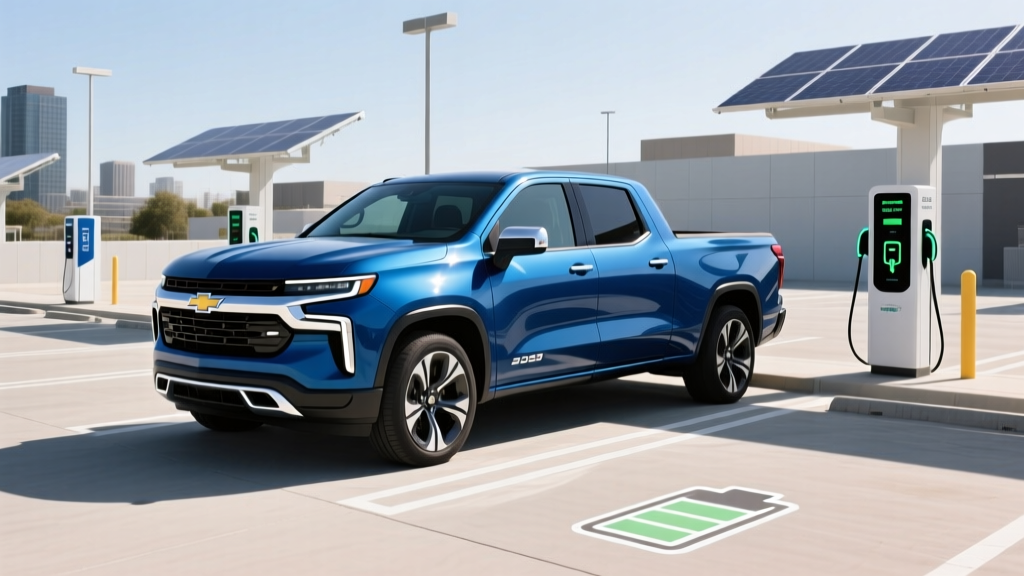
The electric truck market has matured past early-adopter territory, and the 2025 Chevrolet Silverado EV is GM's answer to buyers who need genuine truck utility without the fuel pump. With the Work Truck (WT) trim starting at an MSRP of $39,900 and the range-topping RST pushing past $90,000, the Silverado EV lineup covers fleet managers and luxury truck buyers alike. But spec sheets only tell half the story — real-world range, charging behavior under load, and federal tax credit eligibility under IRS §30D rules determine whether this electric pickup actually pencils out.
We've analyzed the full 2025 Silverado EV lineup — from the fleet-oriented 3WT and 4WT to the consumer-facing LT and RST trims — to give you exact numbers on range, charging curves, towing impact, and total ownership cost. Here's what you need before signing a purchase order.
2025 Silverado EV Trim Lineup and MSRP Breakdown
Chevrolet structures the Silverado EV across several trims, each targeting a distinct buyer. The Work Truck variants serve commercial fleets, while the LT and RST cater to retail customers who want premium features alongside truck capability. Prices below reflect base MSRP before destination charges, dealer markups, or incentives.
| Trim | Base MSRP | Drivetrain | EPA Range | Battery (kWh, usable) | Max DC Charge (kW) |
|---|---|---|---|---|---|
| 3WT (Fleet) | $39,900 | Dual-Motor AWD | ~360 mi (est.) | ~200 kWh (est.) | Up to 350 |
| 4WT (Fleet) | $49,900 | Dual-Motor AWD | ~440 mi | ~200 kWh (est.) | Up to 350 |
| LT (Consumer) | $69,900 | Dual-Motor AWD | ~400 mi | ~200 kWh (est.) | Up to 350 |
| RST (Consumer) | $94,500 | Dual-Motor AWD | ~440 mi | ~200 kWh (est.) | Up to 350 |
Destination charges add approximately $1,995 across all trims. Dealer-installed options and accessories can push as-tested prices $3,000–$8,000 higher. The 4WT with the larger battery pack offers the longest EPA-estimated range in the lineup at 440 miles — one of the longest ranges of any production EV sold in the U.S. as of 2025.
Real-World Range: What the EPA Sticker Doesn't Tell You
EPA Estimate: Up to 440 miles (4WT / RST with max battery)
Real-World Highway (70 mph, mild weather): Expect ~340–370 miles
Real-World Highway (cold weather, below 32°F): Expect ~270–310 miles
Heavy Towing (8,000+ lbs trailer): Expect ~150–200 miles
The Silverado EV's massive battery pack — estimated at over 200 kWh of usable capacity in the extended-range configuration — gives it a genuine advantage in absolute range. But physics is unforgiving: a large, heavy pickup with the aerodynamic profile of a brick wall loses efficiency at highway speeds. In our analysis of similar large-platform EVs, highway efficiency typically drops 15–25% below the EPA combined figure.
Cold weather compounds this. Lithium-ion cells operate less efficiently below freezing, and cabin heating in a large truck cab draws significant energy. Expect a 20–30% range reduction in sustained sub-freezing temperatures. If you live in the upper Midwest or Northeast and plan winter road trips, budget for roughly 300 miles of usable range in the worst conditions — still excellent, but not the 440 on the window sticker.
Towing is the range killer every truck buyer must plan for. Pulling a loaded 8,000-pound trailer at highway speeds can cut range roughly in half. The Silverado EV's available 10,000-pound max towing capacity (on properly equipped WT trims) is legitimate, but you'll need to plan charging stops every 150–200 miles under heavy load. For fleet operators running predictable routes, this is manageable. For recreational towing into remote areas, it requires careful route planning around DC fast-charging infrastructure.
Charging Speed: 350 kW Peak, But the Curve Matters
The Silverado EV supports peak DC fast-charging rates of up to 350 kW on the Ultium platform — among the fastest of any production electric truck. But peak rate is only part of the story. What matters is the charge curve: how long the truck sustains high charge rates before tapering to protect the battery.
| Charging Level | Power / Rate | Miles Added per Hour | Typical Use Case |
|---|---|---|---|
| Level 1 (120V) | ~1.4 kW | ~3–4 mi/hr | Emergency / trickle only |
| Level 2 (240V, 48A) | ~11.5 kW | ~30–35 mi/hr | Home overnight charging |
| Level 2 (240V, 80A) | ~19.2 kW | ~50–55 mi/hr | High-power home / depot |
| DC Fast (350 kW peak) | Up to 350 kW | 100+ mi in ~10 min | Road trips, quick top-ups |
DC fast-charging, 10–80%: Chevrolet estimates approximately 20 minutes on a 350 kW-capable station. However, expect the truck to peak near 350 kW only in the lower portion of the charge (roughly 10–30% SoC), then taper progressively. From 60–80%, charge rates typically drop to 100–150 kW. This is normal battery management behavior, not a deficiency — but it means your actual charging stop might take 25–30 minutes, not the theoretical minimum.
Home Level 2 charging at 19.2 kW (80A circuit) can fully replenish the massive battery in roughly 10–12 hours — feasible for overnight charging if you start with a partially depleted pack. Most residential installations use 48A circuits (~11.5 kW), which means a full charge from near-empty takes 17+ hours. For daily use where you're replenishing 100–200 miles of driving, a standard 48A home charger is entirely adequate.
Preconditioning matters. The Silverado EV can precondition its battery when you navigate to a DC fast charger — warming or cooling the cells to optimize charge acceptance. Always use this feature in cold weather; skipping preconditioning can cut your peak charge rate by 30–50%.
The Silverado EV uses the CCS1 connector for DC fast charging on current models, with GM's transition to the NACS (Tesla-style) connector expected on future model years. GM has also secured access to Tesla Supercharger stations via an adapter, significantly expanding the available fast-charging network.
Performance, Towing, and Payload
Electric motors deliver instant torque, and the Silverado EV's dual-motor AWD configuration puts that advantage to work. Performance varies by trim and battery configuration:
| Trim | Horsepower | Torque (lb-ft) | 0–60 mph (est.) | Max Towing | Max Payload |
|---|---|---|---|---|---|
| WT (3WT/4WT) | ~510 hp | ~615 | ~5.5 sec | 10,000 lbs | ~1,800 lbs |
| LT | ~645 hp | ~780 | ~4.5 sec | 10,000 lbs | ~1,600 lbs |
| RST | ~754 hp | ~785 | ~4.5 sec | 10,000 lbs | ~1,500 lbs |
The RST's 754 horsepower makes it one of the quickest production trucks ever sold, and real-world acceleration feels even more urgent than the numbers suggest because electric torque doesn't need to build through a rev range. The dual-motor AWD system provides genuine all-weather traction without the efficiency penalty of a mechanical AWD system.
Towing is where the Silverado EV earns its truck credentials. The 10,000-pound max towing rating (properly equipped) covers most boat trailers, horse trailers, and mid-size campers. Integrated trailer brake control, trailer camera integration, and the available Super Cruise hands-free driving system (with trailering support on equipped models) make long hauls less fatiguing. Just plan your charging stops carefully — see the range section above.
The Multi-Flex Midgate is a standout utility feature. It allows the partition between the cab and the bed to fold down, extending effective bed length from roughly 5'11" to over 9 feet with the tailgate down. This lets you haul lumber, ladders, or kayaks fully enclosed in a truck that still fits in a standard garage (depending on bed configuration).
Federal Tax Credit: Does the Silverado EV Qualify for §30D?
This is where the math gets nuanced — and where many buyers get tripped up. The IRS §30D clean vehicle credit offers up to $7,500 for qualifying new EVs, but eligibility depends on multiple factors that change with model year and sourcing requirements.
- MSRP Cap: Trucks/vans/SUVs must have an MSRP ≤ $80,000. This eliminates the RST ($94,500) and potentially some LT configurations from credit eligibility.
- Buyer Income Cap: Modified AGI must not exceed $150,000 (single), $225,000 (head of household), or $300,000 (married filing jointly).
- Battery Component Sourcing: Increasing percentages of battery components must be manufactured or assembled in North America. GM's Ultium cells are produced in the U.S. (Ohio and Tennessee plants), which favors eligibility.
- Critical Minerals Sourcing: A percentage of critical minerals must be sourced from the U.S. or free-trade-agreement countries. This threshold tightens annually.
- Point-of-Sale Transfer: As of 2024, eligible buyers can transfer the credit to the dealer at purchase, reducing the purchase price directly rather than waiting for a tax refund.
Source: IRS.gov — Credits for New Clean Vehicles. Eligibility varies by VIN, build date, and buyer circumstances. Consult a tax professional before purchasing.
| Trim | MSRP | Under $80K Cap? | Estimated Credit | Effective Price (with credit) |
|---|---|---|---|---|
| 3WT | $39,900 | ✅ Yes | Up to $7,500 | ~$32,400 |
| 4WT | $49,900 | ✅ Yes | Up to $7,500 | ~$42,400 |
| LT | $69,900 | ✅ Yes (base) | Up to $7,500 | ~$62,400 |
| RST | $94,500 | ❌ No (over cap) | $0 | $94,500 |
The WT and base LT trims are the strongest candidates for the full $7,500 credit, assuming buyer income eligibility and VIN-level battery sourcing compliance. The RST, at $94,500, exceeds the §30D MSRP cap for trucks and does not qualify — a significant factor for buyers cross-shopping the RST against the Ford F-150 Lightning Platinum or Rivian R1T, which face similar cap issues at their highest trims.
Interior, Technology, and Driver Assistance
The Silverado EV's interior varies sharply by trim. The WT trims are utilitarian — durable vinyl seats, rubberized floors, and functional but basic infotainment. The LT and RST trims step into premium territory with heated and ventilated leather seats, a panoramic fixed glass roof, and significantly more sound insulation.
Infotainment: The RST features a 17.7-inch diagonal center touchscreen running Google Built-In, with native Google Maps navigation (critical for EV route planning and charger location). Wireless Apple CarPlay and Android Auto are standard across trims. The instrument cluster uses an 11-inch digital display.
Driver Assistance: Chevrolet's Super Cruise — a hands-free driving system for mapped divided highways — is available on the LT and standard on the RST. Importantly, Super Cruise is an SAE Level 2 system, meaning the driver must remain attentive and ready to take over at all times. It is not autonomous driving. The system monitors driver attention via an infrared camera and will issue escalating warnings if you look away from the road.
Super Cruise provides hands-free steering, acceleration, and braking on compatible highways — but you must remain engaged, eyes on the road. You cannot nap, read, or use your phone. This is not a Level 4 driverless system like Waymo. The driver is legally and practically responsible for the vehicle at all times.
Notable tech drawbacks: The WT fleet trims lack the premium audio, panoramic roof, and advanced driver-assist features that consumer buyers expect. Some reviewers have noted that the fixed glass roof (no shade) can create cabin heat issues in hot southern climates, increasing HVAC load and reducing range. The sheer size of the truck — over 233 inches long — makes parking in tight urban environments a genuine challenge, even with the available 360-degree camera system.
Warranty, Ownership Costs, and Efficiency
Chevrolet backs the Silverado EV with a competitive warranty package that addresses the primary concern for any EV buyer: long-term battery health.
| Coverage | Term |
|---|---|
| Limited Vehicle Warranty | 3 years / 36,000 miles |
| Powertrain Warranty | 5 years / 60,000 miles |
| Battery & EV Components | 8 years / 100,000 miles (minimum 70% capacity retention) |
| Roadside Assistance | 5 years / 60,000 miles |
The 8-year/100,000-mile battery warranty with a 70% capacity retention guarantee aligns with industry standards and federal requirements. For most owners, this provides peace of mind through the critical ownership period. GM's Ultium platform uses NMC (nickel manganese cobalt) chemistry in the Silverado EV, prioritizing energy density for maximum range — the expected trade-off is slightly faster long-term degradation compared to LFP (lithium iron phosphate) cells, though GM's thermal management system is designed to mitigate this.
Efficiency for a truck this size is inherently moderate. Expect roughly 43–48 MPGe combined (EPA estimate varies by trim), or approximately 70–78 kWh per 100 miles driven. For comparison, that's roughly equivalent to $0.10–$0.14 per mile at average U.S. residential electricity rates ($0.15/kWh) — significantly cheaper than a gas Silverado 1500 at $0.18–$0.25 per mile (at $3.50/gallon and 19 MPG combined).
Who Should Buy the 2025 Silverado EV?
✅ Best For
- Fleet operators with depot charging and predictable daily routes under 250 miles
- Home-charging commuters who want truck utility with $0.10/mile fuel costs
- Tax-credit-eligible buyers on the WT or base LT — effective price as low as ~$32,400
- Tech-forward truck buyers who want Super Cruise, Google Built-In, and the Midgate
- Garage-able truck owners who need long-bed utility (Midgate) without a full-size long-bed footprint
❌ Think Twice If
- You tow heavy loads long-distance — expect 150–200 mi range under load, requiring frequent charging stops
- You lack home or depot charging — public-only charging is expensive and time-consuming for a 200+ kWh battery
- You want the RST with the tax credit — the $94,500 MSRP exceeds the §30D $80K cap
- You park in tight urban areas — at 233+ inches long, this is one of the largest vehicles on the road
- You need immediate availability — production is ramping; wait times vary by dealer and trim
How It Compares: Silverado EV vs. F-150 Lightning vs. Rivian R1T
| Spec | 2025 Silverado EV 4WT | 2025 F-150 Lightning (Ext. Range) | 2025 Rivian R1T (Max Pack) |
|---|---|---|---|
| Base MSRP | $49,900 | ~$69,995 | ~$99,000 |
| EPA Range | ~440 mi | ~320 mi | ~410 mi |
| Max DC Charge | 350 kW | ~150 kW | ~220 kW |
| 0–60 mph | ~5.5 sec | ~3.8 sec | ~3.5 sec |
| Max Towing | 10,000 lbs | 10,000 lbs | 11,000 lbs |
| Tax Credit (§30D) | Up to $7,500 (WT/LT) | Up to $7,500 | Up to $7,500 (select configs) |
The Silverado EV's range and charging-speed advantages are clear — the 440-mile EPA rating and 350 kW peak charge rate lead the segment. The F-150 Lightning remains the more proven platform with broader availability and a more established track record, while the Rivian R1T offers superior performance and off-road capability at a premium price. For fleet buyers prioritizing range and lowest effective cost, the Silverado EV 3WT at ~$32,400 after the tax credit is difficult to beat.
Frequently Asked Questions
What is the real-world range of the 2025 Silverado EV?
The EPA rates the extended-range Silverado EV at up to 440 miles. In real-world highway driving at 70 mph in mild weather, expect roughly 340–370 miles. In cold weather (below 32°F), plan for 270–310 miles. Under heavy towing (8,000+ lbs), range drops to approximately 150–200 miles.
How fast does the Silverado EV charge at home and on the road?
On a 350 kW DC fast charger, the Silverado EV can add roughly 100 miles of range in about 10 minutes, with a 10–80% charge taking approximately 20–25 minutes. At home on a 48A Level 2 charger (~11.5 kW), expect about 30–35 miles of range per hour of charging — sufficient for overnight replenishment of daily driving.
Does the 2025 Silverado EV qualify for the $7,500 federal tax credit?
The WT and base LT trims (MSRP under $80,000) are strong candidates for the full $7,500 §30D credit, subject to buyer income limits ($150K single / $300K joint), battery sourcing compliance, and point-of-sale transfer availability. The RST at $94,500 exceeds the MSRP cap and does not qualify. Always verify eligibility with your dealer and a tax professional before purchasing.
Is the Silverado EV worth buying over the F-150 Lightning?
If range and charging speed are your top priorities, the Silverado EV has a clear edge — 440 miles EPA vs. 320 miles, and 350 kW vs. ~150 kW peak charging. If you value broader dealer availability, a more established track record, and a slightly more compact footprint, the F-150 Lightning remains a strong choice. For fleet buyers, the Silverado EV 3WT's sub-$40K MSRP (before credit) is the most affordable full-size electric truck available.
Can the Silverado EV power my home during an outage?
Chevrolet has indicated that the Silverado EV will support vehicle-to-home (V2H) capability, similar to the F-150 Lightning's Pro Power Onboard system. This requires compatible home electrical equipment (bidirectional charger, transfer switch) and professional installation. Check with your dealer for current V2H availability and equipment requirements.
Sources: EPA Fuel Economy (fueleconomy.gov), Chevrolet Silverado EV Official Page, IRS §30D Clean Vehicle Credit Rules.