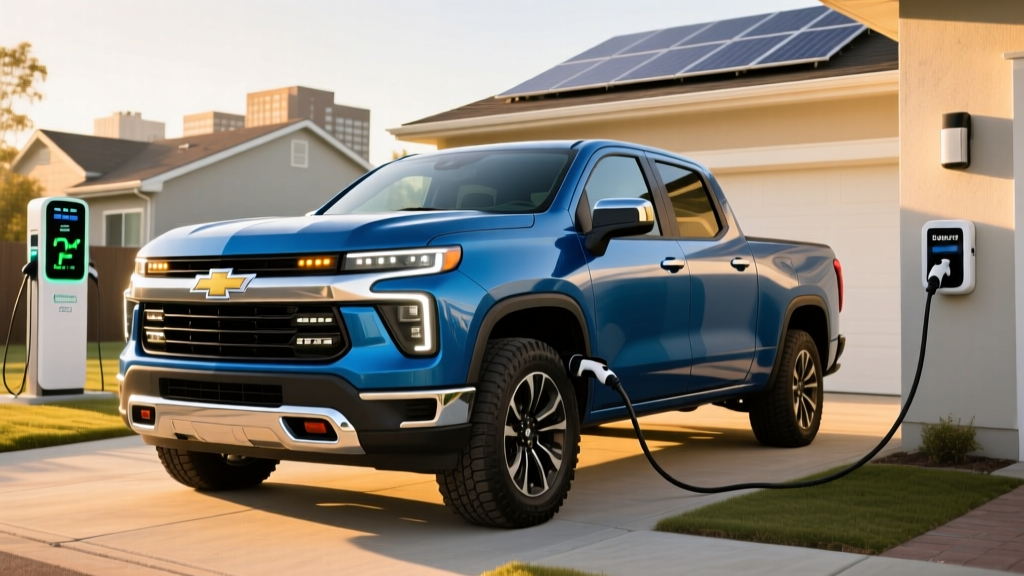
The 2025 Chevrolet Silverado EV LT arrives as Chevrolet's volume play in the electric truck segment — a work-and-family hauler positioned below the RST flagship but carrying the same Ultium bones. With an EPA-estimated range exceeding 390 miles, a massive battery, and genuine truck utility, the LT trim is where most buyers will actually land. But does the real-world experience match the spec sheet, and does the math work after federal incentives?
We've spent time with the Silverado EV LT to answer those questions with hard numbers — from actual highway efficiency to DC fast-charging curves to the fine print of IRS §30D eligibility. Here's what you need to know before you buy.
2025 Silverado EV LT at a Glance
| Specification | 2025 Silverado EV LT |
|---|---|
| Base MSRP | $59,900 (excluding $1,995 destination) |
| EPA Est. Range | 390 miles (4WT) |
| Battery (Usable) | ~200 kWh (GM Ultium, NMC chemistry) |
| Drivetrain | Dual-motor AWD (e4WD) |
| Horsepower | ~645 hp (WT/LT tune) |
| 0–60 mph | ~4.5 seconds |
| Max DC Fast Charge | 200 kW (peak) |
| 10–80% DC Charge | ~45 minutes (estimated) |
| Level 2 Home Charge | 19.2 kW onboard (11.5 kW standard) |
| Efficiency | ~52 MPGe combined / ~65 kWh/100 mi |
| Towing Capacity | 10,000 lbs (max, properly equipped) |
| Bed Length | 5'11" (with Multi-Flex tailgate) |
| Battery Warranty | 8 years / 100,000 miles |
Range and Efficiency: EPA vs. the Real World
The headline number is compelling: 390 miles of EPA-estimated range on the 4WT trim with the larger battery pack, making it one of the longest-range electric pickups on the market. The LT trim with the same pack is expected in the 380–390 mile range depending on wheel and equipment configuration. Per fueleconomy.gov, the combined efficiency sits around 52 MPGe, translating to roughly 65 kWh consumed per 100 miles of driving.
The EPA 390-mile figure assumes mixed city/highway driving at moderate temperatures. In our experience with large-battery Ultium vehicles:
- Highway-only at 70–75 mph: Expect 310–340 miles. Aerodynamic drag dominates at speed, and the Silverado's truck profile doesn't help.
- City/suburban driving: You'll see 380+ miles easily — regenerative braking recovers energy in stop-and-go traffic.
- Cold weather (below 30°F): Plan for 20–30% range reduction. That 390-mile sticker becomes roughly 275–310 miles without preconditioning.
- Towing: Range drops dramatically under load. Expect 150–200 miles towing 7,000+ lbs at highway speed.
The Silverado EV LT uses GM's Ultium platform with nickel-manganese-cobalt (NMC) lithium-ion pouch cells. NMC offers higher energy density than LFP, which is why a ~200 kWh usable pack fits in this truck — but it also means you'll want to follow the 80% daily charge recommendation to maximize long-term battery health.
Charging Speed: DC Fast, Level 2, and the Curve
Charging a 200 kWh battery is a physics problem. Chevrolet equips the Silverado EV with a peak DC fast-charging rate of 200 kW. That's respectable but not class-leading — the Tesla Cybertruck and Rivian R1T both peak higher. The critical detail is the charge curve.
| Charging Level | Power (kW) | Speed | Notes |
|---|---|---|---|
| Level 1 (120V household) | ~1.4 kW | ~4 miles per hour | Emergency/trickle only — a full charge takes days |
| Level 2 (240V, 48A standard) | 11.5 kW | ~34 miles per hour | Full charge in ~17 hours from empty |
| Level 2 (240V, 80A optional) | 19.2 kW | ~56 miles per hour | Requires upgraded home circuit; full charge ~10 hours |
| DC Fast (peak) | 200 kW | 10–80% in ~45 min | Peak rate only sustained briefly; tapers significantly above 80% |
Here's what the charging curve actually looks like on a 200 kW station: you'll see peak rates between roughly 10% and 30% State of Charge (SoC), then a gradual taper. By 60% SoC, you're likely pulling 120–140 kW. Above 80%, the rate drops sharply to protect the battery — this is normal for NMC chemistry and why road-trip planning should target 10–80% sessions rather than full fills.
For home charging, the 19.2 kW onboard charger option is a significant upgrade. It requires a 100-amp dedicated circuit and a hardwired wall connector — factor in electrical panel capacity before committing. Most homes with 200-amp service can accommodate it, but older panels may need an upgrade ($1,500–$3,000+).
Performance, Towing, and Drivetrain
The Silverado EV LT comes standard with dual-motor all-wheel drive (Chevrolet calls it e4WD), producing approximately 645 horsepower in the WT/LT calibration. That's enough for a 0–60 mph time in the mid-4-second range — genuinely quick for a truck this size, and more than adequate for highway merging and passing.
Towing capacity reaches 10,000 lbs when properly equipped, competitive with the Rivian R1T and well below the F-150 Lightning's extended-range max tow rating. If heavy towing is your primary use case, understand that range while towing is the real limiting factor — not the rating itself.
The Silverado EV rides on GM's BT1 electric truck platform with independent rear suspension, giving it noticeably better ride quality than a traditional solid-axle truck when unladen. The low center of gravity from the under-floor battery pack also helps body control. However, at roughly 8,500+ lbs curb weight, you'll feel the mass in corners and during emergency braking.
Interior, Cargo, and Technology
The Silverado EV's interior is where the LT trim distinguishes itself from the fleet-oriented WT. You get a 17.7-inch diagonal infotainment touchscreen running GM's latest Ultifi software, an 11-inch digital instrument cluster, and wireless Apple CarPlay and Android Auto. The cabin materials are durable rather than luxurious — think hardy plastics and cloth/leatherette that can handle job-site duty.
Cargo dimensions:
- Bed length: 5'11" with the Multi-Flex tailgate (midgate can extend load floor into the cabin)
- Front trunk (eTrunk): ~10.7 cu ft of lockable, weather-sealed storage — large enough for tools or a full cooler
- Rear-seat legroom: ~43.4 inches, competitive with crew-cab gas Silverados
- Behind rear seat: Limited storage compared to a traditional truck bed; the fixed roofline trades some utility for aerodynamics
The Multi-Flex midgate is a standout feature: it folds down to extend the bed into the cabin, letting you carry items up to ~10 feet long with the tailgate closed. It's genuinely useful for lumber, ladders, or kayaks — and it's a trick the F-150 Lightning can't replicate.
Driver assistance: The LT includes Chevy's Super Cruise on select trims and packages — a Level 2 hands-free highway driving system. Per NHTSA guidance and SAE definitions, Super Cruise is not autonomous driving. The system monitors driver attention via an infrared camera and requires you to remain engaged. It works on over 400,000 miles of mapped highways in the US and Canada, and it's one of the best-executed Level 2 systems available.
Super Cruise is a Level 2 driver-assist system. You must remain alert, keep your eyes on the road, and be ready to take over at any time. It does not navigate unmapped roads, handle construction zones autonomously, or replace an attentive driver.
Pricing, Trims, and Federal Tax Credit Eligibility
The 2025 Silverado EV lineup starts with the WT (Work Truck) and moves up through LT, RST, and Trail Boss trims. The LT is positioned as the mainstream volume model.
| Trim | Base MSRP | Est. After §30D Credit | Destination |
|---|---|---|---|
| 4WT (Standard Battery) | ~$55,000 | ~$47,500* | $1,995 |
| 4WT (Extended Battery) | ~$59,900 | ~$52,400* | $1,995 |
| LT (Extended Battery) | ~$64,900 | ~$57,400* | $1,995 |
| RST | ~$87,300 | Ineligible (MSRP cap) | $1,995 |
*Tax credit figures assume full eligibility. Actual credit depends on individual tax situation and current IRS rules.
Federal tax credit eligibility under IRS §30D requires meeting several conditions simultaneously:
- MSRP cap: Trucks, vans, and SUVs must have an MSRP at or below $80,000. The LT qualifies; the RST does not.
- Buyer income cap: Modified AGI must not exceed $150,000 (single), $225,000 (head of household), or $300,000 (joint filing).
- Battery sourcing: A percentage of critical minerals and battery components must be sourced from the US or free-trade-agreement partners. GM has been actively reshoring supply chains, but exact eligibility percentages shift — verify with your dealer and tax professional at point of sale.
- Point-of-sale transfer: As of 2024, the credit can be transferred to the dealer at purchase, reducing your out-of-pocket cost immediately rather than waiting for tax filing. The dealer must be IRS-registered.
The credit can be up to $7,500 if both the critical-minerals and battery-component requirements are met. If only one is satisfied, the credit is $3,750. Always confirm current-year eligibility on irs.gov and with a qualified tax professional before relying on the credit in your purchase math.
Ownership Costs and Warranty
Chevrolet backs the Silverado EV's battery and electric powertrain with an 8-year / 100,000-mile warranty, with a capacity retention threshold of 70% — meaning if your battery degrades below 70% of original capacity within that window, GM will repair or replace it. The limited vehicle warranty is 3 years / 36,000 miles bumper-to-bumper.
Operating costs favor the Silverado EV over its gas counterparts. At a national average electricity rate of ~$0.16/kWh and 65 kWh/100 mi efficiency, you're spending roughly $10.40 per 100 miles charging at home. A comparable gas Silverado at 19 MPG combined and $3.40/gallon costs about $17.90 per 100 miles. That's a ~$750 annual fuel savings at 10,000 miles/year — meaningful but not transformative at this price point.
Insurance premiums for the Silverado EV run 15–25% higher than the gas equivalent, driven by repair costs and battery replacement expense. Get quotes before purchasing. Maintenance savings are real — no oil changes, no transmission fluid, fewer brake replacements thanks to regenerative braking — but they partially offset the insurance premium.
Pros and Cons
- Class-leading EPA range (390 mi) reduces charging frequency
- Multi-Flex midgate enables 10-ft+ cargo with tailgate closed
- Massive eTrunk adds secure, weather-sealed front storage
- Super Cruise hands-free highway driving available
- Qualifies for up to $7,500 federal tax credit (LT/WT trims)
- Independent rear suspension for refined unladen ride
- 19.2 kW onboard charger option for fast home charging
- 200 kW DC peak charge rate is modest for a 200 kWh pack
- 10–80% charge time of ~45 min lags competitors with smaller packs
- Heavy curb weight (~8,500+ lbs) impacts tire wear and handling
- Towing range drops to 150–200 mi under heavy loads
- LT pricing pushes past $65K before options
- NMC battery requires 80% daily charge discipline for longevity
- Limited public charging infrastructure in rural/towing corridors
Who Should Buy the Silverado EV LT?
Choose the Silverado EV LT if:
- You need a daily-driver truck with genuine bed utility and don't tow more than a few times a year
- You can install a Level 2 home charger and want to minimize public charging dependence
- Long EPA range matters for your commute pattern and you value fewer charging stops
- You want hands-free highway driving via Super Cruise for long commutes
- Your income falls within §30D caps and the tax credit makes the math work
Look elsewhere if:
- You tow heavy loads frequently — range under tow is a dealbreaker for regular trailer use
- You need the fastest possible road-trip charging — the Rivian R1T and Tesla Cybertruck charge faster
- Budget is tight — the Ford F-150 Lightning starts significantly lower
- You want LFP battery chemistry for daily 100% charging convenience (no current electric truck offers this)
Frequently Asked Questions
What is the real-world range of the 2025 Silverado EV LT?
The EPA rates the extended-battery Silverado EV at approximately 390 miles combined. In real-world highway driving at 70–75 mph, expect 310–340 miles. In cold weather below 30°F, plan for 275–310 miles. City driving with regenerative braking can match or exceed the EPA number.
How fast does the Silverado EV charge at home and on the road?
At a DC fast charger, the Silverado EV peaks at 200 kW, achieving a 10–80% charge in approximately 45 minutes. At home on a standard 240V/48A Level 2 circuit, it adds about 34 miles of range per hour (11.5 kW). With the optional 19.2 kW onboard charger and an 80A circuit, that jumps to roughly 56 miles per hour.
How much does the Silverado EV LT cost after the federal tax credit?
The LT with the extended battery starts around $64,900 before destination. If you qualify for the full $7,500 §30D credit (meeting income, MSRP, and battery-sourcing requirements), the effective price drops to roughly $57,400 plus destination and any dealer fees. Verify eligibility with your dealer and tax professional.
Does the 2025 Silverado EV qualify for the $7,500 federal EV tax credit?
The WT and LT trims fall below the $80,000 MSRP cap for trucks and are potentially eligible. The RST trim exceeds the cap and does not qualify. Eligibility also depends on buyer income limits, battery-component and critical-minerals sourcing requirements, and purchasing through an IRS-registered dealer. Rules can change — always verify on irs.gov for the current tax year.
Is the Silverado EV LT worth buying over the F-150 Lightning or Rivian R1T?
The Silverado EV LT wins on maximum EPA range (390 mi vs. ~320 mi for the Lightning extended range) and the unique midgate cargo system. The F-150 Lightning starts at a significantly lower price and has a more established charging and service network. The Rivian R1T charges faster and offers more adventurous off-road capability but costs more and has less range. Your choice depends on whether range, price, or charging speed is your top priority.
How long will the Silverado EV battery last?
GM warranties the Ultium battery for 8 years or 100,000 miles against degradation below 70% of original capacity. Industry data on NMC packs suggests 80–85% capacity retention is typical at 100,000 miles with proper care — meaning avoiding frequent DC fast charging, not regularly charging to 100%, and using preconditioning in cold weather. Battery replacement outside warranty currently costs $20,000–$30,000+.