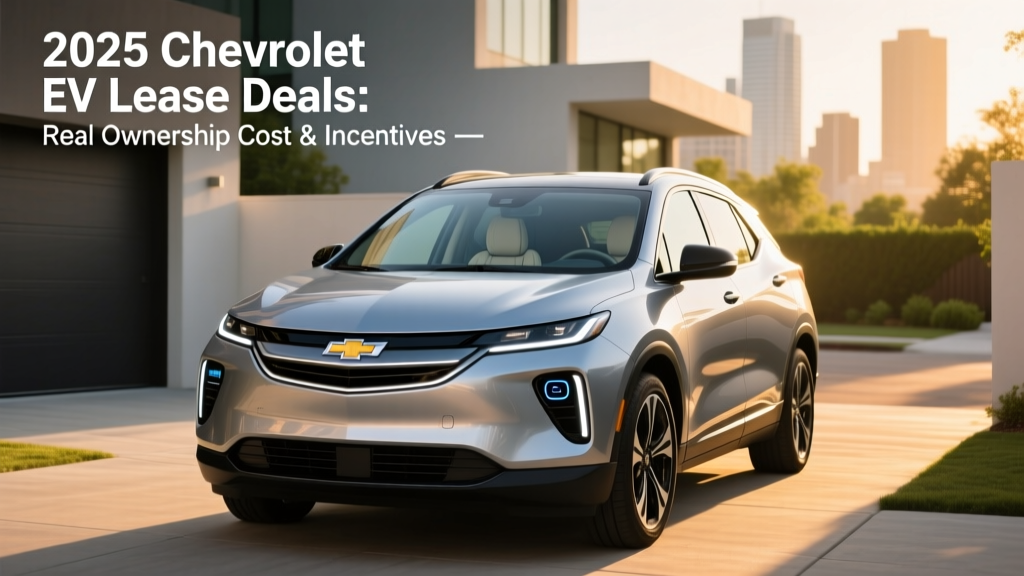
If you've been watching 2025 Chevrolet Equinox EV lease deals circulate online — some advertised under $300/month — you're likely wondering: is this genuinely the most affordable path into a long-range electric SUV, or are the real costs hiding in the fine print? We've run the numbers on purchase price, federal and state incentives, home charging, insurance premiums, maintenance, and depreciation to give you a clear-eyed ownership forecast.
The Equinox EV is Chevy's play for mainstream EV adoption: an 85 kWh usable battery (NMC chemistry), up to 319 miles of EPA-estimated range on the FWD 3LT trim, and a starting MSRP that undercuts most rivals. But a cheap lease payment is only one line item. Here's the full financial picture.
Equinox EV Quick Specs: What You're Leasing
| Spec | 2025 Equinox EV 2LT FWD | 2025 Equinox EV 3LT FWD | 2025 Equinox EV RS AWD |
|---|---|---|---|
| EPA Range | 315 mi | 319 mi | 285 mi |
| Battery (usable) | 85 kWh, NMC | 85 kWh, NMC | 85 kWh, NMC |
| Motor Output | 213 hp / 236 lb-ft | 213 hp / 236 lb-ft | 288 hp / 355 lb-ft |
| 0–60 mph | ~8.0 sec | ~8.0 sec | ~5.7 sec |
| Peak DC Charge Rate | 150 kW | 150 kW | 150 kW |
| 10–80% DC Fast Charge | ~30 min | ~30 min | ~30 min |
| Level 2 (240V) Rate | 11.5 kW | 11.5 kW | 11.5 kW |
| EPA Efficiency | ~96 MPGe | ~96 MPGe | ~90 MPGe |
| Base MSRP (incl. dest.) | $34,995 | $39,595 | $44,895 |
| Battery/Powertrain Warranty | 8 yr / 100,000 mi | 8 yr / 100,000 mi | 8 yr / 100,000 mi |
Breaking Down 2025 Chevrolet Equinox EV Lease Deals
Advertised Equinox EV lease offers have ranged from roughly $249 to $399 per month depending on trim, down payment, term length, and regional dealer incentives. A typical structured deal on the 2LT FWD might look like $299/month for 36 months with $3,500 due at signing. But the critical variable is how the federal tax credit interacts with your lease.
Under IRS rules, a leased EV technically qualifies for the commercial clean vehicle credit (§45W), which the leasing company claims — and may or may not pass through to you as a capitalized-cost reduction. Some automakers pass the full $7,500 through; others absorb part of it. Always confirm with the dealer whether the advertised lease payment already reflects the credit being applied as a cap-cost reduction. If it doesn't, your effective cost is higher than the headline number.
5-Year Total Cost of Ownership: Equinox EV vs. Gas Crossover
To put the lease in context, here's what five years of ownership actually costs. We're comparing the Equinox EV 3LT FWD against a similarly equipped gas compact SUV (28 MPG combined) at 12,000 miles/year.
| Cost Category | Equinox EV 3LT FWD | Gas Compact SUV (28 MPG) |
|---|---|---|
| Purchase/Lease (5-yr effective)* | $22,800 | $21,500 |
| Fuel/Energy (60,000 mi) | $3,450 | $7,500 |
| Maintenance (5 years) | $1,100 | $3,200 |
| Insurance (5 years) | $9,750 | $7,500 |
| Depreciation (estimated) | $14,500 | $10,800 |
| Total 5-Year Cost | $51,600 | $50,500 |
*Purchase/lease effective cost reflects lease payments over 36 months plus buyout or a new lease for years 4–5, minus any applied tax credits. Actual figures vary by deal structure.
The EV's fuel and maintenance savings are substantial — roughly $6,150 over five years — but they're partially offset by higher insurance premiums and steeper depreciation. The gap narrows further if you charge primarily on expensive public DC fast chargers rather than at home.
Federal Tax Credit: Do You Qualify for the Full $7,500?
The IRS §30D Clean Vehicle Credit offers up to $7,500 for qualifying new EVs. The Equinox EV is assembled in Mexico (at GM's Ramos Arizpe plant), which initially complicated eligibility under the North American final-assembly requirement. However, certain Equinox EV trims have qualified depending on model year and battery-sourcing compliance. Always verify current eligibility on fueleconomy.gov before signing.
- MSRP Cap: SUVs must have an MSRP at or below $80,000 — the Equinox EV clears this easily (top trim ~$45K).
- Buyer Income Cap: Modified AGI must not exceed $150,000 (single), $225,000 (head of household), or $300,000 (joint). You can use the prior-year or current-year income, whichever is lower.
- Battery Components: A percentage of battery components must be manufactured or assembled in North America (threshold increases annually).
- Critical Minerals: A percentage of critical minerals must be sourced from the U.S. or a free-trade-agreement country (threshold increases annually).
- Point-of-Sale Transfer: You may transfer the credit to the dealer at purchase, reducing your out-of-pocket cost immediately — but you must still meet income requirements at tax filing time or repay the credit.
- Lease Loophole (§45W): Leased vehicles bypass §30D sourcing and assembly rules under the commercial credit, but the lessor claims the credit, not you.
The bottom line: if you're purchasing, confirm the specific VIN qualifies on fueleconomy.gov and that your income is within limits. If you're leasing, the credit pathway is simpler, but confirm the dealer is passing savings to you in the lease terms.
Charging vs. Gas: The Real $/Mile Math
| Scenario | Cost per kWh or Gallon | Cost per Mile |
|---|---|---|
| Home Level 2 (national avg. electricity) | $0.16/kWh | $0.046 |
| Home Level 2 (California, higher rate) | $0.30/kWh | $0.086 |
| Public DC Fast Charging (avg. ~$0.48/kWh) | $0.48/kWh | $0.138 |
| Gas SUV (28 MPG, $3.50/gal) | $3.50/gal | $0.125 |
| Gas SUV (28 MPG, $4.20/gal — CA premium) | $4.20/gal | $0.150 |
The Equinox EV consumes roughly 2.9 kWh per mile (34 kWh/100 mi). At the national average residential rate of ~$0.16/kWh, home charging costs about 4.6 cents per mile — roughly one-third the cost of gas. But if you rely exclusively on public DC fast charging at ~$0.48/kWh, your per-mile cost actually exceeds that of a 28 MPG gas SUV at $3.50/gallon.
This is the single biggest variable in EV ownership economics: home charging access is what makes the math work. If you can install a Level 2 charger at home and charge overnight at residential rates, you'll save $3,000–$4,000 on fuel over five years compared to a gas crossover. If you're dependent on public chargers, that advantage largely disappears.
Maintenance Savings: Where the EV Wins Decisively
| Maintenance Item | Equinox EV (5 yr) | Gas SUV (5 yr) |
|---|---|---|
| Oil Changes | $0 | $600–$900 |
| Transmission Fluid | $0 | $150–$300 |
| Brake Pads/Rotors | $0–$200 (regen extends life) | $600–$1,200 |
| Engine Air Filter | $0 | $150–$250 |
| Cabin Air Filter | $150–$250 | $150–$250 |
| Coolant Flush | $0–$100 (longer intervals) | $200–$400 |
| Tire Rotation/Replacement | $800–$1,200 (heavier vehicle, more tire wear) | $600–$900 |
| Total Estimated | $950–$1,750 | $2,450–$4,200 |
The EV eliminates oil changes, spark plugs, timing belts, and most exhaust-system repairs. Regenerative braking significantly reduces brake pad wear — many EV owners report original pads lasting 80,000+ miles. The one offset: EVs are heavier, which can accelerate tire wear. Budget for one extra tire replacement over the vehicle's life compared to a lighter gas SUV.
Insurance Cost Reality: The Expense Most Buyers Overlook
EV insurance premiums run 15–30% higher than equivalent gas vehicles, and the Equinox EV is no exception. For a 35-year-old driver with a clean record, expect annual premiums in the $1,800–$2,200 range depending on state, coverage level, and insurer — versus $1,400–$1,700 for a comparably priced gas compact SUV.
Why the premium? Three factors: (1) EV repair costs are higher because battery-pack damage often requires full replacement rather than repair, (2) specialized training and equipment are needed for high-voltage system work, and (3) collision repair shops charge more for EV-certified technicians. As the EV fleet matures and more shops gain certification, premiums should moderate — but for now, budget an extra $300–$500/year.
Shop quotes from insurers with dedicated EV programs (some offer discounts for home-charger installation or low-mileage driving patterns). Bundling with homeowner's or renter's insurance can also close the gap.
Depreciation and Resale Value: The Honest Outlook
EV depreciation has been steeper than gas vehicles over the past few years, driven by rapid price cuts on new models (notably Tesla's aggressive repricing), improving battery technology that makes older models feel dated, and consumer uncertainty about long-term battery health. The Equinox EV, as a relatively new nameplate, doesn't yet have a multi-year resale track record.
Based on current trends for mainstream EV SUVs, expect the Equinox EV to retain roughly 45–55% of its MSRP after five years and 60,000 miles — compared to 55–65% for a well-regarded gas compact SUV. On a $39,595 3LT, that translates to roughly $17,800–$21,800 in retained value, or $17,800–$21,800 in depreciation.
Two factors may help the Equinox EV hold value better than some rivals: its relatively affordable starting price (less room to fall from aggressive new-model price cuts) and GM's 8-year/100,000-mile battery warranty, which provides a floor of confidence for used buyers. If you're leasing, depreciation is the lessor's problem — your risk is limited to excess mileage and wear charges.
State, Local, and Utility Incentives
Beyond the federal credit, state and utility incentives can shift the economics significantly. Examples (subject to change and availability):
- California: Up to $7,000 via the Clean Fuel Rebate and local utility programs for income-qualified buyers; plus access to HOV lane stickers.
- Colorado: State tax credit of up to $5,000 for new EVs (income-capped).
- New York: Drive Clean Rebate of up to $2,000 at point of sale.
- Utility Rebates: Many utilities offer $500–$1,500 for home Level 2 charger installation, and some offer reduced EV-specific electricity rates for off-peak charging.
The Verdict: When Does the Equinox EV Lease Make Financial Sense?
- You can charge at home (garage, driveway, or workplace Level 2)
- Your commute is under 80 miles round-trip (you'll rarely need DC fast charging)
- You qualify for the federal credit (purchase) or the lessor passes through savings (lease)
- Your state or utility offers additional rebates
- You drive 12,000 miles or fewer annually (staying within lease limits)
- You live in an apartment without charging access and public chargers are scarce or expensive
- You regularly drive 200+ miles per day (DC fast-charging costs add up fast)
- You plan to keep the vehicle 8–10+ years and want predictable long-term costs
- Your insurance quotes come in more than 35% higher than your current gas vehicle
The most attractive 2025 Chevrolet Equinox EV lease deals — sub-$300/month with modest money down — represent a genuinely low-risk entry into electric driving, provided you have home charging access. The fuel and maintenance savings are real and measurable, but they only materialize if you're charging at residential electricity rates. Run your own numbers with your local kWh rate and insurance quote before signing.
Frequently Asked Questions
How much does it really cost to own an Equinox EV over 5 years?
Our analysis puts the 5-year total cost at approximately $51,600 for the 3LT FWD, including lease/purchase effective cost, electricity, maintenance, insurance, and depreciation. That's roughly $1,100 more than a comparable gas SUV over the same period — but the gap closes significantly with state incentives, cheaper electricity rates, or if gas prices rise above $4/gallon in your area.
Do I qualify for the $7,500 federal tax credit on the Equinox EV?
Eligibility depends on your income (AGI caps of $150K single / $300K joint), the vehicle's MSRP (must be under $80K for SUVs — the Equinox EV qualifies), and battery-sourcing/final-assembly rules that change annually. Check the specific VIN on fueleconomy.gov. If leasing, the commercial credit (§45W) may apply with fewer sourcing restrictions, but the lessor claims the credit.
How much will I save on fuel and maintenance vs. a gas SUV?
With home charging at the national average rate of $0.16/kWh, you'll spend about $3,450 on electricity over 60,000 miles versus $7,500 on gas — a $4,050 savings. Maintenance savings add another $1,500–$2,500 over five years thanks to eliminated oil changes, fewer fluid services, and extended brake life from regenerative braking. Combined savings: roughly $5,500–$6,500 over five years.
Are EVs more expensive to insure than gas cars?
Yes, typically 15–30% more. For the Equinox EV, expect annual premiums of $1,800–$2,200 versus $1,400–$1,700 for a similar gas SUV. Higher repair costs for battery-related damage and the need for EV-certified technicians drive the premium. Shop multiple insurers and ask about EV-specific discounts.
How well does the Equinox EV hold its value?
Mainstream EVs currently depreciate faster than gas vehicles, retaining an estimated 45–55% of MSRP after five years. The Equinox EV's affordable price point and GM's 8-year/100,000-mile battery warranty may help it hold value better than premium EVs. If you're leasing, depreciation risk falls on the lessor — your exposure is limited to mileage overages and excess wear.
What's the real-world range I should expect?
The EPA rates the FWD 3LT at 319 miles, but expect 260–285 miles on sustained highway driving and 220–250 miles in sub-freezing temperatures. AWD models are rated at 285 miles EPA; plan for 230–250 miles in real-world mixed use. Battery preconditioning (available via the infotainment system when a DC charger is set as your navigation destination) helps recover range and improve charging speed in cold weather.