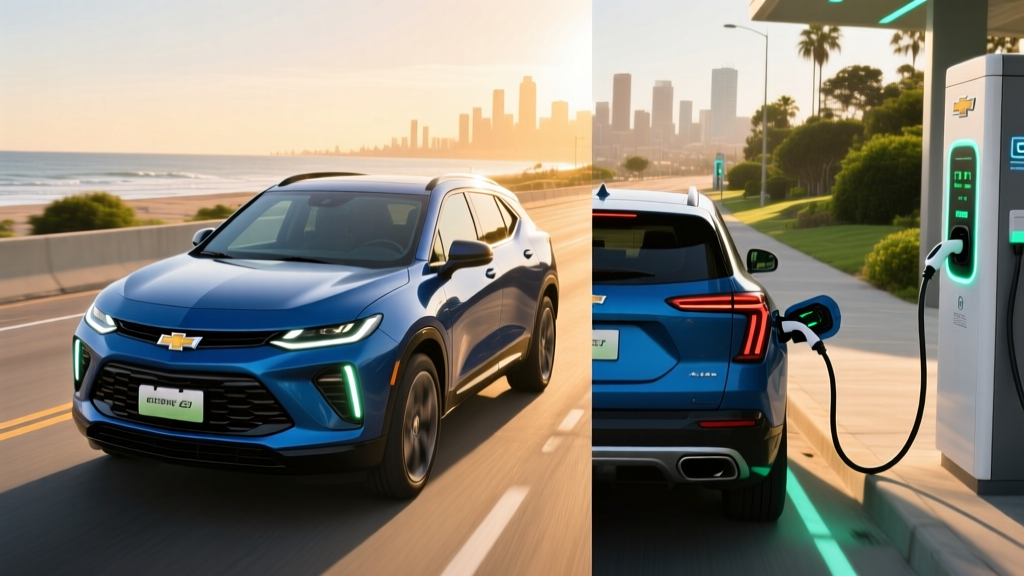
The 2025 Chevrolet Blazer EV SS is the performance flagship of GM's midsize electric SUV lineup — a dual-motor, all-wheel-drive machine that pairs 557 horsepower with a usable battery large enough for genuine road-trip duty. After spending time with the Blazer EV SS on highway loops, suburban commutes, and at DC fast chargers, it's clear Chevrolet has built something that appeals to drivers who want muscle-car acceleration in a practical crossover package. But with a starting price above $60,000 and real-world range that falls short of its EPA sticker under certain conditions, buyers need the full picture before signing.
This review breaks down every number that matters: real range, charging curves, efficiency, interior space, tax-credit eligibility, and how the SS stacks up against the Ford Mustang Mach-E GT, Hyundai Ioniq 5 N, and Tesla Model Y Performance.
2025 Chevrolet Blazer EV SS at a Glance
| Spec | 2025 Blazer EV SS |
|---|---|
| Base MSRP | $61,900 (incl. destination) |
| EPA Range | 303 miles |
| Battery (usable) | 102 kWh, NMC lithium-ion |
| Drivetrain | Dual-motor AWD |
| Horsepower / Torque | 557 hp / 648 lb-ft |
| 0–60 mph | 4.6 seconds (est.) |
| Max DC Fast Charge | 190 kW (peak) |
| 10–80% DC Charge Time | ~29 minutes |
| Level 2 Home Charging | 11.5 kW (~34 mi/hr) |
| EPA Efficiency | 89 MPGe combined (38 kWh/100 mi) |
| Cargo (behind rear seats) | 25.5 cu ft |
| Cargo (rear seats folded) | 55.1 cu ft |
| Battery Warranty | 8 years / 100,000 miles |
| Bumper-to-Bumper | 3 years / 36,000 miles |
Range and Efficiency: EPA vs. the Real World
The EPA rates the 2025 Blazer EV SS at 303 miles of combined range. That figure comes from the 102 kWh usable portion of its Ultium-platform NMC (nickel-manganese-cobalt) battery pack. For context, the non-SS Blazer EV 2LT with the same battery achieves up to 324 miles EPA thanks to lower weight and less aggressive tuning.
EPA sticker: 303 miles combined.
Expect on a 70-mph highway trip in mild weather: ~260–280 miles.
Cold-weather highway driving (below 32°F): ~210–240 miles.
City/regenerative-heavy driving: close to or slightly above 303 miles.
The Blazer EV SS's larger frontal area, performance tires, and dual-motor drivetrain impose a highway efficiency penalty. On a flat, 65-mph cruise you'll see roughly 3.2–3.4 mi/kWh; push to 75+ mph or climb grades and that drops to 2.8–3.0 mi/kWh. In sub-freezing temperatures, expect a 20–30% reduction from the EPA figure due to cabin heating demands and increased battery internal resistance — even with the standard heat pump.
At 38 kWh per 100 miles combined (89 MPGe), the SS isn't the most efficient midsize EV on the market. The Hyundai Ioniq 5 AWD returns 98 MPGe, and the Tesla Model Y Long Range achieves 122 MPGe. The trade-off here is raw power — 557 hp doesn't come free in the efficiency ledger.
According to fueleconomy.gov, the Blazer EV SS's combined efficiency places it in the middle of the performance-SUV pack. If efficiency is your top priority, the SS trim is not the right call — the 2LT with RWD is meaningfully thriftier.
Charging Speed: DC Fast, Level 2, and the Charge Curve
The Blazer EV SS uses GM's Ultium battery architecture with a peak DC fast-charge rate of 190 kW. On a 350 kW CCS-capable charger (Electrify America, EVgo, or any station delivering sufficient power), you can expect a 10–80% session in approximately 29 minutes.
| Charging Level | Power | Speed / Time |
|---|---|---|
| Level 1 (120V household) | ~1.4 kW | ~4 mi/hr — ~75 hrs for full charge |
| Level 2 (240V home/public) | 11.5 kW (max onboard) | ~34 mi/hr — ~9 hrs (10–100%) |
| DC Fast Charge (CCS) | 190 kW peak | 10–80% in ~29 min |
Understanding the charge curve: The 190 kW peak is only sustained at low states of charge — roughly 10–25% SoC. As the battery fills, the rate tapers: expect ~150 kW around 40%, ~100 kW by 60%, and a significant drop above 80%. This is normal for NMC chemistry at this capacity. Charging from 80–100% on DC fast charge can take as long as the 10–80% portion. For daily use, set your charge limit to 80% to preserve battery health and avoid the slow taper zone.
For home charging, the Blazer EV SS's 11.5 kW onboard charger is competitive. On a 48-amp Level 2 circuit (hardwired, 60-amp breaker), you'll add roughly 34 miles of range per hour, meaning an overnight session easily replenishes a day's driving. A full 10–100% charge takes about 9 hours. Installation of a Level 2 home charger typically costs $800–$2,000 including equipment and electrician labor, depending on whether your electrical panel needs an upgrade. (Always consult a licensed electrician for final specs.)
Note: GM has committed to NACS (Tesla-style) connectors for future models, but the 2025 Blazer EV ships with a CCS1 port. GM provides a NACS adapter for Supercharger access, expanding your public charging network significantly.
Performance: 557 Horsepower, Dual-Motor AWD
The SS badge means business. The dual-motor AWD powertrain produces 557 horsepower and 648 lb-ft of torque, delivering a 0–60 mph time in the 4.6-second range. That puts it in the same territory as the Ford Mustang Mach-E GT (3.8 seconds for the Performance Edition) and comfortably ahead of most gas-powered midsize SUVs.
Instant electric torque means the Blazer EV SS pulls hard from a stoplight with no turbo lag or transmission hesitation. The all-wheel-drive system can vector torque front-to-rear, and the SS includes a Watts Link rear suspension for improved cornering stability over the standard Blazer EV trims.
Drive modes include Tour, Sport, and a customizable My Mode. Regen braking is adjustable via steering-wheel paddles, and one-pedal driving is available for stop-and-go commuting. The ride is firm but compliant — Chevrolet tuned the SS for a sportier feel without making it punishing on rough pavement.
One practical note: aggressive driving will crater your range. Sustained high-speed acceleration and frequent hard stops can cut effective range by 30% or more compared to the EPA figure. The SS is a performance vehicle — enjoy it, but plan charging accordingly on road trips.
Interior, Tech, and Cargo Space
The Blazer EV SS features a 17.7-inch diagonal infotainment touchscreen — one of the largest in the segment — running GM's latest Ultifi software platform with Google Built-In (Google Maps, Google Assistant, and Play Store apps natively integrated). Wireless Apple CarPlay and Android Auto are standard, along with a 11-inch driver information cluster.
Interior materials are a mixed bag. The SS includes heated and ventilated front seats, a heated steering wheel, and suede microfiber accents. However, some lower dashboard and door-panel plastics feel hard and budget-grade for a vehicle pushing past $60,000. The Camaro-inspired vents and ambient lighting add visual drama, but the cabin doesn't quite match the premium feel of a Genesis Electrified GV70 or a fully loaded Tesla Model Y.
Passenger and cargo dimensions:
- Front legroom: 43.1 inches
- Rear legroom: 38.0 inches
- Front headroom: 40.1 inches
- Rear headroom: 38.8 inches
- Cargo behind rear seats: 25.5 cu ft
- Cargo with rear seats folded: 55.1 cu ft
- Frunk: Not available (the Ultium platform in this configuration does not include a front trunk)
The lack of a frunk is a missed opportunity for an EV at this price point — competitors like the Ford F-150 Lightning and Rivian R1S offer meaningful front storage. The 25.5 cu ft behind the rear seats is adequate for weekly groceries and a couple of suitcases but trails the Tesla Model Y's 30.2 cu ft rear cargo area.
Driver assistance: The Blazer EV SS comes with Chevy's Super Cruise hands-free driving system available on over 400,000 miles of mapped roads in North America. This is an SAE Level 2 system — despite being "hands-free," the driver must remain attentive, and an infrared camera monitors your eyes. Super Cruise excels on long highway stretches but does not handle city streets, construction zones, or unmapped routes. It is not autonomous driving.
Pricing, Trims, and Federal Tax Credit Eligibility
The 2025 Chevrolet Blazer EV SS carries a base MSRP of $61,900 (including destination). This positions it as the most expensive Blazer EV trim, sitting well above the 2LT (starting around $50,200) and the RS (starting around $54,200).
| Trim | Base MSRP | Drivetrain | Key Differentiator |
|---|---|---|---|
| 2LT (RWD) | ~$50,200 | Rear-wheel drive | Best efficiency, 324-mi range |
| 2LT (AWD) | ~$53,200 | Dual-motor AWD | All-weather capability |
| RS (AWD) | ~$54,200 | Dual-motor AWD | Sport appearance, 21" wheels |
| SS (AWD) | $61,900 | Dual-motor AWD | 557 hp, Watts Link suspension, Super Cruise avail. |
Federal tax credit (§30D) eligibility: The 2025 Blazer EV SS qualifies for up to $7,500 in federal tax credits, but eligibility depends on several factors under current IRS rules. Here's what you need to verify:
- MSRP cap: The Blazer EV is classified as an SUV, so the MSRP cap is $80,000. The SS at $61,900 clears this easily.
- Buyer income limits: Modified adjusted gross income (MAGI) must not exceed $150,000 (single), $225,000 (head of household), or $300,000 (married filing jointly).
- Battery sourcing: A percentage of critical minerals and battery components must meet North American sourcing or free-trade-agreement requirements. GM has worked to qualify the Ultium pack, but sourcing rules tighten annually. Confirm current-year eligibility on IRS.gov or via your tax professional.
- Point-of-sale transfer: As of 2024, buyers can transfer the credit to the dealer at purchase, reducing the upfront cost by up to $7,500 rather than waiting to claim it on a tax return.
If you qualify for the full $7,500 credit, the effective starting price of the Blazer EV SS drops to approximately $54,400. Add state-level incentives where available (check AFDC's state incentive database for current programs), and the value proposition improves further.
How It Compares: Blazer EV SS vs. Key Rivals
| Spec | Blazer EV SS | Mustang Mach-E GT | Ioniq 5 N | Model Y Perf. (LR) |
|---|---|---|---|---|
| Base MSRP | $61,900 | $59,995 | $66,100 | $52,490 |
| EPA Range | 303 mi | 280 mi | 221 mi | 277 mi |
| Horsepower | 557 hp | 480 hp | 641 hp | 510 hp |
| 0–60 mph | ~4.6 sec | ~3.8 sec | ~3.4 sec | ~3.5 sec |
| Max DC Charge | 190 kW | 150 kW | 238 kW | 250 kW |
| 10–80% DC Time | ~29 min | ~38 min | ~18 min | ~25 min |
| Cargo (rear) | 25.5 cu ft | 29.7 cu ft | 27.2 cu ft | 30.2 cu ft |
Key takeaways from the comparison:
- Range advantage: The Blazer EV SS leads the group at 303 miles EPA, beating the Mach-E GT by 23 miles and the Ioniq 5 N by a massive 82 miles.
- Performance deficit: Despite having the highest horsepower, the SS is the slowest to 60 mph in this group. The Mach-E GT, Ioniq 5 N, and Model Y Performance all hit 60 in under 4 seconds.
- Charging speed: At 190 kW peak, the SS charges faster than the Mach-E GT but trails the Ioniq 5 N and Model Y. On long road trips, this means 5–10 extra minutes per stop versus the quickest competitors.
- Cargo: The Blazer EV SS has the smallest rear cargo area in this comparison. If you regularly haul gear, the Model Y or Mach-E offers meaningfully more space.
Pros and Cons
- 303-mile EPA range — best in its performance-SUV class
- 557 hp and 648 lb-ft deliver strong real-world acceleration
- 17.7-inch infotainment screen with Google Built-In
- Super Cruise hands-free highway driving available
- Qualifies for up to $7,500 federal tax credit (verify eligibility)
- Heat pump standard for better cold-weather efficiency
- Competitive 190 kW DC fast-charging
- 0–60 time trails Mach-E GT, Ioniq 5 N, and Model Y Performance
- Smallest cargo area among direct competitors (25.5 cu ft)
- No front trunk (frunk)
- Interior plastics don't match the $62K price tag
- Efficiency (89 MPGe) is below segment average
- Early 2024 Blazer EV recalls for software issues may concern used buyers
- CCS port with adapter needed for Supercharger access
Who Should Buy the 2025 Blazer EV SS?
The Blazer EV SS makes the most sense for a specific buyer profile:
- The performance-oriented commuter who wants serious acceleration for merging and passing but also needs 300+ miles of range for daily driving without constant charging.
- The GM-loyal household transitioning from a gas Blazer, Tahoe, or Silverado that wants to stay in the Chevrolet ecosystem with Super Cruise and familiar dealer service.
- The road-tripper who values range over outright 0–60 times — the SS's 303-mile EPA rating means fewer charging stops than an Ioniq 5 N or Mach-E GT on a 500-mile drive.
The SS is not the right pick if you prioritize maximum cargo space (get a Model Y), the quickest acceleration (get an Ioniq 5 N or Mach-E GT Performance Edition), or the lowest price (the Blazer EV 2LT offers 324 miles of range for $12,000 less). It's also not ideal if you frequently drive in extreme cold without access to home charging — the NMC battery and large cabin mean meaningful range loss in winter conditions.
Frequently Asked Questions
What is the real-world range of the 2025 Blazer EV SS?
The EPA rates it at 303 miles combined. In real-world highway driving at 70 mph in moderate temperatures, expect 260–280 miles. In cold weather (below freezing), plan for 210–240 miles. City driving with regenerative braking can match or slightly exceed the EPA figure.
How fast does the Blazer EV SS charge?
On a DC fast charger capable of delivering 190 kW or more, a 10–80% session takes approximately 29 minutes. At home on a 240V Level 2 charger (11.5 kW), the SS adds about 34 miles of range per hour, with a full charge taking roughly 9 hours. The charge rate tapers significantly above 80% SoC — plan to charge to 80% for the best time-to-range ratio.
How much does the Blazer EV SS cost after tax credits?
The base MSRP is $61,900. If you qualify for the full $7,500 federal §30D tax credit (subject to income limits, MSRP caps, and battery-sourcing requirements), the effective price drops to approximately $54,400. State incentives may reduce the cost further. Use the IRS clean vehicle credit tool and consult a tax professional to confirm your eligibility.
Does the 2025 Blazer EV SS qualify for the federal EV tax credit?
It is eligible for up to $7,500 under IRS §30D, provided you meet income limits ($150K single / $300K joint), the vehicle MSRP is under $80,000 (SUV classification — it qualifies), and the battery meets current-year critical-mineral and component sourcing thresholds. Rules tighten annually; always verify on IRS.gov before purchasing.
Is the Blazer EV SS worth buying over the Mustang Mach-E GT or Tesla Model Y?
It depends on your priorities. Choose the Blazer EV SS if you want the longest range in the performance-SUV segment, GM's Super Cruise system, and a bold design. Choose the Mach-E GT if 0–60 time matters most. Choose the Model Y Performance for the best combination of price, efficiency, cargo space, and Supercharger network access. There is no single "best" — each wins in different categories.
What is the battery warranty on the Blazer EV SS?
Chevrolet covers the Ultium battery pack for 8 years or 100,000 miles, whichever comes first. The warranty guarantees the battery will retain a minimum level of capacity (typically 70% or above, per GM's terms). The powertrain is also covered for 8 years/100,000 miles. Bumper-to-bumper coverage is 3 years/36,000 miles.