The Short Answer: Is There a 2025 Challenger Electric?
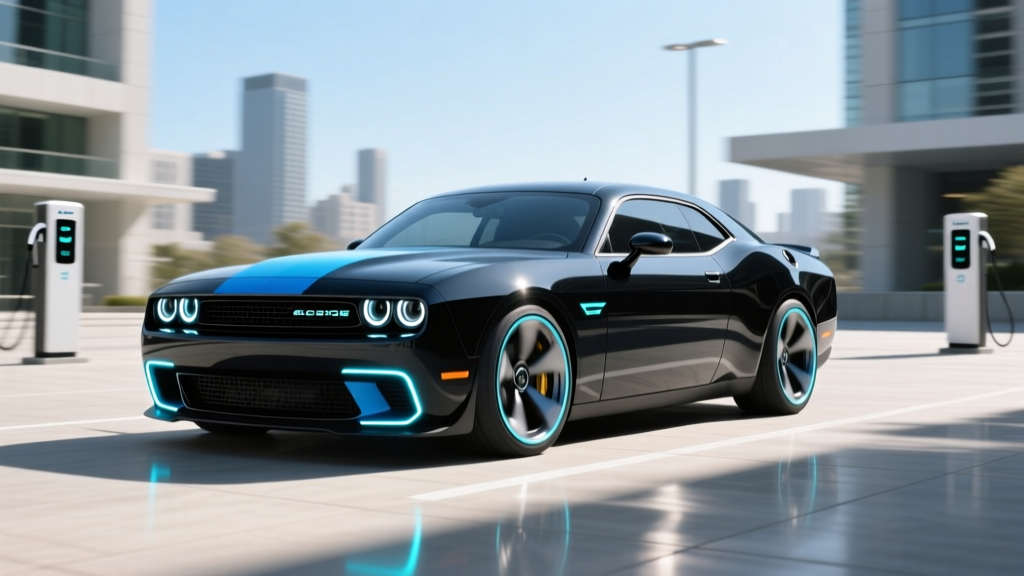
Dodge discontinued the Challenger after the 2023 model year. The brand's electric muscle car successor is the 2025 Dodge Charger Daytona EV, built on Stellantis's STLA Large platform. The all-electric Charger Daytona Scat Pack starts at $61,590 (including destination) and delivers an EPA-estimated 317 miles of range, 670 horsepower, and a 3.3-second 0-60 mph time. A more affordable R/T trim starts at $51,590 with up to 317 miles of range and 496 hp. If you were searching for a "2025 Challenger electric," this is the car Dodge built to fill that slot — and it's already reaching dealers as of early 2025.
Range, Battery, and Efficiency: The Real Numbers
The 2025 Charger Daytona EV uses a 100.5 kWh gross battery pack (approximately 93 kWh usable) with NMC (nickel-manganese-cobalt) chemistry. Stellantis has not published an official LFP variant for this platform.
| Spec | R/T | Scat Pack |
|---|---|---|
| EPA Range | 317 mi | 260 mi |
| Battery (gross / usable) | 100.5 kWh / ~93 kWh | 100.5 kWh / ~93 kWh |
| Horsepower | 496 hp | 670 hp |
| 0-60 mph | 4.7 sec | 3.3 sec |
| Top Speed | 137 mph | 137 mph |
| Peak DC Fast Charge | ~175 kW | ~175 kW |
| 10-80% DC Charge Time | ~27 min | ~27 min |
| Level 2 Charge Rate | 11 kW | 11 kW |
| Drivetrain | AWD (dual motor) | AWD (dual motor) |
| Base MSRP (incl. dest.) | $51,590 | $61,590 |
| Battery Warranty | 8 yr / 100,000 mi | 8 yr / 100,000 mi |
Real-World Range vs. EPA Sticker
EPA: 317 mi (R/T) / 260 mi (Scat Pack)
Expect approximately 250-270 highway miles in the R/T at 70-75 mph in moderate temperatures. In cold weather (below 30°F), plan for a 20-30% reduction, dropping the R/T to roughly 220-250 miles and the Scat Pack to 180-210 miles. The Scat Pack's wider 275-section rear tires and performance tuning reduce efficiency noticeably — this is the trade-off for that 3.3-second sprint.
Charging Speed and Infrastructure
The Charger Daytona's peak DC fast-charging rate of approximately 175 kW is adequate but not class-leading. Competitors like the Hyundai Ioniq 5 (peak 240 kW on 800V architecture) and Tesla Model S (peak 250 kW) charge faster. The Charger's 400V architecture means the charge curve tapers meaningfully above 80% state of charge — a typical session from 10-80% takes about 27 minutes at a capable 180+ kW station.
| Level | Power | Miles Added per Hour | Full Charge Time |
|---|---|---|---|
| Level 1 (120V) | ~1.4 kW | ~4-5 mi/hr | ~65+ hours |
| Level 2 (240V, 48A) | 11.5 kW | ~32-36 mi/hr | ~8-9 hours |
| DC Fast Charge | ~175 kW peak | ~500+ mi/hr (peak) | 10-80% in ~27 min |
The Charger Daytona uses the CCS1 connector for DC fast charging and the J1772 connector for Level 2 AC charging. Stellantis has not announced a NACS (Tesla-style) adapter timeline for this model as of early 2025, though the broader industry is shifting toward NACS. Owners can use a CCS-to-NACS adapter at Tesla Superchargers once Stellantis enables access — check the Stellantis press site for updates.
Home charging reality: A Level 2 home charger (like a ChargePoint Home Flex or Emporia Vue) is nearly essential for this car. Charging 93 usable kWh on a standard 120V outlet takes multiple days. Budget $800-$2,500 for a Level 2 home installation depending on your electrical panel's capacity. A 200-amp panel is generally sufficient; older homes with 100-amp service may need a $1,500-$3,000 panel upgrade before an electrician will sign off on a 48-amp circuit.
How the Charger Daytona EV Compares to Gas and Hybrid Muscle Cars
The last V8 Dodge Challenger (2023 R/T Scat Pack, 485 hp, 6.4L HEMI) achieved an EPA 15 city / 24 highway / 18 combined MPG. Here's how the math works out against the electric successor, based on 12,000 miles driven annually.
| Metric | 2023 Challenger R/T Scat Pack (Gas) | 2025 Charger Daytona Scat Pack (EV) |
|---|---|---|
| EPA Efficiency | 18 MPG combined | ~2.9 kWh/mi (~115 MPGe) |
| Energy Cost per Unit | $3.40/gal (2025 avg) | $0.16/kWh (home avg) / $0.40/kWh (DCFC avg) |
| Annual Energy Cost (12k mi) | $2,267 | $557 (home) / $1,392 (DCFC) |
| Annual Maintenance | $600-$900 | $150-$300 |
| Annual Total (fuel + maint.) | $2,867-$3,167 | $707-$1,692 |
The takeaway: If you charge primarily at home, the Charger Daytona EV saves roughly $2,000-$2,500 per year in fuel and maintenance versus the old V8 Challenger. Over five years, that's $10,000-$12,500 in savings — enough to offset a meaningful chunk of the higher purchase price. However, if you rely exclusively on DC fast charging at public stations, the savings shrink to approximately $1,200-$1,800 annually. Your charging access fundamentally changes the economics.
Federal Tax Credit and Total Cost of Ownership
Under current IRS §30D rules, the 2025 Charger Daytona's eligibility for the up-to-$7,500 federal tax credit depends on several factors:
- MSRP Cap: The vehicle must have an MSRP at or below $55,000 for sedans. The Charger Daytona R/T ($51,590 base) may qualify; the Scat Pack ($61,590) likely exceeds the cap unless reclassified as an SUV/truck by the IRS (unlikely for a sedan).
- Buyer Income Limits: Adjusted gross income must not exceed $150,000 (single), $225,000 (head of household), or $300,000 (joint filers).
- Battery Sourcing: Critical minerals and battery components must meet phased-in domestic-content thresholds. Stellantis has been working to localize supply chains, but the exact credit amount ($3,750 or $7,500) varies by build date and component sourcing.
- Point-of-Sale Transfer: Eligible buyers can transfer the credit to the dealer at purchase, reducing the out-of-pocket cost immediately rather than waiting for a tax refund.
Important: Tax credit rules are subject to change. Consult a tax professional and verify current eligibility on irs.gov before purchasing.
| Category | Estimated Cost |
|---|---|
| Purchase Price (base MSRP) | $51,590 |
| Federal Tax Credit (if eligible) | -$3,750 to -$7,500 |
| Home Level 2 Charger Install | $1,200-$2,000 |
| 5-Year Electricity (home charging) | $2,785 |
| 5-Year Maintenance | $750-$1,500 |
| 5-Year Insurance (est.) | $9,000-$12,000 |
| Estimated Depreciation (5 yr) | $18,000-$24,000 |
| 5-Year Net Cost (approx.) | $70,000-$85,000 |
EV insurance premiums run 15-25% higher than comparable gas vehicles due to repair-cost data and battery replacement risk. Get quotes from multiple carriers before committing. Depreciation for the Charger Daytona EV is uncertain — early EV muscle cars have no long-term resale track record, and Stellantis's decision to kill the V8 may either boost collector interest in the last gas models or accelerate acceptance of the electric replacement.
Common Misconceptions About the Electric Muscle Car
| Myth | Fact |
|---|---|
| "Electric muscle cars have no soul / no fun." | The Scat Pack does 0-60 in 3.3 seconds with instant torque. Dodge includes a "Fratzonic" exhaust sound system to simulate engine notes. Whether that's "soul" is subjective — the acceleration is objectively brutal. |
| "The battery will need replacing in 5 years." | Modern NMC batteries degrade approximately 10-15% over 8 years under normal use. Stellantis warranties the pack for 8 years / 100,000 miles with a capacity retention threshold (typically 70%). Full battery replacement, if needed out of warranty, currently runs $15,000-$25,000 — but is rarely necessary. |
| "I can charge it on a regular outlet overnight." | A 120V Level 1 outlet adds roughly 4-5 miles per hour. Charging the full ~93 kWh usable battery from empty takes 65+ hours. Level 1 is viable only for plug-in hybrids with small batteries or as emergency trickle charging — not for a 100 kWh BEV you drive daily. |
| "It qualifies for the full $7,500 tax credit." | Credit eligibility depends on MSRP cap, buyer income, and battery sourcing rules. The Scat Pack's $61,590 MSRP likely disqualifies it. The R/T may qualify for $3,750 or $7,500 depending on build-date sourcing compliance. Always verify on fueleconomy.gov. |
| "It's basically a Tesla." | The Charger Daytona is a 5,800+ lb. AWD muscle coupe on Stellantis's STLA Large platform with CCS charging. It shares no architecture, software, or charging network with Tesla. Driving dynamics, interior, and brand experience are distinctly Dodge. |
Decision Framework: Is the Charger Daytona EV Right for You?
Choose the Charger Daytona EV If:
- You have home Level 2 charging access (garage or driveway with a 240V circuit) — this is the single biggest ownership satisfaction factor.
- You want muscle-car acceleration (3.3-4.7 sec 0-60) with dramatically lower running costs than a V8.
- Your daily commute is under 100 miles round-trip, meaning you'll rarely need DC fast charging.
- You're willing to accept higher insurance premiums and uncertain long-term depreciation for a first-generation electric muscle car.
- You live in a region with reliable public DC fast-charging infrastructure for road trips (check PlugShare for coverage).
Look Elsewhere (Gas, Hybrid, or Different EV) If:
- You cannot install a Level 2 charger at home and your workplace lacks charging. Public-only charging is expensive, time-consuming, and unreliable in many regions.
- You regularly drive 400+ miles in a single day in cold weather — the Scat Pack's real-world winter range of ~180-210 miles means multiple 30-minute charging stops.
- You need a proven resale value track record. The Charger Daytona EV has none yet.
- You want a lighter, more agile sports coupe. At 5,800+ lbs, this is a straight-line bruiser, not a corner-carver.
- Your budget tops out below $45,000. Consider a used Tesla Model 3, Chevrolet Bolt EUV, or a PHEV like the Toyota Prius Prime instead.
Frequently Asked Questions
Will Dodge ever make an electric Challenger specifically?
Dodge retired the Challenger nameplate after 2023. The Charger Daytona EV is the brand's electric muscle car going forward. Stellantis has not announced plans to revive the Challenger badge on a separate electric model. If you want a two-door electric Dodge, the Charger Daytona coupe is currently the only option.
Can the Charger Daytona EV tow or do burnouts?
Dodge has not published an official towing rating for the Charger Daytona EV. As for burnouts: the "Donut Mode" and "Drag Mode" features on the Scat Pack allow controlled slides and prepped-surface launches, but the AWD system and vehicle weight make traditional V8-style smoky burnouts a different experience. Line-lock front brakes are included for drag-strip preheating.
What's the real-world highway range at 75 mph?
Based on early owner reports and testing, the R/T achieves approximately 250-270 miles at sustained 70-75 mph in 60-80°F conditions. The Scat Pack drops to roughly 210-230 miles under the same conditions due to its wider tires and performance-oriented powertrain calibration. Add 20-30% range loss in freezing temperatures.
Does the Charger Daytona support over-the-air (OTA) updates?
Yes. Stellantis's STLA SmartCockpit and STLA AutoDrive platforms support OTA software updates for infotainment, powertrain calibration, and ADAS features. Dodge has indicated that performance enhancements (including potential horsepower unlocks) may be offered as OTA purchases, similar to how some manufacturers sell post-purchase performance upgrades.
How does it compare to the Tesla Model S or Hyundai Ioniq 5 N?
The Tesla Model S (starting ~$74,990, EPA 402 mi, 0-60 in 3.1 sec) offers more range, faster charging (250 kW peak), and access to the Supercharger network — but starts $13,000+ higher and lacks the Dodge muscle-car identity. The Hyundai Ioniq 5 N (~$66,900, EPA 221 mi, 0-60 in 3.4 sec, 800V architecture with 240 kW peak charging) charges faster and handles corners better, but has significantly less range. The Charger Daytona occupies a unique niche: American muscle heritage, strong straight-line performance, and competitive range at a lower entry price than the Model S.
What charger should I install at home?
For a 100 kWh battery, a 48-amp Level 2 charger (delivering up to 11.5 kW) is ideal. Top picks include the ChargePoint Home Flex ($699, adjustable amperage), Emporia Vue ($399, budget-friendly with energy monitoring), and the Wallbox Pulsar Plus ($649, compact). Ensure your electrician installs a NEMA 14-50 outlet or hardwires the unit on a dedicated 60-amp circuit. Total installation cost typically runs $1,200-$2,500 if your panel has capacity; add $1,500-$3,000 if a panel upgrade is needed.
Sources: fueleconomy.gov (EPA range and efficiency data), Dodge.com (manufacturer specifications), IRS §30D Clean Vehicle Tax Credits.