Quick Verdict: Cadillac's Compact EV Luxury Play
The 2025 Cadillac Optiq enters the premium compact electric SUV segment as the brand's entry-point EV, slotting below the Lyriq in both size and price. Built on GM's Ultium platform and assembled at the Lansing Delta Township plant in Michigan, the Optiq targets buyers who want Cadillac's design language and Super Cruise hands-free driving without stepping up to the Lyriq's $57,000+ starting price. The cabin — which is where this vehicle makes its strongest argument — blends real materials with a 33-inch curved LED display and standard Super Cruise. But with competitors like the Genesis GV60, BMW iX1, and Tesla Model Y pressing on price and performance, the Optiq has to deliver on more than just badge prestige.
This review covers everything from the 2025 Cadillac Optiq interior dimensions and materials to real-world range expectations, DC fast-charging behavior, and whether you'll actually qualify for the federal EV tax credit.
2025 Cadillac Optiq Interior: Materials, Space, and Tech
The keyword bringing most shoppers here is the 2025 Cadillac Optiq interior, and it deserves the attention. Cadillac has trimmed this cabin with a level of material honesty that's rare at this price point. The dashboard and upper door panels use soft-touch stitched surfaces rather than the hard plastics common in the sub-$55K luxury EV space. Available open-pore wood trim and aluminum accents on the Sport trim elevate the feel beyond what the Chevy Equinox EV — its Ultium platform sibling — can offer.
Display and Infotainment
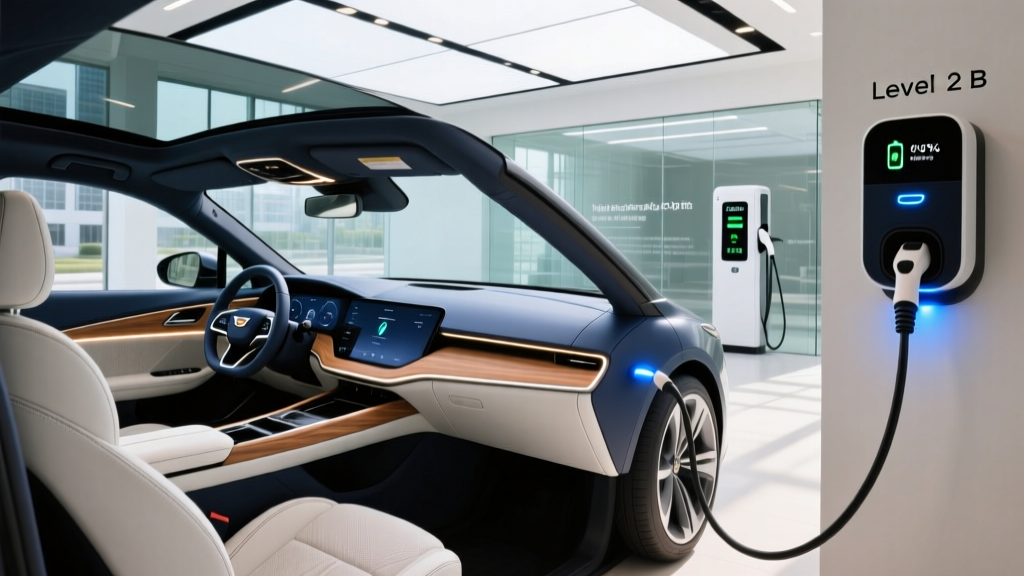
The centerpiece is a 33-inch diagonal curved LED display that merges the instrument cluster and infotainment screen into a single pane angled toward the driver. It runs GM's latest Google Built-in infotainment (Android Automotive OS), meaning Google Maps, Google Assistant, and Play Store apps are native — no phone required for navigation. Wireless Apple CarPlay and Android Auto are also standard. The system responds quickly, though the reliance on touch controls for climate functions (no physical knobs) will frustrate some drivers.
Seating and Cargo Dimensions
Front passengers get 40.1 inches of legroom and well-bolstered seats with available ventilation and massage. Rear legroom measures 37.8 inches — adequate for adults on shorter trips but tighter than the Lyriq's 39.6 inches. Behind the second row, cargo volume is approximately 25.0 cubic feet, expanding to roughly 57 cubic feet with the rear seats folded. There is no front trunk (frunk); the space under the hood houses electronics and the HVAC system.
Driver Assistance: Super Cruise Standard
Every 2025 Optiq comes with Super Cruise, GM's Level 2 hands-free driver-assistance system, mapped for over 750,000 miles of compatible highways in the U.S. and Canada. This is a significant value add — competitors like BMW and Genesis charge extra for equivalent tech. Note: Super Cruise is SAE Level 2, meaning the driver must remain attentive. An infrared camera monitors eye gaze and will issue escalating warnings if attention lapses.
Range, Battery, and Efficiency
The 2025 Cadillac Optiq is equipped with an estimated 85 kWh usable lithium-ion battery pack using GM's Ultium NMC (nickel manganese cobalt) pouch-cell chemistry. NMC offers higher energy density than LFP, which is critical for packaging 300+ miles of range into a compact SUV footprint. The trade-off is that NMC cells degrade slightly faster under extreme heat and repeated 100% charges compared to LFP — but GM's thermal management system and 8-year battery warranty mitigate this concern.
| Spec | Value |
|---|---|
| EPA Est. Range (AWD) | ~305 miles |
| Battery Capacity (usable) | ~85 kWh, NMC chemistry |
| Drivetrain | Dual-motor AWD |
| Horsepower / Torque | ~340 hp / 325 lb-ft |
| 0–60 mph | ~5.5 seconds |
| Max DC Fast Charge | ~150 kW peak |
| 10–80% DCFC Time | ~30 minutes |
| Level 2 AC Charge Rate | 11.5 kW (~31 mi/hr) |
| Efficiency (est.) | ~95 MPGe / 35 kWh/100 mi |
| Cargo (rear seats up/down) | 25.0 / 57.0 cu ft |
| Base MSRP | ~$53,900 (Luxury AWD) |
| Battery/Powertrain Warranty | 8 yr / 100,000 mi |
For efficiency context, the Optiq's estimated 95 MPGe (roughly 35 kWh per 100 miles) is competitive with the Genesis GV60 AWD (95 MPGe) but trails the Tesla Model Y Long Range (122 MPGe). That efficiency gap means higher electricity costs per mile and slightly more range sensitivity on long trips.
Charging Speed: DC Fast, Level 2, and Home Setup
Charging speed is where Ultium-platform vehicles have drawn criticism, and the Optiq doesn't break that pattern. The peak DC fast-charge rate is approximately 150 kW on a CCS connector (with a NACS adapter available for Tesla Supercharger access). That peak rate is maintained only briefly in the 10–30% state-of-charge window before tapering.
| Level | Power (kW) | Speed | Use Case |
|---|---|---|---|
| Level 1 (120V) | ~1.4 kW | ~4 mi/hr | Emergency trickle |
| Level 2 (240V) | 11.5 kW | ~31 mi/hr | Overnight home charging |
| DC Fast (CCS) | 150 kW peak | 10–80% in ~30 min | Road trips |
What the Charge Curve Actually Looks Like
Peak kW is a marketing number; sustained charge rate is what matters. On a 150 kW DC fast charger, the Optiq will pull close to peak power between 10–30% SoC, then taper to roughly 100–110 kW through 60%, and drop further to 50–60 kW by 80%. Charging from 80–100% is slow — expect an additional 25+ minutes — which is why road-trip strategy should target 10–80% sessions. Always precondition the battery (initiated automatically when you navigate to a charger in Google Maps) to achieve these rates; arriving at a DC fast charger with a cold battery can cut charge speed in half.
Home Charging Setup
At 11.5 kW on a Level 2 home charger (requiring a 240V/60A circuit), the Optiq recovers roughly 31 miles of range per hour — meaning a full 10–100% charge takes approximately 8–9 hours, easily accomplished overnight. A quality Level 2 home station (ChargePoint Home Flex, Emporia Level 2, or the GM-approved Ultium Home charger) costs $500–$750 for the unit. Professional installation by a licensed electrician typically runs $500–$2,000 depending on your panel capacity and conduit run. If your home has a 100A electrical panel, you may need a panel upgrade ($1,500–$3,000) to support a dedicated 60A EV circuit.
Performance and Driving Dynamics
The dual-motor all-wheel-drive powertrain produces an estimated 340 horsepower and 325 lb-ft of torque, delivering a 0–60 mph time of approximately 5.5 seconds. That's quick for daily merging and passing but not in the same league as the Tesla Model Y Performance (3.5 seconds) or the Genesis GV60 Performance (3.9 seconds). The Optiq prioritizes ride comfort over sporty dynamics — the suspension is tuned for compliant, quiet cruising rather than corner-carving. Road noise isolation is excellent, aided by acoustic laminated glass and active noise cancellation.
A rear-wheel-drive variant may become available for the 2026 model year, which would likely improve efficiency and reduce the starting price, but for the 2025 model year, AWD is the only configuration.
Pricing, Trims, and Federal Tax Credit Eligibility
The 2025 Cadillac Optiq launches in two primary trims:
- Luxury AWD: ~$53,900 MSRP (including destination)
- Sport AWD: ~$56,900 MSRP (adds black exterior accents, unique wheels, sport seats)
A fully loaded Sport trim with premium packages (panoramic roof, upgraded audio, advanced parking assist) can reach approximately $62,000.
Does the Optiq Qualify for the Federal EV Tax Credit?
Under current IRS §30D rules, the Optiq's eligibility for the up-to-$7,500 federal tax credit depends on several factors that change frequently:
- MSRP Cap: SUVs must be under $80,000 — the Optiq qualifies ✓
- Buyer Income Cap: AGI must not exceed $150K (single) / $225K (head of household) / $300K (joint) — verify your situation
- Battery Component Sourcing: Increasing percentages of battery components must be manufactured or assembled in North America — GM's Ultium cells are built in Ohio and Tennessee, which generally satisfies this requirement ✓
- Critical Minerals Sourcing: A percentage of critical minerals must be sourced from the U.S. or FTA partners — this threshold tightens annually and may reduce the credit to $3,750 or eliminate it for certain model/build-date combinations
- Point-of-Sale Transfer: You can transfer the credit to the dealer at purchase for an immediate price reduction, rather than waiting to claim it on your tax return
Bottom line: The Optiq's North American assembly and Ultium battery sourcing position it well for at least partial credit eligibility, but the critical-minerals threshold is the variable. Always confirm eligibility for your specific build date and personal tax situation with a tax professional referencing IRS guidance.
| Scenario | Luxury AWD | Sport AWD |
|---|---|---|
| Base MSRP | ~$53,900 | ~$56,900 |
| With Full $7,500 Credit | ~$46,400 | ~$49,400 |
| With $3,750 Partial Credit | ~$50,150 | ~$53,150 |
| No Credit (exceeds income cap) | ~$53,900 | ~$56,900 |
How It Compares: Optiq vs. Key Competitors
The compact luxury EV SUV segment is crowded. Here's how the Optiq stacks up against its three most cross-shopped rivals:
| Spec | Cadillac Optiq AWD | Genesis GV60 AWD | Tesla Model Y LR | BMW iX1 xDrive28 |
|---|---|---|---|---|
| EPA Range | ~305 mi | 248 mi | 310 mi | ~240 mi |
| 0–60 mph | ~5.5s | 5.3s | 4.8s | 5.5s |
| Peak DCFC | 150 kW | 235 kW | 250 kW | 130 kW |
| Base MSRP | ~$53,900 | ~$53,350 | ~$48,590 | ~$51,400 |
| Hands-Free ADAS | Super Cruise ✓ | No | Autopilot (hands-on) | No |
| Cargo (rear up) | 25.0 cu ft | 24.0 cu ft | 30.2 cu ft | 25.7 cu ft |
Pros, Cons, and Who Should Buy
- Premium interior materials exceed class expectations
- Super Cruise standard — no extra-cost package required
- 300+ mile EPA range sufficient for most commuters
- Quiet, compliant ride quality
- North American assembly supports tax credit eligibility
- Google Built-in infotainment is responsive and capable
- 150 kW peak DC charging is slow for the segment
- No front trunk (frunk) for additional storage
- Rear legroom is tight vs. the Lyriq and Model Y
- Touch-only climate controls are distracting while driving
- No single-motor/RWD option for 2025
- Efficiency (MPGe) trails Tesla and Hyundai/Kia rivals
- Choose the Optiq if: You prioritize interior luxury and ride comfort over outright performance, you commute on Super Cruise-mapped highways, and you want a premium badge under $55K with potential tax credit savings.
- Look at the Model Y if: Efficiency, charging speed, cargo space, and total cost of ownership are your top priorities.
- Look at the Genesis GV60 if: You road-trip frequently and need 800V-class fast charging (10–80% in ~18 min).
- Look at the Lyriq if: You need more rear-seat space and don't mind spending $57K+.
Frequently Asked Questions
What is the real-world range of the 2025 Cadillac Optiq?
The EPA estimates approximately 305 miles for the dual-motor AWD Optiq. In real-world highway driving at 70–80 mph, expect 260–280 miles. In cold weather (below 32°F), range can drop to 230–250 miles due to battery heating demands and increased cabin climate energy use. City driving with regenerative braking can match or exceed the EPA figure.
How fast does the Optiq charge at home and on the road?
At home on a Level 2 (240V, 11.5 kW) charger, the Optiq adds roughly 31 miles of range per hour, achieving a full overnight charge in 8–9 hours. On a DC fast charger, it peaks at approximately 150 kW, charging from 10–80% in about 30 minutes. This is slower than the Genesis GV60 (235 kW, ~18 min) and Tesla Model Y (250 kW, ~20 min).
Does the 2025 Cadillac Optiq qualify for the $7,500 federal EV tax credit?
It likely qualifies for at least a partial credit. The Optiq is assembled in Michigan (North American assembly requirement met), and its Ultium battery cells are manufactured in Ohio and Tennessee. However, the critical-minerals sourcing threshold tightens each year and may limit the credit to $3,750 depending on build date. Buyer income caps ($150K single / $300K joint) and the $80K SUV MSRP cap also apply. Consult a tax professional and check the latest IRS §30D guidance.
Is the Optiq worth buying over the Tesla Model Y or Genesis GV60?
It depends on priorities. The Optiq wins on interior material quality, standard Super Cruise, and ride comfort. The Model Y wins on efficiency, charging speed, cargo space, and price. The GV60 wins on DC fast-charging speed thanks to its 800V architecture. If luxury ambiance and hands-free highway driving matter most, the Optiq is compelling. If road-trip charging convenience and efficiency dominate your decision, look elsewhere.
What is the battery warranty on the 2025 Optiq?
GM covers the Ultium battery pack and electric powertrain components for 8 years or 100,000 miles (whichever comes first). The warranty covers defects and capacity loss below a specified threshold (typically 60–70% of original capacity, though the exact retention floor should be confirmed in your purchase documentation). The vehicle limited warranty is 4 years / 50,000 miles.
Does the Optiq have a frunk (front trunk)?
No. The 2025 Cadillac Optiq does not offer a front trunk. The space under the hood is occupied by power electronics, the onboard charger, and HVAC components. All cargo must go in the rear cargo area (25.0 cu ft behind the second row, ~57 cu ft with seats folded).
Can the Optiq use Tesla Superchargers?
Yes, via GM's approved NACS (North American Charging Standard) adapter, which GM began providing to Ultium EV owners for access to the Tesla Supercharger network. The Optiq can also charge at any CCS-equipped public station (Electrify America, EVgo, ChargePoint) natively without an adapter.