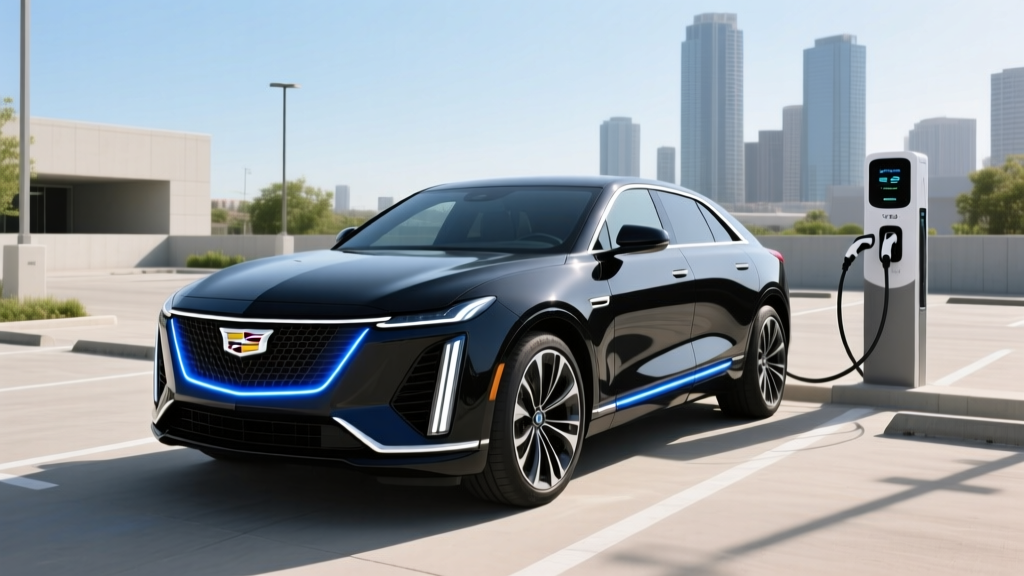
Quick Verdict: The 2025 Lyriq Refines Cadillac's EV Formula
The 2025 Cadillac Lyriq enters its third model year with meaningful updates: a new Sport trim, slightly revised pricing, and the continuation of GM's Ultium platform architecture. For buyers researching 2025 Cadillac Lyriq specs, the headline numbers remain compelling — up to 314 miles of EPA-estimated range, a 102 kWh usable battery, and a luxury cabin anchored by a 33-inch curved LED display. But the Lyriq's real story is about execution: how those specs translate to daily driving, road-trip charging, and ownership costs in a segment crowded with the BMW iX, Genesis Electrified GV70, and Tesla Model X.
This review dissects every spec that matters — from real-world range and DC fast-charge curves to federal tax credit eligibility — so you can decide whether the Lyriq earns a spot in your garage.
2025 Cadillac Lyriq Spec Sheet at a Glance
| Specification | Luxury (RWD) | Luxury (AWD) | Sport (AWD) |
|---|---|---|---|
| EPA Range | 314 mi | 307 mi | 287 mi (22" wheels) |
| Battery (usable) | 102 kWh, NMC (Ultium) | ||
| Horsepower | 340 hp | 500 hp | 500 hp |
| Torque | 325 lb-ft | 450 lb-ft | 450 lb-ft |
| 0–60 mph | ~6.0 sec | ~4.6 sec | ~4.6 sec |
| Drivetrain | Rear-Wheel Drive | Dual-Motor AWD | Dual-Motor AWD |
| Max DC Fast Charge | 190 kW (peak) | ||
| 10–80% DCFC Time | ~33 minutes | ||
| Level 2 Charge Rate | 11.5 kW (~31 mi/hr) | ||
| Efficiency (MPGe) | 95 combined | 89 combined | 87 combined |
| Base MSRP | $58,590 | $61,590 | $63,590 |
| Battery Warranty | 8 years / 100,000 miles | ||
Range and Efficiency: EPA Numbers vs. Real-World Expectations
Real-World Expectation: Plan for ~250–275 miles on highway road trips at 70–75 mph. In cold weather (below 30°F), expect a 20–30% reduction — potentially dropping to 200–220 miles on the RWD model without preconditioning. City/regenerative driving can match or slightly exceed the EPA sticker.
The 2025 Lyriq RWD's 314-mile EPA figure places it squarely in the competitive middle of the luxury electric SUV segment. According to fueleconomy.gov, the RWD Luxury achieves 95 MPGe combined (35 kWh/100 mi), which is respectable for a 5,700-pound vehicle but trails the more efficiency-focused BMW iX xDrive50 (87 MPGe combined with far more power).
Real-world range depends heavily on your driving profile. On a 75-mph highway cruise in moderate temperatures (60–80°F), the RWD Lyriq typically delivers 260–280 miles before needing a charge stop. The AWD models sacrifice some efficiency for traction and power — the Sport trim's 22-inch wheels further reduce range to 287 miles EPA, and real-world highway figures around 230–250 miles are common.
Cold weather remains the Lyriq's biggest range variable. GM's Ultium platform uses a liquid thermal management system, but like all NMC batteries, the chemistry becomes sluggish below freezing. Without preconditioning the battery (which the Lyriq does automatically when a charge stop is navigated to), DC fast-charge speeds also taper significantly in cold conditions. If your winters are harsh and your commute is long, the AWD model's range hit is worth factoring in.
Charging Speed: DC Fast Charge and Home Level 2 Breakdown
| Charging Level | Power | Speed (approx.) | Use Case |
|---|---|---|---|
| Level 1 (120V) | ~1.4 kW | ~4 mi/hr | Emergency/overnight trickle |
| Level 2 (240V, 48A) | 11.5 kW | ~31 mi/hr | Daily home charging |
| DC Fast Charge | 190 kW (peak) | 10–80% in ~33 min | Road trips |
The Lyriq's 190 kW peak DC fast-charge rate is the most misunderstood spec on the sheet. Peak kW is not sustained kW. In practice, the Lyriq holds close to its peak rate only between roughly 10–40% State of Charge (SoC), then steps down progressively. From 40–60%, expect ~140–150 kW; from 60–80%, it tapers to ~90–110 kW. This charge-curve taper is why the 10–80% time lands at approximately 33 minutes — competitive but not class-leading. The Hyundai Ioniq 5, for comparison, hits 10–80% in roughly 18 minutes thanks to its 800V architecture.
For home charging, the Lyriq's 11.5 kW onboard charger is a strong point. On a properly installed 48-amp Level 2 circuit (60-amp breaker), you'll recover roughly 31 miles of range per hour, meaning a full overnight session easily replenishes a day's driving. A full 0–100% charge at Level 2 takes approximately 9.5 hours. Most owners will plug in nightly and rarely see a charge below 20%.
Preconditioning matters: The Lyriq will precondition its battery for faster DC charging when you navigate to a charge station via the built-in navigation. Always use nav-routing to chargers in cold weather — arriving at a DC station with a cold battery can double your charge time.
Performance and Drivetrain: Two Very Different Experiences
The 2025 Lyriq offers a clear split in driving character depending on which powertrain you choose.
RWD (340 hp / 325 lb-ft): The single-motor rear-drive setup delivers smooth, linear acceleration with a 0–60 mph time around 6.0 seconds. It's the efficiency play, maximizing range and minimizing cost. For daily commuting and relaxed highway cruising, the RWD model feels more than adequate — torque is instant, passing power is confident, and the rear-biased weight distribution gives it a composed ride.
AWD Dual-Motor (500 hp / 450 lb-ft): Adding the front motor transforms the Lyriq into a genuinely quick luxury SUV. The 4.6-second 0–60 time puts it in the territory of sport sedans, and the all-wheel-drive traction makes it capable in rain and light snow. The Sport trim shares this powertrain but adds 22-inch wheels, a blacked-out exterior package, and slightly firmer tuning.
Neither version is a track car — the Lyriq's 5,700-pound curb weight is noticeable in tight corners — but the ride quality on the standard 20-inch wheels is genuinely excellent. GM's five-link rear suspension and passive damping tune prioritize isolation, making this one of the quietest and most comfortable rides in the luxury EV SUV class.
Pricing, Trims, and Federal Tax Credit Eligibility
| Trim | Base MSRP | As-Tested (typical) | §30D Credit Eligible? |
|---|---|---|---|
| Luxury RWD | $58,590 | $62,000–$66,000 | Yes, if buyer meets income caps |
| Luxury AWD | $61,590 | $65,000–$70,000 | Yes, if buyer meets income caps |
| Sport AWD | $63,590 | $68,000–$74,000 | Yes, if buyer meets income caps |
| Performance AWD (if avail.) | $70,000+ | $75,000+ | Check MSRP cap — SUVs capped at $80,000 |
The 2025 Lyriq starts at $58,590 for the Luxury RWD — a price that includes the destination charge and positions it below the BMW iX and Audi Q8 e-tron. Well-equipped AWD models with the Premium package (Super Cruise, AKG audio, panoramic roof) typically land in the $65,000–$70,000 range before incentives.
Does the 2025 Lyriq Qualify for the Federal EV Tax Credit?
Yes — with conditions. Under current IRS §30D rules, the Lyriq is eligible for up to $7,500 in federal tax credit, and this can be transferred to the dealer as a point-of-sale rebate. However, eligibility depends on several factors that change periodically:
- MSRP Cap: SUVs must have an MSRP at or below $80,000. All current Lyriq trims qualify.
- Buyer Income Cap: Adjusted gross income must not exceed $150,000 (single), $225,000 (head of household), or $300,000 (joint filers).
- Battery Sourcing: The vehicle must meet critical-mineral and battery-component sourcing requirements that tighten annually. The Lyriq's Ultium battery, assembled in the U.S. with globally sourced minerals, has qualified in prior model years — but verify current-year status at IRS.gov's eligible vehicle list before purchasing.
- Point-of-Sale Transfer: As of 2024+, buyers can transfer the credit to the dealer at purchase, reducing the out-of-pocket cost immediately rather than waiting for tax filing.
Important: Battery-sourcing rules are subject to change. Always confirm the specific VIN's eligibility with your dealer and consult a tax professional. State incentives vary separately — check your state's energy office or the AFDC incentive database.
Interior, Tech, and Cargo Space
The Lyriq's interior is where Cadillac's luxury aspirations are most convincing. The centerpiece is a 33-inch curved LED display that spans from the driver cluster to the center infotainment screen, running Google Built-In (Google Maps, Google Assistant, Play Store). The interface is responsive, though some users find the touch-capacitive climate controls below the screen less intuitive than physical buttons.
Cargo volume: 28.0 cubic feet behind the second row, expanding to 60.9 cubic feet with the rear seats folded. There is no front trunk (frunk) — the space is occupied by HVAC and electronics hardware. This is a notable miss versus the Tesla Model X or Rivian R1S, both of which offer front cargo space.
Passenger space: Rear legroom measures 39.6 inches, which is generous for the class. The flat floor (no transmission tunnel) makes the middle seat usable for short trips. Headroom is adequate even with the available panoramic glass roof, though tall passengers may find the roofline slightly low compared to boxier competitors.
Super Cruise: GM's hands-free driving system (SAE Level 2) is available on the Lyriq with the Premium package. It operates on over 750,000 miles of pre-mapped divided highways in the U.S. and Canada. The driver monitoring system uses an infrared camera on the steering column to ensure your eyes remain on the road. Super Cruise is one of the most polished Level 2 systems available — it handles lane changes, adaptive speed, and curves smoothly — but it is not autonomous driving. You must remain attentive and ready to take over at any time.
Pros and Cons
Pros
- 314-mile EPA range (RWD) is competitive for the class
- Exceptional ride quality and cabin quietness
- 11.5 kW Level 2 charging is faster than many rivals
- Super Cruise is a top-tier Level 2 highway system
- Undercuts BMW iX and Audi Q8 e-tron on price
- Eligible for up to $7,500 federal tax credit (verify sourcing)
Cons
- 190 kW peak DC charge rate trails 800V competitors (Ioniq 5, Taycan)
- No front trunk (frunk) — lost cargo utility
- Sport trim's 22" wheels reduce range by 27 EPA miles
- Infotainment learning curve; no wireless CarPlay on base trims
- Heavy at 5,700 lbs — efficiency suffers vs. lighter rivals
- No third-row or tow rating above 1,500 lbs (not a family hauler)
Who Should Buy the 2025 Cadillac Lyriq?
Choose the Lyriq AWD if: You need all-weather traction, want sub-5-second acceleration, and don't mind sacrificing 7–27 EPA miles of range. Ideal for buyers in snow-belt states who still want a luxury EV daily driver.
Look elsewhere if: You need three rows (Kia EV9, Rivian R1S), you regularly tow more than 1,500 lbs, you prioritize the fastest possible DC charging (Hyundai Ioniq 5, Porsche Macan EV), or you need maximum cargo versatility with a frunk.
The Lyriq is best understood as a luxury grand tourer in EV form — not a performance SUV, not a family hauler, but a refined, quiet, long-range cruiser that happens to wear a Cadillac crest. For two-row luxury EV SUV buyers who value ride comfort and brand cachet, it's one of the strongest options on the market.
Warranty and Ownership Considerations
GM backs the Lyriq's Ultium battery pack with an 8-year / 100,000-mile warranty, covering defects and capacity loss below a specified threshold (typically 60–70% State of Health, though exact terms should be confirmed in your purchase agreement). The powertrain carries the same 8-year/100,000-mile coverage. The limited bumper-to-bumper warranty is 4 years / 50,000 miles.
Long-term battery degradation data on the Ultium platform is still maturing — the Lyriq only launched for the 2023 model year. Early owner reports and GM's own testing suggest NMC Ultium packs are tracking similarly to industry norms: approximately 5–10% capacity loss over the first 100,000 miles, with degradation slowing significantly thereafter. Charging habits matter: regularly charging to 100% and leaving the vehicle at full SoC in hot weather accelerates wear. GM recommends daily charging to 80–90% for routine use.
Insurance costs for the Lyriq run 10–20% higher than comparable ICE luxury SUVs, consistent with EV industry averages. Get quotes before purchasing — premiums vary significantly by state, age, and driving record.
Frequently Asked Questions
What is the real-world range of the 2025 Cadillac Lyriq?
The RWD model delivers an EPA-estimated 314 miles, but real-world highway driving at 70–75 mph typically yields 250–280 miles in moderate temperatures. Cold weather (below 30°F) can reduce range by 20–30%. AWD models see slightly lower real-world figures, and the Sport trim with 22-inch wheels drops to 287 EPA miles with real-world highway range closer to 230–250 miles.
How fast does the 2025 Lyriq charge at home and on the road?
At home on a 48-amp Level 2 charger (240V), the Lyriq charges at 11.5 kW, adding roughly 31 miles of range per hour — a full charge takes about 9.5 hours. On DC fast chargers, it peaks at 190 kW and reaches 10–80% in approximately 33 minutes, though the charge curve tapers significantly above 60% SoC.
How much does the 2025 Lyriq cost after the federal tax credit?
The RWD Luxury starts at $58,590. If you qualify for the full $7,500 §30D credit (meeting income caps and battery-sourcing requirements), the effective price drops to approximately $51,090. AWD models start at $61,590 ($54,090 after credit). Well-equipped models with packages land in the $60,000–$70,000 range before incentives. Always verify eligibility at IRS.gov and consult a tax professional.
Is the 2025 Lyriq worth buying vs. the BMW iX or Genesis Electrified GV70?
The Lyriq wins on price and ride comfort — it's $10,000–$15,000 less than a comparably equipped BMW iX and offers a smoother, quieter ride. The iX counters with faster DC charging, a more modern interior design, and stronger performance. The Genesis Electrified GV70 offers a more traditional luxury feel but less range (236 mi EPA) and slower charging. If ride quality, value, and Super Cruise are your priorities, the Lyriq is the pick. If you want the latest tech and faster charging, the iX edges ahead.
Does the 2025 Lyriq have a frunk (front trunk)?
No. The Lyriq does not offer a front trunk. The space under the hood houses HVAC components, power electronics, and the 12V battery. All cargo goes in the rear — 28.0 cu ft behind the second row, 60.9 cu ft with seats folded.
Can the 2025 Lyriq tow?
The Lyriq has a maximum tow rating of 1,500 pounds when properly equipped. This is sufficient for a small utility trailer or a couple of dirt bikes, but it is not rated for boat trailers, campers, or car haulers. If towing is a priority, consider the Rivian R1S (7,700 lbs) or the upcoming electric SUVs with higher ratings.
What battery chemistry does the Lyriq use?
The Lyriq uses GM's Ultium platform with NMC (nickel-manganese-cobalt) lithium-ion cells. NMC offers higher energy density than LFP (lithium iron phosphate), which is why the Lyriq achieves 314 miles from a 102 kWh pack. The trade-off is that NMC batteries are more sensitive to sustained high-SoC storage and extreme temperatures. GM recommends charging to 80–90% for daily use and reserving 100% charges for road trips.