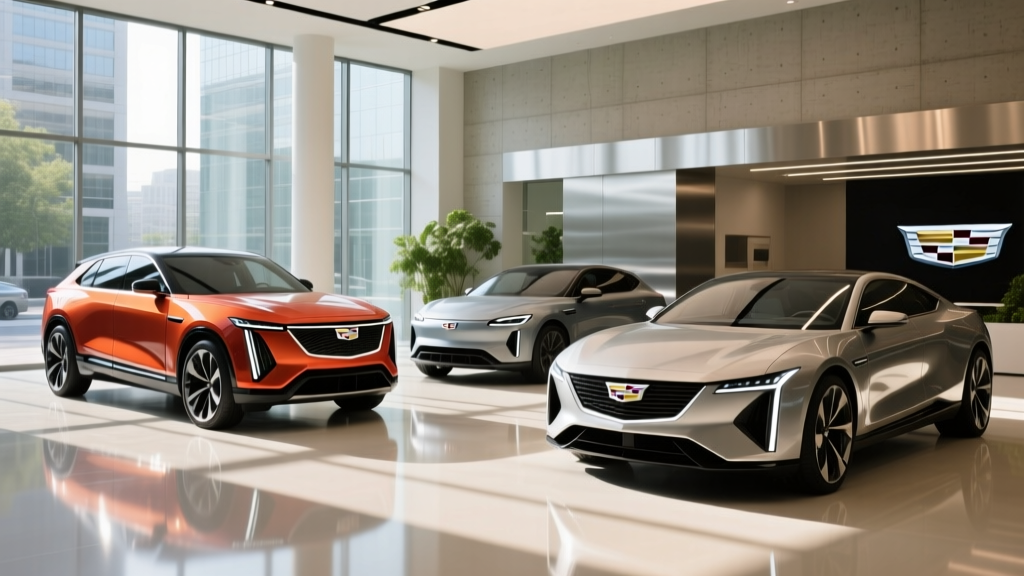
Quick Answer: Cadillac's 2025 EV lineup spans three models on GM's Ultium platform: the Lyriq midsize SUV (314 mi EPA, from $58,590), the compact Optiq (300+ mi EPA estimated, from ~$52,000), and the three-row Vistiq (300 mi EPA estimated, from ~$75,000). All use the North American Charging Standard (NACS), qualify for up to $7,500 in federal tax credits depending on battery sourcing and buyer income, and support DC fast charging at up to 190 kW. The Lyriq is the proven, available choice; Optiq and Vistiq are newer additions that broaden the lineup for compact and large-family buyers.
The 2025 Cadillac EV Lineup at a Glance
General Motors has positioned Cadillac as its EV spearhead, and by the 2025 model year the luxury marque offers three distinct battery-electric vehicles built on the Ultium architecture. Each shares core battery and powertrain DNA but targets different buyer profiles.
| Spec | Lyriq | Optiq | Vistiq |
|---|---|---|---|
| Segment | Midsize SUV | Compact SUV | Full-size 3-row SUV |
| EPA Range | 314 mi (RWD) | ~300+ mi (est.) | ~300 mi (est.) |
| Battery (usable) | 102 kWh (NMC) | ~85 kWh (NMC est.) | ~102 kWh (NMC) |
| Powertrain | RWD or AWD | AWD | AWD |
| Horsepower | 340 hp (RWD) / 500 hp (AWD) | ~300 hp (est.) | ~615 hp |
| 0-60 mph | 6.0s (RWD) / 4.6s (AWD) | ~6.5s (est.) | ~3.7s |
| Max DC Fast Charge | 190 kW | ~150 kW (est.) | 190 kW |
| 10-80% DC Charge | ~33 min | ~30 min (est.) | ~33 min |
| Level 2 Rate | 19.2 kW (AC) | 11.5 kW (AC) | 19.2 kW (AC) |
| Starting MSRP | $58,590 | ~$52,000 | ~$75,000 |
| Federal Tax Credit | Up to $7,500 | Up to $7,500 | Up to $7,500 |
| Battery Warranty | 8 yr / 100,000 mi | 8 yr / 100,000 mi | 8 yr / 100,000 mi |
The Lyriq, now in its fourth model year, carries verified EPA data from fueleconomy.gov. Optiq and Vistiq specifications marked as estimates reflect preliminary manufacturer figures for newly introduced models and may shift as EPA certification finalizes.
Real-World Range: What the EPA Sticker Doesn't Tell You
The Lyriq RWD posts a 314-mile EPA range, but real-world conditions rarely match the laboratory. Based on extensive owner data and independent testing, here's what to actually expect:
Lyriq RWD Range Reality Check
- EPA Sticker: 314 miles
- Highway cruising (70-75 mph, 70°F): ~260-280 miles
- Combined mixed driving (city/highway): ~285-305 miles
- Cold weather (below 32°F, cabin heat): ~220-250 miles (20-30% reduction)
- Cold + highway: ~200-230 miles
The 102 kWh NMC battery pack provides a generous buffer, but EVs lose efficiency at sustained highway speeds because there's no regenerative braking to recoup energy. In freezing temperatures, the battery's internal resistance increases and cabin heating draws significant power — even with the Lyriq's heat pump system.
The AWD Lyriq drops to 307 miles EPA due to the additional front motor and weight. If you regularly drive in sub-freezing climates or take frequent highway road trips, budget for 70-75% of the sticker range as your practical planning number.
Charging Speeds, Connectors, and the NACS Advantage
All 2025 Cadillac EVs use the North American Charging Standard (NACS) connector natively — no adapter required. This is a significant practical advantage: NACS is the Tesla Supercharger connector, and GM's agreement with Tesla gives Cadillac owners direct access to over 20,000 Supercharger stalls across North America, alongside Electrify America, EVgo, and other networks.
| Charging Level | Power | Lyriq Speed | Miles Added/Hour |
|---|---|---|---|
| Level 1 (120V household) | ~1.4 kW | ~1.4 kW | ~4-5 mi/hr |
| Level 2 (240V home/public) | 7.7-19.2 kW | Up to 19.2 kW | ~52-64 mi/hr |
| DC Fast Charge | Up to 190 kW | Peak 190 kW | ~200+ mi in 10 min (peak) |
Understanding kW vs. kWh: Kilowatts (kW) measure the rate of energy flow — think of it as how fast water pours from a hose. Kilowatt-hours (kWh) measure total energy stored — the size of the bucket. The Lyriq's 102 kWh battery charged at 190 kW doesn't take 32 minutes from empty to full, because the charge rate tapers significantly above 80% state of charge to protect battery longevity.
The Lyriq's charging curve peaks near 190 kW between roughly 10-40% SoC, then steps down progressively. Expect 10-80% in approximately 33 minutes at a capable DC fast charger. Above 80%, the rate drops to under 50 kW — plan your road trips around 10-80% charges rather than topping off to full, unless you're charging overnight at home.
For home Level 2 charging, the Lyriq supports up to 19.2 kW on a 100-amp circuit, which is among the fastest in its class. A full overnight charge from 10% takes roughly 5.5 hours at that rate. The Optiq's estimated 11.5 kW Level 2 rate is more typical and still delivers a full charge overnight on a standard 48-amp Level 2 circuit.
EV vs. Gas: Cadillac XT5 and XT6 Cost Comparison
Cadillac's closest gas-powered equivalents are the XT5 (midsize, Lyriq competitor) and XT6 (three-row, Vistiq competitor). Here's how the economics stack up over five years and 75,000 miles:
| Cost Factor | Lyriq RWD ($58,590) | XT5 AWD ($48,395) |
|---|---|---|
| Purchase Price | $58,590 | $48,395 |
| Federal Tax Credit (§30D) | -$7,500 (if eligible) | $0 |
| Effective Purchase | $51,090 | $48,395 |
| Fuel/Energy (75k mi) | ~$3,200 (home charging) | ~$8,100 (premium gas) |
| Maintenance (5 yr) | ~$800 | ~$3,200 |
| Insurance (5 yr avg) | ~$11,500 | ~$9,200 |
| 5-Year Total Cost | ~$66,590 | ~$68,895 |
Key assumptions: Electricity at $0.14/kWh national average, premium gasoline at $4.30/gallon, Lyriq efficiency of 2.0 kWh/mile (89 MPGe combined per fueleconomy.gov), XT5 at 23 MPG combined. Insurance premiums for EVs typically run 15-25% higher than gas equivalents — get quotes before purchasing.
The Lyriq reaches cost parity with the XT5 within roughly 3-4 years when you factor in the tax credit and dramatically lower energy and maintenance costs. Without the tax credit, parity extends to about 5-6 years. The Vistiq vs. XT6 comparison is more favorable to the EV because the larger gas SUV's fuel consumption is significantly higher.
Federal Tax Credit: §30D Eligibility for Cadillac EVs
All three 2025 Cadillac EVs are assembled in North America (Spring Hill, Tennessee for Lyriq; Orion Township, Michigan for Optiq and Vistiq), satisfying the IRS final-assembly requirement. However, the full $7,500 credit depends on several factors:
- MSRP Caps: SUVs must be under $80,000. Lyriq and Optiq trims clear this; top Vistiq trims may exceed it.
- Buyer Income Caps: AGI must not exceed $150,000 (single), $225,000 (head of household), or $300,000 (joint).
- Battery Sourcing: The $7,500 splits into $3,750 for critical minerals and $3,750 for battery component sourcing. Cadillac's Ultium batteries use LG Energy Solution cells manufactured in the U.S., but critical-mineral sourcing requirements tighten annually. Verify current-year eligibility on the IRS qualified vehicles list before purchasing.
- Point-of-Sale Transfer: Since 2024, buyers can transfer the credit to the dealer as an immediate price reduction rather than waiting for a tax refund. This effectively lowers your out-of-pocket cost at signing.
Important: Tax credit rules evolve. Consult a tax professional and check the IRS qualified clean vehicle list for the specific trim and build date you're considering. Never assume the full $7,500 applies without verification.
Home Charging Setup: What You Actually Need
Home charging is where EV ownership either shines or stumbles. If you can install a Level 2 charger, daily life with a Cadillac EV is effortless — plug in at night, wake up to a full battery. Here's a realistic cost breakdown:
| Component | Cost Range | Notes |
|---|---|---|
| Level 2 Charger (hardware) | $400 - $700 | ChargePoint Home Flex, Emporia, Wallbox |
| Electrical Panel Upgrade | $0 - $3,000 | Needed if panel is at capacity or under 200A |
| Wiring & Conduit Run | $500 - $2,500 | Depends on distance from panel to garage |
| Electrician Labor | $500 - $1,500 | Licensed EV-certified electrician required |
| Permits & Inspection | $100 - $400 | Varies by municipality |
| Total Typical Install | $1,500 - $4,500 | Average: ~$2,500 for straightforward installs |
For the Lyriq's 19.2 kW maximum Level 2 rate, you need a dedicated 100-amp circuit with 80 amps of continuous draw capacity. This requires a robust electrical panel — many homes with 200-amp service can accommodate this, but older homes with 100-amp or 150-amp panels will need an upgrade. Have a licensed electrician perform a load calculation before committing to equipment.
If you live in an apartment, condo, or street-parking situation without home charging access, ownership is still viable but requires planning around public charging. The NACS/Supercharger advantage is significant here: Tesla's network consistently outperforms other public networks in uptime and reliability.
Decision Framework: Which 2025 Cadillac EV Is Right for You?
Choose the Lyriq if:
- You want the most proven Cadillac EV with verified EPA data and owner track record
- You need 314 miles of range for road trips but don't need three rows
- You value the 19.2 kW Level 2 home charging speed
- Your budget is $55,000-$70,000
Choose the Optiq if:
- You want a more compact, urban-friendly Cadillac EV
- You don't need maximum range or towing capacity
- Your budget is $50,000-$60,000
- You prioritize maneuverability over interior volume
Choose the Vistiq if:
- You need three-row seating for family duty
- You want the highest performance (615 hp, sub-4-second 0-60)
- Your budget allows $75,000+ and you verify MSRP cap compliance for the tax credit
- You're replacing an XT6 or Escalade for daily and family use
Wait or reconsider if:
- You have no access to home or workplace charging and live in a charging desert
- You regularly tow heavy loads (EV range drops 40-50% under tow)
- Your daily commute exceeds 200 miles one-way in extreme cold
Common Misconceptions About Cadillac EVs
| Myth | Fact |
|---|---|
| "Cadillac EVs can't use Tesla Superchargers." | All 2025 Cadillacs have native NACS ports. No adapter needed — just plug in at any V3 or V4 Supercharger. |
| "The battery will need replacing in 5 years." | GM's Ultium NMC batteries are warrantied for 8 years/100,000 miles with a capacity retention threshold of 60%. Real-world degradation data from Lyriq owners shows roughly 5-8% loss over the first 50,000 miles — consistent with modern liquid-cooled packs. |
| "EVs are slower than gas Cadillacs." | The Vistiq's estimated 3.7-second 0-60 mph handily beats the XT6's 6.9 seconds. Even the Lyriq AWD at 4.6 seconds matches the sport-tuned XT5. |
| "Charging takes too long for road trips." | At 190 kW DC, the Lyriq adds roughly 150 miles of range in 15 minutes. Combined with Supercharger access, road trip charging is practical with brief rest stops. |
| "I need a special electrical service for any EV." | Level 1 (120V) charging adds ~4-5 miles per hour and is sufficient for drivers covering under 40 miles daily. A full panel upgrade is only needed for the fastest Level 2 rates. |
Ownership Costs Beyond the Sticker Price
Budgeting for a 2025 Cadillac EV requires looking past MSRP. Here are the real ownership factors that catch first-time EV buyers off guard:
Insurance: EV insurance premiums run 15-25% higher than comparable gas vehicles due to higher repair costs and battery replacement exposure. Expect $2,000-$2,500/year for the Lyriq depending on your profile. Get quotes from multiple carriers — some now offer EV-specific policies.
Tires: EVs are heavier (the Lyriq weighs ~5,700 lbs) and deliver instant torque, which accelerates tire wear. Budget for tire replacement every 30,000-40,000 miles rather than the 50,000-60,000 miles typical of gas vehicles. OEM-spec EV tires (like the Michelin Pilot Sport EV) cost $250-$350 each.
Maintenance savings: No oil changes, no spark plugs, no transmission fluid, and regenerative braking dramatically extends brake pad life (often 80,000+ miles). Cadillac's EV maintenance schedule is primarily cabin air filter replacement, tire rotation, and fluid top-offs — typically $150-$200/year.
Registration fees: Many states impose additional EV registration fees ($50-$225/year) to offset lost gas tax revenue. Check your state's DMV for specifics.
Depreciation: EV depreciation has been steeper than gas vehicles in recent years, partly due to Tesla price cuts resetting the market and rapid tech advancement. The Lyriq has held value better than some competitors due to limited supply and strong demand, but plan for 45-55% depreciation over five years.
Frequently Asked Questions
Is the 2025 Cadillac Lyriq eligible for the full $7,500 federal tax credit?
The Lyriq meets the North American assembly requirement and falls under the $80,000 MSRP cap for SUVs. Whether you receive the full $7,500, a partial $3,750, or nothing depends on your income (AGI caps apply), the specific battery sourcing compliance for your build date, and your tax liability. Check the IRS qualified vehicle list before purchasing and consult a tax professional.
Can I charge a 2025 Cadillac EV at Tesla Superchargers?
Yes. All 2025 Cadillac EVs feature the native NACS connector, which is physically identical to the Tesla Supercharger plug. No adapter is required. You'll use the Tesla app or your vehicle's built-in navigation to locate and activate sessions at V3 (250 kW) and V4 Supercharger stalls.
How long does the Ultium battery last, and what does replacement cost?
GM warranties the Ultium battery for 8 years or 100,000 miles against defects and excessive capacity loss (below 60% of original capacity). Based on current data, well-maintained NMC packs with active thermal management are expected to retain 85-90% capacity at 100,000 miles. Out-of-warranty replacement costs are not yet widely established for Ultium packs but industry estimates for comparable 100+ kWh packs range from $12,000-$20,000 including labor. This cost is expected to decline as the supply chain matures.
What's the real-world efficiency of the Lyriq in kWh per mile?
The Lyriq RWD consumes approximately 2.0 kWh per mile in mixed driving (equivalent to 89 MPGe per the EPA). Highway-only driving at 75 mph increases consumption to roughly 2.3-2.5 kWh/mile. In cold weather with cabin heating, expect 2.5-3.0 kWh/mile. At the national average electricity rate of $0.14/kWh, that translates to roughly $0.28/mile in mixed driving — about one-third the fuel cost of the XT5 at current gas prices.
Do I need a 200-amp electrical panel for home charging?
Not necessarily. A 200-amp panel is recommended for the Lyriq's maximum 19.2 kW Level 2 rate (requiring a 100-amp breaker), but most homes can install a 48-amp Level 2 charger (delivering 11.5 kW) on a 60-amp circuit without a panel upgrade. This still provides roughly 35-40 miles of range per hour of charging — more than enough to fully replenish overnight. Have a licensed electrician perform a load calculation to determine your options.
How does the Cadillac Lyriq compare to the Tesla Model Y or BMW iX?
The Lyriq sits between the Model Y and iX in both price and size. The Model Y Long Range offers more range (330 mi EPA) and faster Supercharger speeds (250 kW) but has a less premium interior and a lower starting price (~$48,000). The BMW iX xDrive50 offers more power (516 hp) and a more refined ride but starts at $87,250 — well above the Lyriq. The Lyriq's value proposition is genuine luxury materials, Supercharger access, and competitive range at a mid-$50,000 effective price after credits.