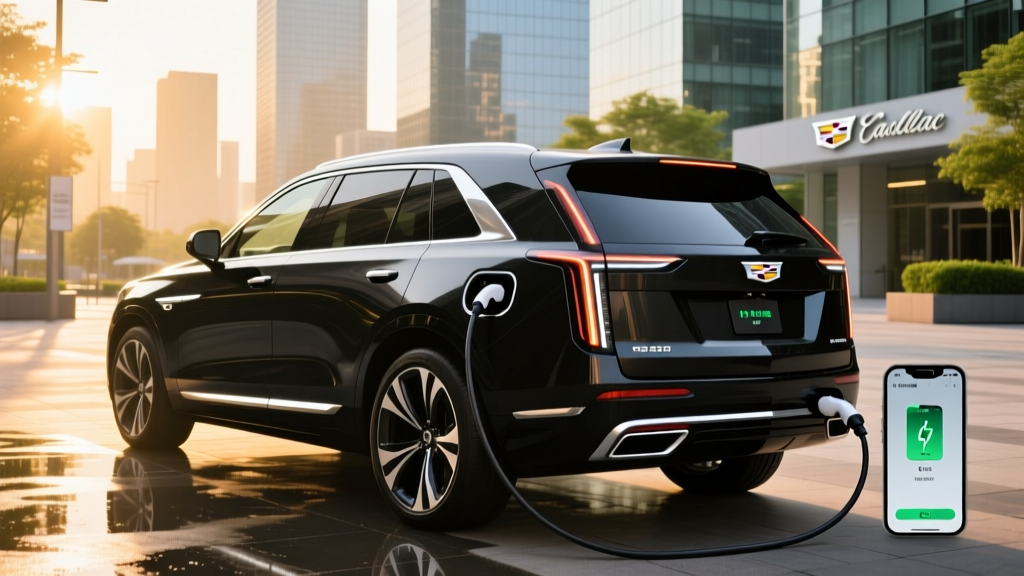
The Cadillac Escalade has defined American luxury SUVs for over two decades. The 2025 Escalade IQ is its first all-electric iteration, built on GM's BT1 electric truck platform — the same architecture underpinning the GMC Hummer EV and Chevrolet Silverado EV. With a massive battery, four-figure torque output, and a starting price north of $129,000, this is a flagship in every sense. Here's a comprehensive breakdown of every 2025 Cadillac Escalade IQ spec that matters to a real buyer.
2025 Cadillac Escalade IQ Specs at a Glance
| Specification | Value |
|---|---|
| EPA Estimated Range | ~460 miles (Luxury trim) |
| Battery Capacity (Usable) | ~200+ kWh (Ultium NMC) |
| Drivetrain | Dual-motor AWD (e4) |
| Horsepower | Up to 750 hp (Velocity mode) |
| Torque | Up to 785 lb-ft |
| 0-60 mph | Under 5.0 seconds (est.) |
| Max DC Fast Charge Rate | ~350 kW (peak, 800V architecture) |
| 10-80% DC Charge Time | ~20-25 minutes (est.) |
| Level 2 Home Charging | Up to 19.2 kW (~52 mi/hr) |
| Towing Capacity | Up to 8,000 lbs (est.) |
| Base MSRP | $129,990 (Luxury 1) |
| Federal Tax Credit (§30D) | Up to $7,500 (eligibility varies) |
| Battery/Powertrain Warranty | 8 years / 100,000 miles |
Range and Efficiency: What to Expect Beyond the EPA Sticker
Cadillac targets approximately 460 miles of EPA-estimated range for the Escalade IQ Luxury trim, powered by a massive Ultium battery pack with over 200 kWh of usable capacity. This is among the largest battery packs ever fitted to a production passenger vehicle and the primary reason the Escalade IQ achieves range figures that rival much smaller, lighter EVs.
EPA estimates assume a mix of city and highway driving at moderate temperatures. Expect approximately 380-420 miles on the highway at sustained 70-80 mph speeds, where aerodynamic drag dominates a vehicle this size. In cold weather (below 32°F), lithium-ion chemistry limitations and cabin heating demands can reduce range by 20-30%, potentially dropping effective range to 320-370 miles. The Escalade IQ's standard heat pump mitigates some of this loss compared to resistive heating, but physics is physics — a 7,500+ lb SUV moving through cold, dense air will consume more energy. For daily commuting under 100 miles round-trip, range is effectively a non-issue with home charging.
The battery uses GM's Ultium NMC (nickel manganese cobalt) chemistry, chosen for its high energy density — essential for packing 200+ kWh into a vehicle platform. While LFP (lithium iron phosphate) batteries offer longer cycle life and lower cost, they lack the energy density needed for a flagship SUV targeting 460+ miles. Efficiency figures are expected in the range of 48-52 MPGe combined, which translates to roughly 65-70 kWh per 100 miles — high in absolute terms, but competitive for a full-size luxury SUV class.
Charging Speed: DC Fast Charging and Home Setup
The Escalade IQ rides on GM's 800-volt Ultium architecture, enabling peak DC fast-charge rates of up to 350 kW at compatible chargers. In practice, this means a 10-80% charge in roughly 20-25 minutes under ideal conditions — battery preconditioned, ambient temperature moderate, and connected to a 350 kW-capable station (such as Electrify America's latest Ultra-Fast chargers).
However, charging curves matter more than peak numbers. Like all large-battery EVs, the Escalade IQ will sustain peak charge rates only through the lower portion of the state-of-charge window. Expect the charge rate to taper significantly above 80% SoC to protect battery longevity. If you're road-tripping and charging from 10-80%, plan for roughly 25 minutes at a high-power station. Charging from 80-100% can take nearly as long as the 10-80% session.
| Charging Level | Power / Rate | Miles Added per Hour | Best Use Case |
|---|---|---|---|
| Level 1 (120V household) | ~1.4 kW | ~3-4 mi/hr | Emergency / overnight trickle |
| Level 2 (240V home) | Up to 19.2 kW | ~52 mi/hr | Daily home charging (full overnight refill) |
| DC Fast Charge (public) | Up to 350 kW (peak) | ~600+ mi/hr (peak) | Road trips, quick top-ups |
For home Level 2 charging, the Escalade IQ supports up to 19.2 kW through GM's available Ultium Home charger or any compatible J1772/NACS wallbox on a 100-amp dedicated circuit. At this rate, a full 0-100% charge takes roughly 10-12 hours — easily accomplished overnight. Most buyers will install a 48-amp or 80-amp circuit, delivering 11.5 kW or 19.2 kW respectively. Given the massive battery, we strongly recommend a minimum 80-amp circuit (19.2 kW) to avoid multi-day charge times from low states of charge. Budget $1,200-$3,000 for professional Level 2 installation depending on your panel capacity and run distance — and factor in a potential panel upgrade ($2,000-$5,000) if your home has a 100-amp main service.
The Escalade IQ ships with the NACS (North American Charging Standard) connector natively, granting access to Tesla's Supercharger network (now open to non-Tesla EVs) as well as all NACS-equipped public chargers. For CCS-only stations, a NACS-to-CCS adapter is available.
Performance: 750 Horsepower in a Luxury Flagship
The Escalade IQ's dual-motor e4 all-wheel-drive system delivers up to 750 horsepower and 785 lb-ft of torque in Velocity mode — figures that would have been supercar territory a decade ago. Cadillac estimates a 0-60 mph time under 5.0 seconds, remarkable for a vehicle with a curb weight expected to exceed 9,000 pounds.
The Ultium platform's low center of gravity (batteries mounted beneath the floor) helps the Escalade IQ handle its mass with surprising composure. GM's adaptive air suspension with Magnetic Ride Control is standard, providing both a plush highway ride and the ability to firm up for canyon roads or reduce ride height for improved aerodynamics at speed. The available four-wheel steering system (similar to the Hummer EV's CrabWalk-adjacent setup) reduces the turning radius significantly — a genuine practicality win for a vehicle this large in urban environments and tight parking structures.
Towing capacity is estimated at up to 8,000 pounds when properly equipped, competitive with the ICE Escalade. However, towing at maximum capacity will dramatically reduce range — expect a 40-50% reduction in effective range when pulling a heavy trailer at highway speeds. Plan road-trip charging stops accordingly.
Pricing, Trims, and Federal Tax Credit Eligibility
The 2025 Escalade IQ launches in two primary trim tiers, each available in standard and extended "V" sport-oriented configurations:
| Trim | Base MSRP | Key Features |
|---|---|---|
| Luxury 1 | $129,990 | Air suspension, 55" total LED display, Super Cruise, 24-way power seats |
| Sport 1 | $130,490 | Blacked-out trim, sport-tuned suspension, unique wheels |
| Luxury 2 | $149,990 | Executive rear seating, massaging all positions, upgraded audio |
| Sport 2 | $150,490 | All Luxury 2 features with sport exterior package |
Destination charges add approximately $1,995. A fully optioned Luxury 2 or Sport 2 can approach $160,000-$170,000 with available packages.
- MSRP Cap: SUVs must be at or below $80,000 to qualify. The Escalade IQ's base MSRP of $129,990 exceeds this cap, meaning it does NOT qualify for the $7,500 federal purchase credit under current IRS §30D rules.
- Lease Loophole (§45W): Commercial leasing entities may pass through the $7,500 commercial clean vehicle credit as a lease incentive. Ask your dealer whether Cadillac Financial or affiliated lessors are offering this pass-through on the Escalade IQ.
- Income Caps (if credit were applicable): $300,000 joint / $225,000 head of household / $150,000 individual MAGI.
- Point-of-Sale Transfer: Eligible credits can be applied at purchase to reduce the upfront price.
Interior Space, Cargo, and Technology
The Escalade IQ's flat-floor EV architecture unlocks packaging advantages the ICE Escalade can't match. Expect approximately 25+ cubic feet of cargo space behind the third row, expanding to over 100 cubic feet with both rear rows folded. A front trunk (frunk) adds additional sealed storage — useful for charging cables or a small bag.
Passenger space remains generous across all three rows, with third-row legroom improved over the outgoing ICE model thanks to the absence of a rear driveshaft tunnel. The Executive Second-Row Seating package (standard on Luxury 2/Sport 2) replaces the bench with individual captain's chairs featuring power recline, massage, heating, ventilation, and individual rear entertainment screens.
The dashboard is dominated by a combined 55 inches of LED display surface spanning the entire dash — a pillar-to-pillar hyperscreen that integrates the instrument cluster, central infotainment, and passenger display into one continuous panel. Google Built-in handles navigation, voice assistant, and app integration. A 23-speaker AKG Studio Reference audio system is available on upper trims.
GM's Super Cruise — a Level 2 hands-free driver-assistance system — comes standard on all trims, with coverage on over 750,000 miles of compatible highways across North America. Super Cruise handles steering, acceleration, and braking on mapped roads, but the driver must remain attentive and eyes-forward (monitored by a steering-column camera). This is not autonomous driving — it is an SAE Level 2 system requiring continuous driver supervision.
Warranty and Long-Term Ownership
GM covers the Escalade IQ's battery pack and electric drive components under its 8-year / 100,000-mile limited warranty, with a capacity retention threshold (typically 60-70% of original capacity, per GM's Ultium warranty terms). The basic vehicle warranty is 4 years / 50,000 miles, with 6 years / 70,000 miles for the powertrain.
For a vehicle at this price point, some buyers may find the basic warranty coverage period shorter than competitors like Mercedes-Benz (which offers 4 years / 50,000 miles but includes more complimentary maintenance). Cadillac includes one scheduled maintenance visit and a limited period of OnStar connectivity.
Long-term battery degradation on the Ultium platform is still being established in real-world use. GM's NMC chemistry with active thermal management is expected to retain 90%+ capacity over the first 100,000 miles based on data from earlier Ultium vehicles. Out-of-warranty battery replacement costs for a pack this size could exceed $30,000-$40,000 — a consideration for second-owners planning to keep the vehicle past the warranty window.
Who Should Buy the Escalade IQ — and Who Shouldn't
Choose the Escalade IQ if:
- You need three-row luxury seating for 7+ passengers and want to eliminate gasoline costs
- You have reliable home Level 2 charging and drive under 300 miles daily
- You value flagship status, cutting-edge interior tech, and silent electric refinement
- You tow occasionally (up to 8,000 lbs) and want electric torque for trailer launches
- Budget allows for a $130,000+ vehicle without depending on the federal tax credit
Look elsewhere if:
- You regularly tow heavy loads over long distances (range drops severely while towing)
- You lack access to home or workplace charging (public-charging a 200+ kWh battery is expensive and time-consuming)
- The $7,500 tax credit is essential to your purchase math (this vehicle doesn't qualify under §30D purchase rules)
- You prefer a smaller, more agile luxury EV (consider the BMW iX, Genesis Electrified GV70, or Cadillac Lyriq)
- Class-leading ~460-mile EPA range
- 800V architecture enables 350 kW peak DC charging
- 750 hp / 785 lb-ft — supercar acceleration in a luxury SUV
- 55" pillar-to-pillar display is a technology showcase
- Flat floor + frunk maximize interior utility
- Super Cruise hands-free driving on 750K+ miles of roads
- Four-wheel steering for improved maneuverability
- $129,990+ starting price; no §30D tax credit eligibility
- 9,000+ lb curb weight impacts efficiency and tire wear
- Range drops 40-50% when towing at capacity
- Home charging requires a high-amperage circuit (potential panel upgrade)
- Real-world highway range significantly below EPA sticker
- Out-of-warranty battery replacement could exceed $30,000
- Large physical footprint challenging in urban parking
Frequently Asked Questions
What is the real-world range of the 2025 Escalade IQ?
While Cadillac targets an EPA estimate of approximately 460 miles, real-world highway driving at 70-80 mph will likely yield 380-420 miles. In cold weather (below freezing), expect 320-370 miles due to battery chemistry limitations and cabin heating loads. For most daily driving, you'll rarely deplete more than 20-30% of the battery.
How fast does the Escalade IQ charge at home and on the road?
At home on a 19.2 kW Level 2 charger (80-amp circuit), the Escalade IQ adds roughly 52 miles of range per hour, with a full charge taking 10-12 hours. On the road, DC fast charging peaks at 350 kW on 800V stations, enabling a 10-80% charge in approximately 20-25 minutes. Charging above 80% slows considerably to protect battery health.
Does the 2025 Escalade IQ qualify for the federal EV tax credit?
No — under current IRS §30D rules, new electric SUVs must have an MSRP at or below $80,000 to qualify for the $7,500 federal purchase credit. The Escalade IQ starts at $129,990 and exceeds this cap. However, leasing through a commercial entity may allow a $7,500 incentive to be passed through as a lease reduction under §45W commercial credit rules. Consult your dealer and a tax professional.
Is the Escalade IQ worth buying over the Tesla Model X or Rivian R1S?
It depends on your priorities. The Tesla Model X starts lower (~$80,000-$100,000), offers Supercharger network convenience, and qualifies for the tax credit on certain trims, but has a less luxurious interior and only two rows standard. The Rivian R1S is more off-road capable, seats seven, and starts around $80,000-$100,000, but offers less range (~400 miles max) and a smaller battery. The Escalade IQ wins on pure luxury, interior technology, and maximum range — but costs significantly more and forgoes the tax credit. If flagship luxury and three-row space are non-negotiable, it's the strongest electric option in its class.
What charging connector does the Escalade IQ use?
The Escalade IQ comes equipped with the NACS (North American Charging Standard) connector, the same plug used by Tesla vehicles. This provides native access to Tesla Superchargers and the growing NACS public charging ecosystem. For older CCS-equipped public chargers, a NACS-to-CCS adapter is available.
How long will the Escalade IQ battery last?
GM warranties the Ultium battery for 8 years or 100,000 miles against defects and excessive capacity loss. Based on NMC chemistry with active liquid thermal management, the battery is expected to retain 90%+ of its original capacity through the first 100,000 miles under normal use. Best practices for longevity include avoiding frequent DC fast charging from 0-100%, limiting time spent at 100% SoC, and using preconditioning before fast-charging sessions.
Sources: Cadillac Escalade IQ Official Page, IRS Clean Vehicle Tax Credits, EPA Fuel Economy.