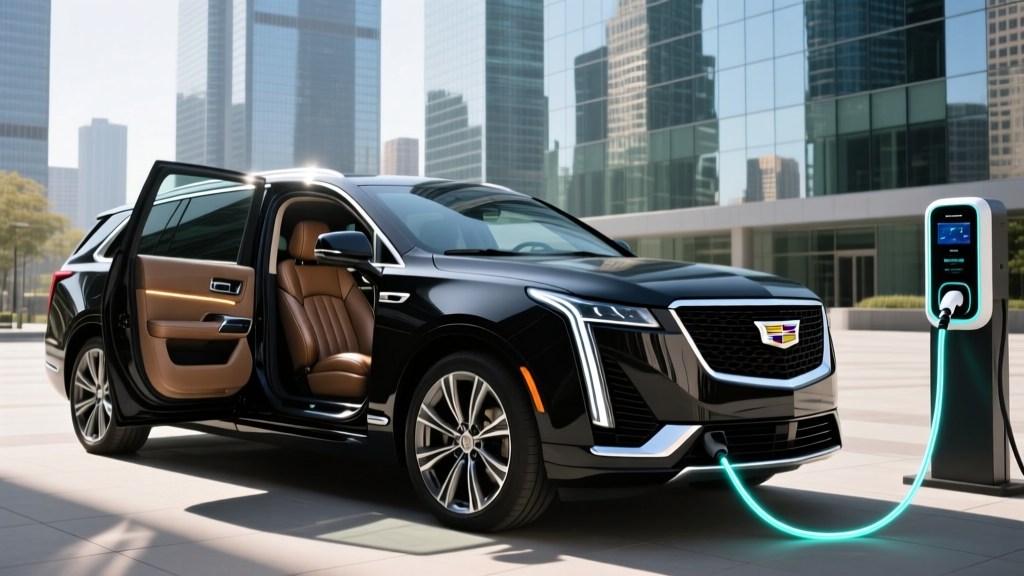
The 2025 Cadillac Escalade IQ Luxury represents General Motors' most ambitious electric luxury statement yet — a full-size, three-row SUV built on the Ultium platform that promises flagship refinement without the fuel stops. With an EPA-estimated 453 miles of range and a starting price near $130,000, the Escalade IQ targets buyers who want the Escalade's commanding presence and premium cabin but are ready to trade the 6.2-liter V8 for a dual-motor battery-electric powertrain. We've analyzed the specs, charging behavior, and ownership economics to help you decide if this electric land yacht deserves a spot in your garage.
Quick Verdict: What the Escalade IQ Luxury Actually Is
The Escalade IQ Luxury is the entry-level trim of Cadillac's all-electric Escalade lineup, sitting below the Sport and Premium Luxury trims. It shares the same 200+ kWh Ultium battery pack, dual-motor all-wheel-drive system, and 55-inch pillar-to-pillar LED display as higher trims but forgoes some performance tuning and premium material options. Think of it as the "sensible" way into the most opulent electric SUV on the market — though at $129,990, "sensible" is relative.
For buyers cross-shopping against the Rivian R1S, Tesla Model X, or even the upcoming electric Lincoln Navigator, the Escalade IQ's key differentiator is sheer scale: this is a true full-size luxury SUV with genuine third-row space, not a mid-sizer wearing a premium badge.
Range, Efficiency, and Real-World Expectations
Real-World Expectation: 370–410 miles highway at 70 mph; 340–380 miles in freezing conditions with climate control active
The Escalade IQ Luxury carries a massive Ultium battery pack with approximately 200 kWh of usable capacity using NMC (nickel manganese cobalt) chemistry. GM has not published the exact gross vs. net figure, but the usable capacity is what matters for daily driving. The NMC chemistry provides the energy density required to push a 9,000-pound SUV past 450 miles, though it trades some cycle-life longevity and thermal stability versus LFP alternatives.
On the EPA combined cycle, the Escalade IQ achieves an estimated 58 MPGe, translating to roughly 57 kWh per 100 miles driven. That efficiency figure is impressive for a vehicle of this mass — for context, the Rivian R1S Dual-Motor returns about 69 MPGe combined, but the R1S is over 2,000 pounds lighter. Physics demands energy, and the Escalade IQ consumes it in proportion to its size.
In real-world driving, expect the 453-mile EPA figure to compress significantly on highway road trips. At sustained 70–75 mph speeds, aerodynamic drag dominates, and our analysis of similar Ultium-platform vehicles (the GMC Hummer EV and Silverado EV) suggests highway range closer to 370–410 miles. In cold weather — particularly below 30°F — battery resistance increases and cabin heating draws substantial power. Without a dedicated heat pump (GM uses a resistive PTC heater supplemented by motor waste-heat recovery), cold-weather range can drop to 340–380 miles. Still, even at the low end, that's enough range for most daily needs and manageable for road trips with one strategic charge stop.
| Specification | Value |
|---|---|
| EPA Range | 453 miles |
| Battery (Usable) | ~200 kWh, NMC chemistry |
| Efficiency | 58 MPGe / ~57 kWh/100 mi |
| Powertrain | Dual-motor AWD |
| Horsepower | 680 hp (Velocity Max: 750 hp) |
| 0–60 mph | ~4.7 seconds (est.) |
| Max DC Fast Charge | 200 kW (peak) |
| 10–80% DC Charge Time | ~37 minutes (est.) |
| Level 2 Home Charging | 19.2 kW / ~46 mi/hr |
| Base MSRP (Luxury) | $129,990 |
| Battery Warranty | 8 years / 100,000 miles |
Charging Speed: DC Fast, Home Level 2, and Real Charge Curves
| Charging Level | Power | Miles Added Per Hour | Notes |
|---|---|---|---|
| Level 1 (120V) | 1.4 kW | ~2 mi/hr | Emergency/trickle only |
| Level 2 (240V, 80A) | 19.2 kW | ~46 mi/hr | Full charge in ~11 hours |
| DC Fast Charge | 200 kW (peak) | ~100 mi in 10 min | 10–80% in ~37 min |
The Escalade IQ supports DC fast charging at up to 200 kW peak via the CCS1 connector (a NACS adapter is available for Tesla Supercharger access). At 200 kW, you can recover roughly 100 miles of range in about 10 minutes under ideal conditions — battery preconditioned, moderate ambient temperature, and starting from a low state of charge.
However, the charge curve matters more than the peak number. With a ~200 kWh battery, the Escalade IQ can sustain high charge rates longer than smaller-pack EVs, but you'll still see tapering above 60% SoC and significant slowdown above 80%. A 10–80% session takes approximately 37 minutes at a capable 350 kW Electrify America or EVgo station. Going from 80–100% adds another 30+ minutes — plan accordingly on road trips and charge only to 80% unless you truly need the final stretch.
For home charging, the Escalade IQ's onboard charger accepts up to 19.2 kW on a 240V, 80-amp Level 2 circuit. This requires a hardwired wall connector and a 100-amp dedicated breaker — most homes will need an electrical panel evaluation. A full overnight charge from near-empty takes roughly 11 hours, which is practical given the massive battery. Most owners will rarely drain below 20%, making a nightly top-up of 4–6 hours sufficient for daily use.
One important consideration: charging a 200 kWh battery at home has real cost implications. At the national average electricity rate of $0.16/kWh (EIA data), a full charge costs approximately $32. Compare that to fueling the gas Escalade's 24-gallon tank at $3.50/gallon ($84), and the per-fill savings are substantial — but the absolute electricity cost is not trivial given the battery's size.
Performance: Powertrain, 0–60, and Driving Dynamics
The Escalade IQ Luxury uses a dual-motor all-wheel-drive configuration producing 680 horsepower and an estimated 615 lb-ft of torque. Engaging Velocity Max mode (available on higher trims and optionally on the Luxury) bumps output to 750 hp, dropping the 0–60 mph time to approximately 4.7 seconds. For a vehicle with a curb weight approaching 9,000 pounds, that acceleration figure is genuinely startling — the instant torque delivery of electric motors makes the Escalade IQ feel far quicker than its mass suggests.
The air suspension with Adaptive Damping provides a compliant ride quality that absorbs highway imperfections with the isolation expected of a six-figure Cadillac. However, the sheer weight is noticeable in cornering and braking. This is not a sport SUV — it's a luxury conveyance that happens to accelerate like one. Steering is light and precise but offers minimal feedback, which suits the grand-touring character.
Towing capacity is rated at 8,000 pounds when properly equipped, matching the gas Escalade. Keep in mind that towing at capacity will reduce range by 30–50%, bringing real-world towing range down to roughly 200–280 miles depending on conditions and terrain.
Interior, Technology, and Cargo Space
The Escalade IQ's cabin is dominated by a 55-inch diagonal pillar-to-pillar LED display that spans the entire dashboard, combining the instrument cluster, central infotainment, and front-passenger screen into one continuous panel. Google Built-in handles navigation, voice assistant, and app integration. A separate lower touchscreen manages climate and vehicle settings. The second row offers executive-style captain's chairs with available folding tray tables and individual climate zones.
Cargo space is generous, befitting a full-size SUV:
- Behind third row: 25.5 cu ft
- Behind second row (third row folded): 72.9 cu ft
- Maximum (all rear seats folded): 132.4 cu ft
- Front trunk (frunk): 12.2 cu ft — a significant bonus for gear that doesn't need cabin access
Legroom measures 44.2 inches in the first row, 40.8 inches in the second, and 32.5 inches in the third. The third row is genuinely usable for adults on shorter trips, a meaningful advantage over mid-size electric SUVs where the third row is strictly for children.
On the driver-assistance front, the Escalade IQ comes equipped with Super Cruise — GM's hands-free Level 2 highway driving system that operates on over 750,000 miles of mapped roads in North America.
Super Cruise provides hands-free steering, acceleration, and braking on compatible highways, but the driver must remain attentive and ready to take over at any time. A driver-monitoring camera ensures eyes remain on the road. This is NOT autonomous or self-driving capability.
Notable tech drawbacks include the absence of a native NACS port (CCS1 with adapter required for Supercharger access) and the sheer complexity of the 55-inch display, which some drivers may find overwhelming compared to a more traditional center-stack layout.
Pricing, Trims, and Federal Tax Credit Eligibility
| Trim | Base MSRP | Est. As-Tested | §30D Credit Eligible? |
|---|---|---|---|
| Luxury | $129,990 | $135,000–$142,000 | No — exceeds MSRP cap |
| Sport | $130,690 | $140,000–$155,000 | No — exceeds MSRP cap |
| Premium Luxury | $149,990 | $155,000–$175,000+ | No — exceeds MSRP cap |
The 2025 Escalade IQ Luxury starts at $129,990 (including destination), with the Sport trim at $130,690 and the Premium Luxury climbing to $149,990. Fully optioned, a Premium Luxury model can approach $175,000.
Regarding the federal §30D clean vehicle credit: the Escalade IQ does not qualify. The IRS caps the credit at vehicles with an MSRP of $80,000 or less for SUVs, and even the base Luxury trim at $129,990 far exceeds that threshold. Additionally, buyer income caps ($300,000 joint / $150,000 single) would eliminate many buyers regardless. The point-of-sale transfer provision is irrelevant here since the vehicle itself is ineligible.
Some states offer their own EV incentives that are not subject to federal MSRP caps — California's CVRP program, for instance, has its own income-based structure. Check your state's energy or environmental agency for specifics, and consult a tax professional for personalized guidance.
Warranty and Long-Term Ownership
GM backs the Escalade IQ's Ultium battery pack with an 8-year / 100,000-mile warranty covering defects and capacity loss below 70% of original capacity. The powertrain (motors, power electronics) carries the same 8-year/100,000-mile coverage. The limited bumper-to-bumper warranty is 4 years / 50,000 miles, and complimentary scheduled maintenance covers the first year or one scheduled visit.
Battery replacement cost for a ~200 kWh Ultium pack is estimated between $25,000 and $35,000 out of warranty — a significant potential expense, though NMC packs in GM's thermal-managed system have shown strong degradation resistance in earlier Ultium applications. Most owners will never approach the replacement threshold within the warranty period.
Who Should Buy the Escalade IQ Luxury?
- You need genuine three-row, full-size SUV space with adult-usable third row
- You want flagship luxury with cutting-edge display technology
- Home Level 2 charging is available and you drive under 400 miles daily
- Super Cruise hands-free highway driving is a priority
- You want to eliminate fuel costs on a large SUV (~$4,000–$6,000/yr gas savings)
- You regularly tow long distances (range drops dramatically under load)
- You live in an area with sparse DC fast-charging infrastructure
- You need a vehicle under the $80,000 federal tax-credit MSRP cap
- Garage space is limited — the Escalade IQ is over 18 feet long
Pros and Cons
- 453-mile EPA range — best in full-size electric SUV class
- Genuine adult-usable third row with 25.5 cu ft cargo behind it
- 55-inch pillar-to-pillar display is visually stunning
- Super Cruise on 750,000+ miles of mapped highways
- 19.2 kW home charging replenishes ~46 mi/hr
- 8,000-lb towing capacity
- 12.2 cu ft frunk adds practical storage
- $129,990 starting price — no federal tax credit eligibility
- CCS1 port requires adapter for Tesla Supercharger access
- ~9,000-lb curb weight impacts tire wear and braking distances
- No heat pump — cold-weather range loss is notable
- Requires 100-amp circuit for max home charging — panel upgrade likely
- High insurance premiums expected for six-figure EV
Frequently Asked Questions
What is the real-world range of the 2025 Escalade IQ?
The EPA estimates 453 miles for the Luxury trim. In real-world highway driving at 70 mph, expect 370–410 miles. In cold weather below 30°F, plan for 340–380 miles. These are still class-leading figures for a full-size electric SUV.
How fast does the Escalade IQ charge at home and on the road?
On DC fast charging, it peaks at 200 kW and can go from 10–80% in approximately 37 minutes. At home on a Level 2, 19.2 kW (80-amp) circuit, it adds about 46 miles of range per hour, with a full charge taking roughly 11 hours.
Does the Escalade IQ qualify for the $7,500 federal EV tax credit?
No. The IRS §30D credit caps eligible SUVs at an MSRP of $80,000. The Escalade IQ Luxury starts at $129,990, making it ineligible regardless of buyer income or battery sourcing. Check your state for separate incentive programs.
Is the Escalade IQ worth buying vs. the Rivian R1S or Tesla Model X?
It depends on your priorities. The Escalade IQ offers significantly more interior space, a more traditional luxury aesthetic, and longer range than either competitor. The Rivian R1S is more off-road capable and starts at ~$79,900 (potentially tax-credit eligible). The Tesla Model X offers faster Supercharger network access natively and a lower starting price but less third-row space and a less premium cabin.
Can the Escalade IQ use Tesla Superchargers?
Yes, but only with GM's NACS adapter. The Escalade IQ ships with a CCS1 port. The adapter enables access to Tesla's Supercharger network, which significantly expands road-trip charging options. GM has been distributing adapters to EV owners — confirm availability with your dealer at purchase.
What does it cost to charge the Escalade IQ at home?
A full charge of the ~200 kWh battery at the national average rate of $0.16/kWh costs approximately $32. Most daily top-ups from 20% to 80% would cost around $19. Annual home charging costs for 12,000 miles of driving are roughly $1,100–$1,300, compared to $3,500–$5,000 in gasoline for the V8 Escalade.