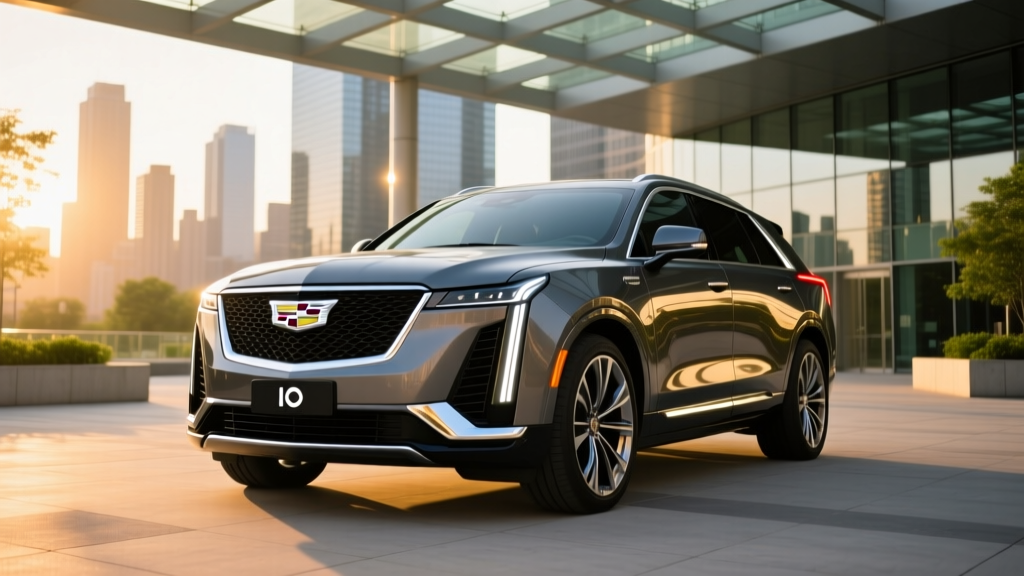
Quick Answer: The 2025 Cadillac Escalade IQ is General Motors' all-electric flagship SUV built on the Ultium platform. It offers an EPA-estimated 460 miles of range from a massive ~200 kWh usable battery, peaks at 350 kW DC fast charging (10–80% in ~25 minutes under ideal conditions), and starts at $129,990. It seats up to seven, produces up to 750 horsepower in Velocity mode, and qualifies for no federal §30D tax credit due to its MSRP exceeding the $80,000 SUV cap. It's best suited for buyers with reliable Level 2 home charging who want a luxury three-row EV with class-leading range.
Range, Battery & Efficiency: What the Numbers Actually Mean
The Escalade IQ carries a usable battery capacity of approximately 200 kWh — one of the largest packs ever fitted to a production passenger vehicle. GM uses NCMA (nickel-cobalt-manganese-aluminum) Ultium pouch cells, prioritizing energy density over the LFP chemistry found in budget-oriented EVs. The result is an EPA-estimated 460 miles of range on the Luxury and Premium Luxury trims, with the Sport trim rated slightly lower at approximately 450 miles due to its 24-inch wheels and stickier tire compound.
Real-World Range Expectation: The 460-mile EPA figure assumes a mix of city and moderate-speed driving in temperate conditions. On sustained 75 mph highway runs, expect closer to 370–400 miles. In sub-freezing winter weather (20–30°F), plan for 300–350 miles depending on cabin heat usage — the Escalade IQ does include a heat pump, which mitigates some cold-weather loss compared to resistive heating systems. These are still class-leading numbers for a three-row luxury EV.
| Specification | Value |
|---|---|
| EPA Range (Luxury/Premium Luxury) | 460 miles |
| EPA Range (Sport) | ~450 miles |
| Battery (usable) | ~200 kWh, NCMA Ultium |
| Peak DC Fast Charge Rate | 350 kW (800V architecture) |
| 10–80% DC Fast Charge | ~25 minutes (ideal conditions) |
| Level 2 Charge Rate | 11.5 kW (onboard charger) |
| Level 2 Full Charge Time (0–100%) | ~17–18 hours |
| Horsepower (Velocity Max) | 750 hp |
| 0–60 mph | ~3.5 seconds (Velocity Max) |
| Seating | Up to 7 passengers |
| Starting MSRP (Luxury 1EQ) | $129,990 |
| Battery/Powertrain Warranty | 8 years / 100,000 miles |
Efficiency is measured at roughly 2.1–2.3 kWh/mile depending on trim and driving style, translating to approximately 66–70 MPGe combined per EPA data on fueleconomy.gov. For a vehicle weighing over 8,500 pounds, that figure reflects the advantage of GM's 800V Ultium platform, though it still consumes significantly more energy per mile than lighter EVs like the Hyundai Ioniq 5 or Tesla Model Y.
Charging the Escalade IQ: Home, Public & What You'll Actually Pay
Charging a 200 kWh battery is a fundamentally different proposition than topping off a 75 kWh crossover. Understanding the math is essential before committing to this vehicle.
| Charging Level | Power (kW) | Miles Added per Hour | Time 10–80% |
|---|---|---|---|
| Level 1 (120V / 12A) | ~1.4 kW | ~3 mi/hr | ~95+ hours |
| Level 2 (240V / 48A) | 11.5 kW | ~23 mi/hr | ~12–13 hours |
| DC Fast (350 kW peak) | Up to 350 kW | Up to ~100 mi in 10 min | ~25 minutes |
Home charging reality: Level 1 (standard 120V outlet) is functionally useless for daily use on a battery this size — you'd add roughly 35 miles overnight. A Level 2 home charger is not optional; it's mandatory. With an 11.5 kW onboard charger and a 48-amp hardwired Level 2 station, a full overnight replenishment takes roughly 17–18 hours from empty. Most owners will arrive home with 40–60% remaining and wake up fully charged in 7–10 hours, which is practical.
Home installation cost: Expect to pay $800–$1,500 for a quality 48-amp Level 2 charger (such as a ChargePoint Home Flex or Emporia Vue) and $1,500–$4,000 for professional electrical installation including a 60-amp dedicated circuit. If your home's electrical panel needs an upgrade from 100A to 200A service, add $2,000–$5,000. Consult a licensed electrician for a site-specific quote.
DC fast charging: The Escalade IQ's 800V architecture allows peak charging at 350 kW on compatible stations. However, charging curves taper significantly above 80% state of charge. The 10–80% sprint takes approximately 25 minutes under ideal thermal conditions with a preconditioned battery. On Electrify America or Tesla Supercharger (via NACS adapter, which GM now supports), real-world sessions often average 180–220 kW sustained, stretching the 10–80% window to 30–35 minutes. That's enough time for a meal stop on a road trip, but the sheer battery size means even "fast" charging involves patience.
Escalade IQ vs. Gas Escalade: Cost of Ownership Breakdown
The most common buyer question: does going electric save money on a six-figure luxury SUV? Let's compare the 2025 Escalade IQ against the 2025 gas Escalade (6.2L V8, 420 hp) over a 5-year, 75,000-mile ownership period.
| Cost Category | Escalade IQ (EV) | Gas Escalade (6.2L V8) |
|---|---|---|
| Base MSRP | $129,990 | $83,895 (Premium Luxury) |
| Federal Tax Credit (§30D) | $0 (exceeds $80K SUV cap) | $0 |
| Fuel/Energy (75K mi) | ~$3,400 (home charging, $0.15/kWh) | ~$14,100 (14 MPG, $3.75/gal) |
| Maintenance (5 yr) | ~$1,200 (cabin filter, wipers, tires) | ~$4,500 (oil, brakes, trans fluid) |
| Insurance (est. annual avg) | ~$4,200/yr ($21,000 total) | ~$3,200/yr ($16,000 total) |
| Estimated Depreciation (5 yr) | ~$52,000 (40%) | ~$38,000 (45%) |
| 5-Year Total | ~$207,590 | ~$156,495 |
Key takeaway: The Escalade IQ saves roughly $10,700 in fuel and $3,300 in maintenance over five years, but those savings are overwhelmed by the ~$46,000 higher purchase price and elevated insurance premiums. This is not an EV you buy to save money. It's an EV you buy for the driving experience — instant torque, silent operation, zero tailpipe emissions — and the range confidence that 460 EPA miles provides.
The gas Escalade achieves approximately 14 MPG combined per fueleconomy.gov. At 75,000 miles, that's 5,357 gallons of premium fuel. The IQ's energy equivalent is roughly 16,500 kWh. The cost gap narrows if you have access to free workplace or solar-offset charging, and widens further if you rely exclusively on expensive public DC fast chargers ($0.40–$0.60/kWh in many markets).
Federal Tax Credit, Incentives & What You'll Actually Pay
The 2025 Escalade IQ does not qualify for the federal §30D clean vehicle tax credit. Under current IRS rules, SUVs must have an MSRP at or below $80,000 to be eligible. At $129,990 and up, the Escalade IQ exceeds this cap by a wide margin. Per IRS guidance on irs.gov, income limits ($300K joint / $150K single), battery sourcing requirements, and the point-of-sale transfer option are all irrelevant here — the MSRP cap alone disqualifies it.
Some state and local incentives may still apply. States like California, Colorado, and New York offer rebates or HOV lane access for zero-emission vehicles regardless of price, though amounts and eligibility vary by jurisdiction. Check your state's energy office or DMV for current programs.
Corporate fleet buyers and those with commercial-use eligibility may be able to leverage the §45W commercial clean vehicle credit, which has different MSRP rules — consult a tax professional for specifics.
Real-World Ownership: Who Should (and Shouldn't) Buy This EV
The Escalade IQ is not a mass-market EV. It's a statement vehicle for a specific buyer profile. Here's a practical framework:
Buy the Escalade IQ if:
- You have a garage or dedicated parking spot with 240V/60A circuit access for Level 2 charging
- You drive 300+ miles regularly and value not stopping to charge on most single-day trips
- You want three-row seating with premium luxury appointments and EV silence/torque
- You're upgrading from a gas Escalade or similar large luxury SUV and want to eliminate tailpipe emissions
- You can absorb the purchase price without needing tax-credit offsets
Skip the Escalade IQ if:
- You live in an apartment or lack reliable overnight Level 2 charging access — a 200 kWh battery on Level 1 is impractical
- You frequently drive in extreme cold (below 10°F) where range drops to ~300 miles and charging slows further
- Total cost of ownership is a primary purchase driver — the gas Escalade or a hybrid large SUV will cost significantly less over 5 years
- You regularly tow heavy loads — towing a 7,000+ lb trailer can cut EV range by 40–50%, dropping effective range to ~200–230 miles
Climate and Driving Pattern Considerations
The Escalade IQ's heat pump is a meaningful advantage in moderate-cold climates (30–45°F), reducing HVAC energy draw compared to resistive heaters. In deep cold (below 15°F), however, battery chemistry and cabin heating demands still impose a 25–35% range penalty. If you live in northern Minnesota or Montana, plan your winter trips around ~300 miles of usable range and longer charging sessions due to cold-soaked battery preconditioning delays.
For highway-dominant commuters in warm climates (Southern California, Texas, Florida), the 460-mile range is genuinely achievable, and home charging at off-peak utility rates ($0.10–$0.15/kWh) makes daily "fueling" costs roughly $1.50–$2.50 for a 50-mile round trip — compared to $12–$15 in the gas Escalade.
Common Misconceptions About the Escalade IQ
| Myth | Fact |
|---|---|
| "It qualifies for the $7,500 federal tax credit." | No — the MSRP cap for SUVs under §30D is $80,000. The IQ starts at $129,990. |
| "You can charge it overnight on a regular wall outlet." | Level 1 adds ~3 miles/hour. You'd need 95+ hours for a full charge. Level 2 is mandatory. |
| "460 miles means I'll always get 460 miles." | EPA is a lab estimate. Highway driving at 75+ mph yields ~370–400; winter cold drops it to ~300–350. |
| "The 350 kW charge rate means it always charges that fast." | Peak rate applies only between ~10–30% SoC with a preconditioned battery. Average rate across the 10–80% session is ~180–220 kW. |
| "Electric means no maintenance costs." | Tires wear faster due to weight and instant torque. Cabin filters, wiper fluid, brake fluid checks, and software updates still apply. |
Driving, Technology & Super Cruise
The Escalade IQ delivers up to 750 horsepower and 785 lb-ft of torque in Velocity Max mode, launching the 8,500-pound SUV to 60 mph in approximately 3.5 seconds. That's supercar acceleration from a three-row luxury vehicle, and the instant electric torque makes highway merging effortless without the downshift lag of the gas V8.
Cadillac's Super Cruise — a Level 2 hands-free driver-assistance system on compatible mapped highways — is standard or available depending on trim. Per SAE automation definitions, Level 2 requires the driver to remain attentive and ready to take over at any time. This is not self-driving. Super Cruise covers over 750,000 miles of compatible roads in North America and includes automatic lane changes, but the driver must keep eyes on the road as monitored by a steering-column camera.
The interior features a pillar-to-pillar 55-inch LED display, executive second-row seating with massage and recline, and a available 36-speaker AKG Studio Reference audio system. Cargo volume behind the third row is competitive with the gas Escalade, though the Ultium battery platform eliminates any under-floor storage depth.
Frequently Asked Questions
What is the real-world range of the 2025 Cadillac Escalade IQ?
The EPA rates it at 460 miles (Luxury/Premium Luxury trims). In real-world highway driving at 70–75 mph, expect 370–400 miles. In winter conditions below freezing, plan for 300–350 miles. These are still best-in-class figures for a three-row electric SUV.
How long does it take to charge the Escalade IQ at home?
On a 48-amp Level 2 home charger (11.5 kW), a full 0–100% charge takes approximately 17–18 hours. Most owners who plug in at 30–50% remaining will reach full overnight in 7–10 hours. Level 1 (120V) is not practical for daily use on a 200 kWh battery.
Does the Escalade IQ qualify for any federal EV tax credit?
No. Under IRS §30D rules, SUVs must have an MSRP of $80,000 or less. The Escalade IQ starts at $129,990, disqualifying it entirely. Some state-level incentives may still apply — check your local energy office.
Can I tow with the electric Escalade?
GM rates the IQ for up to 8,000 pounds of towing capacity. However, towing at or near maximum capacity can reduce range by 40–50%, dropping effective range to roughly 200–230 miles. Plan charging stops accordingly if you tow frequently.
How does Super Cruise differ from full self-driving?
Super Cruise is an SAE Level 2 driver-assistance system — it handles steering, acceleration, and braking on mapped highways, but the driver must remain attentive and ready to intervene. It is not autonomous driving (Level 4). Think of it as an advanced cruise control, not a replacement for the driver.
What does it cost to charge vs. fuel a gas Escalade?
At $0.15/kWh (national average home rate), charging the IQ costs about $0.045 per mile, or roughly $3,400 over 75,000 miles. The gas Escalade at 14 MPG and $3.75/gallon costs about $0.27 per mile, or $14,100 over the same distance — a savings of ~$10,700 in energy costs for the EV. Public DC fast charging at $0.48/kWh reduces the EV savings to roughly $6,000.
What is the battery warranty?
GM covers the Escalade IQ's Ultium battery for 8 years or 100,000 miles, whichever comes first, against defects and capacity loss below 70% of original capacity. This is standard for the industry and consistent with Cadillac's official warranty terms.