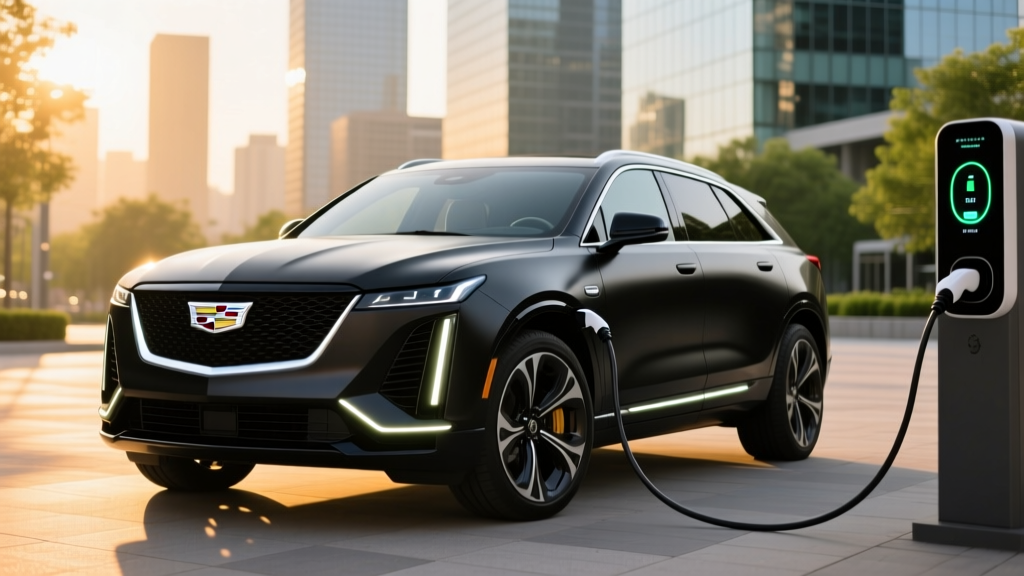
The 2025 Cadillac Escalade IQ electric SUV represents General Motors' most ambitious luxury EV statement yet — a full-size, three-row flagship built on the Ultium platform that promises to deliver the presence of a traditional Escalade without the fuel bill. With an EPA-estimated range exceeding 450 miles, a massive battery pack, and a starting price north of $130,000, the Escalade IQ targets affluent buyers who want silent, instant-torque luxury without compromise. Here's everything you need to know before putting down a deposit.
Range and Efficiency: The 450-Mile Promise
The Escalade IQ leverages a cavernous 200+ kWh Ultium battery pack using NMC (nickel manganese cobalt) chemistry — chosen for its high energy density, which is critical in a vehicle this heavy. GM has targeted an EPA-estimated range of 450 miles for the base configuration, a figure that would place the Escalade IQ among the longest-range EVs ever sold in the United States.
EPA estimate: 450 miles. In real-world driving, expect approximately 370–400 miles in mixed highway/city use at moderate temperatures. At sustained 75+ mph highway speeds, large SUVs face significant aerodynamic drag — anticipate 340–370 miles. In cold weather (below 30°F), NMC chemistry and cabin heating demands can reduce range by 20–30%, potentially dropping effective range to 310–360 miles. The Escalade IQ's standard heat pump helps mitigate this, but physics is physics when you're pushing a 9,000+ lb vehicle through winter air.
Efficiency is rated at approximately 58 kWh/100 miles combined, which translates to roughly 60 MPGe. That's not class-leading — the aerodynamic profile of a full-size luxury SUV and its substantial curb weight work against it — but buyers in this segment prioritize range and comfort over efficiency metrics. For comparison, the Rivian R1S achieves around 69 MPGe combined but carries a significantly smaller battery and less range.
Battery, Platform, and Powertrain Specs
| Specification | Value |
|---|---|
| Battery Capacity (usable) | ~200 kWh (NMC chemistry) |
| EPA Range (est.) | 450 miles |
| Drivetrain | Dual-motor AWD (eAWD) |
| Horsepower (Velocity mode) | 750 hp |
| Torque | 785 lb-ft |
| 0–60 mph | Under 5.0 seconds |
| Max DC Fast Charge | ~350 kW (800V architecture) |
| 10–80% DC Charge Time | ~30 minutes (estimated) |
| Level 2 Home Charging | 19.2 kW / ~36 mi/hr |
| Platform | GM BT1 (Ultium) |
| Seating | 7 passengers (3 rows) |
| Cargo (behind 3rd row) | ~23 cu ft |
| Cargo (all rows folded) | ~120+ cu ft |
| Battery Warranty | 8 years / 100,000 miles |
| Base MSRP (Luxury) | $129,990 |
| Top Trim MSRP (V-Series) | $149,990+ |
The dual-motor all-wheel-drive system is standard across all trims, providing the traction and torque distribution expected of a flagship Cadillac. In the available Velocity mode, the Escalade IQ unlocks its full 750 horsepower output — enough to propel this three-row luxury liner to 60 mph in under 5.0 seconds. That's remarkable for a vehicle of this size and puts it in the company of performance sedans, not just SUVs.
The 800-volt electrical architecture is a critical differentiator. It enables faster charging, more efficient power delivery, and lighter wiring harnesses compared to the 400V systems found in many competitors. This architecture is shared with the GMC Hummer EV and Chevrolet Silverado EV, proving its durability in demanding applications.
Charging Speed: DC Fast and Home Level 2
Charging a 200+ kWh battery is a marathon, not a sprint — but the Escalade IQ's 800V system and ~350 kW peak DC fast-charge capability make it manageable. Here's what to expect across charging levels:
| Charging Level | Power (kW) | Miles Added/Hour | Typical Use Case |
|---|---|---|---|
| Level 1 (120V outlet) | ~1.4 kW | ~2–3 mi/hr | Emergency top-up only |
| Level 2 (240V, 48A) | 11.5 kW | ~20 mi/hr | Standard home charger |
| Level 2 (240V, 80A) | 19.2 kW | ~36 mi/hr | High-power home (recommended) |
| DC Fast Charge | Up to ~350 kW | Up to ~200+ mi in 10 min | Road trips, public stations |
DC fast charging reality: While the Escalade IQ can peak near 350 kW at compatible chargers, sustained rates depend on state of charge, battery temperature, and ambient conditions. Expect the charge curve to taper significantly above 80% state of charge — a 10–80% session should take approximately 30 minutes at a capable 350 kW station. However, finding stations that can consistently deliver 350 kW remains a challenge; most Electrify America and EVgo stations max out at 150–350 kW, and real-world peak rates may be lower depending on station load and connector temperature.
Home charging recommendation: With a battery this large, a standard 11.5 kW Level 2 charger adds only about 20 miles per hour — meaning a full 0–100% charge takes over 17 hours. Cadillac recommends a 19.2 kW (80A) Level 2 home charger for Escalade IQ owners, which requires a dedicated 100-amp circuit. Budget $1,500–$3,500 for professional installation depending on your electrical panel capacity. Many homes will require a panel upgrade (200A to 400A service), adding $2,000–$5,000 to the project. Consult a licensed electrician before purchasing equipment.
The Escalade IQ uses the NACS (North American Charging Standard) connector natively, giving it direct access to Tesla's Supercharger network — a significant advantage for road-trip charging reliability. According to Cadillac's official Escalade IQ page, the vehicle is also compatible with CCS stations via adapter.
Interior, Technology, and Driver Assistance
The Escalade IQ's cabin is where Cadillac justifies its flagship pricing. The dashboard is dominated by a 55-inch total LED display surface spanning pillar to pillar — a hyperscreen-style layout that integrates the instrument cluster, infotainment, and a dedicated passenger display. Google Built-In provides native Google Maps navigation (essential for EV route planning with charging stops), Google Assistant voice control, and access to the Play Store.
Notable tech features include:
- Super Cruise — GM's hands-free Level 2 driver-assistance system, operational on over 750,000 miles of mapped highways in North America. The driver must remain attentive; a camera monitors eye direction.
- Executive Second-Row Seating — available 16-way power-adjustable captain's chairs with massage, heating, ventilation, and fold-out tray tables
- AKG Studio Reference audio — a 38-speaker surround system with headrest speakers
- Air Ride Adaptive Suspension — automatic load leveling and adjustable ride height for entry/exit and highway efficiency
- 4-Wheel Steer — rear-wheel steering reduces the turning circle by several feet, critical for a vehicle this long
- Vehicle-to-Load (V2L) — power external devices or tools from the traction battery
Super Cruise is classified as SAE Level 2 driver assistance. It handles steering, acceleration, and braking on compatible highways, but the driver must remain engaged and ready to take over at any time. It does not handle construction zones, unmapped roads, or complex urban environments. Keep your eyes on the road — the driver-monitoring camera will enforce this.
Passenger and cargo space: The Escalade IQ offers three rows of seating for up to seven passengers. Second-row legroom is generous at approximately 42 inches, while the third row accommodates adults for shorter trips with around 35 inches of legroom. Cargo volume behind the third row measures approximately 23 cubic feet, expanding to 120+ cubic feet with both rear rows folded — competitive with the long-wheelbase Escalade ESV.
Pricing, Trims, and Federal Tax Credit Eligibility
| Trim | Base MSRP | Federal Tax Credit | Effective Price* |
|---|---|---|---|
| Luxury | $129,990 | $0 (over MSRP cap) | $129,990 |
| Sport | $132,990 | $0 (over MSRP cap) | $132,990 |
| Premium Luxury | $139,990 | $0 (over MSRP cap) | $139,990 |
| V-Series | $149,990+ | $0 (over MSRP cap) | $149,990+ |
Federal tax credit status: The Escalade IQ does not qualify for the IRS §30D federal EV tax credit. Under current rules, SUVs must have an MSRP at or below $80,000 to be eligible. At $129,990 and up, the Escalade IQ exceeds this cap by a wide margin. Additionally, buyers must meet income thresholds ($300,000 joint / $150,000 single for the new-vehicle credit) and the vehicle must meet battery critical-mineral and component sourcing requirements. None of these matter here — the MSRP cap alone disqualifies every trim. Do not factor the $7,500 federal credit into your purchase budget for this vehicle.
*Effective price does not include destination charges, dealer fees, state/local incentives (which may apply — check your state's EV rebate program), or taxes. Consult a tax professional for advice specific to your situation.
Warranty and Long-Term Ownership
GM backs the Escalade IQ's Ultium battery pack and electric drive components with an 8-year / 100,000-mile warranty, with a capacity retention threshold of 70% — meaning GM guarantees the battery will hold at least 70% of its original capacity within that period. If degradation falls below this threshold, GM will repair or replace the battery at no cost.
The limited vehicle warranty covers 4 years / 50,000 miles, with roadside assistance for 6 years / 70,000 miles. For a vehicle in this price range, some competitors offer longer basic warranties — Rivian provides 5 years / 60,000 miles on the vehicle and 8 years / 175,000 miles on the battery, which is worth noting.
Battery replacement cost: While no one expects to need a replacement under normal ownership, a 200+ kWh NMC pack of this size would likely cost $25,000–$40,000+ out of warranty based on current Ultium module pricing. Proper care — avoiding frequent DC fast charging to 100%, using preconditioning, and keeping state of charge between 20–80% for daily driving — will maximize longevity. According to fueleconomy.gov, modern lithium-ion EV batteries are designed to last the life of the vehicle under normal use.
Escalade IQ vs. the Competition
The Escalade IQ doesn't have a direct rival at its price point and size, but several vehicles compete for the same buyer:
- Tesla Model X (~$80,000–$110,000): Lower price, faster charging, Supercharger access, but significantly smaller interior, fewer luxury appointments, and no third row suited for adults long-term. The Model X is a performance-first EV; the Escalade IQ is a luxury-first EV.
- Rivian R1S (~$80,000–$100,000): More off-road capable, qualifies for the $7,500 tax credit on eligible trims, smaller battery (~149 kWh max), and less range. Excellent for adventure-oriented families.
- Mercedes-Benz EQS SUV (~$105,000–$130,000): Closer competitor in luxury and tech, but only three rows as an option, ~305-mile EPA range, and slower DC charging. The EQS SUV is more car-like; the Escalade IQ commands more road presence.
- GMC Hummer EV SUV (~$100,000–$140,000): Shares the Ultium platform and 800V architecture, more off-road focused, less refined interior. The Hummer is the Escalade IQ's mechanical sibling with a completely different personality.
- You need genuine three-row adult seating with luxury appointments
- 450-mile range is a priority for long-distance travel without frequent stops
- Super Cruise hands-free highway driving appeals to you
- Budget is $130,000+ and the federal tax credit is irrelevant to you
- You want NACS native access to the Supercharger network
- Tax credit eligibility is important (consider Rivian R1S or Tesla Model X)
- You prioritize off-road capability (Rivian R1S or Hummer EV)
- You want the fastest possible DC charging (Tesla Model X at V3/V4 Superchargers)
- You don't need three rows and want to save $30,000+ (Mercedes EQS SUV)
Pros and Cons
Pros
- Class-leading 450-mile EPA range for a full-size luxury SUV
- 800V architecture with ~350 kW peak DC charging
- NACS connector — native Supercharger access
- 750 hp Velocity mode — sports-car acceleration in a three-row SUV
- Super Cruise hands-free driving on 750,000+ miles of highway
- Massive 55-inch display surface with Google Built-In
- Genuine adult-capable third row with strong cargo volume
- 4-Wheel Steer dramatically improves maneuverability
Cons
- $130,000+ starting price — no federal tax credit eligibility
- 200+ kWh battery means very long home charging times (17+ hours at 11.5 kW)
- Requires 80A/19.2 kW home charger for practical overnight charging — costly install
- Heavy vehicle — expect significant cold-weather range loss (20–30%)
- Efficiency of ~58 kWh/100mi is poor vs. smaller EVs
- Availability limited — high demand and constrained initial production
- Insurance premiums expected to be substantial at this MSRP
Frequently Asked Questions
What is the real-world range of the 2025 Cadillac Escalade IQ?
The EPA estimates 450 miles, but real-world highway driving at 75 mph will likely yield 340–370 miles. In cold weather below 30°F, expect 310–360 miles depending on cabin heating use and driving style. The heat pump helps, but a 9,000+ lb vehicle moving through cold, dense air demands significant energy.
How fast does the Escalade IQ charge?
On a 350 kW DC fast charger, the Escalade IQ can add approximately 200 miles of range in 10 minutes and charge from 10–80% in roughly 30 minutes. At home on a 19.2 kW Level 2 charger, expect about 36 miles of range per hour. A full charge from empty takes 10–11 hours at 19.2 kW, or 17+ hours on a standard 11.5 kW home charger.
Does the Escalade IQ qualify for the federal EV tax credit?
No. The IRS §30D credit caps SUV eligibility at $80,000 MSRP. The Escalade IQ starts at $129,990, disqualifying all trims. State and local incentives may still apply — check your state's energy office or DMV for current programs.
Is the Escalade IQ worth buying vs. the Tesla Model X or Rivian R1S?
If your priorities are maximum interior space, traditional luxury craftsmanship, and 450-mile range, the Escalade IQ has no equal. The Model X is faster-charging and cheaper but far less luxurious inside. The R1S is more adventure-capable and qualifies for the tax credit but offers less range and a smaller third row. Your decision should hinge on budget, tax-credit relevance, and whether you prioritize luxury or performance/adventure.
What home electrical upgrades will I need?
For the recommended 19.2 kW (80A) Level 2 charger, you'll need a dedicated 100-amp circuit. Many homes with 200-amp main panels won't have sufficient spare capacity and may require a panel upgrade to 400-amp service ($2,000–$5,000). Get a load calculation from a licensed electrician before committing to equipment.
How long will the Ultium battery last?
GM warranties the battery for 8 years / 100,000 miles with a 70% capacity retention guarantee. Real-world data from other Ultium vehicles is still accumulating, but NMC packs with active thermal management typically lose 10–15% capacity over 150,000–200,000 miles under normal use. Avoid habitual DC fast charging and frequent 100% charges to maximize longevity.
Sources: Cadillac Escalade IQ Official Page, IRS §30D Clean Vehicle Credit Rules, fueleconomy.gov EV Technology.