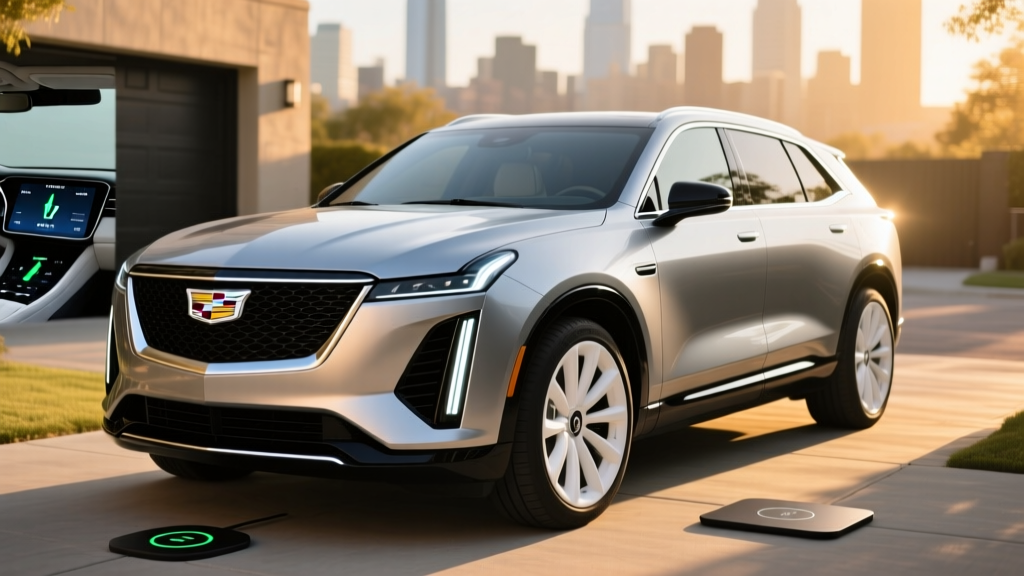
Quick Answer: The 2025 Electric Escalade — officially named the Cadillac Escalade IQ — is GM's flagship luxury EV SUV. It delivers an EPA-estimated 460 miles of range from a massive 200+ kWh Ultium battery, charges at up to 350 kW DC fast charging (adding ~100 miles in 10 minutes), and starts at $129,990 before destination. It does not qualify for the federal §30D tax credit due to its MSRP exceeding the $80,000 SUV cap. If you're cross-shopping the gas Escalade, the IQ eliminates fuel and most maintenance costs but demands home Level 2 charging access and a significant upfront premium.
What Exactly Is the 2025 Electric Escalade?
When buyers search for the "2025 electric Escalade," they're looking for the Cadillac Escalade IQ — a ground-up electric luxury SUV built on GM's BT1 electric truck platform (shared with the Silverado EV and Sierra EV). This is not a converted gas Escalade; it's a dedicated battery-electric vehicle with a flat floor, available four-wheel steering, and a 24-module Ultium battery pack.
Cadillac positions the Escalade IQ as the electric successor to one of America's most recognizable luxury nameplates. The gas-powered Escalade continues alongside it, giving buyers a genuine choice between internal combustion and electric propulsion in the same showroom.
| Specification | Value |
|---|---|
| EPA Range (est.) | ~460 miles (Luxury trim); ~440 miles (Sport trim) |
| Battery Capacity | 200+ kWh usable (Ultium, NMC chemistry) |
| Peak DC Fast Charge Rate | 350 kW (800V architecture) |
| 10–80% DC Charge Time | ~25–30 minutes (at 350 kW-capable station) |
| Level 2 Charging (AC) | 19.2 kW onboard charger (~11.5 kW typical home) |
| Horsepower | Up to 750 hp (Velocity Max mode) |
| 0–60 mph | Under 5.0 seconds (estimated, Velocity Max) |
| Towing Capacity | Up to 8,000 lbs (estimated) |
| Starting MSRP | $129,990 (Luxury); $130,490 (Sport) |
| Federal Tax Credit (§30D) | Not eligible (exceeds $80,000 SUV MSRP cap) |
| Battery/Powertrain Warranty | 8 years / 100,000 miles |
Range Reality: EPA Sticker vs. Real-World Miles
The Escalade IQ's estimated 460-mile EPA range is headline-grabbing, but real-world conditions rarely match laboratory estimates. Here's what to actually expect based on physics and testing patterns from GM's Ultium platform vehicles:
EPA Estimate: ~460 miles (Luxury trim, 24-inch wheels may reduce to ~440)
Real-World Highway (70–80 mph): Expect 350–390 miles. Aerodynamic drag at highway speeds disproportionately affects a vehicle this size (estimated 10,000+ lb curb weight, large frontal area).
Cold Weather (below 32°F): Expect 300–340 miles. NMC chemistry loses efficiency in cold temperatures, and cabin heating draws significant energy. The Escalade IQ's heat pump helps mitigate this, but physics wins.
Mixed Driving (city/highway/errands): Expect 380–420 miles in moderate climates — still exceptional for any EV.
For context, the gas-powered 2025 Escalade with the 6.2L V8 achieves roughly 16 mpg combined per fueleconomy.gov. With a 24-gallon tank, that's about 384 miles of real-world range — meaning the IQ actually matches or exceeds the gas model's range in most conditions, a first for a full-size electric SUV.
Charging the Escalade IQ: What You Need to Know
A 200+ kWh battery is enormous — larger than most home battery walls — and charging it requires planning. The Escalade IQ uses an 800-volt architecture, enabling peak DC fast charging at 350 kW on compatible stations like Electrify America's newest 350 kW chargers or Tesla Superchargers (via GM's NACS adapter, included with the vehicle for 2025+ models).
| Charging Level | Power (kW) | Miles Added Per Hour | Full 0–100% Time | Best For |
|---|---|---|---|---|
| Level 1 (120V household) | ~1.4 kW | ~3–4 miles/hr | ~60+ hours | Emergency trickle only |
| Level 2 (240V, 48A home charger) | ~11.5 kW | ~28–32 miles/hr | ~14–16 hours | Daily overnight charging |
| Level 2 (240V, 80A / 19.2 kW capable) | ~19.2 kW | ~45–50 miles/hr | ~9–10 hours | Faster home / depot charging |
| DC Fast Charge (350 kW peak) | Up to 350 kW | ~600+ miles/hr (peak) | 10–80% in ~25–30 min | Road trips |
Charging curve reality: The 350 kW peak rate only holds at low states of charge (roughly 10–30% SoC). Expect the rate to taper to ~200 kW by 50% SoC and ~100 kW by 70% SoC. This is normal for all EVs and why the 10–80% metric matters more than peak kW. On a road trip, plan 25–35 minute stops at 350 kW stations — not the "100 miles in 10 minutes" marketing claim, which applies only at optimal low-SoC conditions.
Home charging is essential. A 200 kWh battery cannot practically be charged on Level 1 (standard outlet). You'll need a dedicated 240V Level 2 circuit — ideally a 60A or 80A circuit with a hardwired charger. Expect $1,200–$3,500 for a professional home installation (charger + electrician + permit), potentially more if your electrical panel needs upgrading to 200A service. Per Energy.gov, most EV owners charge 80%+ of their miles at home.
Cost Breakdown: Escalade IQ vs. Gas Escalade
The upfront premium is steep, but ownership costs tell a more nuanced story. Here's a 5-year comparison assuming 15,000 miles/year, $3.50/gallon gas, and $0.14/kWh home electricity:
| Cost Category | Escalade IQ (Electric) | Gas Escalade (6.2L V8) |
|---|---|---|
| Base MSRP | $129,990 | $83,895 |
| Federal Tax Credit | $0 (MSRP cap exceeded) | $0 |
| Fuel/Energy (5 yrs, 75K mi) | ~$5,250 (home charging) | ~$24,600 (16 mpg avg) |
| Maintenance (5 yrs) | ~$1,500 (tire rotation, cabin filter, fluid top-offs) | ~$5,500 (oil, filters, brakes, spark plugs) |
| Insurance (est. annual) | ~$4,200/yr ($21,000 total) | ~$3,400/yr ($17,000 total) |
| Estimated Depreciation (5 yr) | ~$52,000 (40%) | ~$38,000 (45%) |
| 5-Year Total Cost | ~$209,740 | ~$169,995 |
| Cost Per Mile | ~$2.80/mi | ~$2.27/mi |
The verdict: The Escalade IQ saves roughly $19,350 in fuel and $4,000 in maintenance over five years — about $23,350 total in operational savings. But the $46,095 MSRP premium and higher insurance costs mean the gas Escalade remains the more economical choice on pure cost. The IQ's value proposition is refinement, instant torque, silent operation, and zero tailpipe emissions — not financial payback.
If you charge primarily on public DC fast chargers at $0.40–$0.60/kWh, your energy cost rises to $12,000–$18,000 over five years, significantly eroding the fuel savings advantage. Home charging access is a prerequisite for the IQ's economics to work.
Common Misconceptions About the Electric Escalade
| Myth | Fact |
|---|---|
| "It qualifies for the $7,500 federal tax credit." | False. The §30D credit caps SUV MSRP at $80,000. At $129,990, the IQ is ineligible. See IRS §30D guidelines for current rules. |
| "The range isn't enough for road trips." | False. 460 EPA miles means 350+ real highway miles — enough for most drives between major charging corridors. The 350 kW DC fast charging adds meaningful range in a typical rest stop. |
| "I can charge it on a regular outlet." | Technically yes, practically no. Level 1 adds ~3 miles/hour. A full charge would take 60+ hours. A 240V Level 2 home charger is mandatory for daily ownership. |
| "It's basically a self-driving car." | False. The Escalade IQ offers Super Cruise (hands-free on compatible highways), which is SAE Level 2 — you must remain attentive and ready to take over. It is not autonomous. |
| "The battery will need replacing in a few years." | Highly unlikely. GM's Ultium batteries are warrantied for 8 years/100,000 miles with a capacity retention threshold (~70%). Real-world Ultium degradation data from the Hummer EV and Lyriq suggests 5–10% loss over 100K miles — far from needing replacement. |
Who Should Buy the Escalade IQ (and Who Shouldn't)
Buy the Escalade IQ if:
- You have home Level 2 charging (or can install it) and drive under 350 miles daily
- You value silent, vibration-free luxury and instant electric torque (750 hp in Velocity Max)
- You want a three-row luxury SUV with cutting-edge tech and don't mind paying a premium
- You tow occasionally (up to ~8,000 lbs) and want electric torque for trailer launches
- You live in an area with reliable DC fast-charging infrastructure (Electrify America, Tesla Superchargers via NACS adapter)
Stick with the gas Escalade (or wait) if:
- You cannot install home charging — public-only charging a 200 kWh battery is expensive and time-consuming
- You regularly drive 400+ miles in a single day in cold weather where real range drops below 300 miles
- The $46,000+ upfront premium over the gas model is a dealbreaker for your budget
- You live in a charging desert (rural areas with sparse DC fast-charging coverage)
- You want federal tax credit savings — the IQ doesn't qualify, but some smaller luxury EVs do
First-Time EV Buyer Essentials for the Escalade IQ
If this is your first electric vehicle, the Escalade IQ is a deep end to jump into. Here's what matters most:
1. Install your home charger before delivery. Schedule a licensed electrician to install a 240V, 60A (minimum) circuit with a NACS or J1772 connector. Budget $1,200–$3,500. If your home has 100A electrical service, you'll likely need a panel upgrade to 200A ($1,500–$3,000 additional) to support a 19.2 kW charger alongside normal household loads.
2. Understand kW vs. kWh. This is the single most common confusion. kWh (kilowatt-hours) measures energy — think of it as the "gallons" in your battery tank. The Escalade IQ has ~200 kWh. kW (kilowatts) measures power — the rate at which energy flows. A 350 kW charger fills that tank faster than an 11.5 kW home charger. Never confuse the two.
3. Precondition before fast charging. The IQ's battery management system will warm or cool the battery to optimal temperature when you navigate to a DC fast charger. This is critical — a cold battery may charge at 50 kW instead of 350 kW. Always use the built-in navigation to route to chargers and let the system precondition.
4. Budget for higher insurance. EVs typically cost 15–25% more to insure than equivalent gas vehicles due to higher repair costs and specialized parts. Get quotes before committing — expect $3,800–$5,000/year depending on your profile and location.
5. Super Cruise is not self-driving. The Escalade IQ's available Super Cruise enables hands-free driving on over 750,000 miles of compatible divided highways in North America. However, it remains an SAE Level 2 driver-assistance system. You must keep your eyes on the road — an infrared camera monitors your attention. This is not a Level 4 autonomous system like Waymo.
SAE Automation Level Reminder: The Escalade IQ's Super Cruise and any available advanced driver-assistance features are Level 2 — partial automation requiring continuous driver supervision. The vehicle does not drive itself. Only Level 4 services (Waymo, Zoox in limited geofenced areas) operate without a human driver. Never treat Level 2 as "self-driving."
Frequently Asked Questions
Does the 2025 Electric Escalade qualify for any tax credits or incentives?
The Cadillac Escalade IQ does not qualify for the federal §30D new clean vehicle credit because its MSRP ($129,990) far exceeds the $80,000 cap for SUVs/vans/pickups. It also likely exceeds most buyer income caps. However, some states and utilities offer separate EV rebates or reduced electricity rates for EV charging — check your local utility and state energy office. Always consult a tax professional for personal eligibility.
How long does it take to fully charge the Escalade IQ at home?
On a typical 48A, 240V home charger delivering ~11.5 kW, a full 0–100% charge of the ~200 kWh battery takes roughly 17–18 hours. On a hardwired 80A charger at 19.2 kW, that drops to about 10–11 hours. In practice, you'll rarely charge from 0% — most owners plug in nightly and top off, similar to charging a phone.
Can the Escalade IQ tow a boat or camper?
Cadillac estimates towing capacity at up to 8,000 pounds when properly equipped. Electric motors deliver instant torque, which is excellent for trailer launches. However, towing significantly reduces range — expect a 30–50% range reduction depending on trailer weight, aerodynamics, and terrain. A 460-mile range could drop to 230–320 miles while towing a heavy load.
What's the difference between the Luxury and Sport trims?
Both trims share the same battery, powertrain, and range (approximately). The difference is primarily cosmetic: the Luxury trim features bright chrome exterior accents and a more traditional luxury aesthetic, while the Sport trim uses darkened trim, unique wheels, and a more aggressive appearance. Pricing is nearly identical ($129,990 vs. $130,490). Higher-tier trims (expected to reach $150,000+) add features like Executive Rear Seating with massaging and reclining second-row seats.
How does the Escalade IQ compare to the Tesla Model X or Rivian R1S?
The IQ is in a different league on size and price. The Tesla Model X starts around $80,000, seats up to 7, and offers ~330 miles of range — significantly less space and luxury but far more affordable and tax-credit-eligible. The Rivian R1S (Tri Motor, ~410 miles range, ~$100,000) is closer in capability but smaller (mid-size vs. full-size) and less luxurious in the third row. The IQ is the only full-size, three-row electric luxury SUV with 450+ miles of range at launch.
What happens if the battery degrades over time?
GM warrants the Ultium battery for 8 years or 100,000 miles against defects and excessive capacity loss (typically below 60–70% of original capacity). Real-world data from GM's Ultium platform suggests degradation of roughly 5–10% over 100,000 miles under normal use. Battery replacement, if ever needed outside warranty, would be expensive — likely $20,000–$35,000+ for a pack this size. However, most EV batteries outlast the vehicle's useful life with proper care (avoiding frequent 100% charges and extreme heat exposure).