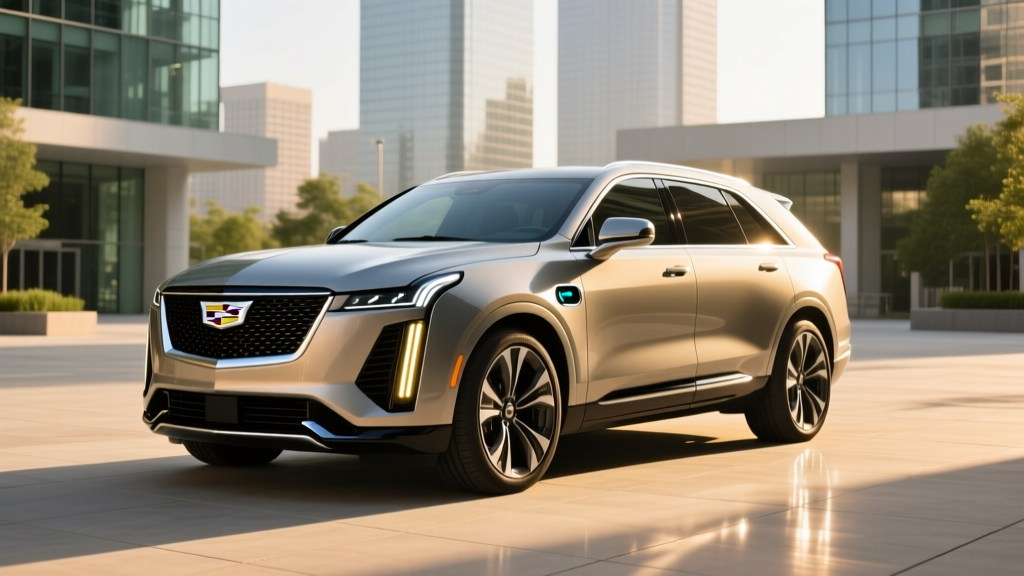
The 2025 Cadillac Escalade IQ is the first all-electric version of General Motors' flagship luxury SUV, and it arrives with a statistic that dominates every conversation around it: mass. With a published 2025 Cadillac Escalade IQ curb weight of approximately 8,500 pounds in its heaviest trims, this three-row electric hauler is heavier than many full-size pickup trucks. That number isn't just trivia — it directly shapes the vehicle's efficiency, tire wear, braking distances, and the enormous battery required to move it.
Built on GM's dedicated BT1 electric truck platform (shared with the GMC Hummer EV and Chevrolet Silverado EV), the Escalade IQ pairs a massive Ultium battery pack with dual-motor all-wheel drive, air suspension, and the kind of interior opulence Cadillac buyers expect. But does the physics of an 8,500-pound EV actually work in the real world? Here's the full technical breakdown.
Full Spec Sheet: What the Numbers Say
| Specification | Value |
|---|---|
| Curb Weight (est.) | ~8,500 lbs (Luxury / Sport trims vary) |
| Battery Capacity | 200+ kWh usable (Ultium, NMC chemistry) |
| EPA Estimated Range | Up to 450 miles (target, Luxury 1SC trim) |
| Drivetrain | Dual-motor AWD (eAWD) |
| Horsepower | Up to 750 hp (with Velocity Max) |
| Torque | Up to 785 lb-ft |
| 0–60 mph | ~3.8 seconds (Velocity Max mode) |
| Max DC Fast Charge | 350 kW (800V architecture) |
| 10–80% DC Charge Time | ~20 minutes (estimated, preconditioned) |
| Level 2 Home Charging | 19.2 kW / ~37 miles per hour |
| Efficiency (target) | ~55–60 MPGe / ~58 kWh/100 mi |
| Towing Capacity | Up to 8,000 lbs (estimated) |
| Starting MSRP | $129,990 (Luxury 1SC) + $1,995 destination |
| Battery/Powertrain Warranty | 8 years / 100,000 miles |
Why the 2025 Cadillac Escalade IQ Curb Weight Matters
At roughly 8,500 pounds, the Escalade IQ is among the heaviest passenger vehicles sold in the United States. For context, a gas-powered 2025 Escalade with the 6.2L V8 weighs approximately 5,800 pounds — meaning the electric version carries nearly 2,700 additional pounds, primarily from its battery pack.
This mass has real consequences:
- Tire wear: Heavier vehicles consume tires faster. Expect replacement intervals of 20,000–30,000 miles on standard all-season rubber, and replacement costs for 24-inch wheels are significant.
- Braking: GM equips the IQ with large Brembo calipers and regenerative braking to manage stopping distances, but kinetic energy scales linearly with mass. Stopping an 8,500-lb vehicle from 70 mph requires roughly 46% more energy than stopping the gas Escalade.
- Efficiency: Moving more mass requires more energy. The IQ's estimated 58 kWh/100 miles means it consumes substantially more electricity per mile than lighter EVs like the Rivian R1S (~42 kWh/100 mi) or Tesla Model X (~36 kWh/100 mi).
- Infrastructure limits: Some older parking structures, residential driveways, and car lifts have weight limits below 8,500 lbs. Verify before installing a home lift or parking on elevated surfaces.
The weight also explains why GM equipped the IQ with a 200+ kWh battery. Smaller packs simply couldn't deliver acceptable range while hauling this much mass.
Range and Efficiency: EPA vs. the Real World
Real-World Expectation: Plan for ~340–380 miles on mixed highway driving at 70–75 mph. In cold weather (below 32°F), expect a further 15–25% reduction, potentially dropping highway range to ~280–320 miles. City driving with regenerative braking recovers more energy and will push closer to the EPA sticker.
Cadillac has targeted 450 miles of EPA range for the base Luxury 1SC trim with the standard 24-inch wheels. The Sport trim and available larger wheel/tire packages are expected to reduce that figure by 10–30 miles due to higher rolling resistance and aerodynamic drag.
The physics here are straightforward: an 8,500-lb vehicle requires roughly 1.5 to 1.8 times the energy per mile of a 5,000-lb sedan at highway speeds. Aerodynamic drag dominates above 65 mph, and the Escalade IQ's tall, boxy profile doesn't help. On a flat, 55°F day at 65 mph, you may approach the EPA number. At 80 mph on a 25°F interstate in Montana, you'll be watching the range meter closely.
GM's Ultium platform includes a heat pump for cabin heating and battery thermal management, which helps mitigate cold-weather losses compared to resistive-heater EVs. But battery chemistry still slows at low temperatures, and the large pack takes longer to precondition.
Charging: 800V Architecture and 350 kW Peaks
| Charging Level | Power / Rate | Miles Added per Hour | Notes |
|---|---|---|---|
| Level 1 (120V) | ~1.4 kW | ~2–3 mi/hr | Emergency/trickle only |
| Level 2 (240V, 48A) | 11.5 kW | ~22 mi/hr | Standard home charger |
| Level 2 (240V, 80A) | 19.2 kW | ~37 mi/hr | Requires hardwired 100A circuit |
| DC Fast Charge | Up to 350 kW | ~200+ mi in 10 min (peak) | 800V architecture; 10–80% in ~20 min |
The Escalade IQ uses GM's 800-volt Ultium architecture, enabling peak DC fast-charging rates of up to 350 kW at compatible stations. This is critical for a 200+ kWh battery — at slower 150 kW rates, a 10–80% charge would take over 45 minutes.
However, peak kW is not sustained kW. Like all EVs, the IQ's charge curve tapers significantly above 80% state of charge to protect battery longevity. Expect the 350 kW peak to hold between roughly 10–40% SoC, then step down through 200 kW and eventually below 50 kW as you approach full. Plan road-trip stops around 10–80% charges for the fastest throughput.
At home, the 19.2 kW Level 2 rate is impressive but requires a hardwired wall connector on a dedicated 100-amp circuit. Most homes will need an electrical panel upgrade to support this — budget $2,000–$4,000 for the panel work alone, on top of $500–$800 for the charger hardware and $1,000–$2,500 for installation labor, depending on run length. Consult a licensed electrician before committing.
At ~37 miles of range per hour on 19.2 kW, a full overnight charge (10 hours) adds roughly 370 miles — enough to replenish a nearly depleted battery before morning.
Performance: 750 HP Moves 8,500 Pounds
The Escalade IQ's dual-motor eAWD system produces up to 750 horsepower and 785 lb-ft of torque when Velocity Max mode is engaged. Cadillac estimates a 0–60 mph time of approximately 3.8 seconds — remarkable for a vehicle that weighs as much as a Ford F-250.
The instant torque delivery of electric motors means the IQ feels even quicker than the numbers suggest in around-town driving. There's no transmission downshift delay, no turbo spool-up. Press the accelerator and 8,500 pounds of luxury simply moves.
GM's Adaptive Air Ride suspension manages the mass effectively, with automatic load-leveling and up to 2 inches of ride-height adjustment. The rear-axle steering (up to 12 degrees) shrinks the turning circle to roughly 40 feet — tighter than many midsize SUVs and a genuine advantage in parking lots.
That said, physics wins eventually. Cornering feels composed but never sporty, and you'll feel the weight transfer during aggressive lane changes. This is a luxury cruiser, not a performance vehicle, despite the supercar-rivaling straight-line speed.
Pricing, Trims, and Federal Tax Credit Eligibility
| Trim | Base MSRP | Destination | Total Starting Price |
|---|---|---|---|
| Luxury 1SC | $129,990 | $1,995 | $131,985 |
| Sport 1SC | $130,490 | $1,995 | $132,485 |
| Luxury 2SC / Sport 2SC (est.) | $145,000+ | $1,995 | $147,000+ |
The Escalade IQ starts at $129,990 before destination, placing it firmly in ultra-luxury territory and above the gas Escalade's starting price. Fully loaded 2SC trims with the available Executive Seating package, AKG Studio Reference audio (36 speakers), and dual rear screens will push transaction prices well above $150,000.
- MSRP Cap: SUVs must have an MSRP at or below $80,000 to qualify. The Escalade IQ starts at $129,990 — it does NOT qualify for the federal §30D credit.
- Income Cap: Even if it qualified, adjusted gross income limits apply ($150K single / $300K joint).
- Battery Sourcing: Critical minerals and battery component sourcing requirements further restrict eligibility.
- Point-of-Sale Transfer: Available for qualifying vehicles, but irrelevant here given the MSRP cap.
Source: IRS Clean Vehicle Tax Credits. Always consult a tax professional for your specific situation. Some state and local incentives may still apply — check your jurisdiction's energy office.
Without the federal credit, the IQ's value proposition rests entirely on its luxury content, technology, and operating-cost savings versus the gas Escalade. Electricity at the national average of ~$0.16/kWh costs roughly $9.28 per 100 miles in the IQ. A gas Escalade at 16 MPG combined with gas at $3.50/gallon costs $21.88 per 100 miles — a savings of about $12.60 per 100 miles, or $1,890 per year at 15,000 miles. Meaningful, but not enough to offset the higher purchase price for most buyers.
Interior, Cargo, and Technology
The Escalade IQ seats up to seven passengers across three rows. Second-row captain's chairs are standard on Luxury trims, with an available Executive Seating package that adds power-reclining, heated, ventilated, and massaging outboard rear seats with stowable tray tables.
Cargo volume: Approximately 23 cubic feet behind the third row, 65 cubic feet behind the second row, and 110+ cubic feet with both rear rows folded. The front trunk (frunk) adds an estimated 10+ cubic feet of sealed, drainable storage — useful for wet gear or groceries.
The dashboard is dominated by a pillar-to-pillar 55-inch total LED display array, combining a digital instrument cluster, central infotainment touchscreen, and passenger-side display. Google Built-In handles navigation, voice assistant, and app integration. A 36-speaker AKG Studio Reference audio system is available.
Driver assistance: Cadillac's Super Cruise — a Level 2 hands-free driving system — is standard on mapped divided highways (over 750,000 miles of compatible roads in the US and Canada). The driver must remain attentive, with an infrared camera monitoring eye position. Super Cruise is not self-driving; it does not handle city streets, construction zones, or unmapped roads. Expect expanded functionality via OTA updates, but the driver remains responsible at all times.
How It Compares: Escalade IQ vs. Key Rivals
The Escalade IQ occupies a narrow segment: ultra-luxury, three-row electric SUVs above $100,000. Its closest competitors include:
- Tesla Model X: Lighter (~5,100 lbs), faster (0–60 in 2.5 sec for Plaid), more efficient (~36 kWh/100 mi), and starts around $80,000. But it can't match the IQ's interior materials, ride quality, or third-row space. The Model X is a tech-forward performance SUV; the IQ is a luxury flagship.
- Rivian R1S (Tri-Motor): More off-road capable, starts around $100,000, and weighs ~6,900 lbs. Smaller third row and less cargo space. Better for adventure-oriented families; the IQ wins on pure luxury and highway comfort.
- Mercedes-Benz EQS SUV: Starts around $105,000, seats up to seven, and is lighter (~5,900 lbs). Less range (EPA ~305 mi) and less cargo space. The IQ offers more presence and towing; the EQS SUV offers better efficiency and a lower entry price.
Pros, Cons, and Who Should Buy
- 450-mile targeted EPA range is class-leading for a luxury 3-row SUV
- 350 kW DC fast charging minimizes road-trip downtime
- 750 hp / 3.8-sec 0–60 defies the 8,500-lb curb weight
- Air suspension + rear-axle steering = surprisingly maneuverable
- Super Cruise hands-free highway driving included
- Frunk + generous cargo volume for a luxury flagship
- Silent, vibration-free powertrain transforms the luxury experience
- 8,500-lb curb weight accelerates tire wear and increases stopping distances
- $130K+ starting price; no federal tax credit eligibility (MSRP exceeds $80K cap)
- Efficiency (~58 kWh/100 mi) means high electricity costs on road trips
- 19.2 kW home charging requires a 100A circuit and likely panel upgrade
- Cold-weather highway range may drop to ~280–320 miles
- Third row best suited for children on longer trips
- 24-inch wheels carry expensive replacement tire costs
Look elsewhere if: You need federal tax credit eligibility, prioritize efficiency, frequently drive in extreme cold on long highway routes, or want a more engaging driving experience. The Rivian R1S or Tesla Model X may serve better in those scenarios.
Frequently Asked Questions
What is the real-world range of the 2025 Cadillac Escalade IQ?
Cadillac targets up to 450 miles of EPA range. In real-world mixed highway driving at 70–75 mph, plan for approximately 340–380 miles. Cold weather (below 32°F) can reduce that further to 280–320 miles on the highway. City driving with regenerative braking will get you closer to the EPA sticker.
How fast does the Escalade IQ charge at home and on the road?
On DC fast chargers, the IQ peaks at 350 kW and can charge from 10–80% in approximately 20 minutes when preconditioned. At home on a 19.2 kW Level 2 charger (requiring a 100A circuit), it adds about 37 miles of range per hour, or roughly 370 miles overnight. On a standard 48A Level 2 charger (11.5 kW), expect about 22 miles per hour.
Does the Escalade IQ qualify for the federal EV tax credit?
No. Under current IRS §30D rules, SUVs must have an MSRP at or below $80,000 to qualify for the up-to-$7,500 federal credit. The Escalade IQ starts at $129,990, well above that cap. State and local incentives may still apply — check your jurisdiction.
How much does the Escalade IQ cost after incentives?
Without the federal credit, expect to pay the full MSRP: starting at $131,985 (including destination) for the Luxury 1SC trim. Fully loaded 2SC trims will exceed $150,000. Some states offer additional rebates or HOV lane access — check your state's energy office for details.
Is the Escalade IQ worth buying over the gas Escalade?
It depends on your priorities. The IQ delivers a fundamentally quieter, smoother driving experience with lower per-mile fuel costs (~$9.28/100 mi vs. ~$21.88/100 mi for gas). But the $30,000+ price premium over a similarly equipped gas Escalade, combined with no federal tax credit, means the payback period on fuel savings alone is very long. The IQ makes sense if you value the EV driving experience, want cutting-edge tech, and can charge at home.
What is the battery warranty?
GM covers the Escalade IQ's Ultium battery and electric powertrain components for 8 years or 100,000 miles, whichever comes first. The warranty covers defects and excessive capacity degradation (typically defined as falling below 60–70% of original capacity, though confirm exact terms at purchase).
Can the Escalade IQ tow?
Cadillac estimates a maximum towing capacity of approximately 8,000 pounds when properly equipped. However, towing significantly reduces range — expect a 30–50% reduction depending on trailer weight, aerodynamics, and terrain. A 450-mile range may drop to 225–315 miles while towing a heavy load.